Category: graduate student writing

You May Hate It, But There’s a Reason for All This: Co-Writing about Co-Writing Part 1

This post is the first in a two-part series on co-authorship from different perspectives. In this first post, we’ll discuss key cognitive and pedagogical considerations in co-writing projects. The second part will both address ways to use writing center sessions as a model for negotiating the co-writing process and reflect on the experience of co-writing this blog. 
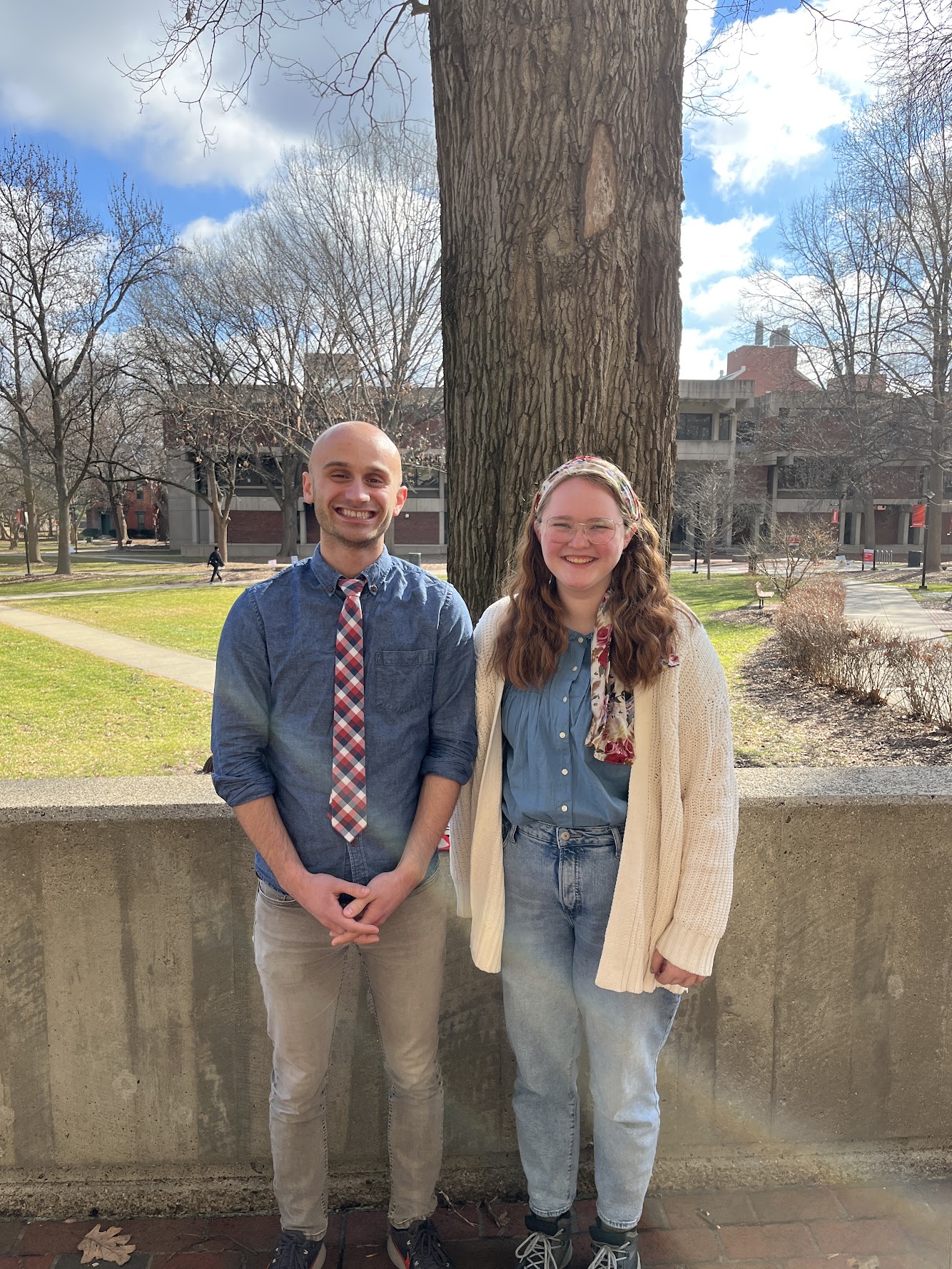
From right to left: Brice Montgomery, Writing Consultant; and
Kylee Auten, Writing Consultant

Ah, the dreaded group project, known for its ubiquity and the frustration it inspires. Few assignments elicit opinions as strong as those which require co-writing, but through this post, we’ll argue that the severity of those opinions—while perhaps not unavoidable—can be softened by recognizing features of co-writing projects.

To go about this task, we have opted to get a little meta in our approach and co-write about co-authorship. Using both external research and the lessons learned from our experience, we hope to shed some light on several considerations to keep in mind when approaching a co-authoring project, whether you are a student, instructor, or potential co-writer.

1.   Co-authoring is valuable. No, really!

First, it’s necessary to answer the question on every student’s mind—“Is there even a point to all of this?” Research suggests the answer is yes, and not just because it makes grading easier for a TA. 

James Reither and Douglas Vipond found that collaborative writing is a complex social process, and beyond the surface-level act of writing something down, it offers a unique form of “knowledge making,” positioning collaborative texts not as a product, but as a testament to the collaborative process. Unfortunately, despite other research indicating similar values, the average instructor may be hard-pressed to explain why they use group writing projects. For frustrated students, vague discourse on the importance of collaboration may not feel like sufficient justification for these exercises. Thankfully, there are several other reasons to value the practice.

2.     The co-authoring process is procedurally different from a solo write.

During the process of writing this blog, we found that co-writing is anything but linear. Even though we chose this project of our own volition, the initial enthusiasm waned, and early meetings resulted in a great deal of work from Kylee and a few stray sentences from Brice. The project moved forward in fits and starts, and it became clear that the effort would be weighted towards planning and revision, with the initial draft quickly becoming an afterthought. Suffice it to say, our anecdotal experience suggests co-writing requires a different set of metacognitive skills, and research agrees.

Helen Dale found that in student co-authoring assignments, the additional input from peers created a kind of feedback loop that eliminated the archetypical brainstorm-draft-edit process. Projects also had more logical structures because it was necessary for co-writers to plan in detail before beginning, simply to maintain coherence. Ultimately, co-writing can be a more extensive and intensive writing process, but it has the potential to transform what ends up on the page.

3. Collaboration succeeds when collaboration is the point. 

 Louth et al. compared both student scores and attitudes on individual papers and collaborative papers in a college freshman English course, and while they found no statistically significant difference between the scores, there was a markedly positive difference in attitude, with collaborative groups being more satisfied than their individual counterparts. The authors suggest that dissatisfaction arises when collaboration is elevated as a pedagogical value rather than a theoretical one; it works when the focus is on what is gained through the collaborative process.

In the case of this blog project, is the writing inherently better? Not necessarily, but it did push our approach in directions that might otherwise have gone unexplored. In the early stages, we riffed and asked each other questions about possible ways to broach the subject of co-authoring, and we challenged each other’s expectations about the goals and parameters of the project. For example, the initial draft of this post was specifically directed towards instructors planning co-writing assignments, but Kylee wisely pointed out that it was too narrow of a focus to be very helpful, and it negated the relevance of our own co-writing process. By shifting our attention to more general principles, the post opened out into something more accessible for different types of readers. 

4.     Successful collaboration as a learning process may largely be a matter of personality. 

If you’re one of the many individuals who resents collaborative writing, fret not—research indicates that group work will not be universally beneficial or enjoyable for everyone. Utilizing attachment theory, Shiri Lavy studied whether there was a correlation between personality types and performance in group projects. While it’s difficult to say how metacognitively beneficial the practice was, Lavy found that students’ self-reported satisfaction was influenced by their attachment style, with anxious and avoidant students both expressing dissatisfaction with group work compared to individual work, despite performing well. Some people just won’t enjoy collaboration, and that’s okay.

Ultimately, group projects aren’t going anywhere, and while it may seem reductive to point out that co-writing may not be for everyone, recognizing that reality may help reluctant co-authors re-evaluate their approach.  

Check back next week for a deep dive into the lessons we learned by co-writing as well as how writing center sessions can model the skills necessary to be effective co-authors. 


Works Cited

Dale, Helen. “The Influence of Co-Authoring on the Writing Process.” Journal of Teaching Writing, vol. 15, no. 1, 1996, pp. 65-79, https://journals.iupui.edu/index.php/teachingwriting/article/view/1194/1154.

Lavy, Shiri. “Who Benefits from Group Work in Higher Education? An Attachment Theory Perspective.” Higher Education, vol. 73, no. 2, 2017, pp. 175-187, JSTOR, https://www.jstor.org/stable/26447599.

Louth, Richard, et al. “The Effects of Collaborative Writing Techniques on Freshmen Writing and Attitudes.” The Journal of Experimental Education, vol. 61, no. 3, 1993, pp. 215-224, JSTOR, https://www.jstor.org/stable/20152373.

Reither, James, and Douglas Vipond. “Writing as Collaboration.” College English, vol. 51, no. 8, 1989, pp. 855-867, JSTOR, https://www.jstor.org/stable/378091.

Wrestling with the Blank Page

Zoe Donovan, Writing Consultant

One of the most daunting things to a writer or student is the blank page. While thinking on the topic of this specific blog post I found myself paralyzed by choice. “A short blog about writing” could mean anything. I started writing, erased the first line, started over. Editing as a I went, I found myself held back from what the point of this was, that I was getting caught up in the minutiae of writing instead of actually writing.

 I am, of course, being somewhat hyperbolic in the above paragraph, but it isn’t far off from my experience engaging with past and current writing projects. We tend to get caught up in the sentence we are constructing rather than the point of the piece.  

I find that taking a step back from that detail-oriented nature can do more good than letting an inner editor take over constantly. Instead, try to focus on getting something on the page. Prohibit yourself from using the backspace, repeat your points and repeat yourself in different ways. This type of repetition can be monotonous in a final draft, but a mock-up first draft can provide a writer with options when returning to the piece.

Then, once you have created something, step back, make a cup of tea, meander over your thoughts. Take the evening, day or week. Then use this piece that is what I lovingly refer to as a “word explosion” to create an outline and reorganize your thoughts. Returning to it with a fresh head can prevent you from becoming fatigued over a specific project or idea. From there, you can make edits, rewrite sections, omit unnecessary information, reorganize your thoughts, and fully flesh out points in your future drafts.

It is impossible to edit a blank document. Good writing takes multiple attempts, revisions, and proofreading. Half the battle is getting something on the page. In addition to this, it is exceptionally difficult to fully edit an unfinished piece, because you don’t know what additional context you need to provide, you can’t know how to transition into or from a paragraph or idea that you don’t yet have on the page.

Silencing my inner editor during my initial draft has become my go-to in the last few years. In the past, I have often been struck with choice paralysis or perfectionist desire. I feel that every piece I put out should be perfect as soon as it first hits the page. This is not a healthy or productive writing strategy. It creates this false narrative in early writers, (and late writers) that revision is not a key step in the process.

Instead, your first draft should be passionate. Why does this matter to you, why is it important that it is said, and what is your evidence to further support these claims? Writing is about growth, about changing the way the audience sees something or approaches a topic. Along that same vein, writing is process in which you can discover yourself and your arguments about a piece.

If you’re constantly dissecting every word or sentence you put on the page, then you can become overwhelmed and lose the motivation to continue writing. Instead, just focus on getting words on the page. They don’t need to be good. They don’t need to be ready for publication or submission–get your thoughts down without hesitation and with total freedom to put whatever you want. This early draft isn’t what you are sending in, it is for you and you alone as the writer to better understand yourself, your process, and your approach to this particular piece you are writing.

I know this strategy doesn’t work for everyone, but it can be something that works for writers who struggle with starting. I find that in my own writing, starting with a loose thesis works best. You can always come back to the thesis and make it stronger, or, if after writing you decide that the evidence you’re presenting doesn’t fit, then there’s no harm in returning to the drawing board on your thesis statement. Revisit your writing, what are you trying to accomplish in your stream of consciousness? Hone in on those points and fully articulate them. If you can argue it in a fully-fledged piece, then don’t be afraid to change it and make it your own.

Shutting off that critic side of your brain and just putting words on the page in a stream of consciousness style can help to create a framework for yourself during the writing process. You might discover that your initial thesis doesn’t quite fit, that a certain piece of evidence doesn’t hold as much weight as you originally thought or that you need additional information or research to fully set your argument. Giving yourself and piece a space to grow without an internal critic can lead you down a path that may be different from your initial intent and provide you a better understanding of your argument.

While it is important to be critical of your own work and edit that work, within the writing process that internal criticism can detrimental and create a sort of choice paralysis and inhibit us from actually engaging within the writing process. So, instead I encourage you write your first drafts like no one is watching and shut out the editor.   

For The Love of Writing

Michael Benjamin, Assistant Director and Writing Consultant

It’s not lost on me that this is being posted on Valentine’s Day, 2022. So I’m going to try and stick to the day’s theme: love.

Love is hard. Complex. It’s a feeling, sure, but it’s also an action. These days I’ve been conceptualizing love within the framework of care. Caring about ourselves, our dearest ones, our community, our larger world. Care can be shooting a text to a friend you haven’t heard from in a week or two or volunteering at the local community literacy center. Care takes energy but is always worth it even though it usually comes with little to no reward. In an affective economy, care is a currency. Tying love and care together begins to make visible all of the little acts we do. It pushes us to be thoughtful and reflective and, frankly, better people.

I realize this probably feels like it’s going off of the rails, but please bear with me.

I think I can speak for everyone at the writing center. We care about writing at the here because we care about our UofL community. And we know that we have a unique opportunity to spread the joy of a love for writing.

Here’s a quick story: it was my first month of my undergraduate career and I’d gotten a lower grade than desired on an assignment. I went to the writing center, not really knowing what to expect, hoping that I’d come back with a better text to bump my grade up. What I got was an experience that has powered my academic career for the past decade. My consultant smiled at me and told me Play with your writing. Find the joy in it. Keep caring and putting love into it. That experience was so transformative for me that seven months later I was working in that writing center. I’m sure it has something to do with my pedagogical ethos, too. That consultant cared about me, showed a love for her work and writing and the writers she worked with in a way that was so infectious and powerful that I needed to take action, to pass it along.

I write this as a call for all of us to radiate that love and care throughout our worlds. I also write this as a way to urge us to use the written word as a means of care.

Next week, we are hosting an event for International Mother Language Day. I’m excited to see y’all UofL community members show a love for writing through all of these guest blog posts written in your mother tongues. I’m even more excited to fill out these notecards for recent immigrants and refugees. Handwritten letters of simple words of encouragement are an act of care. Taking the time out of your day, in the middle of what has been a brutal semester, to stop and focus writing something for someone you don’t know in your best handwriting won’t show up on your CV or transcript, but it’s a loving act that can have a world of meaning. I’m personally excited for our little writing center community to show love to all of the multilinguists and polyglots amongst us.

I know today is viewed as a day or romantic love. A day you spend with your partner, showing them how much you appreciate them. I implore you to show that care to everyone. What if you jotted a little note of appreciation for the wait staff at the restaurant? Sent a couple coworkers/colleagues/classmates a small compliment? Took 10 minutes to yourself to journal what and who you love and care for? Care for you? What if you went completely old school and snail mailed your folks? Words are powerful and cost nothing. Write them. Share them. Care for and with them.

Why Can’t I Write Like Derrida?

Yuan Zhao, Writing Consultant

The other day, I had a discussion with our acting director on what are the standards for good writing. As a graduate student, I have witnessed numerous writing styles published in academic journals. Some are written in straightforward plain English; some are less accessible to read, as those written by Derrida, Lacan, Spivak, and Homi Bhabha. Whenever I attempt to read these great thinkers, I would often find myself trying to single out the main arguments from their obscure styles—convoluted syntax, jargon with special connotations, and complicated sentence structures. I have heard people complain about these authors: “Their writings are too incomprehensible!” “Why can’t they write in a more reader-friendly way?” My discussion with the acting director on the standards of good English writing remained unresolved. We were uncertain whether it is appropriate for us to decide if these great thinkers compose good writings, but we agreed without any doubts that these authors are super intelligent.

Bearing in mind the question of what makes good writing, I started to read one of Barbara Johnson’s essays “Bad Writing.” In this short article, Johnson defends at least three types of “bad writings.”  One of these “bad” qualities lies in obscurity—that readers assume a text to be bad if it is difficult to read. “‘Don’t understand!’ becomes an accusation,” and readers blame the “incomprehensible writing” as “the cause of incomprehension” (Johnson 160). However, Johnson argues, it is unfair to critique authors simply because their works are difficult to read. Readers can at least suspend their judgment and reflect more on their own reading attitudes, skills and strategies (Johnson 160). Johnson notes, “[a]fter the theory revolution it is no longer possible so serenely to separate style from thinking, idea from language” (162). In other words, complex theoretical thoughts sometimes require convoluted expressions. Style and thoughts are in a unity. Reading thus becomes demanding. To appreciate such complexity needs a set of advanced reading skills that readers can hardly achieve unless they are properly trained. No other way out.

Therefore, obscure works are not a result of bad writings. They are just difficult to read, foreign to our established mindsets. To read them needs time and reflection. Johnson notes “[u]nderstanding the conceptual breakthrough … depends on pausing there long enough” (164). She also points out, “[t]hought as a break is different from thought as a chain” (165). Whenever we pause and attempt to comprehend the obscure writings, the fluency of reading is surely to be interrupted, but the breaks are also chances for our mindsets to welcome transitions. To digest new and complex knowledge cannot be an easy task. It needs time and effort.

Last semester, a course instructor criticized my writing style as convoluted and complex. She also mentioned that I failed to follow the spirit of Barbara Johnson who can express complicated arguments in a clear and accessible way. Such accusations made me feel so anxious to the extent that I started to deliberately avoid composing complex sentences. I was disappointed that she did not appreciate the designs I embedded in the selection of words and paragraph organizations that were intended to respond to the main arguments and to relate the resources I read. I understood that my reader-instructor expected a style of clarity. But what if my arguments are complicated and they need complex organizations? Does a student assignment have to be explicit direct and simple-minded? Does it mean a complicated student assignment can only be marked as a product of bad writing? After reading Johnson’s essay, I might challenge the instructor’s critique: why can’t the instructor follow the spirit of Barbara Johnson to read—to pause and reflect when reading a student’s assignment?

Should the instructor respond to me, she might say it is both impossible and unnecessary to invest so much time in reading a student’s assignment. If a student has complicated ideas, they have to be expressed in an explicitly direct manner so that instructors can comprehend them at first glance. I can understand this excuse. Nowadays, instructors are often so fully occupied with teaching duties, research tasks and administrative jobs that they can hardly spend more time than necessary on reading students’ assignments. Within the limited time, instructors don’t expect to encounter obscure works at the student level. Otherwise, they might tend to assume the convoluted writings are a product when students fail to try harder to express in a clearer way. However, in the meantime, we will find instructors tend to spend hours readings the obscure works of Derrida and Lacan. Why can’t they spare more time on the obscure students’ writings? The disparities in writers’ academic achievements and social status are another factor to affect instructors’ reading attitudes and expectations. As Johnson notes, most obscure works will keep being condemned by most readers until they enter into the canon, and only since then, readers can attempt to appreciate the poetic genius in the obscurity (160). As for students’ works, they are far from being recognized by academia, not to mention the canon. No wonder instructors tend to underestimate the possible significance and academic contributions in students’ writings. At the student level, writing styles are supposed to yield to the expectations of their readers.

Cruel reality, isn’t it? What can we do? Can we still write like Derrida if we have complicated thoughts to express? The strategy I propose is to keep writing. Keep writing the way colonized writers “write back” to colonizing powers in postcolonial studies. Like them, we can use writing to issue our subaltern voices when we practice complicated thoughts. Keep writing in the spirit of Derrida’s “as if.” Write as if we are complicated scholars, who always attempt to develop sharp arguments while balancing between complex ideas and the accessibility for readers. Keep writing with a consciousness to look for potential quality readers in academia—compose quality papers, send them to journals, respond to feedback from editors and reviewers, and try to get them published.

Now, we can repeat the question “Why can’t I write like Derrida?” in a plain tone, without agitation or anxiety. Repeat it as a rhetorical question because it no longer is an unsolved problem. I can write like Derrida, but sometimes, I choose not to. Now, I will consider the factors, such as context, reader and genre, before I make the decision whether it is necessary to write like Derrida.

Of Bottled Water and Exigency

Justin Sturgeon, Writing Consultant

January 31—the first moments of the semester. You are in an English class, and you’ve just been handed an assignment sheet in which you will spend a great deal of the semester researching a topic of your choice in which you must:

A) utilize scholarly sources to support a well-crafted thesis statement that argues in favor or against some conversation occurring in the field of your topic.

B) create a specific thesis statement that consists of an imperative claim and addresses the ‘so what?’ of your argument.

Maybe you have experienced your fair share of these projects or are beginning one for the first time, or maybe you are entering this mode of writing into your classes now—either as a scholar yourself or as a student in the classroom.

When writing about research, one question that can be challenging is that of answering ‘So what?’ Often, when we ask this question about our research, what we are looking for is: ‘Why does this matter, and how can I get them to care?’ A struggle to answer the “so what” question becomes apparent through hesitations such as: “I am not sure why I am writing about this” and “I have no idea what to say here, especially since I’m not an expert.” Sometimes the “so what” question appears in instructor feedback. Most often when addressing the question of so what, we are engaging with the imperative of exigency. Exigency, coined by Lloyd F. Bitzer in “The Rhetorical Situation,” refers to demand or need for writing on a particular subject or stance based on the context of the situation. Basically, exigence is the why behind what you are writing. When revealing the exigency of a writing project, it often relies on appealing to what is urgently waiting to be said about the situation at hand.  

If someone were to write a paper arguing in favor of stricter regulation for the bottled water industry, they might appeal to the expanding industry and potential harm that a lack of regulation may produce. To convey exigency in a project such as this, many writers would deliberate on the rhetorical device known as kairos, or the timeliness of a message as it is being sent to its audience. In this same example of writing a paper about the bottled water industry, the timeliness of such a paper would make a monumental difference depending on the time in which it were written. Consider writing making an argument against bottled water industries in the 1970s when bottled water was invented. No one would believe that bottled water would become as prevalent as it is. However, the same argument today has a much clearer sense of exigency. The industry today is expected to continue to grow and pervade a number of environmental processes related to water distribution which  has led to issues like The Bolivian Water Wars.

One might say that bigger, larger issues such as the potential crises related to the bottled water industry can be easy for fishing out exigency and building it up. But what about writing related to the everyday? Or to those assignments that we might rather avoid altogether? Finding authority and purpose for small-scale projects can be just as challenging. For example, you might have a two to three page essay about a Shakespeare poem you’ve tried to read over and over again and just can’t find a rhyme or reason to care. It can be easy to think about how important a crisis like the Bolivian Waters is and the large scale implications of such an event. But how can that same sense of authority and urgency be illuminated in an introductory writing assignment about a topic that you might stuggle to find a purpose to write about it in the first place—especially if it’s a topic that everyone already knows about and has written extensivly on? Sometimes writers don’t feel like they are qualified to even say anything about a given research assignment at all!

Certainly, exigency can still be accessed in moments like these as well.  

With even the most over-saturated of topics, how can you find a purpose to continue to write about them? What we often fail to glean from reading written work about unappealing topics is what the initial writer found important or exigent about the topic. Specifically, when being asked to examine the rhetorical devices at play in a given text, we often take for granted the ways we as readers are being asked to think about a text through its rhetorical stratagy.  We tend to overlook in these moments how a text—whether literary or visual—creates reflective nuggets of the world and is informed by various world views. When you tap into analysis on the level of these rhetorical concerns, you often begin to see how nearly every motion of stimuli is a text and is channeled through rhetorical devices that influence the way we make decisions and respond to the world around us.

Even at times when you feel like there is nothing to be said about the topic you are being asked to respond to, finding exigency doesn’t always start with the most compelling or flashiest of reasons for writing, but rather from acknowledging yourself as a reader of a text and calling attention to what response you make of it and then highlighting how you came to that response or how the text lead you to reach that conclusion. From this locus of reflection, you often find that you are faced with a wide assortment of reasons to care about a topic and the implications of choosing one interpreation over another—no matter how seemingly small the impact feels.

Exigence isn’t just timeliness; it’s also why we write what we choose to write about. In the University Writing Center, we love to have conversations with writers about exigency and these strategies. Often, discussing issues relating to finding purpose and authority when writing can be challenging to think through on your own, which is why the University Writing Center is a great place to visit and talk through your thoughts with a consultant. We are eager to discuss these rhetorical building blocks and help you become more comfortable with finding purpose in your own writing. Whether the topic discusses growing concerns about Western consumption habits (like bottled water) and their impact on more vulnerable countries, or examines an Elizabethan sonnet: we are here to listen and see you develop exigency as you navigate writing with purpose.

Done is Better Than Perfect

Todd Richardson, Assistant Director and Writing Consultant

I have always expected too much of my writing. In high school, I wrote poetry that I was certain conjured magic on the page, only to find sheepish typos and garish rhyme schemes when I later reread it. I was surprised, embarrassed. After uncovering my own fallibility, I lost the confidence to show my writing to anyone save my closest confidants. The discovery that one draft of writing could come out feeling so perfect only to later realize that the same piece needed more work indicated some clear flaw in myself. How could one written thing sound so good today and then so horrid tomorrow? Clearly the issue was me. I needed some work, some practice, to push harder. Instead of fun, writing became painful, an exercise reaching for the unattainable. The pressure I placed on myself forced me to improve and justified my expectations, but it also led to bad habits: procrastination, negative self-talk, loss of perspective.

               This pattern continued in college. I required spectacular feats of my five paragraph essays. Introductions had to begin with perfect first lines, hooks that lured my professor sentence by sentence towards my thesis. Conclusions had to culminate by offering some sort of profound philosophical truth that I was certain riveted my composition instructor’s perceptions of time and space as they read through their biweekly stacks of essays. My word choices had to amount to pithy remarks and razor-sharp observations. I earned A’s, a few smiley faces, check marks. These academic at-a-boys further entrenched my devotion to the cult of perfection, and when I didn’t receive the happy face or check mark it only reinforced my insufficiency. I chased a high of perfection but mostly experienced self-doubt and disappointment. Still, I was convinced that this quest for success was the process of writing. Perfection served as my pie-in-the sky.

               Then I went to grad school. Whereas before I had the time to obsess over my writing, the demands of an advanced degree knocked me on my heels. I floundered through stacks of academic articles and whole books due in a week. Professors assigned essays double the length I was used to with only half as much time to complete them. Perfection slipped from my grasp. I turned in first drafts that I started the night before. I spent more time understanding my readings than on their corresponding assignments. I abandoned my perfect first lines for functional sentences, let my conclusions fall flat, and didn’t turn in a single essay that used the word “pithy.” I received feedback of triple red question marks next to phrases like “So what?” and “I’m lost.” When I lamented to one of my professors that I felt my writing had sunk to sub-par levels since starting the program, she cocked an eyebrow.

               “How so?” she asked.

               “I don’t spend the time I used,” I told her. “I just finish it and turn it in.”

               “Done is better than perfect.” She handed back my paper, which was covered in red pen and included the phrase “Interesting Insight.” I got a B+.

               I wish I could tell you that I followed her advice from then on. It took me several more years and another master’s degree and a baby until her advice stuck in my skull, and only then I learned it because I didn’t have another choice. Diapers and midnight feedings superseded my desire for perfection. I swapped simple, short sentences in exchange for fifteen more minutes of REM. And finally, one the day, I received praise for it. Mentors wrote me about how clean my work was, celebrated the fact that I stopped using the word “pithy.” All of my work came back with criticism. I read it while bouncing my daughter on my lap, did the best I could to internalize the advice, and moved on. Letting go of perfection provided me a new opportunity I did not anticipate: the freedom to write for myself.

               Many writers learn this lesson well before I did, but many do not. I see some of them in the Writing Center and the library, pining over sentence structure and flow and tone. Some of them are young freshman. Some of them are veteran PhD students well on their way into their doctorate. Having spent a good portion of my younger life stuck in the cult of perfection, I understand its draw, and sometimes I still get sucked in. But, if you can, remember that perfection is bupkis. Reading drafts from your younger self should give you the ick, just a smidge, not because you are a bad writer, but because you are a better writer today than you were yesterday. In writing, there is always room to grow, and that growth requires giving ourselves the grace that the pursuit of perfection denies.

Today, entering the third year of the corona-go-round, we need to remember grace now more than ever. Writing is hard, school is hard, and the pandemic makes it harder. We face pressures at work and school to meet expectations set when the world was normal. Yet, this is not normal, not yet. Write from a place of grace, not perfection. Perfection has its place, but keep in mind this piece of advice as you plug away at your assignments—done is better than perfect.

Collective Motivation as an Incentive for Achieving Writing Goals: Narratives from Our Graduate Student/Faculty Writing Group

Olalekan Adepoju, Assistant Director for Graduate Student Writing

‘Hanging in there’ is a common expression at our weekly writing group. It is an expression that resonates with both graduate students and faculty participants as they seek to navigate the plethora of writing demands as well as other academic and life anxieties. Mostly, the expression is not out of frustration; rather it is made to describe how this group of people are progressing along in their academic activities, specifically graduate-level writing, despite its attendant challenges and struggles. Hence, they are not only ‘hanging in there,’ but also consistently taking ‘baby steps’ toward the completion of their various projects. And the weekly writing group has thus become a safe environment for writers to connect with, encourage, and motivate each other along the way.

A brief overview: the weekly writing group, which is organized by the University Writing Center, invites graduate students and faculty at the University of Louisville to come together during a dedicate time to work on any writing project at their own pace. The primary goal of our writing group is to provide support, community, and accountability for participants working on research or scholarly writing. Hence, it is not surprising that participants are open to discussing writing struggles, offering strategies working for them and sharing writing resources beneficial to everyone. Below are perspectives anonymously shared by some of the writing group participants on the importance of the weekly writing group:

“I appreciate having a space in which I can be a part of a community of writers and also can be held accountable.”

“It gave me the structured time to write with a group of people and see their progress in their writing journey and also see my own progress.”

“The writing group was a supportive group of peers steadily working on their individual writing goals.”

From participants’ reports above, we see that the writing group not only provides an influential support to the writers, but it also facilitates a sense of belonging to community working toward similar goals. To these participants, the writing group becomes a literal representation of ‘hanging in there’ because the group promotes significant actions that encourage them to forge ahead despite the difficulties. These significant actions invariably become a means for collective motivation that incentivizes participants to accomplish their writing goals as much as possible. Some of the significant actions peculiar to our writing group include:

  • Respectfully listening to writing concerns, needs, and struggles.
  • Discussing both writing related and non-writing related concerns: From work-life balance to organizing literature review, to self-care, among others
  • Celebrating milestones and success stories: Be it completing the day’s writing goals, completion/defense of dissertation, submission of articles for publication or conference abstract
  • Sharing relevant writing (and non-writing) resources such as blogposts, productivity planner, and yes, movie recommendations
  • Setting a week-long, specific writing goal to keep everyone accountable

Research has shown that writing groups help writers to improve their writing, establish a good writing habit, and be more productive in and confident about their writing. In addition to these benefits, the participants at our weekly graduate students and faculty writing group continue to affirm how the group encourages them to hang in there and take consistent baby steps toward accomplishing their writing projects.

If you are a University of Louisville graduate student or faculty member and are interested in participating in our supportive writing community, please e-mail writing@louisville.edu for more information.

A Sisyphean Task

Zoë Donovan, Writing Consultant

There is a quote from the Tenth Anniversary Edition of American Gods by Neil Gaiman in the introduction that at the time I first read it in 2016 seemed trivial, unimportant and just a bit pretentious.

“I remember when it [American Gods] was all done in first draft telling Gene Wolfe, who is the wisest writer I know and has written more excellent novels than any man I’ve met, that I thought I had now learned how to write a novel. Gene looked at me, and smiled kindly. “You never learn how to write a novel,” he told me. “You only learn to write the novel you’re on.”He was right. I’d learned to write the novel I was writing, and nothing more.” – Neil Gaiman American Gods (Tenth Anniversary Edition)

Since reading those words I have written an innumerable amount of novellas, short stories, poems, audio dramas, plays, and of course essays. Looking back, I’ve found that in every piece of writing, no matter how similar the subject material it may be to other previous works, this statement stands true.

                And yet, every time I finished a project I would find myself in the same line of thinking that Gaiman had at the end of the first draft. “I’ve finally figured out how to write!” And yet, every time I’d start a new project I would crumple into an agonizing state of imposter syndrome. Suddenly, it’s hard again and the words don’t fit right, the flow is off, my characters are stock image facsimiles of how I imagined, the page is blank, erased over and over again or scratched out ,and I can’t shut off the never ending rant telling me I’ve been deluding myself the entire time. I would find myself asking, how can I even consider myself a writer if it’s always this difficult for me.

                Since then, I have come to believe that it is a myth that someone can be a good writer or a bad writer. Throughout my experience I have found that Gaiman and Wolfe, in true fashion of their profession, stated something fundamental to the writing process. I only really grasped the weight of what this meant to me as a writer upon a reread of the book in 2020. We learn to write the things that we are working on. We learn to hone it into something that the intended audience will understand. No project will ever be the same, and you don’t ever really learn how to “Write”.

 Writing is a Sisyphean task. It is a grueling process that can at times be quite enjoyable, but at other times can feel like walking across broken glass. With the start of every new project, the boulder has rolled back down the hill and you find yourself cursing the writing gods for your own hubris. I say it’s a myth to be a good writer but a caveat is needed. The only thing that I believe separates a good writer and a bad writer is perseverance. Whether that perseverance looks like 100 words a day or 5,000 words a day, putting pen to paper is what matters, whether a project takes you ten hours or ten years, when it is finished you will have learned how to write that piece. No project will ever be the same as the last. You can bring in existing knowledge and skills, but at the end of the day you won’t know how to write that paper until you’ve already written it. 

                You will never know where to begin, where to end, and what exactly happens in between until you actually the piece. There will be tears, frustration and so much revision. But these stages help you, and you take something onto the next project that you didn’t know before, though as writers we are always growing, and it will never be exactly the same process.

“Tomorrow is the day”: Thoughts on Writer’s Block and Procrastination

Derrick Neese, Writing Consultant

I am going to write tomorrow. I mean it. Tomorrow is the day I’m starting my next big story and there is nothing that can stop me. And it will be the best story I’ve written—knock your socks off good—but, you know, tomorrow. Why not today? Because I’m a little tired right now, and there is a baseball game starting in an hour, and, well, tomorrow is the day I said I’d start. Tomorrow it is.

            My personal best streak of “tomorrow is the day” was a year. A year of guilt, anxiety, and frustration renewed each afternoon, starting the moment I told myself tomorrow is the day, a cycle of hopelessness that paralyzed my fingertips. Right before my monumental run, I’d set the goal of writing 2,000 words a day—even achieving it once or twice. Then I failed a few times and moved the goal post when stress replaced joy, shifting down to 1k, then a page, and finally, after all the satisfaction was sucked out, a year of nothing. But here I am today, writing in my office on a bit of a hot streak. So what changed?

All it took was writing one minute a day. This isn’t a gotcha moment. I’ve talked to a lot of writers, from teens who write fanfic on internet forums to famous authors with seven-figure book deals. The one thing I’ve noticed that we all share is anxiety for the next draft. This feeling is insidious, stomping out creativity for sport, chasing down the characters and storylines we have imagined and hiding them from our creative selves. We stop ourselves before we even start. To be a writer, you have to write, it’s as simple as that. Each morning I make my coffee, sit down at my desk with my phone far away in a distant land, and write for one minute. What happens is this: I never write for one minute, it’s the biggest lie I’ve ever told myself. Sometimes I end up with a few pages, others, a few sentences. The real magic comes from a lack. Lack of guilt, lack of fear, lack of writer’s block. All (mostly) gone. I am free to tell my stories now, to write my research papers, and above all, to just write.

            But the war for creativity doesn’t simply stop when I sit down, because the next clash starts during the drafting process. My creative and editorial brains are mortal enemies in my head, each fighting to have the lead role in my next story until tomorrow comes. So, I make a deal with my internal editor. Let me write today until all the words are down, I beg them. And then it’s all yours. I grant my creative self the opportunity to write freely in this moment, without judgment or fear, allowing the draft to be as bad as it can be. Often, it is really, really bad. And that’s okay. When I finish, I put it away until the characters call my name again, and then I hand over control to my editorial brain. They have been patiently waiting for this moment after all. I give them permission to revise critically (as opposed to judgmentally, which lends itself to a finality that does not exist in our drafts) until each sentence, word, and comma are where they want them to be. This is where craft meets creative. In this way, I stifle the battle between creator and editor, giving each the freedom they crave.

As writers, we must fight the good fight against tomorrow. We do this in the name of creativity and craft. Without them, we are lost before we begin, and therefore defending them is our primary focus. This is an unseen battle that permeates through the deepest crevices of our writerly minds. We must protect both creator and editor at all costs. Otherwise, we are doomed to repeat the mistakes of tomorrow.

So, write for one minute a day, today.

A Week of Community and Hospitality at the Dissertation Writing Retreat

Bronwyn T. Williams, Director

This May, for the tenth time, we held our annual Dissertation Writing Retreat. Over the ten years we have held these Retreats, we have worked with doctoral student writers from every college in the University – more than 150 writers during that decade. The Retreat offers writers time and structure to focus on writing their dissertations and daily writing consultations to get feedback on their writing. In addition, each day there are morning and afternoon check-in meetings to set goals for the day and talk about accomplishments and daily small group discussions at lunchtime about writing issues such as structuring a dissertation, time management, and editing and citation issues. Again, this year, the Retreat took place online. (If you want a blast from the past, here is a blog post from that first Retreat in 2012).

The Dissertation Writing Retreat is a busy time – and a lot of work – on our end, but it is also reliably one of the highlights of our year. It’s always exciting to see the writers who attend both make progress on their writing. Yet, just as important, is the ways in which writers develop and refine their writing processes and their approaches to navigating the complexities of audience, genre, and authorial position necessary to write an effective dissertation. At the same time, our writing consultants, who are all doctoral students themselves, always talk about the things they learn during the Retreat about writing and new approaches to teaching writing. In this way, the Dissertation Writing Retreat is a vivid example of the ethic and theory of “hospitality” that we work from in the University Writing Center. Based on the work by Richard and Janis Haswell, hospitality as an approach to education draws from traditional conceptions of hospitality in which a guest and host are both understood to bring value to an encounter and in which reciprocity is a cultural norm. During the Retreat, we always hear how both the writers and consultants learn from each other and, even in just a week, for a supportive community of writers.

Here, in their own words, is a sense of how some of the writers and consultants benefited from the Retreat

First the writers:

Charlotte Asmuth, English. I got so much out of the Dissertation Writing Retreat! I was surprised at how much work I could accomplish in just one week. I came into the week with some writing anxiety and concerns about how to organize particular sections of two chapters. As I worked on my writing and talked with my consultant and other participants in small groups, I learned that I wasn’t alone and I also picked up some strategies for managing my writing time that really helped. In one week, I learned more about my writing process and what will help me write than I’ve learned in several years. For example, outlining and then writing in chunks helps me––as does closing my email, turning my phone off, and writing down concerns as they arise so that I can come back to them later (instead of trying to solve them right away). I’m leaving the week with a great set of strategies to maintain momentum on my dissertation and I’m going to stay in touch with several participants, too.

Doroty Sato, Social Work. The Dissertation Writing Retreat 2021 gave me the resources to continue improving my writing skills. Beyond that, it gave me confidence that I am on the right track. There are so many factors playing a role in this process, so struggling with academic writing is okay. It is not a shame. The Writing Center Team and my colleagues in the group did such an excellent job offering advice and listening to our concerns without judgment. I felt comfortable and included. At the end of the week, my takeaway is that academic writing could be painful sometimes (or most of the time 🙂), but it doesn’t have to be unpleasant.

Eric Shoemaker, Humanities. At the beginning stages of my dissertation writing process, it was important to me to sit down and strategize my own writing processes and procedures. The dissertation writing retreat and my consultant helped me figure out what works for me and what doesn’t and helped me to value all of the work that I do for my project, not just the page count. This was a very valuable and enjoyable experience!

And our consultants:

Olalekan Adepoju, Assistant Director for Graduate Student Writing: The 2021 dissertation writing retreat was, among many things, a period of reflection, especially for the writers I had the opportunity to work with. The writers’ reflection during the week-long writing retreat encouraged them, both of whom have been stuck at some point in their writing due to the challenges posed by the COVID-19 pandemic, to feel more motivated to get back into their dissertation work. Through their reflective efforts as well as conversations during the retreat, these writers could identify what they have done well so far and where/what seems not to be going right. Likewise, as shared by both writers, the retreat has inculcated in them a habit of the mind necessary to create and stay committed to a consistent writing schedule as they continue to write from home

Megen Boyett: This is the third time I’ve worked the Dissertation Writing Retreat. Every year, I find it so rewarding to help a dissertation take shape even just for a week. The deep, sustained focus on the individual writer’s project and process seems to be such an effective way to start the summer writing “semester.” Just like last year, I started the week unsure whether I had useful advice for bio-engineers. Once again, I quickly found that while disciplinary differences are real, the principles for shaping long-term projects and organizing clear writing are consistent.

Nicole Dugan, Assistant Director for the Virtual Writing Center. I completed my first year at the UWC by working as a consultant during the 2018 DWR, and now I’ve come full circle, ending my time at the UWC with this year’s retreat. Working with writers is always so rewarding, and dissertation writers are no different. They bring such passion and excitement to their work, and it’s easy to quickly immerse yourself in the environment of camaraderie and growth built by the leadership and participants of this retreat. The last two years I have been focused on my work with writers in my courses and writing centers, and I haven’t found much inspiration or time for my own writing. After this week, I feel recharged and ready to revisit research projects and creative writing with new momentum and vision. I’m grateful for the community of this retreat, and I am particularly thankful to my two writers whose projects are such intriguing and necessary works that offer new insights and avenues for change in their fields. It was a privilege working with them both, and I can’t wait to see where they take their work moving forward.  

THANKS FOR ALL WHO MADE THIS POSSIBLE

It is important to acknowledge the people who did the hard work of organizing the Retreat – Cassie Book, our Associate Director, organized and oversaw the Retreat this year. Also central to carrying out the Retreat were Amber Yocum, our Administrative Associate, and Assistant Directors Edward English, Olalekan Adepoju, and Nicole Dugan. Our other consultants were Megan Boyett, Aubrie Cox, Cooper Day, and Liz Soule. And thanks to Dean Paul DeMarco, of the Graduate School, for again sponsoring and supporting the Dissertation Writing Retreat.