Author and educator Joseph S. Cotter (1861-1949) made an untold number of contributions to Louisville during his lifetime. He fought explicitly for equity in education in a time where the educational resources available to students of color were both separate and unequal. In 1913, Cotter partnered with Louisville Free Public Library’s Western Branch—a Carnegie library that was both run by and served black residents—in order to establish the Cotter Cup, a storytelling contest that encouraged Library patrons to explore literacy and express themselves.
In 2023, the Western Branch held its 3rd annual Cotter Cup. We were there again, this time present in-person to work with Louisville’s young writers. 20 participants, all K-12 students local to Louisville, took part in the contest. This year’s winners are:
Elementary School
1st – Luka Sulkowski
2nd – Gibson Gurley
3rd – Lilly Shetler
Middle School
1st – Elina Sulkowski
2nd – Sufyan White
3rd – Glory Miller
High School
1st – Aiden Vilo
2nd – Jayla Carver
3rd – Audrey Scott
In addition to celebrating all of our amazing participants, I also want to offer a special thanks to the University Writing Center volunteers that worked with these young writers: Clay Arvin, Jessica Gottbrath, Dylan Williams, and Cassidy Witt. Thank you so much for all of the creativity and enthusiasm you shared. This was the first year that we were able to recruit both graduate and undergraduate volunteers, and we’re so grateful that we did. The range of experiences and knowledge that you all brought to the tables of the Western Branch truly helped shape the experience of these writers.
Having had the pleasure of working with several of these winning participants, I can attest to how phenomenal their works were. But truthfully, I think the benefit of the Cotter Cup extends far beyond titles and prizes. This year, more than ever, we were able to engage Louisville’s youngest poets in authentic conversations around literacy and self-expression. We were able to look one another in the eye and share affirming smiles and nods. We were able to pass papers back and forth, and remark upon annotations and scribbles. We were able to create real connections, and this means something! We also were able to achieve a long-standing goal of the Cotter Cup: bringing more individuals to the Western Branch. We hope this introduction to this beautiful, historic space, this beacon of equity and racial advancement, results in them coming back again and again.
This is my last year as an assistant director in the University Writing Center. I’ve had the pleasure of helping run the Cotter Cup for two consecutive years; this experience has helped shape me as a writing center professional. Each and every interaction I’ve had within the walls of the Western Branch has left me feeling increasingly more in awe of the coming generation’s knowledge and talents. I also can’t speak highly enough of the staff at Western Branch, in particular Natalie Woods, who has taught me so much about not just the value of community literacy, but the beautifully messy practice of it.
Although I won’t be a part of leading the Cotter Cup in 2023, I have no doubt that the contest will be in good hands with both the fabulous Western Branch staff, along with my co-worker, Kendyl Harmeling. Kendyl will be stepping into my role next year, and is excited to be involved with the Cotter Cup. She has a long-standing interest in community writing, and a personal love of poetry which she hopes to share with participants and volunteers alike. One impact she hopes the Cotter Cup will have upon participants is that they will come to realize that “what [they] feel and how [they] see the world, and the sharing of [their] thoughts and experiences, are valued and supported and praised.” Suffice it to say, I look forward to helping her spread this message as one of the Cotter Cup volunteers in 2024.
Each year at the University Writing Center, in the sweltering last days of August, we welcome a new staff of consultants. And each year each staff has its own personality. Temperaments, personalities, areas of expertise, senses of humor, are individually and delightfully varied from one year to the next. The new consultants arrive at the end of summer with much to learn about teaching writing in a writing center, and with much to teach us through their new ideas and new approaches.
University Writing Center Staff 2022-23
Now, as the dogwood and redbud trees start to light up with blossoms, and the season turns toward the closing of the academic year, it’s always a time at the University Writing Center of wrapping up and reflecting. We’re having our last consultations, finishing our own projects, and talking of plans for the summer. I’ve been watching these cycles as director of the University Writing Center for twelve years now and this time of year once again brings with it a mixture of gratitude, satisfaction, and a touch of weary wistfulness. This year will be the last time these cycles at the University Writing Center will include me as I will be stepping down as director after July (more on that later). Still, the cycles go on and it is indeed time for wrapping up and reflecting.
Our Ongoing Work in the Writing Center
For all the differences in personality among various University Writing Center staffs from year to year, what is more important is the consistency. What did not change this year was that the consultants in the University Writing Center engaged in the most interdisciplinary, wide-ranging teaching on campus, working with writers from every grade level, every college and from more than 50 different majors.
Whether working with first-year students or doctoral student writers, our writing consultants helped people at every possible stage of their writing processes – from the brainstorming at the start to the polishing at the end. Our consultants are exceptional teachers who never lose sight of the fact that they are working with individual writers, not just responding to the words on a page. Through their work, consultants help writers feel more confident, not just for the moment, but in navigating unfamiliar writing situations in the future. Such work requires that our consultants be good listeners and resourceful teachers. Working collaboratively, patiently, and focusing on learning, not grading, takes time and energy, but such approaches made significant differences in the lives of thousands of UofL writers this year. From our perspective, this individualized, personal teaching is the best way learning happens and it all depends on the talent and commitment of our consultants. I’m so proud of the work they do, every day and every year.
Collaborative, reciprocal learning also requires the contributions and commitments of writers and we are also grateful for the trust placed in us by the writers who bring their work to the University Writing Center. We are always learning from them as they learn from us. I also thank all the faculty and staff who supported our work by recommending us to their students.
This is my last semester as director and I will be writing more about that on this blog next week week. Today, however, I want to focus on this year’s amazing staff and what they’ve accomplished.
Transitions at the University Writing Center
Annmarie Steffes
The most important transition at the University Writing Center this year was the arrival of Dr. Annmarie Steffes to the position of Associate Director. In this full-time position she provides the intellectual core and ethical heart of our work. Annmarie came here from a faculty position at the University of Saint Francis in Fort Wayne where she had developed a writing center and made huge contributions to our daily work and long-term planning as soon as she arrived. Annmarie brings to the position energy and innovative ideas that will help move the University Writing Center forward in vital and exciting ways. For example, just since starting her position in September, she has developed a series of workshops for faculty about teaching writing and has many more ideas ahead for how to improve our work as a center of writing on campus.
Tim Johnson
Dr. Tim Johnson, associate professor of English, will become director starting in July. Tim has exceptional insights into approaches for teaching writing across disciplines and in professions. He’s an exceptional teacher and and insightful researcher. He’s friendly and warm and will help energize and inspire both staff and writers in the years to come.
I am excited to see what innovations and new strategies Annmarie and Tim will bring to the University Writing Center in the future. Writing support and teaching at UofL is in excellent hands.
The Best Writing Center Staff Around
It is also essential to thank the fantastic administrative staff who carried us through this year with calm creativity and good humor. In addition to Annmarie, Maddy Decker, handled the front desk and office managing responsibilities flawlessly and was supported in this work by our undergraduate student workers Katelin Wilkinson and Tera Hathcock. Maddy also coordinated our social media, including this blog, with imagination and wit.
The assistant directors were also indispensable this year. Liz Soule, as Assistant Director for the Writing Center, helped both with mentoring new consultants, but also researched and held workshops to respond to the many questions we received about AI in writing, such as ChatGPT. And Kendyl Harmeling, the Assistant Director for Graduate Student Writing, both facilitated the Faculty and Graduate Student Writing Group and engaged in outreach at the Health Sciences Campus.
All of these people make the Writing Center work, day in and day out, and make it a positive, inclusive, and productive place for the UofL community.
Writing at the Center – Community Writing, Workshops, Writing Groups, and More
Community Writing and the Cotter Cup: Our commitment to writing is not limited to the UofL Campus. Once again we worked closely this year with Western Branch of the Louisville Free Public Library (LFPL). This participatory and collaborative partnership, under the coordination of Assistant Director Liz Soule, is an important part of how we understand writing as transcending communities and boundaries. You can find out more about these community writing projects, including how to get involved with them, on our website. We worked with Western Branch to provide workshops and mentoring. But our primary project for the year was the third annual Cotter Cup K-12 poetry contest. This is the third year we have partnered with restoring the 100-year old tradition of this contest. University Writing Center volunteers met at the Western Branch Library with K-12 writers to brainstorm, draft and revise their poems for the contest. We worked with 30 student writers and the contest winners will be announced later this spring. We’re grateful to the contributions of our volunteers: Liz Soule, Jessica Gottbrath, Clay Arvin, Cassidy Witt, and Dylan Williams.
Writing Groups: We continued our commitment to provide UofL writer with safe, supportive communities where they can write and talk about writing. We continued to facilitate our LGBTQ+, Faculty and Graduate Student, and Creative Writing writing groups. We have always believed that writing, and the confidence to explore new ideas in writing, is a social activity as much as a solitary one. Through our writing groups we want people to be able to gather and learn more about the craft of writing, but also build the confidence that comes from writing in a supportive community.
International Mother Language Day, 2023
Writing Events: Once again we hosted or took part in a range of writing-related events, including our Halloween Scary Stories Open Mic Night and a Valentine’s Day Open Mic, both hosted with the Miracle Monocle Literary Magazine. Annmarie also organized our annual celebration of International Mother Language Day. We’re always delighted to celebrate writing of all varieties and hope to continue with more such events in the future.
Dissertation Writing Retreat: In May we will hold our 12th annual Dissertation Writing Retreat. During the retreat, 14 doctoral writers, from 10 different disciplines, will spend a week writing, talking about dissertation writing strategies, and having daily consultations about their writing. This event is the capstone to each academic year and an important moment for us.
The University Writing Center is also an active, ongoing site of scholarship about the teaching of writing. Staff from the University Writing Center were engaged in a number of scholarly and creative projects during the past year in rhetoric and composition, literature, and creative writing.
Annmarie Steffes, Associate Director, presented ““Instructor Autonomy: Exploring the Role of OER in Composition Classrooms” at the Conference on College Composition and Communication.
Liz Soule, Assistant Director, will be the Assistant Director of Writing in the College of Business next year. She also held two workshops this spring on ChatGPT and writing and also completed her doctoral exams and will be moving on to writing her dissertation.
Kendyl Harmeling, Assistant Director for Graduate Student Writing, had a book review published in Rhetoric Society Quarterly (in press): “Writing Their Bodies: Restoring Rhetorical Relations at the Carlisle Indian School” By Sarah Klotz. She will be the Assistant Director for the Writing Center next year.
Christina Davidson, presented a digital humanities project at the UofL Graduate Student Regional Research Conference (GSRRC). Next year she will be an Assistant Director in the Composition Program.
Braydon Dungan, presented on “American Dreams, Desires, and Deception: Nationalistic Pride and Toxic Heteronormativity in Theodore Roosevelt’s ‘The Strenuous Life'” at the Community in Peril: From Individual Identities to Global Citizenship Conference in Brno, Czech Republic. He also visited Longbranch Elementary School to exemplify how public educators can apply Writing Center techniques to elementary composition curriculum and pedagogy. And he self-published a book of poetry titled Songs for the Public from a Poet Who Can’t Sing.
Katie Fritsche, presented at two conferences, on “Princess Mononoke: Animated Solutions for the Global Climate Crisis”, at The 16th Annual Graduate Student Conference, University of Ottawa, and on “Colliding Forms in Fitzgerald’s The Great Gatsby and Collin’s The Hunger Games” at The Louisville Conference on Literature & Culture. She also published an article in the St. John’s University Humanities Review titled, “A Freudian Interpretation of Familial Dreams in the Demon Slayer Anime.”
Mahde Hassan served as a Scholastic Awards Juror at SUNY Oneonta for Leatherstocking Writing Project, which is writing contest for secondary students. He also worked as a volunteer with facilitating the Louisville Conference on Literature and Culture
Wendell Hixson chaired a panel at the Louisville Conference on Literature and Culture.
Andrew Messer will be the Assistant Director Creative Writing in the English Department next year.
Elizabeth Pope will have the poem “Coal Camp” published in North Dakota Quarterly. She was also awarded The Annette Allen Poetry Prize sponsored by the UofL Humanities Department and read her work at the Louisville Conference on Literature and Culture.
Charlie Ward, presented “Exploring Gender in Tommy Orange’s There There” at the Louisville Conference on Literature and Culture and “Black Identity and Performance in ‘Sonny’s Blues'” at the Coast-to-Coast 2023 Conference. They also have two poems accepted for publication, “nightmare.” in Printed Zine and “fire” in Louisville Zine.
Yuan Zhao presented at the 2022 International Conference on Romanticism and the16th Graduate Student Regional Research Conference (GSRRC) at University of Louisville. Yuan also completed his MA Culminating Project titled, “Formulaic Writing and Technology in TOEFL: Algorithm in e-rater and White Supremacist Desire.” Yuan will be joining the UofL Rhetoric and Composition PhD program next year.
On behalf of all the University Writing Center staff, thank you again for another fulfilling and exceptional year. We hope to see you back this summer or in the fall.
The weather report: Today in Louisville it is partly cloudy and 68 degrees. In Manila, Philippines it is 88 with thunderstorms. In Graz, Austria it is cloudy and 60 degrees, in Rustenburg, South Africa it 85 and sunny and in Sydney, Australia it is 63 and raining. If you are teaching a classroom of students about climate change in any of these places, their immediate experience of climate will be the transitory weather they see out the window. Yet, from the perspective of the global climate emergency, things look quite different. In Louisville and in Graz, there have been increases in flooding and heat emergencies in the summers. The Philippines continues to be battered by stronger and more frequent typhoons. The countryside around Sydney still shows scars of the unprecedented wildfires of 2020 and, in Rustenburg, increasing heat and drought conditions mean that sometimes students are sent home from school when there is no water.
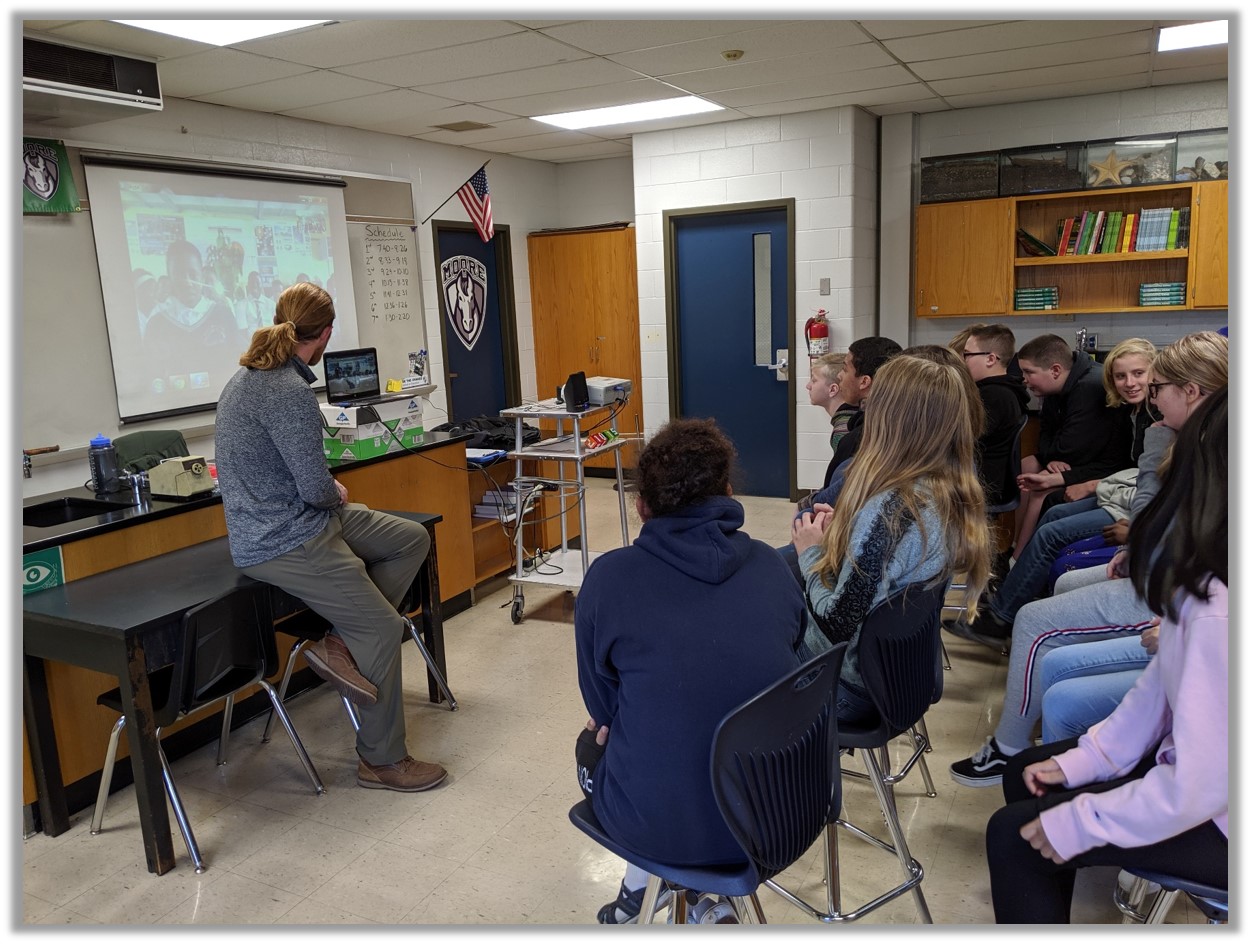
Louisville students talk with South African students by video
Climate change is simultaneously global in scope, yet experienced locally in quite different ways. From the perspective of education, it can be a challenge to convey to students how what is happening to the climate is more than the immediate weather out the window, but also not as abstract as an image of a polar bear on an iceberg. Currently I’m involved in a climate change education project focused on thinking of new ways of learning – and writing – about climate change across cultures. This interdisciplinary education project is initially focused on connecting middle-school students from around the world share what they are learning – and experiencing – about how climate change affects their local communities. The researchers and teachers involved in the pilot stage of this Global Climate Change Education Project – from Austria, South Africa, the Philippines, Australia, and the US – will gather here at the University of Louisville next week for a planning conference funded by a Spencer Foundation grant. The goal of the project is to help students learn about climate change not only from the perspective of science, but also how it affects, and is affected by, history, politics, culture, and the media. We hope that making these kinds of human connections across cultures can make climate change seem less abstract and, as a result, can lead to a greater sense of empathy and an increased commitment to the behavioral change and political action required to address the climate emergency.
The project brings together teachers and researchers from the sciences, education, and social sciences, and all have crucial roles to play in our planning. But, from my perspective as a literacy researcher and writing teacher, I also see writing and communication as key parts both of how students learn about climate change, and how they will communicate with people in their communities and with their peers across cultures. Part of what intrigues me about working on this project are the interdisciplinary possibilities. The science part of it is crucial, of course, but issues of sustainability are also about culture and community. And our explorations of culture and community are through science, but also through stories, history, poetry, images, film, and more. If we are to communicate and build relationships across cultures, we need to understand more about place and identity, and how those shape both science and our daily lives. What’s more, there is substantial research that indicates that what persuades people to act on social issues is not only facts and evidence-based reasoning, but also narratives, emotions, and relationships.
So I’ve found myself thinking about how science, art, narrative, oral history, poetry, and more might be brought together in climate change education, both in this project and others. This raises questions that are shaping many of my research and teaching interests right now. How is sustainability more than science? How must we also explore and examine issues of culture, community, history, and relationships in terms of climate change? What experiences and relationships motivate people toward action in a given context? How do we promote agency in students? And how is all of that mediated through interpreting and creating texts – both in print, but also in sound, video, images and other media and modes?
In exploring these, and other questions about location, culture, and sustainability, I am also interested in how we can use digital technologies to create these kinds of texts and opportunities for communication. We’ve already been doing some pilot projects among the students involving writing, video, and other forms of communication. Down the line we may explore other ideas, such as possibly creating a digital repository of student climate change narratives, interviews, podcasts and more, where people can upload video or audio or print and then they are available to others for teaching and research. Sharing this kind of writing would be another way to get students communicating about local knowledge across cultures and, I hope, increasing knowledge and empathy.
We are in the early days of this project, but I am eager for the conversations and work we will engage in next week in the planning conference and to think about how writing and literacy will play a role in climate change education going forward. As a teacher and researcher I have always been interested in the knowledge people have in their daily lives and how we draw on that, and connect it, to issues and ideas in school. I believe that, to engage in kind of broad-based change needed to address the climate emergency we need to explore new perspectives for that are grounded in local knowledge, languages, and cultures. We’re taking what we hope will be a helpful steps next week for learning and action across communities and cultures. Stay tuned.
Last year, the University Writing Center played a central role in reviving the Cotter Cup storytelling contest. Working alongside the Western Branch of the Louisville Free Public Library—especially branch manager, Natalie Woods—we engaged K-12 youth throughout the city of Louisville in exciting literacy experiences as we helped them craft, revise and submit poetry to the contest. Writing about his hopes for the Cotter Cup, University Writing Center director Bronwyn Williams wrote, “We hope that this year’s contest is just the first of what will be a growing and important writing event in our community.”
A year on, and a second Cotter Cup under our belt, I believe it is safe to say that this event has met both of these criteria. During the 2022 Cotter Cup, University Writing Center volunteers worked with 28 youths, over twice the amount we were able to engage with the previous year. While we’re pleased with the growth of the Cotter Cup, we’re even more delighted with the depth and variety of experiences we cultivated with young Louisville writers and their families.
The writers who attended Cotter Cup consultations arrived with a diversity of ideas and experiences. For some writers, consultations were a space in which they could share their interests, like unicorns or pokemon, and turn them into subject matter for poetry. For others, the consultations were a space in which rhymes were built and imagery was developed. No matter the approach, feedback from family members suggests that these sessions resulted in writers feeling motivated to tackle the next step of their writing process.
Family members also played an important role in this year’s Cotter Cup. Through e-mail correspondence, we found that families were excited to participate in the Cotter Cup alongside their children. Many sought out ways to get started with the writing process, or even to keep the momentum from the contest going. These interactions reveal to us that the impact of the Cotter Cup extends far beyond the contest’s start and end dates!
This year’s successes would not have been possible without the help of our volunteers. We had an absolutely all-star cast of consultants who were excited to work with these writers. The enthusiasm and knowledge they brought to each session made a huge impact. Thank you to: Eli Megibben, Maddy Decker, Aubrie Cox, Brice Montgomery, Cassie Book, Kylee Auten, Yuan Zhao, Zoë Donovan, and Ayaat Ismail.
Reflecting on their Cotter Cup interactions, one tutor wrote, “These kids are wildly talented.” I think they speak for all of us in saying this. The writers who participated in this year’s Cotter Cup are incredibly talented, but most of all, they are driven. We are so grateful that we were able to be witness to their amazing creativity this spring, and we look forward to Cotter Cup ‘23!
One of our goals in our ongoing community partnership with the Western Branch of the Louisville Free Public Library, is to create programming and tutoring that not only engages young people in writing and reading, but also connects to and supports the distinctive and important history of this library. The Western Branch library, built in 1908, and the first library in the nation to serve and be fully operated by African Americans has a history of significant contributions to the city’s West End. One of those important contributions was the founding in 1913, by Louisville educator and poet Joseph Cotter, of an annual storytelling contest. The “Cotter Cup” was a ‘storytelling bee,’ intended to encourage children to read and learn through the art of storytelling.
A couple of years ago, Natalie Woods, branch manager of the library, raised the idea of reviving the Cotter Cup as a writing contest. Her vision was of a Cotter Cup in which Louisville K-12 students would produce creative writing and be supported in that work through consultations of University Writing Center staff. The goal of the contest would be to encourage creative writing in the community and to connect K-12 students with writing support and conversations with our university writing consultants. We were excited at the possibility and have been delighted to work with Natalie and her staff on planning and implementing the contest. On our end, Edward English, our Assistant Director for the University Writing Center, organized and facilitated scheduling and supporting the consultations.
It has been a great experience to take part in the inaugural Cotter Cup poetry contest. Although the pandemic necessitated that the contest and consultations take place online this year, we had a great time working with dedicated and imaginative students from across grade levels and across the city. All the participants in the contest received books and writing journals, funded by the UofL English Department Thomas R. Watson Endowment. The winners also received prizes and will have their names engraved on the new “Cotter Cup.” You can read the winning poems here! It was also meaningful, during the pandemic year when so many programs were cancelled and put on hold, to have the chance to create a new program with our community partner and connect to students across the city. We hope that this year’s contest is just the first of what will be a growing and important writing event in our community.
Our consultants also had a great time working with the young writers from across the city. Here is what some of them had to say about the experience:
Ayaat Ismail: I was completely taken aback by these young writers’ creativity and drive during our meetings. It was truly inspiring to watch such young students brainstorm ideas and write poems based on their interests and experiences, whether limericks, free verse, or narratives, as they immersed themselves in poetry and demonstrated their talents and capabilities. It made me appreciate writing in a whole new way, as well as the concept of progression and learning in general.
Caitlin Burns: I really enjoyed being able to tutor elementary students for the Cotter Cup. They were so creative and energetic. I loved hearing their ideas for their poems and working with them, and I learned quite a bit from them as well. It was so lovely to get out of my grad school bubble a bit and have fun playing with words with them. Thanks for all of your and the Writing Center team’s work putting it together!
Alex Way: It was a great experience tutoring students for the Cotter Cup. I worked with an elementary school student who produced an amazing poem and ended up winning first place. Not only was his work exceptional, but he had a deep knowledge of poetry forms and what makes good poetry. Even though I only tutored my student for one session (and he did all the hard work), I can’t help but feel proud of what he has accomplished
Edward English: Working as a consultant for the Cotter Cup was one of the most rewarding activities I’ve done this year. It was so fun and encouraging to work with such promising young writers and be inspired by their creativity and intelligence. It was also an incredible honor to be part of contest which continues the exceptional legacy of Joseph Cotter and Western Branch Libraries.
Maddy Decker: I really enjoyed expanding my tutoring horizons from working with college students to also working with high school and elementary writers. I feel like I learned more about myself as a tutor and about what creative writing looks like at different levels. As someone who started writing poetry and short stories in middle school, I’m glad to see so many young writers putting themselves out there, and I hope they continue to explore their talents!
I’ve been struggling with how to start this version of my annual, end-of-year blog post. Every attempt to find words to convey how the extraordinary events of the past nine months, from pandemic to protests to political insurrections, have affected us in the University Writing Center quickly crumbles to cliché. At the same time, just a proud listing of accomplishments doesn’t seem appropriate to capture what has happened in the past year. So I think I’ll leave the big themes to someone else and just keep it simple.
I am always proud of the people who work in the University Writing Center and often tell people we’ve got the best Writing Center staff in the business. Yet it would be hard to overstate how special this year’s staff has been. As you may know, we have a completely new staff of MA Graduate Teaching Assistants as consultants each year. Despite the challenges of having to learn how to conduct all their consultations online, under the public health protocols of the pandemic, this group of consultants were consistent in their commitment to helping and supporting UofL writers. Whether they were working, in their masks, from our on-campus space, or from their homes, our consultants continued to listen carefully to writers and to provide excellent advice about writing, and empathetic support about how to navigate, and respond, to writing in such deeply unsettling times.
The less visible, but every bit as essential, part of our work happens behind the scenes with our administrative staff who kept everything organizationally running smoothly given the unprecedented challenge of having both writers, and often consultants, scattered all over the city (and beyond). It is a testament to their creativity, patience – and tenacity – that the organizational aspects of the things ran splendidly, allowing the consultants and writers to focus on issues about writing. This year, as in every year, the work done by Associate Director Dr. Cassandra Book, Administrative Associate Amber Yocum, and Assistant Directors Edward English, Olalekan Adepoju, and Nicole Dugan was simply indispensable to everything we accomplished.
Though it may be hard to appreciate from the outside, conducting all writing consultations online is a far more challenging teaching context than conducting appointments in person. For our consultants and our administrative staff, having to work completely online, while dealing with taking their own courses online, technological glitches, screen fatigue, physical isolation, students in the Library not wearing masks, and the political turmoil all around us, really has been truly extraordinary. It has also been exhausting. Like everyone else, we’re tired. It’s been hard on all of us and that is important to acknowledge. What I am proud of – and moved by – is that all of the University Writing Center staff, weary as they are, have done their best to remember that the writers bringing their work to us are also weary and stressed and worried about their writing. We have done our best all year to keep the writers’ needs at the forefront and to provide the individual, one-to-one response that is the core of our work in the University Writing Center. It’s been amazing to watch.
Thanks to the Best Writing Center Staff in the Business
Our superb, dedicated, and brilliant consultants make such a significant difference in so many UofL writers’ lives. Our consultants this year have been Michelle Buntain, Lauren Cline, Maddy Decker, Amanda Dolan, Chuck Glover, Ian Hays, Andrew Hutto, Ayaat Ismail, Zoe Litzenberg, Demetrius Minnick-Tucker, Cat Sar, Spenser Secrest, and Emma Turner. Also special thanks go to Writing Center Intern Kendyl Harmeling. Our amazing student workers were Mikaela Smith and Jency Trejo.
We want to give our special thanks and congratulations to Jency Trejo, on her graduation with her BA in English. Jency joined us as a student worker during her first semester at UofL and has been a central and important part of the University Writing Center ever since. We wish her all the best in the future.
We will be open during the summer, starting May 10, from 9-4 every weekday. You can find out more on our website. You can also follow us on our blog and on Twitter, Facebook, and Instagram.
Beyond Tutoring – Writing Groups, Retreats, Community Writing
We were particular excited to collaborate with the Western Branch Library on re-establishing the “Cotter Cup” competition. In the early 20th Century Louisville poet and educator Joseph Cotter established a storytelling competition for local youth called the “Cotter Cup.” We worked to support Western Branch Library in re-establishing the Cotter Cup as a poetry contest. As part of the contest, local K-12 students had individual writing consultations with our University Writing Center consultants. The contest entries will be judged by local poets with an awards celebration next month. We hope that this will become an important and vital part of writing in the community going forward.
Writing Center Staff Achievements
The University Writing Center is also an active site of scholarship and creative work. Staff from the Writing Center were engaged in a number of scholarly projects during the past year in rhetoric and composition, literature, and creative writing.
Cassandra Book, Associate Director, gave a presentation on “Passing or Trespassing?: Asynchronous Tutoring, Consultant Practices, and Center Ethos” at the 2021 Southeastern Writing Center Association Conference.
Olalekan Adepoju, Assistant Director for Graduate Student Writing, gave a presentation titled,presented a paper on “Discursive Practices in Recurring Asynchronous Consultations: Implications for Peer Tutoring” at the 2021 Southeastern Writing Center Association Conference. He also published the essay, “Rethinking Tutor-Writer Engagement in Asynchronous Consultations: A Conversational Approach to Recurring Witten Feedback Appointments” in The Dangling Modifier .
Consultants
Michelle Buntain completed her MA Culminating Project, titled,”To Listen is to Witness: Discovering Suffering Through Literary Analysis.”
Maddy Decker was an intern for the Miracle Monocle Literary Magazine in Spring 2021 and served as editor of reviews. She also completed her creative MA Culminating project titled “Register 16.”
Amanda Dolan was an intern for the Miracle Monocle Literacy Magazine and will have a book review published in the upcoming issue. She also completed her creative MA Culminating project titled “Precipitated.”
Kendyl Harmeling completed her MA Culminating Project titled, “Circumventing Self-Destruction: A Study on Imposter Syndrome, Affect Dissonance, and the Power of Hospitality in a first-year Graduate Program.” She gave a presentation, “Passing or Trespassing?: Asynchronous Tutoring, Consultant Practices, and Center Ethos” at the 2021 Southeastern Writing Center Association Conference . Kendyl also was a Writing Center Administrative Intern in Fall 2020 and will be joining the UofL Rhetoric and Composition PhD program next year.
Ayaat Ismail was an intern for the Miracle Monocle Literacy Magazine and published a book review with poet Steve Kistulentz in the current issue. She also became managing editor of the Miracle Monocle’s mini anthology called MONSTER.
Demetrius Minnick-Tucker completed his MA Culminating Project, titled, “Sho Baraka’s The Narrative: Hip Hop and the Social Role of the Church.” He will also be joining the Georgia State University Literature PhD program in fall 2021.
Cat Sar completed her creative MA Culminating Project titled, “Ghosted.”
The University Writing Center stands with our staff, colleagues, students, and community members who are protesting for social and economic justice and against White supremacy. We condemn systemic racist and violent oppression of Black people both in our community and nationwide. We recognize and pledge to act against historical and ongoing inequitable treatment of Black people.
In our own work at the University Writing Center and in our community partnerships, we reaffirm our commitment to antiracist education. Like the University and the community, our consultants, staff, and the writers with whom we work, come from a wide range of backgrounds and experiences. Some experience the direct effects of racism in their daily lives, while others benefit from systems of white privilege. We recognize that, as an organization, we must do more than simply respect diversity. As we say on our Statement on Diversity, Inclusion, and Equity, we “commit to critiquing and speaking out against individual and structural oppression in an effort to create a safer, more just university for all students.”
We also see our role as an educational institution as reaffirming our ongoing commitment to antiracist education. As our statement says,
We approach this work by listening to voices that are experiencing racism and oppression and by continuing to work to educate ourselves about systems of power and inequality. We continue to work as a staff to educate ourselves, listen carefully, and reflect on issues of identity, language, and power so that we can respond as allies and advocates for writers in the UofL community. We understand issues of inclusion and diversity require ongoing, daily work that is never finished.
Such work requires listening to and reading the work of those whose voices can educate us on both systems of racism in our culture as well as the pain, injury, and inequality such systems perpetuate. Such work requires honest reflection and ongoing conversation about our roles in institutions shaped by ideologies of White supremacy. The work is ongoing and we can and must do better.
In an effort to promote and continue antiracist education and activism, I am including links below to a few of the many resources that I hope people will find useful. My thanks to those who have done the work of putting these resources together.
This past Friday, February 21st, the University of Louisville Writing Center celebrated International Mother Language Day. This celebration offered me the chance to interact with students from different cultures and languages who are members of the university community, which opened my eyes to how diverse our campus is. If you are unfamiliar with this day, like I originally was, it has a fascinating history worth researching.
This observance was established by the United Nations in 1999 to promote multilingualism and language diversity across the world. The history behind this day has its roots in the Bengali Language Movement – a movement that emphasizes the stakes associated with multilingualism. On February 21, 1952, demonstration were head at Dhaka University, in what was then East Pakistan, against the adoption of a new state language at the removal of their mother tongue, Bangla. This event resulted in the killing of demonstrators who gave their lives to preserve their language. This event also lead to Bangla becoming one of the state languages of Pakistan. Until the writing center event this past week, I did not know the significance of this day, but I now have an entirely new perspective on the importance of multilingualism. As someone who grew up speaking English in America, the cultural significance of language was not something that often occurred to me, particularly not the impact that a loss of language can have on a culture.
As we celebrated on Friday, I realized that the relevance of this day within the university community and is crucial. As a university with over 700 international students and 200 scholars, recognizing and understanding the need for language diversity becomes even more significant, as language is foundational in preserving cultural tradition and diversity. The United Nations states that “When languages fade, so does the world’s rich tapestry of cultural diversity. Opportunities, traditions, memory, unique modes of thinking and expression — valuable resources for ensuring a better future — are also lost.” These characteristics of language highlight the importance in preserving an encouraging multilingualism, especially within our university community.
Instead of seeing language as a barrier, the university allows us the opportunity to learn from other cultures through a variety of ways. Even though International Mother Language Day has passed, there are still a number of ways to interact with a diverse range of cultures on campus. The University of Louisville offers a variety of ways for students to connect with and learn from other languages, ranging from classes to clubs, such as the American International Relations Club, which is open to all students interested in multilingualism. There are also clubs like the Arabic Language and Culture Club and the Chinese Club, as well as events like the French Film Festival (showing films until 3/7!), which focus on particular languages and cultures. By participating in these clubs and supporting more language diversity on campus, we can help to create an environment that fosters and celebrates a variety of cultures, viewpoints, and opinions.
If you’re interested in finding a club, a list of UofL organizations can be found here.
If you would like to become more involved in the community, here are a few places to start:
What are the attributes and traits of an inclusive tutor? Why do we need an inclusive tutor?
How does an inclusive tutor differ from a non-inclusive tutor? Why is the question of inclusion so important to writing centers?
These are the questions that have compelled me to ponder.
We have sufficient records that our writing center has been visited by a large number of students year by year. Among those students who have visited our writing center, a considerable number of them are non-American, non-native speakers of English, resident students, visa students, students belonging to 1.5 generation, students on F1 and J 1 status. Some of these students are enrolled in undergraduate classes whereas others are enrolled in graduate level courses. These students embody different socio-cultural, linguistic, historical, and continent specific experiences.
The number of those students having unique cultural differences is on the rise. To provide care, support and guidelines, the writing center has been widening its scope. Since the writing center has already taken constructive steps to include students regardless of caste, creed, convention, color, disability and gender, it has been hailed as the hub where diversity, the differential, and disability are carefully accepted and constructive counseling is given keeping in mind the unique nuance, agency and concern of student writers.
To address constructively all those voices, expectations, dignity, agency and sensibilities of students, writing center needs inclusive tutors. Only inclusive tutors can handle with dignity the longings, concerns and curiosities of student writers. In the present time in which writing centers have been witnessing the flow of students both native and nonnative speakers of English, what writing centers need is inclusive tutors.
By an inclusive tutor, I mean the sort of tutor who demonstrates tremendous patience and a sense of acceptance when it comes to looking into the student drafts. Only those tutors who have the capacity to say ‘yes’ to their own weaknesses, frailties, flaws, feet of clay, shortcoming and limitations can accept the others as they really are. Here I am reminded of what Francis Fukuyama in his book Identity says “the longing to get recognition from others is the universal longing everyone is endowed with. It is this longing for recognition from others that drives us to forge and foment the question of identity”.
Below I have presented some attributes and traits of an inclusive tutor:
• The inclusive tutor does not get stuck on any identity category rooted in caste, creed, convention, color and gender when he or she starts tutoring in writing center.
• An inclusive tutor possesses tremendous power of acceptance. In no way, he or she deviates from the centrality of his or her power of accepting difference in any form.
• Language has the power to influence thought and vice versa. So, the inclusive tutor does not believe in the dichotomy of lower order concern and higher order concern.
• The inclusive tutor is always ready to address any concern of students be it grammar and punctuation or structural chronology of ideas without compromising with the foundational belief that writing center is not a grammar fixing center.
• The inclusive tutor acts in an innovative way. Labels, categories, stereotypes and banal modes of expressions are simply rejected by an inclusive tutor.
• The inclusive tutor knows when and how to switch deftly and smartly from non-directive modes of tutoring to directive modes of tutoring.
• The inclusive tutor believes and acts on the assumption that every student writer is a world in himself or herself. And the tutor navigates this world with consciousness.
• The inclusive tutor is driven by the belief that all forms of literacy are interrelated, supplementary, complementary, correlative, and symbiotically linked. Alphabetic literacy, visual literacy, digital literacy, community literacy, twitteracy etc. are all important in knowledge making process. The inclusive tutor makes use of anything that serves the best goal of tutor and boosts the institutional prestige and standing of writing center.
• An inclusive tutor forcibly believes that after each interaction with student writer, a new self is born in the life of inclusive tutor.
• The inclusive tutor is a mirror on which student writer finds the reflection of his or her own image, face.
• Writing is not a product of solitary endeavor. It is a product of collective efforts. This is the quintessence of inclusive tutoring.
Sharing writing can be challenging, especially when you’re joining an established community like a writing center or creative writing group.
It can be difficult to navigate the established norms and find just the right niche for your writing. Yet, every writer in the community has gone through those same experiences. It’s also okay to shop around a bit. Each writing community is unique, and some may be more or less accessible than others.
When I was a teenager, I started looking for an online, forum based, play-by-post fantasy role playing game (we’ll just call it an RPG). I wanted a place to create my own characters and explore their lives with the characters of other writers. Much to my dismay, some of the communities had hundreds of members, book-length lore files, and thousand-word posts. You could even be kicked from the community for being inactive for a week or two. Nope! Too scary. I ended up joining a very low-key forum, specifically picked for its small community and short posts.
I didn’t say very much at first. I would sign in, post, and leave for the day. That was about all of the social writing interaction I could handle; I did not, in any way, want to be around when the other members read my post. But guess what: no one complained. The stories continued on their merry way. I did not, in fact, derail the writing community.
Encouraged by this turn of events, I started talking to the other members through the forum’s chat box. The chat box took the stress out of socializing because it was so informal. There was no sense of finality when hitting the submit button like there was with a regular post. It also humanized the other members; they stopped being their characters and became themselves, and gradually they became friends, too.
At this point, the RPG really became fun. The social relationships improved the stories we were writing. We got to discuss where we wanted the stories to go and how we were going to get them there. Or, we complained when our characters refused to cooperate. We also started to recognize each other’s writing styles and got to watch as everyone’s writing naturally improved. We never set out to become better writers, though. It happened naturally, through time, practice, and experimentation.
I’d like to say that this experience made it easy to join new communities later on, but it didn’t. However, that didn’t stop me from going through the process again. I continue to make friends and learn through all of the writing communities I’m part of. There will always be some degree of anxiety when entering a new group, and that’s okay. Just try to keep in mind that writing communities tend to be very open and welcoming; we all have the same anxieties and reservations.









 University of Louisville Writing Center