Tag: writing

Creative by Choice: Persevering through Doubts and Droughts

Tim Phelps, Consultant

Perhaps nothing can be as daunting to a writer as an empty screen or a blank piece of Tim Phelpspaper.  It taunts you.  It knows you can’t do it.  It erases every budding idea you have and replaces it with indecision.  It’s the ultimate bully–the one who manifests your fears with more efficiency than Pennywise the Dancing Clown.  You’ve lost any ability to be rational at this point.  You know you’ve faced this demon before and made it through, but you’ve convinced yourself you won’t be able to do it again.  This will be the end of you.  This will be the first time you’ve failed to turn in a paper, or—even worse—you’ll end up stringing together an essay of words so incoherent that everyone will finally find out you’re just an imposter.

That worst-case scenario never comes to fruition, of course, but it sure feels like it will sometimes.  We find a way to get through it, and the world keeps turning.

I’ve come to believe that the roots of this struggle are based in creativity.  More specifically, our doubt-ridden self-image about our creative talents.  If we have convinced ourselves that we are not creative, then it makes sense that we’d have difficulty designing that eye-catcher the beginning of our paper deserves.  It makes sense that we would look at polished or published writing and be unable to picture ourselves producing it—when the words feel so good, it’s more appropriate to call it a “creation” instead of a text.  Writing like that must have been fashioned by someone who won the creative gene lottery, we might think.  This creativity is not limited to fiction writing or poetry; its presence is just as ubiquitous in well-written academic work as well—we feel the sting of its absence when we can’t come up with a compelling thesis statement or find incontrovertible evidence in our research.  Even pallet-wood projects on Pinterest and sugar-cookie decorating on Instagram haunt our creative confidence.  How can I possibly create if I’m not creative?

It’s important to recognize that all writers have faced that empty-page paralysis at one point or another.  It’s even more important to recognize, however, that practiced writers have found strategies for dealing with times like these. We’ve accepted it as a part of the process, and have found solutions that work for us.  Some writers make a pointed effort to temporarily abandon the writing for a little while, refocusing their brains on something unrelated until they feel ready to give it another try.  Some find solitude, others seek out company.  If writers are constantly finding themselves in this struggle, they might ask if they are trying the same ineffective strategies over and over.  If so, I encourage them to try doing something different and see how that works.

The longer I write, the more I’m comfortable that I’ve found an effective strategy for me.  If I just start writing something, even if it’s horrible, it will eventually evolve into a final product.  I’m not always satisfied with what I write, but these are first drafts we’re talking about here.  They’re allowed to be horrible.

I will admit that it’s more complicated than just getting words on the page.  Word production does not automatically create a well-written paper.  Strategies may get you started, but what use is that if none of it has that unique, creative zing?  It boils down to either accepting that certain lucky people are born with a creative gene, or accepting that creativity, like having any other skill, takes practice and hard work to develop.  Subscribing to the former absolves the writer from any responsibility.  But the latter makes the writer accountable for improving, which is a scary prospect.  If creativity is indeed a product of practice and effort, then that includes a heavy implication of failure.  For writers, the fear of failure is often what keeps the page blank to begin with.

However, I’m convinced it is a struggle worth fighting for.  Once writers accept that it will take work, they can focus on combining strategies with perseverance.  It’s the confidence (whether real or faked) that the words will eventually come to you, and a willingness to embrace the discomfort of labor.  It takes patience, comfort with failure, and a commitment to pushing through the block.  It’s not a problem limited to non-professional writers.  In his book On Writing: A Memoir of the Craft, Stephen King compares writing not to “creative fluttering,” but to blue-collar labor such as plumbing and driving long-haul trucks (153).  (I know that this is my second King reference of the post; I offer no apologies.)  Common metaphors we use to describe this kind of toil are just as pitiless as you might expect: “putting your nose to the grindstone” and going “off to the grind.”  Both examples express this undertaking as a prolonged and drudging effort.  Even video gamers, when faced with challenging goals that require lots of time, effort, and perseverance, call the act “grinding.”  The origin of using “grind” in these metaphors is a reflection of two inventions of production: a vertical, spinning stone for knife sharpening, and the giant stone wheels used to pulverize grain into flour in watermills.  These examples represent the unforgiving nature of this approach, and in all fairness, sometimes the grind is tedious and exhausting.  But the metaphors also represent a connection between writing and the efforts of other disciplines.  These commonalities highlight a stark truth: those who find success usually have to work very hard for it.  Creativity therefore, and its subsequent creation, are choices.

This all means that, when faced with a writing block, the best way of fighting through it is committing to fighting through it.  The writing that looks easy for other people is less likely a product of a lucky birth and more likely the result of a practiced skill.  That practice means that once you have a merely acceptable idea of what to write, you keep grinding until you create something you’re proud of.  It won’t come easy.  It will be frustrating.  Failure is a real possibility.  But just like anything that is challenging, you will be rewarded when you work for it.

Works cited:

King, Stephen. On Writing: A Memoir of the Craft. Hodder, 2012.

Good Enough is a Shot in the Dark or: How I Learned to Stop Worrying and Love the Revision.

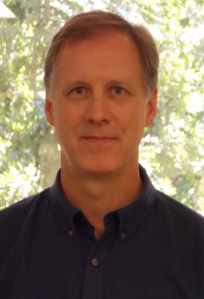
Christopher Stuck, Assistant Director of the Virtual Writing Center

Every once in a while, I stumble upon an article Christopher Stuckabout writing that really sparks with my own experience and struggles in getting words on the page and then turning them into something worthwhile. A lot of my writing time is spent worrying about that first reader and how they will react. As such, I struggle with getting the first draft out, caught up in making it finished on the first go. From teaching here at the University of Louisville and at the University of South Carolina before that, plus working with writers in the University Writing Center, I know I’m not alone in this thought process.
We know it’s bad for us to get into the editing while we’re writing. We know nothing is finished on the first try. But we don’t want to show that we don’t quite have it down right to start, either because we don’t want to be embarrassed or because we don’t want to edit. Good enough isn’t good enough, but we want it to be.

Last week, the University Writing Center posted a link to “The Book He Wasn’t Supposed to Write,” an article published in The Atlantic, to our Facebook page and Twitter feed. Written by author and journalist Thomas E. Ricks, the article details his hidden struggles in writing his latest book and the dismay he felt in the editing process.

He worked on the book for three years and when he finally submitted it to his editor, his editor hated it. Ricks says “Partly, I was crushed. But even more, I was puzzled. How could I have been so off in my perception of my manuscript?” Ricks’s book wasn’t a true first draft, but this was the first time he had sent it out for reading. He was sure of the way he had written the manuscript, but “What [Ricks] had sent [his editor] was exactly the book he had told [Ricks] not to write.” Ricks rethought and revised the book heavily, transforming what he already had, the work he had already done, and added a lot of things he had initially discarded. Through revision, it fell into place, and he ended up with a much better book, even in his own opinion.

Ricks concludes his article, “Most art has a public face—music is played, paintings are displayed, plays are enacted, movies are filmed and often watched by groups. Books tend to be more private, from one person’s act of writing to another’s act of reading. Most mysterious of all is the hidden middle stage, the offstage act of editing. Yet sometimes it can make all the difference.” For me, this is much like the work we do here, as students and academics. Even with an audience in mind, whether it’s an editor, a professor, or a specific group of people out there in the world, there feels like mystery in the writing process. No matter how many times we go through it, no matter how practiced and sure of ourselves we get, the private acts of writing and revising tend to stay private.

Even the few of us who truly love to write fret and worry and make writing hard for ourselves. Rethinking and revising your work after getting the raw materials down on the page in a rough or first draft can counteract some of the mystery, making the whole process easier. Be willing to cut, scrap, rethink, reshape, rearrange, and rewrite. It may seem like more writing, but it’s easier writing.

Find that trusted friend or trusted professor and have them help you by reading and commenting on your work (most of us are willing) or come to the University Writing Center and work on it with us (all of us are willing). But most of all, trust yourself to get words on the page and shape it up later. Learn to stop worrying and love the revision.

Time, Talk, and Attention to the Individual Writer: How Learning Happens in the Writing Center

Bronwyn T. Williams, Director

Every year I spend much of my August telling people about the University Writing Center. I go to a number of departmental and college orientations and resource fairs so I can offer an overview of our services. I tell people that we work with any member of the UofL community on any kind of writing at any point in the writing process. I talk about dscn2185our various writing groups, writing events, and the workshops and retreats we offer. And I describe, briefly, how we don’t edit papers for people, but work with them to discuss the strengths and weakness of a draft and come up with strategies for revision that will make the writer stronger yet.
Yet, I usually have only about 15 minutes to talk, at best, at these events, so I don’t get to explain much beyond that. There are any number of things I’d like to be able to say, but with the start of the new academic year, I want to take a moment to focus specifically on a few values and approaches that we have in the University Writing Center that both set us apart from other parts of the University and create distinctive learning experiences that keep people coming back to make appointments with us. These are all ideas we spent the day talking about at our start-of-the-year orientation this past Thursday.

People, Not Just Pages: We work with writers, not just on drafts. We’re not an editing service that marks up a draft with “corrections.” Instead, our focus is working with a writer to provide that person with suggestions and strategies that help the writer make the draft in question stronger, but also offer the writer ways to write more effectively in the future. We remember that we’re responding to a person, not just a set of pages. Such an approach also means that we work in dialogue with writers, listening to their concerns, offering suggestions, and emphasizing that the best learning comes from such cooperative and collaborative approaches.

Location, Location, Location: We can start with writers where they are. In a class full of students instructors have to make assumptions about what the students know and start from there. Being able to work with writers individually means we can find out what they know, what they want to learn, and adapt our responses accordingly. The reality is that no writer is always a strong or weak writer. Competence and confidence depend on the writer’s familiarity with the genre in question, whether you’re a first-year student or working on a doctoral dissertation. We tailor our teaching to the individual and the context.

Time Is On Our Side: Unlike conventional courses, we’re not bound by the limits of a 14-week semester. Our timeline for learning is up to the individual writer. Some writers make multiple appointments with us during a given writing project (writers can make up to three appointments per week). Some make regular, standing appointments each week was they work on a longer piece, like a dissertation or book. Others we see from time to time during their years at UofL. The point is, we can keep working with a writer over the course of college career and our approaches to teaching and learning can take the long view and not be truncated by the semester schedule. Such an approach, again, means we can focus on teaching the individual, not just fulfilling a course syllabus.

Learning, Not Grading: When we sit down with a writer, our focus in on helping that person write more effectively, not coming up with an evaluation of that writer that

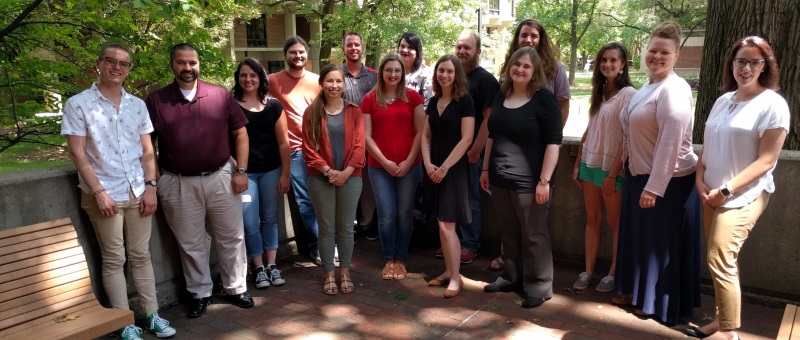
WC staff 17
University Writing Center Staff, 2017-18

reduces it to a number or single letter. Taking this approach allows writers to be more honest about their struggles and more willing to explore a variety of approaches knowing that an approach that doesn’t work won’t result in a failing grade, but just having to try again. In the Writing Center the response of the reader is what matters, and in that way reflects more closely the reality of writing in daily, non-academic contexts. What’s more, research on motivation – and research on grading – overwhelming demonstrates that instrumental reward systems such as grades diminish both internal motivations and learning. We offer a learning environment that emphasizes individual learning, not group assessment, and that makes the learning and motivation that much stronger.

Writing Matters in the World: We’re committed to cultivating and sustaining a culture of writing on campus and in the community. Our writing groups (Graduate, Creative Writing, LGBTQ), our community work and workshops, and our events (Banned Books Week, Celebration of Student Writing, International Mother Language Day, among others) are all done with the goals of supporting the writing that people do, but also reminding people of the important work that writing does in their lives and in the world. Toward that end, we also value and emphasize the role of writing and literacy in advancing and advocating for equality and social justice.

Regardless of your political views, it’s hard to argue with the idea that these feel like tumultuous times. But, as my father once said, “Education is an optimist’s racket,” which means I can’t look at the new faces on campus and not feel hopeful. We are excited to  open our doors at the University Writing Center to begin another academic year and remain a positive force for UofL writers and their writing.


A Year of Successes, In and Out of the University Writing Center

A Year of Successes, In and Out of the University Writing Center

Bronwyn T. Williams, Director

Any time you move you have dreams about how your life may be in a new space. Yet you never know what the reality will look like, so you go forward with your fingers crossed and hope for the best. Looking back on our first full year in our new space on the first floor of Ekstrom Library, it’s gratifying to see how many of our hopes have been realized and how excited we are to continue this work in the year ahead. We had hoped that the new, larger, space for the University Writing Center would both make us more visible and offer us more room in which to hold consultations, events, and other activities that would foster and celebrate a culture of writing on campus. All of that has happened, and more.

In Fall 2016, we set a record for the number of one-on-one consultations in a single semester (and we may be headed for a record for spring semester as well). Thousands of writers at UofL come to see us, and come back again, because they feel they’re engaging in productive conversations about

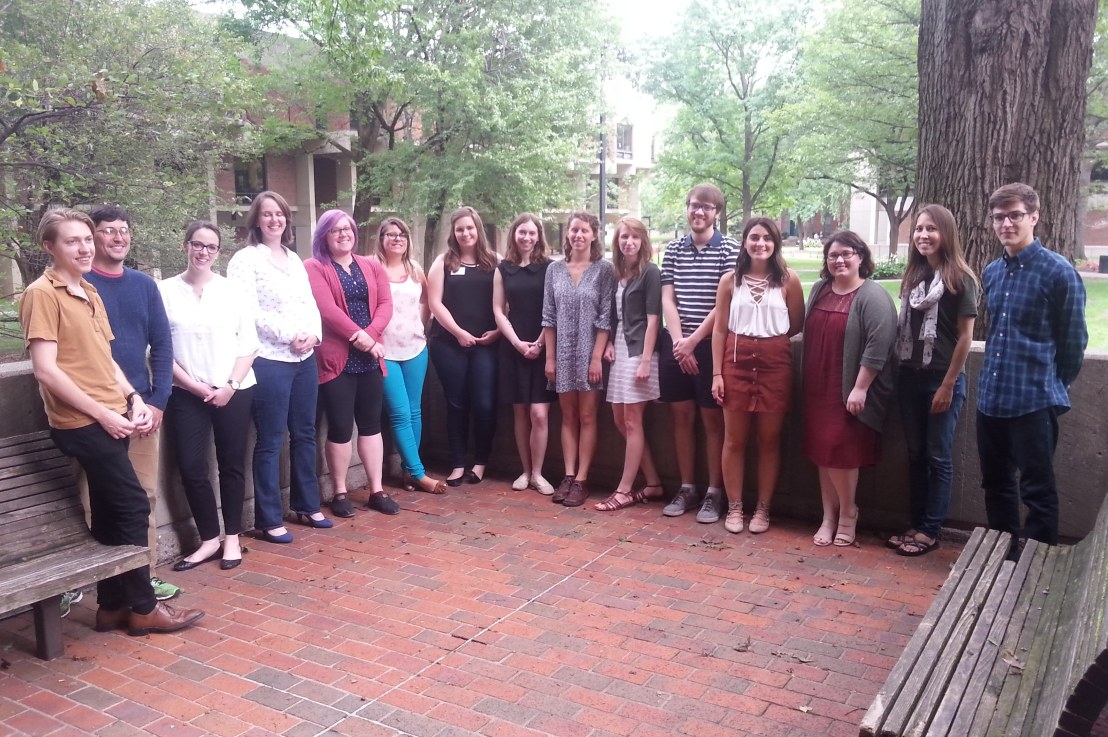
20160818_130303
The 2016-17 University Writing Center Staff

writing that help them grow as writers. The writers who come to the University Writing Center represent every college in the university and include undergraduates, graduate students, faculty, and staff. It takes an extraordinary staff to work with so many different writers from different disciplines who bring distinctive and individual concerns about writing to their appointments. So, while it’s great to have a shiny new space, it is our talented and dedicated writing consultants and the inspired teaching they do, day after day, that are at the heart of our work.

One of our other goals for our new space was to be able to hold writing-related events and sponsor writing groups, and that is another of our dreams that we have been able to realize. We’ve held a range of events, from a Halloween Creative Writing Open Mic night, to celebrating the National Day on Writing and International Mother

mother-lang-day-4
Celebrating International Mother Language Day

Language Day , to doing our part to participate in events such as Banned Books Week, Kick Back in the Stacks, and the Celebration of Student Writing.

We also want the University Writing Center to be a place where people can come to do their writing, so in the past year we have expanded our sponsorship of writing groups. In addition to continuing our Graduate Student Writing group and LGBTQ Writing Group, we added a very successful Creative Writing Group this year. We will be continuing all of this groups, so be sure to check our our website for information and dates.

It’s also worth noting that not all of our work takes place inside the University Writing Center space. In the last year we have conducted writing workshops across both UofL campuses that have served more than 1,000 undergraduate and graduate students. If you would like to request a workshop, you can contact us through our website or by email. We also collaborated with the Digital Media Suite on workshops to support faculty teaching. In the digital world, our social media presence on Twitter, Facebook, and Instagram continued to grow. And this blog, with its combination of posts about writing and writing pedagogy and our ongoing How I Write series, continues to increase in popularity, with more than 12,000 hits this year.

We also have expanded our community literacy work this year. In addition to holding regular writing workshops and consultations at Family Scholar House, we have begun a Amy Picture2partnership with the Western Branch of the Louisville Free Public Library. At the Western Branch Library we’ll be working with young people, both through literacy tutoring as well as organizing a variety of writing-focused activities. You can read more about these partnerships in this blog post.

It is important that credit goes to the fantastic administrative staff who are the brains and heart of the University Writing Center and support UofL writers in so many ways, both large and small. Associate Director Cassandra Book, Assistant directors, Layne Gordon, Amy Nichols, Jessica Newman, and Chris Scheidler handle every opportunity or challenge with creativity and good humor. Robin Blackett runs the front desk, with the help of our student workers Brianna McIntyre and Bailey O’Leary,  with warmth and professionalism.

Whatever we do, we are committed to always putting writers and their writing first. We work to make the University Writing Center an inclusive and safe space where all writers can explore their ideas. We want writers to know that we will respond respectfully and thoughtfully to their work, and that we can learn from them as they learn from us. Such a reciprocal and collaborative relationship is essential to our the work we do. So I want to end by thanking the writers who have trusted us with their writing and their ideas this year.

We will be open during the summer, starting May 8, from 9-4 every weekday. Meanwhile, take a look at our website and we hope to see you soon.

Writing Center Staff Achievements

The University Writing Center is also an active site of scholarship about the teaching of writing. Staff from the Writing Center were engaged in a number of scholarly projects during the past year in rhetoric and composition, literature, and creative writing.

Cassandra Book, Associate Director of the University Writing Center, presented at the International Writing Center Association Conference, Thomas R. Watson Conference on Rhetoric and Composition, and International Writing Center Association Collaborative at the Conference on College Composition and Communication. She was also awarded a the Christine Cozzens Research Grant by The Southeastern Writing Center Association for the project “Online Writing Tutoring: Usability, Access, and Participation.” She also published a book review in IEEE Transactions on Professional Communication of Tracy Bridgeford and Kirk St. Amant’s Academic-Industry Relationships and Partnerships: Perspectives for Technical Communicators and co-authored a post on the Coalition of Feminist Scholars in the History of Rhetoric and Composition Blog on “Teaching and Researching Feminist Rhetorics: Digital Curation as Collaborative Archival Method.”

Layne Gordon, Assistant Director for the Writing Center, presented at Thomas R. Watson Conference on Rhetoric and Composition and the Popular Culture Association/American Culture Association National Conference and co-authored an article titled “On Multimodal Composing.” in Kairos: A Journal of Rhetoric, Technology, and Pedagogy.

Jessica Newman, Assistant Director for Graduate Student Writing, presented at the International Writing Center Association Conference, Cultural Rhetorics Conference, and Conference on College Composition and Communication.

Amy Nichols, Assistant Director for the Writing Center, presented at the Thomas R. Watson Conference on Rhetoric and Composition and co-authored a policy brief titled, “Charter Schools Not Just for K12 Advocacy,” in Policy Analysis Initiative. She also published the poems “For my men” in Pine Mountain Sand and Gravel and “Cave Run Lake” and “Passing Through” in Appalachian Heritage.

Chris Scheidler, Assistant Director for the Virtual Writing Center, presented at the College Conference on Composition and Communication and participated in the Louisville “Hack The Ville” project focused on providing resources to help the     transition for refugee and immigrant populations.

Kevin Bailey co-edited the Miracle Monocle literary magazine and was awarded a Department of English Creative Writing Scholarship. He will be the Assistant Director of the Creative Writing program next year.

Kelly Carty will be the Morton Endowed Chair Research Assistant next year and will present at the South Central Modern Language Association Conference.

Emily Cousins presented at the Northeastern Modern Language Association Conference and was awarded U.S. Dept. of State’s Critical Language Scholarship to learn Bengali this summer.

Katie Kohls presented at the College English Association of Ohio Conference.

Carrie Mason was accepted to present at the national Community Writing Conference in October.

Michael Phillips presented at the Louisville Conference on Literature and Culture since 1900 and the Kentucky Philological Association Conference. He is also the Henry James Review Research Assistant for next year.

Melissa Rothman completed her MA degree and defended her thesis, “Ironic Deference-An Inquiry into the Nineteenth Century Feminist Rhetoric of Kesiah Shelton”

Ashleigh Scarpinato gave readings of her poetry in the Flying Out Loud and River City Review creative writing series in Louisville.

Ashley Taylor founded the River City Revue Reading Series and read at the Flying Out Loud reading series. She also co-edited the Miracle Monocle literary magazine and was awarded a Department of English Creative Writing Scholarship. Her poems will be published in the following journals: “Shipwreck,” The Merrimack Review; “Shipwreck,” Lavender Review; “A clean void paints a silhouette where your dresser was,” The Stillwater Review; and “Botanical garden duplex” & “The Seamstress,” FIVE:2:ONE.

Finally, along with former University Writing Center staff members, Adam Robinson, Tika Lamsal, and Ashly Bender Smith, I co-authored an article “`Find Something You Know You Can Believe In’: The Effect of Dissertation Retreats on Graduate Students’ Identities as Writers” for the edited collection Re/Writing the Center: Pedagogies, Practices, Partnerships to Support Graduate Students in the Writing Center, to be published this summer. Also my forthcoming book, Literacy Practices and Perceptions of Agency: Composing Identities, draws in part from research conducted over the years at the University Writing Center.

The Writing Center: Every Step of the Way

Kevin Bailey, Consultantkevin-b

The spring semester is drawing to a close.  Tensions are high, schedules are full, and it seems like there’s no way on earth that all the work that needs to get done will ever get done (at least not on time).  Of course, it will get done, though; it always gets done.  And when it does get done, there’s a feeling of exhaustion, followed by a moment of relief, and then, within a matter of days, an overwhelming sense of – “What now?”

And the answer to that question is different for all of us.  Perhaps you’re finishing your first year of college and making plans to take more difficult coursework next semester.  Or perhaps you’re jumping straight into summer classes.  Maybe this is your final semester before graduation and you’re preparing to enter the job market.  Or maybe you (like me) are gearing up to teach for the first time in the fall.  These are all big and potentially scary changes.

It can be daunting to consider all the work that lies ahead.  No matter what stage of your academic career (or life) you’re in, new obstacles are always going to stand in your way and new responsibilities are inevitably going to take up your time.  And I can’t in good conscience recommend you put these things out of your mind.  It’s important to plan.  It’s important to look ahead and approach your “What now?” with confidence.

The point I’m making, I think, is that even though your workload may increase and you’ll take on larger projects, you will always be able to adapt to new challenges, especially when resources like the Writing Center are around to help you along the way.  One of the many mantras I’ve memorized from my time tutoring over the past year has been: “We’re here to help with any writing project at every stage of the writing process.”  This phrase is usually applied to the standard college essay, and by it we tutors often mean we can help regardless of how much of said essay has been written.  We help to brainstorm topics for papers that have not yet been started as readily as we discuss strategies for revision on papers that are mostly finished.   But this same mantra can be slightly repurposed to say “We’re here to help with every step of your writing career,” and it would remain equally true to the Writing Center’s purpose.

The Writing Center can help in a big way with every one of those “What now?” scenarios I mentioned earlier.  If you have a summer project you want to work on, the Writing Center is open for consultations during the summer.  If you’re entering the workforce or applying for positions, you can set up an appointment to construct or review your CV, resume, or personal statements.  If you’re teaching next semester, you can bring in and receive feedback on your syllabi and lesson plans (something I’m already making plans to do).

No matter what’s next for you, you’ll be writing.  And no matter what you’re writing, the Writing Center can help.

“Can someone hold my hair while I word-vomit?”

Michael Phillips, Consultantmichael-p

Recently, I found myself in a pickle.  I put off a research paper until the last minute (guiltily), partly because I didn’t really know how to get started and partly because I didn’t really know what to argue.  I’d already conducted practically all of my research, but I didn’t know how to make my contribution, my part of the scholarly conversation, novel or interesting.  I was bogged down by my own self-consciousness and insecurities about the topic, trying to grapple with whether I would sound academic or formal enough for the assignment’s requirements.  What pulled me out of that slump, that inability to get my ideas out onto the page, was a critical stage of the writing process that I’d forgotten to employ: word-vomiting.  One of my professors introduced this non-committal, helpful practice that can enable the writer to produce their best possible writing.  Word-vomiting, for me, is a lot like freewriting but with one critical difference.  While freewriting is a good exercise to employ to start writing about anything, word-vomiting can be much more direct, much more specific to a certain topic, to get the writer to start unpacking and flushing out ideas particular to that topic.

So how can you best engage with this strategy?  I suggest compiling whatever materials you’ve gathered through the research part of the process, like your notes, primary sources, secondary sources like scholarly articles / books / journals relevant to your topic, etc.  Once you have these resources and have familiarized yourself with them, I recommend putting yourself in the most comfortable position to get your thoughts about your topic onto the page.  Whatever kinds of thoughts you have about the topic, both significant, and insignificant, personal and impersonal, communicating those thoughts in whatever way will help you locate what aspects of your topic you find most interesting or compelling.  This stage of the writing process is so important for this very reason; I’ve skipped out on word-vomiting altogether in the past, and I’ve found myself writing at length about an argument that doesn’t inspire me.  When I’ve historically found myself in that position, the writing stage is both grueling and seemingly interminable.

Word-vomiting is also important because it puts you in a much better position to sift through ideas you’ve already fostered rather than having to generate entirely new ideas when you’ve already begun writing the paper.  It’s so much easier to cut ideas or synthesize ideas you already have on the page than it is to create new ones as you’re executing the writing of your paper.  When you’ve exhausted the word-vomiting stage of the process, you’ll realize a lot of your ideas just don’t work or don’t fit into this assignment.  They’re still important, though!  And they may have a place in a future assignment or a future scholarly / creative endeavor.

Research papers are hard, and finding your position / stake in a research paper can be even more difficult. If you’re looking for other ideas about how to get started your can check out our Writing FAQs and ideas for getting started with digital project. But with this helpful strategy of getting your ideas about a topic onto the page at whatever pace, of word-vomiting whatever you think or feel about that topic, you may find your research paper may be just a little bit easier or smoother to execute.

Evaluating Sources in the Age of “Fake News”

Melissa Rothman, Consultantmelissa-r

Alternative facts, fake news, disinformation, propaganda…despite their recent step into the spotlight, none of these concepts are by any means new phenomena. Nonetheless, the recent stir in the media has even caused the Oxford Dictionary to name “Post-truth” the word of the year for 2016. Many have pointed to the ever-increasing availability of information in our digital age as the cause of our current skepticism, but publicity stunts and sensationalized media date back to the early stages of mass publication. In 1809, Washington Irving is perhaps one of the earliest cases for knowingly fabricating “fake news,” placing a fake missing person’s advertisement in several local newspapers for a Mr. Diedrich Knickerbocker just prior to releasing his first work published under this pseudonym. Tabloids such as “Star” and the “National Enquirer” have stared back at us from the supermarket lines our whole lives reminding us to question the validity of printed news. Even in academia, the notorious “Sokal Hoax” serves as a cautionary tale illustrating the value of close reading. However, despite the apparent prevalence of misinformation in our world, we should not slide into the nihilistic view that truth is relative. In fact, this recent heightened interest in the validity and soundness of sources has fostered a necessary awareness of misinformation. Likewise, there are several strategies available for evaluating sources.

Melissa Rothman pic 4-10

[CC Image courtesy of The Public Domain Review  on Flickr]

To begin with, there are several research guides available on the web. Ekstrom Library even has a list of strategies for evaluating sources here. It includes questions of context, authorship, and credibility that are useful for evaluating any type of source, but is specifically geared toward academic works. However, sometimes we want to use data from outside scholarly databases.  There are tons of tips online for building digital literacy, but I’ll break down these lists into the cliff notes version that we college students know and love.

Here are some strategies:

  1. Consider the Source. Questioning an author’s motivation should be second nature to every college student by the time they graduate. There is no such thing as an agenda free text. However, this isn’t necessarily a bad thing. For instance, this blog post was written with two main goals: 1. To please my wonderful boss (*note the potential motivation of sucking up with my adjective choice). 2. To supply you guys with a handy-dandy tool for evaluating sources. But always be aware that some agendas are a bit more nefarious than others, particularly when you get into the realm of politics.
  2. Look for Evidence. This could be cited explicitly in the article, provided at the bottom of the page, or embedded in hyperlinks. But if the author is stating something as common knowledge, that…well…isn’t common knowledge, approach with caution.
  3. Fact check, Fact check, Fact check. Below I’ve listed some links to some great sites for this, but while they certainly do try, they can’t cover every piece of information available on the web. Luckily, if you have a question, our Reference Assistance and Instruction department is fantastic asset for questions like these.
  4. Pay Attention to Images: By now, pretty much everyone should be aware of the magical abilities of Photoshop. However, did you know that Google has a reverse image search that can help trace where else an image has appeared online? Find the original source can perhaps help identify the reliability of the image. Likewise be aware of charts and graphs. They can also be appropriated to distort truth…even when using real data.
  5. Check the URL. URLs ending in .edu and .gov are inherently trustworthy, but still continue to consider the source to identify possible partisan biases. During my undergrad I was told that .org was more trustworthy than .com. However, while there was a time when getting a .org meant you ran an actual organization, today anyone can get this type of domain. Also, beware of URLs designed to intentionally mislead you by using other organizations’ names. For example, ABC.com.co, is a fake news site mimicking ABC.com.
  6. Be Aware of Your Own Biases: Part of providing a convincing argument is showing that you’ve thoroughly considered all opposing viewpoints. The only way to do this is to read AND consider opinions from other people’s perspectives. They may not change your point of view at all, but in considering them you are enabled to form a stronger argument in support of your viewpoint.

Fact-Checking Sites:

Self Care and the University Student

Brooke Parker, Consultantbrooke-p

The ins and outs of the university can be stressful and anxiety inducing for many of us, particularly at this point in the semester. While Spring Break’s brief moment of relaxation has left us, our final exams and seminar papers are fast approaching. It’s easy to forget that engaging in self care is just as important as the writing and studying you’re doing.

As someone with a mental disability, self care is a really familiar and helpful concept to me, but this is certainly something every student can benefit from. The term “self care” refers to anything you yourself can do for your own physical or mental health. And while both physical and mental health are tied to each other, I’d like to emphasize self care’s benefits for emotional and mental well being in the university.

So, what does self care look like for a student? According to Psych Central, self care is individual and looks different for everyone. But they do provide some helpful suggestions:

  1. Think about what activities make you feel relaxed and write them down. For example, walking my dog, painting, and watching Rick and Morty with friends are all activities that make me feel calm and relaxed. So, I try to engage in them regularly.
  2. Schedule self-care moments on your calendar. Or, set an alarm on your phone to take breaks from writing or studying. I like to take frequent breaks when writing to decompress and give my mind some respite. In fact, I took a break will writing this post to take a hot bath, which is another helpful de-stressing tool.
  3. Get your self care in when you can. While some of us may be able to lock down a self care schedule on the calendar (I have a really hard time doing this), the rest of us can sneak in self care when a moment frees up. My colleagues and I often take turns laying on the couch in our consultant room between sessions—catching naps or just moments to close our eyes when we can.
  4. Take care of your physical health as well. This is something I’ve had quite a hard time doing this academic year. I often feel like I don’t have the time to go for a run or attend an hour long yoga session. However, even walking your dog or doing light stretching can be acts of physical self care that can also help you destress.
  5. Know that its ok to say no.  I grew up with a mother who never said “no” to her clients, and I saw how quickly she burnt out during the week because of this. Making sure not to overextend yourself is important. You’ve got enough on your plate as a student—don’t feel bad if you want to or have to say no to something.
  6. Keep checking in with yourself. I keep a bullet journal to track my state of mind each day. If my anxiety is high or I experience a dissociation, I will write about it. This allows me to find trends in my stressors so that I can recognize and avoid/navigate them in the future. I’ve found this to be one of the most helpful aspects of my own self care.

While this is in no way a comprehensive list of ways to take care of your self during these last stretches of the semester, I hope these examples provide a starting point from which you can construct your own, unique approach to self care.

I’d like to add to this list taking advantage of counseling services. While self care is certainly beneficial to everyone, some students (including myself) have mental disabilities for which the structure of the university isn’t always as understanding. Counseling services can be a space in which we find that understanding. Further, coming to the Writing Center when you’re overwhelmed with an assignment or just don’t know where to begin can help relieve the stress you are feeling. Our consultants know that, for many, writing can be a stressful activity, but we are here to provide you with the tools to help you confidently (and hopefully less stressfully) navigate your assignments.

Silence in Writing Center Sessions

Emily Cousins, Consultantemily-c

I’ve always known that silence can be beneficial in various ways during writing center sessions. It recently dawned on me, though, that silence often requires a conscious effort to create, and that perhaps I could be doing more to actively create productive silences during meetings with writers.

My desire to incorporate more silence into my writing center sessions is largely based on the role silence plays in facilitating my own writing and thinking process. When I receive feedback on something I’ve written, I need time to comprehend verbal feedback and to process my own thoughts. I also need time to think of the words I want to use to articulate my responses. This is why I’m grateful whenever I work with people who, when giving feedback, allow for moments of silence throughout the discussion.

When I have my tutoring hat on while working at the Writing Center, I sometimes forget that the writers I work with may feel the same way about silence as I do. I always try to be ready with the next question or the next suggestion, to keep the trains of thought all moving smoothly forward without much pause. I tell myself that by doing this we’re getting the most out of the allotted 50-minute time frame. But I think it’s worth asking: am I not giving us enough time to nurture certain conditions that might fuel productive, reflective, creative thinking?

One strategy tutors use is to have writers brainstorm and/or write on their own; the tutor might walk to another room and come back after 5-10 minutes or more, depending on the context. This is one way to allow for quiet time for writers to work, and can be an effective way to incorporate silence into a session. However, this is not quite the kind of silence I have in mind. The silence I want to use more during my sessions is a mutually shared, collaborative sort of silence, during which both the tutor and writer are still sitting together side by side, thinking. Sometimes the silence might be broken to exchange an idea or two. I’m thinking of a type of silence that is the opposite of empty and/or uncomfortable – the anti-awkward silence.

The “awkward silence” is an interesting concept I learned about as I became more familiar with social conventions in American culture. Growing up in Japan, I always felt that silence was the default way to exist in the world, a way to convey respect and mindfulness. It was difficult moving to the U.S. where presence often seems to be measured by how much one speaks. There appears to be a widespread aversion to silence in social situations, which is perhaps linked to the phenomenon of “small talk.” So, while I personally appreciate moments of collaborative silence when discussing my own writing with people, I understand that some writers might find silence uncomfortable. So, as tutors, we should be attentive to cues that might suggest whether or not a writer might really benefit from silence during sessions.

I sometimes initiate collaborative silences by asking the writer, “can I take a moment to write this down?” Sometimes I will stop myself from thinking of the next thing to say. It has been surprising how many times writers will then break the silence with a new idea or insightful comment they may not have offered had we not taken a moment to pause. Whenever this happens, I remind myself of how valuable and productive silences can be.

There’s More to Life than School

Carrie Mason, Consultantcarrie-m

This weekend my fiancé and I traveled down to my home for some family time. I’ve done a little schoolwork, but not much, and this blog is the last thing I’ll do. I’m learning a slow lesson: school work – or even regular work – does not define my life. It is just a part. I enjoy academics, but it’s not the most important part of my existence.

You see, the thing is, on May 27 I’m getting married. There’s a lot of stuffs that go into this wedding planning and most of it I hadn’t even thought about before being engaged. And since I live with family in Louisville, while my fiancé lives in an apartment with friends, we also have to find a place to live. But I’m not writing this blog to talk about all the things that I have to do, I’m sure you also have tons of things you also have to accomplish.

What I am saying is that sometimes school just needs to take a back seat.

Don’t misread me, doing well in school is still a good and right goal; it would be foolish to abuse the privilege and skimp through the semester. However, it is infinitely more important for me to continue building a deeper, stronger relationship with my fiancé as we work toward marriage.

You see, dear reader, life is not all grades and articles and books to read. There is more than an essay exam. There are trees to see and flowers to smell. If I get straight As in every class and write the most profound papers, but I fail to cultivate lasting relationships, then I have wasted time. And if I end my academic career with institutional laurels, but have a mind full of demerits because I did not take time to care for myself, then I am worse than when I started.

So, dear reader, take care of yourself and your relationships. Keep working to achieve your academic goals, but remember there are other parts of life that would be unwise to neglect.  It’s hard to learn and remember, because right now everything seems to be on the very top of the to-do list, but remember, the academic accomplishments are more enjoyable if you have people to share them with. Besides, an essay exam only lasts about an hour anyway.