Category: Working in the Writing Center

How to Get into the “Flow” of Things: Writing a Well-Structured Essay

Lindsey Gilbert, consultantlindseygilbert
Many writers come into the Writing Center with concerns about the “flow” of their ideas in their papers. Occasionally, this concern comes up late in the writing process, allowing for little or no time to review the final piece with a writing consultant. A good way to resolve this issue is by simply examining the organization of the paper on your own. This answer may seem like a no-brainer, but many approaches exist that can help you reexamine and strengthen the structure of your paper, allowing for smooth transitions between ideas.

Outlining

While this is not a new approach by any means, creating an outline before writing can greatly help you structure your paper. Seeing how the ideas shift into each other allows for an easy edit to the structure of your essay if necessary. Even though prewriting strategies such as an outline may seem tedious, they can greatly help and even speed up your overall writing process, meaning you spend less time crafting the structure during or after writing.

Identifying Key Ideas: Reverse Outlining

Structure is a key component to keep in mind while writing an essay, but you may not know how to structure your paper until you begin writing. After completing a draft, you can read through and mark down the main idea in each paragraph. Compiling all of the main ideas will provide you with the groundwork for shifting paragraphs around to illustrate a logical progression throughout your paper.

Thesis Statements and Topic Sentences

If you decide to rearrange your paragraphs, you will want to read through and reorganize your thesis statement. Remember, the thesis statement is the spoiler of your paper and outlines what topics you are covering and in what order. If your thesis statement reads, “Dogs are soft, fluffy, and cute,” the body paragraphs should be in the description order of “soft” first, “fluffy” second, and “cute” third. In turn, the topic sentences of each paragraph should align with the descriptions presented in your thesis statement. This will allow your reader to understand the main topic of each paragraph before reading through it.

Working with Transitions

New topic sentences help to create better organization throughout your paper, but a smooth transition is needed in between paragraphs for the ideas to build on each other. Make sure to develop strong transition sentences between paragraphs by concluding the ideas of a paragraph and finding a link to the next topic that will be covered in the following paragraph. This provides a logical flow of ideas for the reader.

Subheadings

Transition sentences are greatly important for the ideas in your paper to shift efficiently, but some concepts may be too large and drastically different to allow for an easy transition. For example, if you write a position paper, you will need to state the advantages and disadvantages of a specific topic. These two areas are drastically different and could contain much detail and explanation, allowing for multiple paragraphs to develop in the process. In this case, the use of subheadings can be greatly beneficial to make that shift for the reader, allowing him/her to follow along with larger ideas that cover a greater length of pages.

The approaches provided above can greatly strengthen the organization of your paper, providing the “flow” that is so desired by the reader. Organizing your ideas well can ultimately give you more credibility as a writer, a strategy that you should keep in mind before you submit your final essay.

Ready to start writing, but not quite sure how? Read our blog post on non-generic ways to start your paper.

Happy writing!
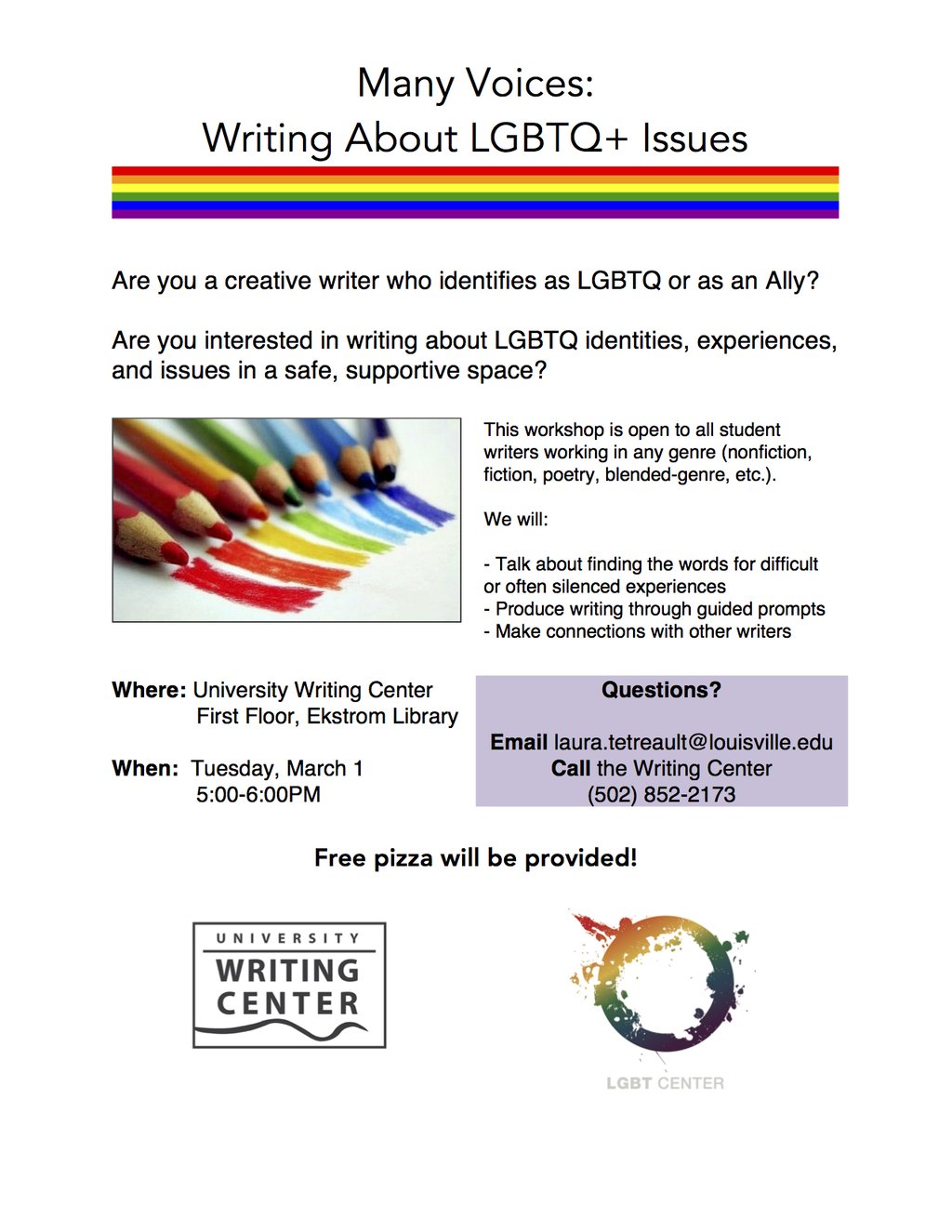
Event: Many Voices: Writing About LGBTQ+ Issues

We are excited to offer an upcoming event in partnership with the LGBT Center at the University of Louisville. Details below!

CbRuVrsUcAAhsmx.jpg large

Text of flyer:

Many Voices: Writing About LGBTQ+ Issues
Tuesday, March 1
5:00-6:00 p.m.
University Writing Center, First Floor Ekstrom Library
This workshop is open to all student creative writers who identify as LGBTQ or as an ally, and will focus on writing about LGBTQ identities, experiences, and issues in a safe, supportive space. We will talk about finding the words for difficult or often silenced experiences, produce writing through guided prompts, and make connections with other writers.
Participants will not be required to share their work, although they are welcome to do so. Contact laura.tetreault@louisville.edu with any questions.

IWCW Day 5: A Culture of Writing

Our final insights for the week are from Assistant Director Laura Tetreault and consultants Karley Miller and Jessica Good. They share some ways our Center fosters a culture of writing at the University of Louisville.

Laura
“I have a lot of favorite things about working at the University Writing Center as one of the Assistant Directors: mentoring our awesome staff of consultants; planning programming and events; visiting classes in different disciplines; and working with writers from widely different backgrounds and learning about their projects during sessions. It’s a great opportunity to meet so many writers and hopefully help foster a culture of writing on campus.”

Join Laura for an upcoming Writing Center workshop: Writing About LGBTQ+ Issues
Tuesday, March 1 at 5pm in the University Writing Center, all UofL student writers welcome

Jessica
“Having the opportunity to talk writers through ‘assignment anxiety’ is probably my favorite part about working in the Writing Center. Writers often come in questioning their ability to interpret prompts, articulate ideas, or write in a new genre. The assignment has become this overwhelming thing that makes them feel powerless and alone. I like being able to emphasize that they aren’t weird or “bad” at writing, that all writers (including myself) have the same fear(s). This moment of connection enables us to focus on demystifying the assignment and renewing the writer’s sense of control. I absolutely love to watch a writer’s demeanor grow more and more confident throughout a session.”
Jessica answers: What Justin Bieber can teach us about genre?

Karley
“The best part of our writing center is Robin’s desk (and all the great people who work behind it). They take care of getting people registered, on the schedule, and to the right consultant. At UofL’s Writing Center, we work with everyone–including many people who might not feel comfortable using the online appointment system. Without Robin and her team, I don’t think we’d be nearly as accessible. Not to mention, the folks at the desk are constantly modifying the schedule to keep up with change throughout the day, and making sure as many people as possible are able to make the appointment they need.”
Karley’s suggestions for handling revision anxiety

DSCN3887
Karley meets with a writer.


IWCW Day 4: Valuing All Writers

Often we’re asked: What kind of writers visit the University Writing Center? Our honest response is always: All types. Really.

We welcome everyone in the UofL community–students, faculty and staff– and many writers a year take us up on that offer. (Side note: we tallied over 5,000 consultations last year). Today, Assistant Director Amy Nichols and consultants Emily Blair and Elizabeth Dean share how they value the writers who visit our Center.

Elizabeth
“I really love working with writers several times over the course of the semester, because I really get to know them and their work. Writers work so hard to do well in a difficult course or to perfect the details of their application, and it’s always exciting to hear that they were accepted to their dream internship or got a good grade in their hardest class. It’s so rewarding to watch their hard work pay off, and I feel like it’s a privilege for me to be a part of their process.”
Elizabeth’s Five Strategies for Citation Management

Amy
“I really enjoy watching writers experience someone taking their ideas and their writing seriously. When we start to have conversations about what a writer wants for their work, I often see questions of organization and language start to answer themselves, and those moments are so rewarding.”
Amy expands upon the “bigger picture” of writing center work, the writers (from 2013)

Emily
“I think my favorite thing about working in University of Louisville’s Writing Center is how diverse the writers are who visit us. We have writers from around the world who are working on everything from English 101 reflections to doctoral dissertations. I get to work with non-traditional students coming back to school for the first time in decades, and students who are the first people in their families to go to college. I learn from every student’s unique perspective through working with them on their writing, and I feel incredibly lucky to have the opportunity to have dialogues with so many people every day.”
Emily’s Five Tips for Successfully Rewriting

IWCW Day 3: Experiencing Writing

When we asked them about their favorite aspect of writing center work, three of our staff mentioned the opportunity to experience writing. As we continue our celebration of International Writing Center’s week, today we hear from Assistant Director of the Virtual Writing Center Jamila Kareem and consultants Deanna Babcock and Jenny Kiefer.

Jenny
“I love learning about all of the different subjects and genres writers bring in with their essays. I appreciate seeing the multitude of different ways writing can be used in many different fields. Most of all, I love being able to help these writers express their ideas and arguments.”
Jenny explains how the scientific method could help with your writing process.

Jamila
“My favorite part of working in the Writing Center has to be seeing how all of the writers we work with use written language to achieve do many different goals. As a lover of writing, working for the Writing Center gives me the opportunity to experience it across genres, contexts, and meanings while helping others become more confident writers.”
Learn more about Jamila and the Virtual Writing Center for distance students

Deanna
“My favorite part of working in the Writing Center is having the opportunity to teach writers something new. I especially love it if I see them again and they’ve used my suggestions in a new piece, indicating that they’ve learned a new skill, or that they’re at least trying it out.”
Deanna’s advice for avoiding cliches at the beginning of your paper.

IWCW Day 2: Reciprocity and Tutoring

Our consultants continue to share their favorite aspects of the Writing Center to celebrate International Writing Centers Week. Today Anthony Gross, Rhea Crone and Lindsey Gilbert exemplify the reciprocal nature of writing tutoring. The consultant learns and grows alongside the writer.

Rhea
“I suppose my favorite part about working in the Writing Center is being given the opportunity to set aside my own academic stressors and focus my attention on all the different kinds of papers and people that come through our big glass door. It’s pretty rare to be given the chance to so fully engage with dozens of diverse, disparate topics, or the time to understand new and evolving sets of writerly concerns. I also appreciate the insights into my own work that I’ve gained, simply by having candid, open discussions with all the writers I get to consult with during any given week.”
Rhea discusses “academic voice.”

Anthony
“I’d say my favorite part of working at the Writing Center is helping writers understand something they didn’t grasp before, whether it’s how to use a comma, how to write a thesis statement, or how to be sensitive to particular audiences. Likewise, writers are constantly helping me understand things I’d never considered before.”
Anthony’s advice for making significant, but difficult, revisions

Lindsey
“Being able to connect with writers who regularly make appointments with me and seeing their growth throughout the year are by far my favorite parts of working in the Writing Center. Both the writer and I become more comfortable with each other, allowing for our conversations to develop from talking about the weather to ‘How did your friend like your gift?’ or other details that I’ve learned since our first appointment together. I find myself and the writer more at ease in these situations, allowing for personal growth and creative expression to occur during each appointment. These appointments bring me much joy, and I often find myself looking forward to them more each week.”
Lindsey weighs in on those “fierce” English 101 papers.

Picture1

Lindsey meets with a writer.

“Since the Beginning of Time:” Avoiding Generic Opening Sentences

Deanna Babcock, consultantDSCN3612

Throughout history, students have continuously used generic opening sentences in their essays. Teachers continue seeing papers with the same types of openings again and again and, despite any attempts to change students’ habits, they keep cropping up. A likely reason is that students are being told to avoid certain sentences in their introductions (if they are told at all) without being taught what to do instead.

There are a number of phrases that can begin an assigned paper, but are ineffective, too general, or just plain boring. An example of this is, in fact, “throughout history…”

Here are some other phrases you should avoid:

  • “Since the beginning of time/history/mankind…”
  • “Everyone/we all…”
  • “So and so dictionary defines ____ as…”

These phrases are very broad and essentially ‘empty,’ and your instructor will likely see them as having no important value to your paper. They are also very general and start off the topic too broadly. If you are writing about different dog breeds, defining either the term “dog” or “breed” is unnecessary and does nothing for your essay. Telling us that “dogs have existed since the beginning of time” is not necessarily true and is also vague and pointless, and saying “we all love dogs” or “everyone has a favorite dog breed” can isolate readers who are not dog fans and cause them to lose interest.

clicheClichés are best avoided, as their meanings are abstract and likely will not add anything to your ideas, especially at the very beginning of the paper. “All that glitters is not gold” is a common saying, but is so common that it would be too general to start a paper with. Use your own words instead to be original and express your individual ideas. If you’re not sure, check here for more examples of cliches.

So what should you do instead? There are other ways of starting an essay that avoid these general phrases and cut straight to the point while still grabbing your reader’s attention. Here are some other ways to start your paper:

Start straight off with your topic.

Not a general idea, but the specifics. If you are writing about the themes of a novel, your readers do not need to know much, if any, background information on the author or the novel itself. Briefly discuss your specific subject, paving a clear path for your thesis statement and the rest of your paper.

General: “There are many different breeds of dogs.”

Specific: “Knowing the difference between dog breeds can help pet owners and shelter workers do what is best for each dog.”

Figure out the scope of your paper.

What can you realistically address in terms of time, place, and audience? You will likely never write a paper that requires you to address everything about your subject “since the beginning of time.” It would also be simpler to discuss a smaller scope than the entire world (think countries, states, even cities), and to address an audience who might actually be interested in or have reason to read about your topic. If you are writing about a recent issue, your audience likely does not need to understand the entire history of the issue to understand your stance on it.

General: “We should all consider the issue of poverty throughout the world/throughout history.”

Specific: “Legislators should consider the current problems facing those in poverty in the  city of ___ when creating new laws.”

Begin with a rhetorical question.

Keep the question open so it could not be answered with a simple yes or no. Ask something that the audience should not already have the answer to; the question indicates what you plan to answer in your essay. It should also be something that you are able to answer. If you only have 5 pages, you should not tackle a question about how to solve world hunger, but you could address a smaller issue related to hunger problems.

General: “How can we solve world hunger?”

Specific: “What can we do about widespread hunger in so-and-so city/state/country?”

Additionally, these questions could be phrased as statements, where the question is implied rather than directly asked. These create a question in the reader’s mind that can    be assumed to have an answer provided.

General: “There are several ways we could go about solving the problem of world    hunger.”

         Specific: “The hunger problem in ____ can be dealt with, if we…”

There are a number of other ways to begin an introduction; these are certainly not the only ones. Keep in mind that your first sentence should spark the reader’s attention and make him or her want to continue reading, and remain as close to your topic as possible.

For more tips on beginning a paper, check out the University of Louisville Writing Center’s handout on introductions. The UNC Writing Center’s page on introductions is another good resource.

­

­

Happy International Writing Centers Week!

In honor of International Writing Centers Week, we’re highlighting our wonderful staff! Today we feature Assistant Director Stephen Cohen and consultants Alex Wasson and Cheyenne Franklin.

What is your favorite aspect of working in the University Writing Center?

Stephen
“For me, the most rewarding thing about working in the Writing Center is getting to share in what people are working on. I’ve seen some amazing projects in process, from Art History papers to articles on new MRI techniques. Every appointment is a new chance to see what’s going on elsewhere in the University, and it is always so impressive!”
Stephen’s advice for focusing personal statements

Alex
“Collaborations with writers on resumes, personal statements, and cover letters are my favorite moments as a writing center consultant. There are few moments more nerve-wracking in a person’s life than job or program applications, and I aim to do everything I can to soothe nerves and help writers put their best foot forward.”
Alex’s suggestions for overcoming anxiety at the beginning of the writing process

Cheyenne
“My favorite part of our Writing Center is the fun our consultants and writers have together. Just the other day I overheard a writer smiling and joking with his consultant as they worked on his paper. Whether writers come once or they are long time regulars, we welcome them to come grapple with writing and have a little fun doing it.”
Cheyenne’s tips for interpreting and understanding writing assignments

Cheyenne
Cheyenne talking with a writer.

Do you have a good memory from the University Writing Center? Share it in the comments!

Upcoming Workshops, Events, and Writing Groups in the Spring Semester

DSCN3694Laura Tetreault, Assistant Director

As one of the Assistant Directors of the University Writing Center, I had the privilege of working closely this semester with our staff and consultants to help develop some new projects. We are hoping to use the new, more centrally located space on the first floor of the Ekstrom Library to host some exciting events in the spring semester, with the goal of working with more writers and strengthening campus conversations about writing.

We are hoping in particular to strengthen the Writing Center’s contributions to the creative writing community here at UofL. We enjoying working with many writers completing academic or professional projects, but some may not know that we can also work with any writers doing creative writing—whether for classes or for personal projects. Although I believe that any strict separation between “academic” and “creative” is a false one, I am also invested in expanding the Writing Center’s presence as a welcoming space for creative writers. Many of our consultants this year have expertise in creative writing and are eager to work with students on fiction, poetry, nonfiction, screenwriting, or any other genre.

One of the upcoming projects connecting the Writing Center with creative writing will be a series of three writing workshops aimed at any undergraduate writers. Each workshop will be themed around a specific topic or genre of writing, and we hope for these to be highly participatory. In addition to learning about the overall topic of each workshop, writers will produce work during the sessions through interactive brainstorming and drafting activities. We plan for these to be helpful to writers working on a variety of projects, whether those are for personal, professional, or academic purposes.

The Writing Center is already a space for writers across campus working on a wide variety of projects. We are also thinking of other ways to make our new location a space to bring writers together, build community, and celebrate the creative work that many of our students do every day. With these goals in mind, we are hoping to host events such as a student open mic night.

We are also continuing our already successful graduate student and junior faculty writing groups this spring. Please refer to our website for more information if you are a graduate student or faculty member who would like to participate in a group that provides support, accountability, and feedback for any kind of writing project.

To stay up to date on these and other upcoming projects, please return to this space in the spring for more specific details and feel free to follow us on Twitter at @UofLWritingCtr. We wish all of our readers a restful winter break and a happy holiday season!


You Can’t Teach That: Facilitating Discussion on Tutor-Writer Rapport?

DSCN3709Amy Nichols, Assistant Director

As one of the assistant directors at the writing center, I have the opportunity to teach two lessons in Bronwyn’s “Writing Center Theory and Practice” course, where our graduate consultants receive training during the fall semester. Recently, I facilitated one of our class discussions around “Student-tutor relations in the Writing Center.” Writing center sessions can include wildly varying levels of language and disciplinary expertise between both tutors and writers, making relationship-building critical to successful communication. In addition, rapport is also a crucial (and under-discussed) part of being a successful student, employee, or person generally.

Building individual relationships, particularly in professional settings, is a complex and deeply contextualized activity, and most of what I know about it is instinctive, built on trial and error over time. Because of this, I had a difficult time planning our lesson. For our discussion, I ended up choosing two recent articles from the journal Language and Education: Cynthia Lee’s (2015) “More than Just Language Advising: Rapport in University English Writing Consultations and Implications for Tutor Training” and Innhwa Park’s (2014) “Stepwise Advice Negotiation in Writing Center Peer Tutoring.” Lee’s focus on individual elements that go into building a relationship and Park’s discussion on how to deal with minor disagreements helped us find a way in to this difficult-to-teach subject.

Lee’s framework pulled from discourse and rapport scholarship to detail descriptions of the kinds of behaviors that we often take for granted: greetings, small talk, qualifiers/mitigation devices, open-ended questions, first-person plural pronoun use, and praises/related forms of encouragement (436). Saying hello and chatting about unrelated matters tend to be givens in social interaction, but they can also help ease the tension when two people don’t know one another well. Qualifiers such as “maybe” or “perhaps” and open-ended questions such as “Can you tell me more about your goals for this project/assignment?” help build understanding and ease discussions around disagreements. First-person plural pronouns like “we” and “us” are helpful in creating a more team-oriented work environment during sessions, while encouragement and praise help build confidence.

I don’t know about the consultants (feel free to comment!), but it was really helpful for me to have a conversation about those elements of a writing center session that often go unrecognized and (seemingly) unnoticed, but which can make a real difference to the success or failure of a session. For example, a few of our consultants shared that small talk tends to make them uncomfortable, particularly if students responded to small talk by discussing their frustration with particular assignment or situation, while another shared that she sees such situations as an emotional opening to help writers address their concerns. Understanding a variety of approaches to such small interactions and the rationale beneath them gave me more resources for interacting with a variety of personalities.

Park’s article details the ways in which advice resistance is a negotiated construction for both the tutor and the writer. She discusses the steps that resistance, acknowledgment, and resolution move through within sessions, and I thought her work might prove a helpful springboard for discussing the ways in which we negotiate advice resistance in our own sessions. We did discuss ways that we tend to navigate through (or around) resistance during our discussion. One of our consultants commented that, while she was aware of her own intentional practices in navigating resistance, she had not thought about the fact that writers might also follow certain linguistic formulations in constructing their resistance, such as saying “Yes, but what I was really trying to do there was….”. We also discussed the ways in which people from different classes and cultures might navigate resistance more or less directly than the examples in the article, which led one of our consultants to ask a very helpful question about balancing a knowledge of intersectionality (every person is different) with strategic approaches to consulting (we have to apply concrete strategies to our work).

Ultimately, I enjoyed our discussion, but I would love to hear some comments. Consultants, how did the session go from your perspective? Colleagues (and that includes you, too, consultants), how would you/do you encourage productive discussion on building relationships/rapport during writing center sessions? Writers, what kinds of discussions have been most helpful to you in moving your writing forward?