Category: Working in the Writing Center

Silence in Writing Center Sessions

Emily Cousins, Consultantemily-c

I’ve always known that silence can be beneficial in various ways during writing center sessions. It recently dawned on me, though, that silence often requires a conscious effort to create, and that perhaps I could be doing more to actively create productive silences during meetings with writers.

My desire to incorporate more silence into my writing center sessions is largely based on the role silence plays in facilitating my own writing and thinking process. When I receive feedback on something I’ve written, I need time to comprehend verbal feedback and to process my own thoughts. I also need time to think of the words I want to use to articulate my responses. This is why I’m grateful whenever I work with people who, when giving feedback, allow for moments of silence throughout the discussion.

When I have my tutoring hat on while working at the Writing Center, I sometimes forget that the writers I work with may feel the same way about silence as I do. I always try to be ready with the next question or the next suggestion, to keep the trains of thought all moving smoothly forward without much pause. I tell myself that by doing this we’re getting the most out of the allotted 50-minute time frame. But I think it’s worth asking: am I not giving us enough time to nurture certain conditions that might fuel productive, reflective, creative thinking?

One strategy tutors use is to have writers brainstorm and/or write on their own; the tutor might walk to another room and come back after 5-10 minutes or more, depending on the context. This is one way to allow for quiet time for writers to work, and can be an effective way to incorporate silence into a session. However, this is not quite the kind of silence I have in mind. The silence I want to use more during my sessions is a mutually shared, collaborative sort of silence, during which both the tutor and writer are still sitting together side by side, thinking. Sometimes the silence might be broken to exchange an idea or two. I’m thinking of a type of silence that is the opposite of empty and/or uncomfortable – the anti-awkward silence.

The “awkward silence” is an interesting concept I learned about as I became more familiar with social conventions in American culture. Growing up in Japan, I always felt that silence was the default way to exist in the world, a way to convey respect and mindfulness. It was difficult moving to the U.S. where presence often seems to be measured by how much one speaks. There appears to be a widespread aversion to silence in social situations, which is perhaps linked to the phenomenon of “small talk.” So, while I personally appreciate moments of collaborative silence when discussing my own writing with people, I understand that some writers might find silence uncomfortable. So, as tutors, we should be attentive to cues that might suggest whether or not a writer might really benefit from silence during sessions.

I sometimes initiate collaborative silences by asking the writer, “can I take a moment to write this down?” Sometimes I will stop myself from thinking of the next thing to say. It has been surprising how many times writers will then break the silence with a new idea or insightful comment they may not have offered had we not taken a moment to pause. Whenever this happens, I remind myself of how valuable and productive silences can be.

Community Literacy and the Writing Center: Building Foundations

Amy McCleese Nichols, Assistant Director Amy N

For the past two years, the Writing Center has been working to build a commitment to community literacy into our activities. While writers from all over the university come to us for help with course assignments and beyond, writing centers constantly inhabit a liminal space where personal, academic, and professional writing collide. To honor this fact, we also wanted to expand our offerings to value writing that may happen off-campus, whether connected to higher education or not. While the role of writing centers and community engagement is still relatively new to writing center scholarship, we are excited about the potential benefits that what we might call writing center values, with their focus on listening and building trust over time, may have for the way university entities approach community partnerships.

Amy Picture1In Summer 2015, we began conversations with academic support staff at Family Scholar House to find out how our skills might be of use, and started offering workshops and tutoring hours for student writers on FSH campuses. This year, we expanded those hourly offerings and began allowing some of our trained consultants to volunteer as well. Three accomplishments we are particularly proud of this year:
  • Working in conjunction with Bronwyn Williams’ Spring 2017 Community Literacy course, we have been able to expand our spring hours to offer hours on multiple FSH campuses throughout the week, meeting a long-term FSH goAmy Picture2al of providing more in-house academic support for student writers.
  • Assistant Director Amy McCleese Nichols led families in a set of “Story-Making Workshops” during Fall 2016, which focused on composing for fun using family (or imagined) stories. This 3-day set of workshops had a total attendance of 81 adults, 52 children, and 48 hand-sewn booklets with individualized covers were made for participants to write stories in and take home.
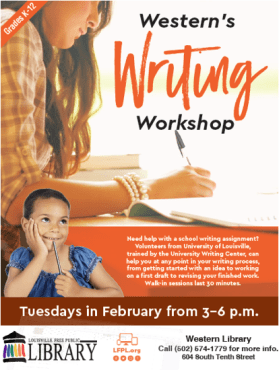
  • This spring, we have also added another community partner: the Western Branch of the Louisville Free Public Library. Also working with the Community Literacy course, we are providing writing help every Tuesday for K-12 students.

Throughout these conversations, we have kept several values in play: showing up, listening, and building partnerships gradually for continuity. In Bronwyn’s words, we begin by simply “showing up.” Showing up in our context has meant keeping a sense of flexibility when setting up programs and plans. While we have put time and effort into making sure our work is meeting a need articulated by our partners, we also save room for the moments when no one shows up – and then we show up the week afterward. By building our relationships and a sense of trust gradually, we have found ourselves more able to have conversations when offerings need to change for the mutual benefit of both organizations.

We are also creating logistical structures within the Writing Center to support long-term partnerships. As the first Assistant Director working with community literacy, I brought a unique skill set from my previous work as a nonprofit volunteer coordinator. As I have worked with our partners, I have written manuals, kept records of previous conversations, and passed that knowledge on to other staff in the Writing Center so that our partnerships are not bound entirely to a semester-by-semester schedule. While our offerings and volunteer numbers will ebb and flow over time as partnerships evolve, we hope that having a consistent contact who stays in touch from year-to-year within the university will provide a sense of continuity for us and our partners while also providing opportunities for graduate student assistant directors to gain experience in the logistics of managing partnerships.

We look forward to learning more with Family Scholar House and Western Branch Library. This fall, we are partnering with the English 508: Literacy Tutoring course, taught by Dr. Andrea Olinger. The course will cover teaching writing individually and in small groups in academic, professional, and community contexts, and students that have taken it will be qualified to complete internships and volunteer work through these partnerships.

Ultimately, we hope that what Tiffany Rousculp has termed a “rhetoric of respect” will define our community literacy efforts. By putting our partners’ voices first in the conversation, keeping elements of our partnerships consistent, and strategically partnering with service-learning courses, we look forward to learning more with Family Scholar House and Western Branch Library.


International Mother Language Day

Emily Cousins, Consultantemily-c

Last week, on February 21st, we hosted our first celebration of International Mother Language Day here at the U of L Writing Center.

I first found out about International Mother Language Day a few years ago, and I wish I’d known about it earlier. The UN Educational, Scientific and Cultural Organization (UNESCO) officially declared International Mother Language Day in 1999, and since then, countries worldwide have celebrated annually to promote multiculturalism, intercultural communication and linguistic diversity. February 21st was chosen for its historical significance, to commemorate the day in 1952 when university students in Bangladesh were killed by police while demonstrating for their rights to speak Bangla, their mother tongue. UNESCO is also committed to raising awareness about preserving endangered languages that are at risk of disappearing altogether. The 2017 theme was “Towards Sustainable Futures through Multilingual Education.”

In preparation for our event, we decorated using color printouts from an art series by Ella Frances Sanders featuring words in different languages that do not have direct translations in English (see her book here). We also set up a table with language trivia, and a poster on which participants could write in response to the question, “What do you love about your mother language?”

mother-lang-day-3

During the event, which took place from 2-4pm, nine student volunteers gave presentations about their mother language(s). The languages represented were Japanese, Mongolian, Korean, Bengali, Kazakh, Russian, Arabic, Spanish and Filipino. Presenters used Powerpoint, showed Youtube clips, played song recordings, and used the whiteboard to share about their mother languages. Audience members got a sense of what the languages sound like when spoken, as well as what the scripts look like in writing. The presentations were highly interactive, with participants inviting each other to practice saying different words aloud.


I found myself truly inspired that day, seeing each volunteer speak in and about their mother language(s) with such enthusiasm, and also watching members of the audience raising their hands, asking questions, requesting presenters to repeat things or write words on the board. It’s this type of openly curious interaction and dialogue that I think can partly give rise to a sense of community we talk about and think about—often, unfortunately, in the abstract. As I reflect on the event, I think it was successful not just because of the diversity of cultures and languages represented, but also, more importantly, because participants were so actively engaged, eager to teach others and learn new things.

mother-lang-day-2

At the Writing Center, we tutors are constantly learning from the writers we work with – but not always as much as we’d like. 50 minutes goes by pretty fast. The cultural exchange that we’d ideally hope to foster often gets sidelined in the face of a looming deadline. This is why I think all Writing Centers should observe International Mother Language Day every February 21st, to take some time to look up from our day-to-day routines and learn more about the cultures and languages of the students we work with. Writing from the perspective of a Writing Center tutor and someone whose mother language is not English, I think curiosity goes such a long way in creating truly inclusive spaces – and celebrating International Mother Language Day is a perfect opportunity to create such a space.

Thank you to all the student participants for their wonderful presentations, and to those who attended and contributed to making the event a success. I’d also like to extend a thank you to the International Center office and OASIS staff, who helped publicize the event.

See you again next year!


There’s More to Life than School

Carrie Mason, Consultantcarrie-m

This weekend my fiancé and I traveled down to my home for some family time. I’ve done a little schoolwork, but not much, and this blog is the last thing I’ll do. I’m learning a slow lesson: school work – or even regular work – does not define my life. It is just a part. I enjoy academics, but it’s not the most important part of my existence.

You see, the thing is, on May 27 I’m getting married. There’s a lot of stuffs that go into this wedding planning and most of it I hadn’t even thought about before being engaged. And since I live with family in Louisville, while my fiancé lives in an apartment with friends, we also have to find a place to live. But I’m not writing this blog to talk about all the things that I have to do, I’m sure you also have tons of things you also have to accomplish.

What I am saying is that sometimes school just needs to take a back seat.

Don’t misread me, doing well in school is still a good and right goal; it would be foolish to abuse the privilege and skimp through the semester. However, it is infinitely more important for me to continue building a deeper, stronger relationship with my fiancé as we work toward marriage.

You see, dear reader, life is not all grades and articles and books to read. There is more than an essay exam. There are trees to see and flowers to smell. If I get straight As in every class and write the most profound papers, but I fail to cultivate lasting relationships, then I have wasted time. And if I end my academic career with institutional laurels, but have a mind full of demerits because I did not take time to care for myself, then I am worse than when I started.

So, dear reader, take care of yourself and your relationships. Keep working to achieve your academic goals, but remember there are other parts of life that would be unwise to neglect.  It’s hard to learn and remember, because right now everything seems to be on the very top of the to-do list, but remember, the academic accomplishments are more enjoyable if you have people to share them with. Besides, an essay exam only lasts about an hour anyway.

Flying Out Loud

Ashleigh Scarpinato, Consultantashleigh-s

As a Writing Center tutor, I am always encouraging the writers I meet with to read their work aloud because there are so many benefits: it helps find typos, places with awkward syntax, etc. Sometimes, I have noticed that hearing someone else read your work aloud is also very beneficial. So, I have also suggested to the writers I tutor to download reading software that will read their work back to them. Given that I offer this advice fairly regularly, you would think I would have taken that advice for myself.

I had the honor of reading some of my poetry for the reading series Flying Out Loud on Monday, February 13th. First there would be an open mic for any local poets, then the featured writers would each have ten minutes to read their work. I had never read in a coffee shop or for a reading series. I knew I needed to prepare accordingly, so I organized my poems and began reading them aloud, in a soft, mumbled whisper to ensure that I was within my time limit. With my printed poems in one hand and a copy of The Woman in White in the other, I walked into Sunergos Coffee Shop—the smell of freshly brewed coffee whisking through the air. Arriving early, I ordered a decaf Frappuccino, and when I picked up my order, I noticed that the baristas had pulled designs through the froth. I collapsed on the couch and attempted to get some reading done.

The open mic started just after 6 o’clock, and it was so enjoyable hearing poets read their work—with varying rhetorical choices. As one of my poetry professors once said, poetry is meant to be read aloud, so no amount of internal reading can quite do a poem poetic justice. And with each poet, the clock crept closer and closer to my time slot, and those familiar butterflies began creeping their way back into my stomach. Finally, it was my turn to read my work—to say aloud the words I had crammed in the margins of notebook paper and reworked into stanzas on my laptop. I was going to read some poems that I had never read for anyone other than myself; I never feel quite as honest as when I read someone one of my poems. I fumbled my way through the chairs in front of me and up to the microphone, centered in a dim spotlight. I began reading my poems to the audience, attempting to regulate my breathing and pounding heart. While reading, I noticed a typo on the page, but luckily my brain registered the error before my mouth could formulate the mistake. I knew what I wanted it to say, what it was meant to have said. And when I finished reading, just under my ten-minute limit, I looked up for an applause of reassurance. I kept thinking about that single error no one else was even cognizant of. After resuming my seat on the couch, I reflected on my decision to whisper my poems while practicing. I thought about the fact that if I had just read them aloud with a full, clear voice, I would have caught the typo before printing the copy.

Will I read again at another reading series? Yes, and I would encourage all poets to do the same. I truly believe that there is nothing else in this world quite like reading your work aloud. So, even if you do not have the connections to be one of the featured readers in a local reading series, try to do the open mic. You can hear yourself read in an authentic setting and provide yourself with an opportunity to see and hear the way an audience responds to your writing. After all, reading and writing go hand and hand, and along with that comes the benefit of reading what you have written aloud.

Artistic Awards in a World of Divisiveness

Katie Kohls, Consultantkatie-k

The Grammys were this weekend. Besides the beautiful and oftentimes odd fashion that will be on the pages of every magazine, musical artists (albeit primarily English speaking) were rewarded for their talents and creations. Since its introduction in 1959, The Grammys have been the highest award most musicians can achieve. The Grammys are ranked among the top award shows like the Emmy Awards (television), the Tony Awards (stage performance), and the Academy Awards (motion pictures). Like the Pulitzer Prize is for composition, these awards attempt to recognize creative people and their accomplishments.

I think it is important to appreciate what these awards, and others like them, attempt to do. They recognize and promote creative artistry that typically doesn’t have a pragmatic use. A song isn’t supposed to cure cancer, a film isn’t made to stop world hunger, a television series isn’t created to raise math and science scores, a stage production isn’t performed to create the next technological advancement, and many texts aren’t composed to achieve any capitalist aim. These pieces of creativity are crafted to appeal and help something that cannot be measured and that doesn’t have a logical end goal. In a world where STEM is prioritized and money seems to be the greatest source of power, these awards stress and celebrate almost a counter-culture of creativity for the soul’s sake.

And this is not to say that science, math, and pragmatic things aren’t good or necessary, but living in a world with only them is not only boring but also stifling. Creativity is necessary even for science and math and sports. A few months ago there was backlash against actress Meryl Streep for her comments on some people’s feelings on immigration and what makes America great: “So Hollywood is crawling with outsiders and foreigners. And if we kick them all out you’ll have nothing to watch but football and mixed martial arts, which are not the arts.” You can read the rest of her speech here https://www.nytimes.com/2017/01/08/arts/television/meryl-streep-golden-globes-speech.html?_r=0. Whatever your opinions on Streep’s talents or her political opinions, I think she gets at another issue with this comment. Football, MMA, and other sports aren’t the arts; they have artistic elements and places for creativity, but they are not the arts. They, like the sciences and math, have their places and uses, but they cannot be substituted for the arts. Sports champion physical strength and competition above all, and fall short of what arts allow and the people the arts bring together.

The arts bring people together not by competition or to see who is superior, but by something deeper that cannot be adequately defined. A song can’t cure cancer, but it can give strength of spirit and comfort to a suffering patient. A film can’t feed every hungry individual but it can bring recognition to people in need. A television series can’t raise test scores, but it can make learning enjoyable. A stage production can’t make new technology, but it can cause people to think differently about their world and history. And a piece of writing, along with most of these endeavors, can and do make money, but most of the time they have bigger, more important meanings behind their creation. The Grammys and other creative awards celebrate a part of our culture we must try to champion and show its importance. We must not let our creativity and connectedness be trivialized or dismissed. These award shows are important, and they, in some respect, represent all of us creators who dare to do something beyond the logical, beyond the normal, and beyond the expected.

Growing as Writers through Journaling

Jeremy Dunn, Consultantjeremy-d

Now and then writers I work with in the Writing Center ask me if I know of any tips to help them improve their writing. I find that offering cogent suggestions isn’t always easy. Perhaps part of my difficulty in offering “easy” tips to improve writing lies in the glacial rate at which my own writing seems to progress, and it’s difficult to imagine easy fixes for the challenges we face as growing writers. Still, it’s important to acknowledge the desires of writers (myself included) who earnestly want to know what they can do outside of things like going to the Writing Center to help them develop their craft. So, here goes my attempt at mustering a nugget of writing advice: First, if possible, allow yourself to let go of the anxiety to “improve” your writing. Second, keep a journal. In this post, I’ll try to explain my reasoning for these suggestions.

We seem to live in a goal-oriented age full of sensationalized bullet lists for self-improvement. For example:

  • Seven steps to lose 30 pounds in 30 days
  • 10 habits of highly successful people
  • Three ways to live a longer, healthier life
  • 17.6632173333333 quick tips to becoming a smarter, stronger, better looking, wealthier, more well-liked human being

Jeez.

I resist trying to make writing advice fit this mold. While I think we can take measures to improve our writing, I’m afraid the goal of simply “being better” at writing sometimes eclipses the importance of writing itself.

But in the university, where students often equate writing with assessment, a goal-oriented approach to writing seems nearly unavoidable, perhaps even natural. I often hear things like “I want/need an ‘A’ on this paper” from writers I work with. To be honest, I think the same thing while writing my own papers, even as I tell myself grades aren’t the point of writing. As writers in the university, we are writing in what we perceive as high-stakes environments where, for better or worse, assessments and credential-getting come into play. We value GPAs as means to keep scholarships, advance professionally, and measure our performance. However, I would like to suggest that by writing in situations where we can suspend quantifiable goals, we might give ourselves a better opportunity to grow as writers at a more organic pace.

Give up goals of becoming better to become better? How does this work? While my suggestion is admittedly based on personal experience rather than extensive research, I will venture to defend my suggestion by showing what writing in a journal—a venue divorced from assessment—has done to help me progress as a writer.

I’ve kept a journal, writing with varying degrees of regularity, for years. Outside of required writing for school or the odd freelance job, journaling represents my most consistent writing and has generally been the writing I’ve enjoyed the most. Over the years, keeping a journal has given me the chance to write about whatever I’ve felt like writing about, free from the pressure of formality or worrying about an audience. My entries tend to be pretty mundane, often just recordings of a day’s events, but I think writing routine journal entries has helped me become a better writer over time. To explain my thinking here, I’ll try to draw an analogy between writing in my journal and playing soccer. There’s a connection eventually, I promise.

Growing up, I loved to play soccer. I spent hours each week in the backyard kicking the soccer ball around. These hours were unstructured time spent doing something I liked to do. I had no clear goal and generally was not consciously striving to get better, but as successive soccer seasons rolled by, I began to see that my time spent playing soccer in the backyard was helping me become a fundamentally better player in organized games.

When I think about the journaling I’ve done over the years, it occurs to me that in many ways my journaling parallels my time playing soccer in the backyard. I started writing in my journal simply because I sometimes felt like writing something down. Beyond that, I had no real goal. For instance, I might take an evening walk, and there would be something special about the walk—something in the cool air, the way the sun sank behind a nearby ridge, some memory that came to me as I experienced everything—that would make me want to write about the moment, that would inspire me to try to find the best words I could to describe the experience. I might return home and write a short journal entry about the walk, not as a conscious exercise in writing, but as an attempt to pen down an experience I wanted to remember. Writing would, I hoped, help me find the words to do some glimmer of justice to the experience. Trying to write about various events in my life in short journal entries turned out to be a fair amount of writing practice and helped me become more comfortable with writing in general.

Journaling hasn’t turned me into Shakespeare, but the practice has helped me grow little by little as a writer over time. My journal is a place where I’ve tried on different hats as a writer, a place where I’ve recorded funny episodes, random thoughts, or events from perfectly unremarkable days spent working and running errands. I’ve written through times of happiness, melancholy, frustration, and transition. I’ve written simply to write. Free from the fear of assessment or judgment, I’ve experimented and played with writing for years outside of any formal writing assignments.

As we continue to negotiate new genres, assignments, and challenges in academic settings, perhaps something as simple as journaling at night before bed could go a long way toward making us more practiced writers. Journaling offers us the chance to get to know our own voices a little better and, just maybe, can make us a little savvier in our writing when we meet the next writing project coming down the road.

Finding the Time to Write

Ashley Taylor, ConsultantAshley T

One of my favorite questions to ask writers out in the world is:

“When do you find time to write?”

Out of the various answers, whether creative or academic, ultimately the collective response in the midst of a busy life is to schedule time to write. However, you can’t stop your third shift manual labor job and say “hold on, I have to finish this paragraph real quick” or tell your 5 month old baby “I need this time to myself, sorry.” The world doesn’t stop for writing assignments.

Students live busy lives and learn to balance their schedules between academic, work, and personal life. But writing can be a monster when put under pressure, which can cause writers to put off an assignment, feel overwhelmed by the writing process, or feel as if they have to make sacrifices in the other areas of their life just to tackle the next rhetorical essay, research proposal, or short story.

A polished draft is not required to make an appointment with the us. You can make up to three sessions in the same week and we help through all stages of the writing process. My absolute favorite appointments are when we brainstorm and plan because in those sessions, writing feels approachable, manageable, and a little less scary.

When I hear that the key to finding time to write is to schedule it, it seems as if that means on my own. Schedule alone time, to write alone, to tackle writing alone. But that’s not the case. You are most certainly not alone in having a busy life and even when writing alone, there’s an audience involved as a silent party. Sharing your writing through all the stages of the process helps to foster the idea that writing is most certainly a social act. Reach out. Schedule time with others.

Here are just a few resources that can be helpful in this process:

In the University  Writing Center alone we have consultants who are a parent-to-be, a new parent for the first time, a new parent for the second time, a parent with two children entering grade school, and a parent with three teens. We have consultants who are planning weddings and starting internships. Many of our consultants are graduate students in our first year of the master’s program and PhD candidates taking steps toward building careers. We are students with writing assignments in the midst of busy personal lives and we know the value of reaching out.

Have compassion for yourself.

We are a resource for you.

Accessibility and Accommodations in the Writing Center

Layne Gordon, Assistant Directorlayne-g

At the end of last semester, the Writing Center debuted a new page on our website for Accessibility and Accommodations. We are excited to be among the relatively small group of writing centers who have public statements along these lines, and we’d like to take a moment at the beginning of this new semester to account for some of the decisions we made and to address why we think accessibility is an important philosophy for writing centers to adopt.

Although I was responsible for the specific content of the page, the decision-making process was a team effort. As we started brainstorming, we quickly realized that there were a few things that would be central to our approach to accessibility. First, we wanted to communicate the ways in which accessibility is already part of how we think about tutoring writing and the design of our space and resources. For example, we emphasize in our statement that we work with writers at any stage in the writing process. We already work regularly with writers on brainstorming and understanding assignments, and writers with disabilities might find this particularly helpful. I go on to note that our consultants spend time discussing identity and disability in our Writing Center Theory and Practice Course. And, in terms of space and resources, we offer transcripts of our videos, our consultants are currently working on making our handouts screen reader-friendly, and we have a long-standing history of welcoming additional visitors to tutoring sessions such as American Sign Language interpreters and service animals. These are just a few ways that our existing efforts and approaches can be beneficial to writers with disabilities.

Second, we wanted to convey that we are committed to accessibility as a disposition as well as a policy. We know that students often encounter accessibility policies on syllabi and in other official documents from the University, but we wanted to offer a slightly different take on what accessibility could mean for all writers who visit the Writing Center. Accessibility as a disposition means that we are not only willing to adjust our space and our tutoring approaches when requested, but more importantly that we are committed to being inclusive of writers with a range of abilities, experiences, and identities. In other words, it means that we strive to be proactive about accessibility rather than reactive. Understanding accessibility in this way is part of our broader commitment to an ethic of service and hospitality, and this is one reason why accessibility and accommodations policies are particularly important for writing centers to consider. If we are going to claim to serve all writers in a particular community, it is essential that we try to anticipate the range of abilities and identities that those writers will bring with them to their Writing Center experiences.

Finally, we wanted this page to communicate that we are receptive to any and all accommodations requests that writers may have. One way we work towards this goal is by explaining that, in most cases, we do not require official documentation to make accommodations. Rather, we are open to dialogue with all writers who have ideas about how we can accommodate their needs, including writers with undocumented disabilities or those who may simply have learning styles and preferences that don’t match up perfectly with our typical approaches to tutoring writing. For example, we can conduct tutoring sessions in one of our side rooms and we can use a variety of media to communicate with writers about what they’re working on. Rather than a narrow approach to accommodations that would place a kind of burden of proof on the writer, we hope that this conveys a broader and more inclusive attitude toward accommodations.

As we mention on our Accessibility and Accommodations page, we welcome feedback and suggestions for how we can improve our efforts at accessibility, and we hope that this initial work offers others the opportunity to think about accessibility as a philosophy.

Writing Places and Spaces

Jeremy Dunn, Consultantjeremy-d

You’ve picked a paper topic, done some research, and now you’re ready to begin writing that term paper. Or maybe you’ve just struck on a bit of inspiration for a new poem, or a short story—maybe even the next great American novel. There’s only one question left: Where do you go to write?

The question seems simple, but sometimes the answer isn’t. Over the years, I’ve had to do a lot of writing, and one factor that has turned out to be crucial for any writing project I’ve undertaken has been my writing environment, the physical places and spaces I inhabit while writing.

Researchers have taken an interest in how material environments and writing tools can aid or inhibit writing. In a study of how college students’ “composing unfolds materially through space and time in a mobile culture,” Stacey Pigg observes, “While the materiality of academic writing easily slips under the radar, how students access and incorporate places and technologies in composing habits outside classrooms may be one of the most important determinants of their success within them” (271). In other words, the places where we write, and the technologies we employ in our writing (i.e. pen and paper, laptops, desktops, typewriters, stone and chisel, etcetera) constitute foundational elements of the composing process.

Indeed, as examples of famous writers illustrate, writing is often a ritualistic, idiosyncratic process deeply rooted in particular environments and surroundings. Mark Twain reportedly wrote while lying in bed. Dylan Thomas had his writing shed where, legend has it, his wife would lock him up each day to ensure he got some writing done. Similarly, Virginia Woolf sometimes wrote in a toolshed she had converted into a “writing lodge.” Sir Walter Scott apparently liked to compose poetry on horseback.

I find other writers’ writing places and spaces interesting and inspiring, but not all of us have access to a cozy writing shed overlooking rolling English hills—or a horse to sit astride, if you’re interested in that sort of thing—while we write. So where do we turn to carve out writing spaces for ourselves?

Perhaps the local coffee shop. As Pigg suggests, “Informal public spaces such as cafés, coffeehouses, and commons areas serve as commonplace productive locations for many writers” (261). Pigg further explains that such environments often provide Wi-Fi to support mobile laptops, or in-house desktops in commons areas. These spaces thus offer technological access in addition to “clean space” where writers can concentrate on their projects (261).

Public spaces help many writers write, but they are not ideal for everyone. A quiet-seeking introvert at heart, I’ve learned that coffee shops—even library study areas—are not great writing spaces for me. I’ve tried to write in such places, only to realize I don’t really feel comfortable in them, or there’s too much going on for me to focus. Consequently, I’m unable to do much writing in those environments. Though the café or common area are good work areas for many, I’ve discovered that I do better by writing in my bedroom at home. There, I have a small, worn desk and lamp that help me settle into writing. The environment is a quiet one where I feel comfortable and able to focus (most of the time). In addition, writing at home better accommodates my idiosyncrasies. For example, while I write, I like to take breaks to stand up and pace around a bit, a practice I’m not exactly comfortable trying in a coffee shop. I also like the convenience of being down the hall from the kitchen if I want a snack or a drink of water, or in case I feel like brewing some coffee or tea. In short, at home in my room I simply feel a greater sense of quiet and am consequently able to get more writing done.

All of this rambling is simply to say that if the coffee shop helps facilitate your writing, or the park bench, or the library, or maybe a room at home, go there and write. If you find you’re stuck in a rut, consider seeking out a different writing space for a while and observe whether or not the new environment helps you break through your writer’s block. We all have to write somewhere. Learning which environments are most conducive to our writing practices can help us demystify writing and develop our composing processes in productive ways.

Works Cited

Pigg, Stacey. “Emplacing Mobile Composing Habits: A Study of Academic Writing in Networked Social Spaces.” CCC 66.2 (2014): 250-75.