Category: Space

Writing in Retrograde

Kendyl Harmeling, Writing Consultant

I remember sitting outside my old apartment with my best friend, smoking in the heat wave that broke Connecticut at the end of this past July, and talking about how the world felt like it was topsy-turvy.  We laughed about how Mercury was in retrograde, and how every little detail of being alive felt only slightly off-kilter, how our lives were noticeably ever just different.
Like we were still us, but not the us we had once so recently been. In the week leading up to my move, we sat outside our old apartment-home every night like that. Hazy and confused. We cried. Mostly, we laughed. Sometimes, we yelled at our neighbor for never having baked us the broccoli quiche he promised to. The night before I left, my friends and I went to the dive bar I had worked at that entire year, and sang, badly, our favorite classic rock karaoke songs.

But, “you-know-what-they-say about the young…” I woke up the next afternoon and was alone. My room full of everything I ever owned, packed, and pristinely kept. My dad had already left for work. I left a note on the counter that I was moving 816 miles in a few minutes, and I loved him so much. I drove first to New Haven to pick up my mom for our drive west, and then I left Connecticut. I would like to reach out my hand… I may see-you…and tellllll you to run!

I’ve lived here in Louisville for a month now. Over a month. Spent nights at friends’ houses, found the bars I like, coffee shops, bookstores. I’ve found all the things here that I thought made my life back home a home. A life. I thought it was in the minute, the things I did during the day, that comfort came, but I just feel vacationed.

It’s made me wonder about the qualities of home which transcend distance, the parts of who I am that were just parts of my old environment, and most of all, how uprooting myself from the only place I’ve ever called home has felt like more to me than just a “moving forward” but also feels very really like a “leaving behind.” No one told me that the bore weight of leaving someplace doesn’t lighten, quickly at least.
I read Rilke’s Letters to a Young Poet this summer, in that other life I lead. His writing inspired and terrified. In it, Rilke writes about the importance of observational poetry, how being tragically human and trying to understand the profound are incongruent pursuits. How humans really can’t understand the profound, how we’re sentenced to living only in the momentary, the lovely, and the ugly. It’s in the making poetic these things that poetry can attempt to transform meaning from nothing into profundity.

Since moving here and trying to find that settlement of home in a thin crusted, forced routine, I write a poem every day. I started this practice the third night after my mom left and I was suddenly aware that I was alone, 816 miles from everything I love. The poems aren’t all good. Most of them, actually, are real bad. But they’re little homes, each one. The beginning observation of this new place, where I live and am, in fact, not vacationing. Rilke was right whenever he wrote that, that we can learn how to live just from looking around. Here are some observations that have helped me ground myself in this, a new home:

I sleep next to a street lamp, near the corner of Saint Catherine and Preston where that woman sits on a bench with her cat. It’s a yellow light.
I’m waiting for a crack of thunder again.
I’m waiting for tiredness to set in and put me to sleep.
I’m waiting for my body to stop moving and for that great unknowable to quiet.
It feels like the air here is static with wait, a pause, a moment before exhale.
Out my window is unrushed, cattle traffic and the eager unrest for the arrival of that great big thing…
I had a dream last night that the world would end in one searing-hot, pink instant.
Immediate and satisfying.
Unlike the visible end of the crumbled rock wall across from my apartment.
The one keeping the giant oak tree from cracking through the sidewalk we seldom use.
That end took time.
It’s the sort of decay which weathers into material.
The patient kind.
My someday bright-stop is restless.
Waiting for the oak fall, the sidewalk end, and my momentary to begin.

In my 18th century poetry class, my professor said, “Well… I suppose it never really feels like anything comes to a conclusion.” I know she was talking about Defoe’s lack of chapter division in Moll Flanders, but the fluidity of story reaches me, here, in Louisville, Kentucky. I am the same person, only further from home. But, maybe closer than I think.
Converting Anxiety to Enthusiasm in Community Writing

Haley Salo, Writing Consultant

Sharing writing can be challenging, especially when you’re joining an established community like a writing center or creative writing group.

It can be difficult to navigate the established norms and find just the right niche for your writing. Yet, every writer in the community has gone through those same experiences. It’s also okay to shop around a bit. Each writing community is unique, and some may be more or less accessible than others.

When I was a teenager, I started looking for an online, forum based, play-by-post fantasy role playing game (we’ll just call it an RPG). I wanted a place to create my own characters and explore their lives with the characters of other writers. Much to my dismay, some of the communities had hundreds of members, book-length lore files, and thousand-word posts. You could even be kicked from the community for being inactive for a week or two. Nope! Too scary. I ended up joining a very low-key forum, specifically picked for its small community and short posts.

I didn’t say very much at first. I would sign in, post, and leave for the day. That was about all of the social writing interaction I could handle; I did not, in any way, want to be around when the other members read my post. But guess what: no one complained. The stories continued on their merry way. I did not, in fact, derail the writing community.

Encouraged by this turn of events, I started talking to the other members through the forum’s chat box. The chat box took the stress out of socializing because it was so informal. There was no sense of finality when hitting the submit button like there was with a regular post. It also humanized the other members; they stopped being their characters and became themselves, and gradually they became friends, too.

At this point, the RPG really became fun. The social relationships improved the stories we were writing. We got to discuss where we wanted the stories to go and how we were going to get them there. Or, we complained when our characters refused to cooperate. We also started to recognize each other’s writing styles and got to watch as everyone’s writing naturally improved. We never set out to become better writers, though. It happened naturally, through time, practice, and experimentation.

I’d like to say that this experience made it easy to join new communities later on, but it didn’t. However, that didn’t stop me from going through the process again. I continue to make friends and learn through all of the writing communities I’m part of. There will always be some degree of anxiety when entering a new group, and that’s okay. Just try to keep in mind that writing communities tend to be very open and welcoming; we all have the same anxieties and reservations.

New Ideas, New Progress, and New Friends: Reflections on our 2019 Dissertation Writing Retreat

By Edward English, Assistant Director

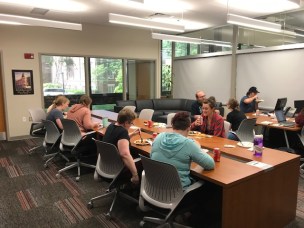
Last week we once again hosted fourteen Ph.D. students who participated in our spring Dissertation Writing Retreat. This is the ninth year we have held a week-long writing retreat in May during which the participants spend their days writing and having daily individual writing consultations with members of the Writing Center staff.
Every day we also have small-group discussions about various issues of dissertation writing (Ways to Structure Chapters, Strategies for Self-Editing, How to Revise Work for Other Purposes, and How to Approach Literature Reviews). We also keep everyone well-fed throughout the week with snacks and lunches.IMG_6628

The writers who participated in this year’s retreat represented ten different disciplines at the University: Biochemistry, Biology, Early Childhood and Elementary Ed., Education, Microbiology, Nursing,  Public Health, Rhetoric and Composition, Psychology, and Social Work. The best way to get a sense of the experience of the retreat and its impact on the writers who took part, however, is to hear from the participants and consultants themselves.

Jessica Newman, Consultant (PhD Candidate in Rhetoric and Composition)

This is the third UofL Dissertation Writing Retreat that I’ve helped out with, while working on my own dissertation. For the first two, I was an assistant director at the University Writing Center and so took part in the retreat introduction, breakout groups, etc. This year, though, I participated as consultant only, coming in after lunch and leaving two and a half hours later.

The determination and productivity of the grad students who take part in the retreats were more salient to me than ever this year: rather than arriving each morning as things were getting started, I would instead step from the afternoon heat into a room quiet with reading, typing, scribbling and highlighting, and I would leave before the Writing Center closed for the day, the writers just as focused as when I arrived. I really appreciated working with my two writers as they shared their projects, obstacles and strengths. Talking with them reminded me, as I hope that I and the retreat reminded them, that we are not alone in this.

Rachel Rodriguez, Consultant (PhD Candidate in Rhetoric and Composition)

rachel.jpgThe Dissertation Writing Retreat serves as a designated space and time for individual drafting and revising, but this year I reflected on the myriad of unexpected benefits of the retreat. There is something magical about working in the presence of others (don’t mind my shameless plug for the Faculty and Graduate Student Writing Group). Many writers flock to libraries or coffee shops to work within that buzz of human activity, but even if silence reins during the retreat, the gravitational force of a group of individuals all working together on different iterations of the same massive, complex task is undeniable. One writer mentioned that when they felt like they couldn’t focus, they’d look around the room at everyone who was still intently writing and say to themselves, “if they can, I can!” before diving back in.

This week, several of us consultants would even arrive early to work on our own writing projects in the staff room, hoping to ride that productivity wave. When the writers surface for breakout workshops and sessions with their consultants, we’re all given the rare opportunity to act as representatives of our disciplines, verbalizing what we know tacitly about how knowledge is made and shared in our fields.

It’s a strange realization that “dissertating” doesn’t look the same in every discipline, and that a dissertation serves different roles and materializes into different products depending on your field. This exposure to interdisciplinarity crafts us all into better and more reflective scholars. As this year’s group of writers look ahead at seemingly disparate careers in university departments, science research labs, hospitals, K-12 classrooms, and even tropical rainforests, the dissertation writing retreat is one avenue through which we all learn about how writing is contextual, adaptive, and always evolving.

Melissa Amraotkar, Writer (PhD Candidate in the School of Nursing)

The social accountability of being in an atmosphere surrounded by other graduate students working on their dissertations kept me on track. Daily one on one meetings with the same writing consultant gave me more confidence in my writing plan, helped me to be more creative in writing, and provided a space outside of my committee to discuss my dissertation topic. Small group discussions with Writing Center staff members were beneficial in exploring aspects of writing that I hadn’t considered. I would recommend this retreat to any graduate student writing a thesis/dissertation.

THANKS FOR ALL WHO MADE THIS POSSIBLEcassie.jpg

It is important to acknowledge the people who did the hard work of organizing the Retreat, including Bronwyn Williams, our Director; Cassie Book, our Associate Director; and Amber Yocum, our Administrative Assistant. In addition, Assistant Directors Aubrie Cox, Edward English, Rachel Rodriguez , and Christopher Stuck were instrumental in the planning and execution. Finally, the fantastic consultants, themselves Ph.D. students in English, Megen Boyett, Layne Gordan, Jessie Newman, and Christopher Schiedler helped our writers make progress each day. And thanks to Paul DeMarco, Acting Dean of the School of Interdisciplinary and Graduate Studies, for again sponsoring and supporting the Dissertation Writing Retreat.

(Literally) Meeting Writers where they are at Community Literacy Sites

Rachel Rodriguez,  Assistant Director of The Writing Center

My favorite tutoring session this year was a group session, where the two writers were working on drastically different projects.Rachel Rodriguez One writer was working on a paper in which she had to identify an area in her life where she possessed rare expertise, and our brainstorming led her to a past job as a phlebotomist and her unique knowledge on how to draw blood.

This brainstorming and outlining was often interrupted by the other writer, whose projects included buttoning, unbuttoning, buttoning, unbuttoning, and buttoning both her and my jackets, discussing why snowmen don’t need jackets and monkeys prefer bananas, and finding the perfect video on Youtube of children baking imaginary cakes. If you haven’t guessed yet, this “other” writer was about 3.

When you imagine a “typical” writing center session (does such a thing exist?) you probably envision a quiet setting in which two people are examining a draft, exchanging ideas, and conversing, with plenty of pauses to think, consider, and reflect. Sessions in community literacy sites tend to take on a slightly different hue. Community means many, ever-shifting, laughter.

At the Gladys and Lewis ‘Sonny’ Bass Louisville Scholar House Campus, writing sessions happen in an open space designed to look like a Starbucks, with computers and chic furniture. Large windows connect this room to a playplace so moms, many of whom live on-site, can keep an eye on their young ones. Every writer I have worked with at Family Scholar House is a mother, and every one is intensely and impressively dedicated to the pursuit of education.

At the Western Branch of the Louisville Free Public Library, tutors sit at a table at the center of the main floor – strategically within view of the entrance as well as the computer banks nearby. While cushioned by stacks of books, the sound of Fortnite is a constant buzz. Here, the typical writer may be a middle-schooler, hanging out with friends at the library after school but before heading home. Sometimes tutors cajole writers to take out their homework with the wave of a coveted piece of gum.

This is all to say that writing sessions at community literacy sites are all the things you might not expect: noisy, chaotic, dynamic. And this is precisely what makes tutoring there so fun!

A key skill in writing tutoring is flexibility, going with the flow, recognizing when a strategy isn’t working and changing it up, moving from poetry analysis to a biology lab report to an engineering dissertation in the span of a few hours. Community literacy stretches this skill to the max, expanding what we think of as a “session,” “writer,” and even “writing.”

This expansion is good for tutors’ brains: we return to the UWC with a bigger sense of what is possible. After all, the University of Louisville doesn’t exist in a vacuum. It is part of a vibrant, complex community of individuals, families, and groups who in turn pursue a myriad of writing and reading endeavors. This may take the form of a comic book, rap lyrics, fan fiction, or a personal memoir. The University Writing Center is one of many writing centers that takes as a central tenet the idea of meeting writers where they are, and community literacy projects take this to a new level, literally seeking out writers where they live and play and gather, to listen to their needs and offer up our knowledge of audience, genre, and style. This literacy matters to the UWC, and this academic year, our volunteer tutors have contributed 477 hours towards these sites, with a few weeks to go.
Two former Assistant Directors of the University Writing Center, Dr. Layne Porta Gordon and Dr. Amy Nichols, have both stressed the importance of continuing to “show up” for our community (check our Layne’s post here, and Amy’s here), and I’m proud to continue to move our initiatives forward. Personally, I’m looking forward to a summer of tutoring at Western Branch, where I hope to encounter many writers like my friend so deft at buttoning.


I think it’s fair to say that the denouement of most writing tutoring sessions isn’t having a 3-year-old fall slowly into a heavy sleep on your lap, while talk with your writer of ethos and evidence-based claims is punctuated by the chatter of a tour group of local business people. But that’s precisely what made this my favorite session of the year, and I can’t wait to see what next year has to offer!

Putting the Puzzle Pieces Together: Finding a Starting Point to Write

Jacob DeBrock, Writing Consultant

You’ve been staring at a blank page and a blinking line for the past hour. Jacob DeBrock know what you want to write about, you’ve done your research, and you’re in the perfect environment to let your thoughts turn into words. The problem is you don’t know how to start or where to go after that.

At times like this, you might be wishing “Why didn’t I write an outline ahead of time?” Fortunately, I’m here to show you how to make the outline that will make your paper a breeze to write.

1: Think of it like a puzzle

First, you’ll need to figure out what you want in your essay. To go along with my metaphor, these are the pieces of your puzzle, typically dumped out in a random fashion. You’re not sure how they fit, but you know they’re each important.

At first, your outline will look rough and disjointed, like trying to put together pieces without a greater sense of the picture. It’ll take some time, but eventually some aspects will start to come together. An order forms. You might have an edge or a corner of the puzzle done before you begin to feel confident.

As you get more of your paper outlined, the puzzle will start to look like an actual image; you’ll understand how everything connects. By the end of it, you’ll have hopefully come to an understanding of what you want your paper to be and how you want it to flow. All the pieces matter.

2: Be detailed, but not too detailed

Writing an outline isn’t as simple as having a few ideas and putting them in some order. You’ll want to make sure that you know what you want to talk about in each section of your paper to make it as fleshed out and coherent as possible. Each section of your outline should have several points underneath it that structure the section and elaborate what you are going to do with it.

However, this isn’t saying you should have every little detail in it; this is still an outline right now. Instead, pick the most important items you will need to discuss and then build the section around it. Having a good number of first-level details will provide the skeleton for your outline that your paper will be built around.

3: Give it room to breathe

Just because you have your outline set up doesn’t mean it’s going to go the way you expected. You may start writing your paper only to realize that your pieces have been sown together with cheap thread, leaving them barely hanging together in a disjointed body. One should always expect that some part of the outline will not go the way they expected once they start writing. Your outline should have enough space that your paper doesn’t fall apart if a part needs to be altered, shifted, or removed entirely.

Writing a paper is always difficult, especially when it’s a subject that is not a forte. Creating an outline beforehand, however, can take some of the stress of your back. It’s like drawing a map; it takes a while to figure out the basic outline of the terrain, but once you get squared away, the little details just pop right out.

Writing as Self-Reflection: A Personal Writing Process

Josh Christian, Writing Consultant

When most people write, they do so with a goal in mind. Employees and employers write emails to communicate dates and quotas. Josh ChristianFamilies write texts to make dinner plans. Journalists write to meet a deadline. And students write to meet the requirements of their assignments.

Rarely is any form of writing done without some sort of purpose, to achieve or gain something. This is why not all forms of writing are valued equally by all people. If writing as an employer of a company or a journalist of some big-name paper, your writing will be valued over the student, who is only writing for a grade. What about writing that seems to have even less of a purpose, that isn’t done for a grade or paycheck?

Journaling is a perfect example. It is a form of writing that seems to have no purpose at all. It doesn’t exist to be seen or shared with anyone outside of the writer. So why do it? Here, I would argue that while journaling doesn’t seem to be accomplishing anything, it very much is. And the product of journaling is of endless value. If this is true, a personal writing practice adds to one’s life.

So why journal? Most think journaling is for the dreamy school-girl or angst-filled teen. However, these people don’t consider the benefits of journaling. When journaling, a person is choosing to reflect on a moment, maybe traumatic or joyous; they reflect on their day or the possibilities of a decision they have to make. Journaling is then a form of self-reflection, which is defined by google as “meditation or serious thought about one’s character, actions, or motives.” Self-reflection can be found in most religious faiths, as they promote meditation as a religious practice.

The value of self-reflection has even been noted by major cooperations and business conglomerates, as they have integrated it into their various training programs to insure the making of responsible and effective leaders capable of learning and growing from their mistakes. At a personal level, self-reflection enables one to think over their past choices, words said and actions taken, becoming aware of how their actions or words affected others. Past decisions that caused broken relationships could go unnoticed if not for self-reflection. Journaling enables this form of self-reflection, as it allows one to write about their day, often in a narrative form, which allows for the assessment that leads to personal growth.

Similarly, journaling about an impending decision one has to make enables this form of self-reflection. When a person needs to make a decision about their future, say attending a specific university or taking a job, journaling enables them to reflect on their own characteristics and assess whether they are or are not a good fit for the university or position. Not only does journaling help one process their thoughts, it also helps one cope with the anxiety of the decision.

Sometimes it can feel like so much is at stake in making a decision, the anxiety is paramount, making it impossible to sleep or think. Journaling helps relieve this tension. As one writes out their thoughts and feelings, they process this anxiety and get space from their feelings, enabling them to think objectively. Thus, even in moments where one has to make a difficult decision, it is easy to feel overwhelmed with the many possibilities and weighty pros and cons. Journaling makes this process a bit easier.

Thus, journaling is not useless. It enables self-reflection that generates tangible results for people in their everyday lives. So if you are one of those people who think writing is just about achieving something, either commercially or academically, think again. Begin to incorporate journaling practices into your everyday life and watch as the benefits of self-reflection manifest. It only makes sense that a regular, personal writing practice that incorporates journaling would multiply these benefits. So, journaling, as a personal writing practice, is for everyone. It isn’t only for the journalist, novelist, student or businessmen. And writing does more than make profit. It adds infinite value to your life.

So, if you are thinking about beginning a personal writing practice, here are a few questions to get you started:

  • What did you say or do for someone to make their day better?
  • Did you say or do anything that could have hurt another person? If so, what?
  • What made you feel good, today? What made you feel bad?
  • Are you more anxious than usual? What is different that could be causing your anxiety?
  • How might you change something you have done or said today to have a more desired impact tomorrow, or in the coming days?

The Blinking Cursor of Doom: How to Begin Writing Academically

Brooke Boling, Writing Consultant

Across the board, writers both new and veteran acknowledge how difficult it is to begin an academic paper.Brooke Boling Do you start with a thesis? Do you write from introduction to conclusion? Should you make an outline? Where do you put your research in the flow of your argument? What is the “best” way to start a paper?

The best-kept secret in academic writing is this: there is no “correct” process to writing or beginning a paper. There’s no way that works better than every other way. Lots of writers who are new to academic writing, returning after a long hiatus, or write academically as a career are daunted by beginning a paper and making an effective argument. You might feel like that blinking cursor on your word processor might as well be a physical wall stopping you from getting started.
A few questions to ask yourself when you’re starting a paper might be: what, to you, is the most important part of your paper? What ideas do you need to get down before they slip away? What is the overall argument you’re aiming to make? What pieces of research and evidence do you think are the most important? These are some great places to begin thinking about your paper overall.

I, personally, write my introduction first, and it is always long and rambling, leading to a thesis that is comprised of keywords rather than a solid claim. This process does, however, enable me to get all of my formulated ideas in one place, and it helps me order the rest of my paper. I can always go back and edit, so I try not to get hung up on grammar or spelling in a first draft (which is also a helpful tip as you’re beginning your paper). Some consultants in the Writing Center outline extensively, plugging in their research and relevant quotes in different parts of the outline, and even spending more time on their outline than their paper when all is said and done.

Other consultants find it helpful to free-write and see where it leads regarding the topic; I find this to be especially helpful in creative writing. Still others write all of their paragraphs out of order before figuring out where each element of their argument belongs, and then write around these paragraphs once they put them in order to make their overall argument. Lots of writers claim that writing their introduction last is what helps them get started on their paper. If parts of these approaches resonate with you, mix and match and see what works!

The bottom line is, feel free to experiment with different writing processes and ways of ordering your writing. There is no correct way to begin to write, and the more ways you experiment with, the more you will find what works for you, and you’ll be well on your way to developing your own personal writing process.

Slow Writing: 5 Ways to Rebel against the Culture of Urgency

Abby Wills: Writing Consultant

The culture—especially that of the university—is all too often frantic.

Image result for abby wills writing centerYou perpetually have too much to do. It’s embarrassing to not be busy. Procrastination both alleviates and creates urgency (and everybody does it, so it’s okay). If you are stressed and anxious, you are merely conforming to the culture.

But thriving at the university does not require conformity. Instead, refusing to conform to franticness often leads to better quality work and increased enjoyment in that work. So try going slow.

“But if I have three papers due tomorrow that I haven’t started yet, how can I get them done slowly?”

Good question. The voice of wisdom is not always the voice of the culture. It’s possible that it usually isn’t. So here is some countercultural counsel:

1. Say no.

Culture: Get involved! Take every opportunity! Get out of your comfort zone! Fill your CV! Your whole future rests on your ability to juggle as many opportunities as you can! You will fail if you miss an opportunity!

The never-ending extra-curriculars, organizations, and opportunities of the university can be overwhelming, and if you attended orientation, you may or may not have been told to participate in all of them. The pressure is heavy.

Wisdom: Think very carefully about which specific opportunities would be most meaningful to you and your hopes for your vocation. Slow down. Consider carefully. Think through your choices for at least as long as you thought about which starter Pokémon to take. Your schedule does not need to be completely full in order to be successful.

2. Ask for grace.

Culture: Never show any signs of failure! Never give up! Hide your weaknesses and pull through by your own strength!

Wisdom: If you ask, more people are willing to be gracious than you might expect. If you have no time to write a good paper in time for the due date—ask for an extension. Most professors would prefer a good paper late than a bad paper on time. Asking is not failing. Asking is showing that you care about the quality of your work (and your health).

3. Get alone.

I used to think that the library was a place that inherently nourished productivity. This depends on your personality, but after my first couple years of undergrad I finally realized that the conversations, passersby, and moving bookshelves (my undergraduate university was higher tech than UofL) were usually too distracting. I did my best writing in the woods (my undergrad was also not in the middle of a city), the empty chapel, and on the floor of empty, soundproof practice rooms in the music building.

Culture: Loners are losers.

Wisdom: Loners get stuff done.

Of course, it would be unhealthy to be always isolating yourself, but a balance between enjoying others’ company and working hard on your own is crucial to success, especially when you are an introverted writer.

4. Go off the grid.

You know what I mean. Put your phone in your sock drawer. Ignore its petulant cries for attention.

Culture: But if I turn off my phone, I will miss important things! What if someone needs to get a hold of me?

Wisdom: You miss important things every time you look at your phone. Get your life together.

5. Stake your time.

If you know your most productive time of day, claim it. For me, this is first thing in the morning, before other people have gotten up, when my mind is clear and I can be alone. I guard this time jealously, which means I usually give up sleeping in. Putting a stake in your productive time usually means giving up something—sleep, social events, Pokémon raids—but if your best work comes from this time, it is worth it.

Culture: Gotta catch ‘em all!

Wisdom: This saying originated in the golden era in which only one hundred fifty Pokémon roamed the region. It is anachronistic to apply it to today.

Slow Down

Remember that franticness is not necessarily productivity. Taking the time to do good work, to rejuvenate, to be alone, to sleep—slowing down in these ways may make your writing flow better than you think. It is possible that the reason you are stuck in your writing process is because you have not had a break from all of the voices—present or virtually present via internet—clamoring for your attention.

Slowness is countercultural, but that doesn’t mean it is worthless. Sometimes revolution is necessary before progress is possible. In a culture of stagnant urgency, slowing down is the resistance.

How I Write: Ron Whitehead

Our “How I Write” series asks writers from the University of Louisville community and beyond to respond to five questions that provide insight into their writing processes and offer advice to other writers. Through this series, we promote the idea that learning to write is an ongoing, life-long process and that all writers, from first-year students to career professionals, benefit from discussing and collaborating on their work with thoughtful and respectful readers.

“I have long admired Ron Whitehead. He is crazy as nine loons, and his poetry is a dazzling mix of folk wisdom and pure mathematics.” – Hunter S. Thompson

Ron and Rainbow copy.jpg

Ron Whitehead is a poet, writer, editor, publisher, scholar, professor, and activist. He grew up on a farm in Kentucky and later attended The University of Louisville and the University of Oxford.

First recipient ever of The English Speaking Union’s Joshua B. Everett Scholar Award to study at the University of Oxford’s International Graduate School. As poet and writer he is the recipient of numerous state, national, and international awards and prizes including The All Kentucky Poetry Prize, Ariel/Triton College Poetry Prize (Judge, Lisel Mueller), The Yeats Club of Oxford’s Prize for Poetry, and many others. In 2006 Dr. John Rocco (NYC) nominated Ron for The Nobel Prize in Literature. He was inducted into his high school’s (Ohio County High) Hall of Fame, representing his 1968 graduating class. Louisville Mayor Greg Fischer recently presented Ron witha City of Louisville Proclamation thanking for him for his lifetime of work in and support of the arts.

Ron has edited and published the works of such luminaries as His Holiness The Dalai Lama, President Jimmy Carter, Hunter S. Thompson, Thomas Merton, Jack Kerouac, Seamus Heaney, John Updike, Wendell Berry, Andy Warhol, Yoko Ono, BONO, Allen Ginsberg, William S. Burroughs, Rita Dove, Douglas Brinkley, Robert Hunter,
Amiri Baraka, Lawrence Ferlinghetti, and hundreds more.

Location: Louisville, KY & Clarksville, IN.

Current projects: March 1st: THE DANCE by Ron Whitehead & The Glass Eye Ensemble featuring Sheri Streeter (sonaBLAST! Records & Howard & Nancy Wilson release), 10 tracks, online & CD, full art, music, film, photography, live performance Installation at The Tim Faulkner Gallery.

July 16th & 20th: WHIRLPOOL by Ron Whitehead & The Storm Generation Band and Shakespeare’s Monkey featuring Dean McClain (possible sonaBLAST! Records), online & CD, release concerts on 7/16 at The Bokeh Lounge/Evansville and 7/20 at Gonzofest/Louisville Free Public Library.

July 20th: RIDING WITH REBEL JESUS by Ron Whitehead & The Storm Generation Band featuring Sheri Streeter (possible sonaBLAST! Records), 7-track EP, online & CD, live performance at Gonzofest/Louisville Free Public Library. Album cover art by Somerset folk artist Jeremy Das Scrimager.

Last weekend of July: THE VIEW FROM LAWRENCE FERLINGHETTI’S BATHROOM WINDOW: Beat Poems & Stories by Ron Whitehead (Underground Books/NYC), Ron will be UB’s featured poet at annual New York City Poetry Festival, Governor’s Island/NYC.

September/October: David Amram & Ron Whitehead, KENTUCKY BOUND: The Cabin Sessions, produced by Vince Emmett and Stephen W. Brown, online & CD, more info to come.

Currently reading: Volume 2 of Winston Graham’s Poldark Series plus several other titles.

1. What type(s) of writing do you regularly engage in?

Poetry and prose.

2. When/where/how do you write?

Two writing studios: one my wife created for me at our home in historic Clarksville, the other at my writing hermitage, 919 Cherokee Road, which was built for me by Howard and Nancy Bruner Wilson eight years ago. I write an equal amount at both
locations plus I write wherever I am. I travel often, near and far.

3. What are your writing necessities—tools, accessories, music, spaces?

Pen, paper, tablet.

4. What is your best tip for getting started and/or for revision, (5). and what
 is the best writing advice you’ve received?

Young folks (of all ages) often ask what they should do to become better poets and writers:

14 Suggestions for Aspiring Poets and Writers

1) Join a writing group. Outgrow it as soon as possible.

2) Dig deep into your childhood. Write the best and the worst memories. Embrace your past. You’ll find your voice by fully embracing your past. Be an autodidact. Teach yourself. The School of Hard Knocks is The Best School of All! Learn everything you can about everything you’re interested in. Learn things you don’t even want to learn things that are uninteresting but are related to your poem your story. Read everything you can get your hands on.

3) Take classes classes classes on literature, poetry, prose, and on writing.

4) Master grammar and scansion, the terrible mechanics of prose and poetry.

5) Be a master skeptic. Doubt and question yourself and everyone else.

6) Be a master believer. Believe in yourself and nearly everyone else.

7) Submit submit submit your work to every publication under the sun and moon.

8) You’re gonna get rejected. A million times. Get used to it. Suck it up. Develop your will power. Quit whining. Be strong!

9) Gather your poems and stories into book manuscripts and send them to publishers and when you’re rejected publish your own work.

10) Read read read your work out loud in private in public at open mics read read read your work out loud to dogs cats birds people to anyone and everyone.

11) Entertainment is central! Captivate your audience! Do you want to be bored by someone reading their poem their story?! Put all the energy you have into your reading. Sing your work. Even if you can’t carry a tune sing your work out loud. Listen for the rhythm. Get rhythm. Build music into your poem your story. Poems and stories are dancing songs.

12) Listen. Listening is the greatest art of all. We’re all dirty potatoes floating in the same tub of polluted water. The more we bang into each other by openly honestly sharing the stories of our lives the more we come clean. By listening to others and to yourself as you read your work out loud you will become a better writer a better editor.

13) On the darkest stormiest night of the year take everything you’ve learned and get in a car and drive as fast as you can along the coastline with a deep cliff falling down to the pounding ocean and throw everything you’ve learned out the window while screaming as loud as you can “Farewell!” “Goodbye!” then go your own way and start anew. Be your own original voice.

14) Language is an experiment. Always has been. Always will be. Have fun. Never give up!

Ron Whitehead’s official website is http://www.tappingmyownphone.com

The Places and Spaces of Writing

Katie Frankel, Writing Consultant

Sometimes, when I know I need to write – either creatively or academically – something possesses me and I think that writing in my bed is a good idea.Katie FrankelEven if it’s the middle of the day, I usually put on pajamas, because you’re supposed to wear pajamas in bed and I can write in pajamas just fine.

I crawl into bed, fluff my pillows, and set my laptop on my lap. If I’m determined to get some serious writing done, sometimes I’ll even open a Word document.

My dog sees me in bed so he jumps into bed, too, and snuggles up next to me. He is so cute. I set my laptop aside and grab my phone to take an adorable picture of him. While looking over this picture I start looking at other pictures, and the next thing I know, I am three years deep watching iPhone videos of my niece. I’ve now been in bed for half an hour and not gotten anything done. I’m kind of tired, and since I’m already in bed, a little nap wouldn’t really hurt, would it?

Does this writing process sound familiar to you? If it does, it’s probably time to reconsider the places and spaces where your writing is taking place. Today, I present to you a few suggestions of different writing locations that may allow you to be a more efficient writer.

The Coffee Shop

If you’re not a coffee shop goer, you’re probably already discarding this suggestion, but hear me out. I once was not a coffee shop writer either, believing that I needed privacy and silence to work, but mostly knowing that I didn’t want to pay the five-dollar-a-cup entrance fee. However, I have found that the coffee shop can be a great workspace. I like to write at coffee shops because I can usually sit with a friend (accountability partner), there’s some background noise that isn’t to the degree of being overwhelming, and food and coffee is there if you need it. If you don’t want to frequent coffee shops to write in because you don’t want to always spend money, then save coffee shops as an occasional writing space where you can also treat yourself (maybe for writing the last part of that paper?).

The Library

Sometimes, being surrounded by other students who are determined to make dents on their school assignments is helpful to me as I try to stay focused and write my own papers. Because the Ekstrom Library at UofL is so big, whether you want to be surrounded by constant noise or complete silence, you can find a place to sit and write on one of its four floors. And, if you’re doing research, the immediate accessibility to the stacks is certainly helpful. A major bonus working at the library affords students is that if you would like some additional help, you can stop in at the University Writing center on the first floor.

Your Home

Last but not least, your home can actually be a great place to get some writing done if you have more self-discipline than I do. Some people are actually more productive at home, and prefer to make various areas of their home their writing workspaces. Try writing at your desk, or kitchen table, or even sitting outside on your porch, if you have one. The benefits of working at home include not having to leave the house or interact with others, being able to stay in your pajamas, and having a constant source of food.

Leave a comment describing your favorite (or least favorite) writing space. And, if you have a dog, leave a comment if he’s a better assistant than mine.