Author: UofL University Writing Center

Write What You Know: Researching for Fiction

Jenny Kiefer, consultantDSCN3660
All creative writers have likely heard the phrase “write what you know.” But fiction would be comprised of a fairly boring (though surreal) collection if authors were limited solely to experiences they had personally experienced. Historical fiction would be nonexistent. So how can you write what you know if it’s something you haven’t experienced? Research! Research probably reminds you more of writing a scholarly essay than a short story. Fiction is a made-up story, right? So why should you research for something you’re creating?

There are many reasons why research can benefit your creative writing. The main reason would be to provide verisimilitude (a fancy word for believability) and credibility. Readers can likely tell when you’re winging it, and even small errors can bring the reader out of your story. They shouldn’t believe your story actually happened, but they should believe it could have happened. Further, small, specific details can make your story entirely more believable. As a knitter, for a visual example, I immediately find fault with a movie or TV show when knitting is animated wrong. Not only am I drawn out of my immersion in the story, but I can’t help but wonder: the animators or creators couldn’t have spent ten minutes watching a video or learning what it looks like to knit?

Another reason to research is to learn more about your characters or setting. During the research project, you will probably uncover interesting and new details and facts that will improve upon your existing character or setting. (Unfortunately, sometimes a detail you wanted to include is actually incorrect and you have to put it away for later use.) Even if you don’t use every little thing you uncover–and you likely won’t need to–it will still make your story more realistic. For example, if you’re researching Air Force bombs, you might find a lot of technical information that will give you a good idea of how to write about their destruction, even if you don’t tell the reader that it fell at 600 feet per second.

So what are some methods you can use?

  • Internet. The internet is probably the most obvious source–but it is usually better for smaller research tasks. YouTube Videos can be useful for mechanical and technical tasks like crafts, cooking, how to load a gun, etc. Google Maps can help you see a far-away place and “walk around” by using the street view.

  • Documentaries can provide factual and visual information on a topic.

  • Memoirs can provide a personal and narrative aspect to your subject.

  • Newspapers can provide historical information and editorials can illuminate social opinions of certain times.

  • Relevant museums, places, or restaurants can give you a hands-on experience without traveling (through time or space). Eating at a French restaurant can help you describe French food, for example.

  • Interviews will allow you to ask specific, pointed questions about someone’s real life experience.

Research is a necessary tool when crafting a work of fiction, if you want to create a believable story. You might even end up discovering that you are having fun researching–just be sure you actually get around to writing!

Essays Need Characters: Imagining Audience

Karley Miller, consultantDSCN3615

Fiction writers often struggle with writing stories that are “too close.” Many things can make a story too close—a protagonist they identify with, an event they’ve experienced and are now writing about—some element of autobiography. When writing about something they feel strongly about, or have experienced, writers often have difficulty removing themselves from their story. The end result is that their audience, oftentimes in workshop, can feel that the story is autobiographical. Stories that are too close to their author fail to do what we expect of a story—build tension, have an arc, et cetera.

But why?

Let’s say my grandmother recently died, and I’m torn up about it, so I decide to write a story about her funeral. I think it’s a great story idea because the death of my grandma certainly moved me, so it will surely move others as well. I write my story, and end it with a scene between my protagonist and her father (because I don’t know where I should end it, and my dad did say something uncommonly nice on that day, which moved me to tears).

My workshop day arrives, and the class fixates on the fact that the story wasn’t as much about the funeral, and my protagonist’s relationship with her grandmother, as it was about my protagonist’s relationship with her father. No one can understand why it takes place entirely in a funeral home, instead of somewhere that the father-daughter issues can be resolved.

This is embarrassing to me because I don’t get along very well with my father but didn’t think it came across in my fiction. I hadn’t considered that other people have experienced funerals in all sorts of ways, and that just because I thought an interaction between the protagonist and her father, at her grandma’s funeral, would be moving (because that had been my experience), it doesn’t mean that my audience will find it so. I was too close to the story to see that the scene didn’t belong.

Oftentimes, fiction writers remedy this issue of closeness by making their protagonist someone who is obviously not them (for example—I once made my female protagonist 5’ 11”; I am not 5’ 11”), which allows for distance. However, the issue is really one of audience—and is applicable to all sorts of writing, particularly analytical essays.

Had I kept the audience of my story in mind, and not just written what I, personally, found cathartic, I may have been able to write a better story—one that moved my audience and didn’t reveal my personal issues. Likewise, when writing an essay in which you are instructed to take a side, or do an analysis, it is best to keep audience in mind. If your essay is fueled by a personal bias, and not by a fair assessment of the material, your audience will know.

So how do you remedy this?

Because you have no protagonist to reimagine, I would suggest inventing a character for yourself—one that might come from a totally different background, and have a different bias toward the material you’re working with. Imagine this person reading your essay; would they see an analysis, or you?

The Narrative Arc: Where Storytelling Meets Professional Writing

DSCN3636Emily Blair, consultant

Consider your favorite book or movie. You have probably been reading and watching TV since you were young. Some stories are more exciting than others; some have adventurers, travelling bands of heroes, or great villains that need conquering. Other stories place you within the mind of a character not so unlike yourself, showing how one person’s life unfolds in a realistic world

Now, think about an email to your professor. You likely don’t think it is as exciting as a blockbuster film; in fact, you probably don’t think about it as a story at all, but rather, a completely utilitarian writing assignment. However, it can be helpful and productive to think of your writing as an exercise in storytelling, with some relation to the narrative arc that you know from years of enjoying books, movies, TV shows, and video games.

Let’s take a professional email as an example. I need to ask a professor for a letter of recommendation, which would be a great favor. I might be tempted, for brevity’s sake, to write something like this:

Dr. Smith,

Can you write me a letter of rec for grad school?

–Emily Blair

This style of email likely will not get the response you hope, not only because of its brief tone but also because there are ways to make this story more compelling in a way that allows my professor to see why their letter of recommendation would help me achieve my goals. Depending on the situation, you can employ different facets of storytelling, such as characterization, exposition, the building of plot, climax, and conclusion:

Dear Dr. Smith,

I am writing to ask if you would be willing to write me a letter of recommendation for the University of Louisville’s Master’s program in English. I felt that your class in Southern Literature in Fall 2015 informed my understanding of current literary research in contemporary regional literature, as well as what my own place could be in the field. You had mentioned that my papers in your class were well thought out, and I consider you a mentor in this vein of literature. I would like to earn my MA at U of L because the work that Dr. Jones and Dr. Lakes are doing in Southern and regional literature before going on to a Ph.D. program with those focuses as well.

If you have any questions, or would like to see my resume, please let me know. Thank you for considering writing me a letter of recommendation for a graduate program.

Sincerely,

Emily Blair

The difference between these emails is not only length but also how I, as a student, could speak to a professor using a narrative. I have walked the professor, my audience, through not only why I am applying to this graduate program, but also why they, in particular, have the ability to help in my application process. I have drawn a direct line between this professor’s class and my future Ph.D. program, allowing the professor to follow the story of my path through a literature education. I have also made myself a unique person, or a “character,” in this narrative by reminding Dr. Smith of my performance in their class and setting myself apart with specific goals to attend U of L.

While most of the things you write in a professional setting won’t be as exciting as Lord of the Rings or as entertaining as Friends, you can use some creative writing techniques to better convey your narrative to others.

Feasible Futures of Writing Centers

Cassie Book, Associate Director

This week the University Writing Center hosted an exciting event with our regional affiliate of the International Writing Center Association, the Southeastern Writing Center Association (SWCA). The event,“Directors’ Day Out,” is an opportunity for regional Writing Center Professionals to gather and discuss issues across contexts. Each Directors’ Day Out has a unique theme.

The preceding Kentucky Directors’ Day Out happened in October 2014 at Bellarmine University. Through the theme of “Writing Center Assessment,” we focused on ways to demonstrate our institutional audiences the Writing Center’s effectiveness, impact, and value. We talked about measurable goals, data, and timelines, but also how to share our stories. Scott Whiddon and Rhyan Conyers, from the Transylvania University Writing Center and Institutional Research and Effectiveness respectively, shared their experience collaborating.

Building on sharing stories, our 2016 Directors’ Day Out embraced, broadly, creating a culture of writing in our local contexts. Specifically, how can we push forward our writing center values such as interdisciplinary, writerly agency, non-evaluative response, and dialogic learning into our larger institutional structures? Bronwyn Williams presented the “Future Creating Workshop” as a model for constructing “feasible utopias.” The workshop has three parts: 1) Critique and complaining 2) Dreaming of utopias and 3) Realization and feasibility. We first pinpointed both specific problems and underlying issues. Then, we imagined institutional worlds with unlimited time, money, and influence. For instance, we proposed built-in time for writing and professional development each week, a writing center dog, and writing center satellites (“pods”) for each department across the university. Finally, we stepped back to articulate realistic steps toward our utopian visions, which is why we call it a feasible utopia. For example, one center plans to initiate collaboration with the Athletics department, while another will start the social media hashtag #MarkupMondays to share messy rough drafts.

Although creating feasible utopias was our main emphasis for the day, most also relished the opportunity to speak “our language,” i.e. writing center language. We informally shared experiences, networked, and motivated each another. We enjoyed lunch in the new University Writing Center space while chatting with the UofL writing consultants. Though we recognize that not everyone speaks “writing center language,” we’re hopeful that building community among Writing Center Professionals can help us extend our writing center values within each of our own campuses and communities.

lunch
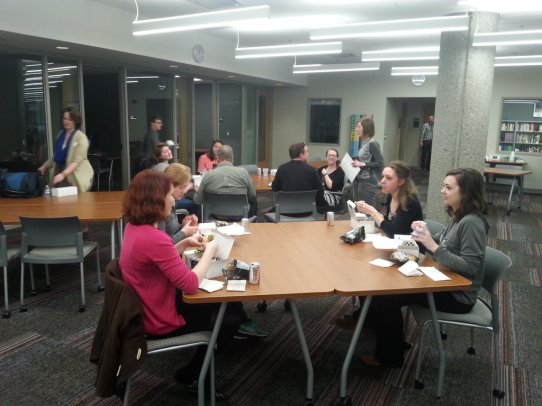
Writing Center Professionals eat lunch and chat in the new University Writing Center.

Achieving Clarity, Sentence by Sentence

Cheyenne Franklin, consultantDSCN3677

An instructor once told my class that the greatest criticism a writing can receive is that it is unclear. Although clarity does not come from any one formula, there are some tips that can help you get your message across clearly and keep you from writing the complicated texts we all hate.

1. Keep the real subject in the subject slot.

English is an SVO language. This means its basic structure runs Subject, Verb, Object. Sometimes we alter this structure to add variety, but generally readers look for the subject first and then the verb. When we provide these pieces quickly and in this order, readers are better able to focus on the message of our sentence.

Two types of structures can lose a sentence’s subject:

Passive Voice: The text was confused by the unnecessary passive voice.

Revision: The unnecessary passive voice confused the text.

You can find more information about passive voice here.

False subject there: There were two kids fighting at school.

Revision: Two kids fought at school.

In the first version of this sentence, there occupies the subject position right before the verb were. Two kids is the real subject though. The revision forms a clearer sentence with the true subject in the subject slot.

2. Cut deadweight words.

Certain valueless words enter our speech without our even realizing it. In our writing, where we have time to edit, we should always cut life-sucking deadweight that distracts from the sentence’s valuable parts.

Wordy: I believe the results clearly show obesity is a very real problem for each and every one of us, regardless of age.

Revision: I believe the results basically show obesity is a very real problem for each and every one of us, regardless of age.

Although the struck-out words seem to add intensity to the sentence, they don’t add any real meaning. In addition to overcomplicating the sentence, they weaken the statement because they appear to be trying too hard.

3. Write in manageable doses.

If a sentence extends to three lines or more, it has lots of commas/conjunctions, or contains strings of prepositions or which/that, look to see if you have stuffed too many ideas into one sentence. Just because a sentence is long, doesn’t mean it needs to be divided, but it is a good indicator. It’s good to combine ideas in a single sentence when showing a relationship between those ideas, but you need to give each idea its own attention first. This means giving each idea its own space.

Dense Sentence: If the chemicals combine, they can produce a toxic fume which can harm a human and might even kill plants and animals, presenting a serious risk and outweighing the good that such chemicals could provide in the home.

Separate ideas with connection following: If the chemicals combine, they can produce a toxic fume. This fume can harm a human and might even kill plants and animals. These dangers present a serious risk and outweigh the good that such chemicals could present in the home.

The revision splits the complicated sentence in places where which, and, or a comma was present.

4. Use the Old-New structure

The old-new structure involves both sentence and paragraph structure. It clearly strings together related ideas or steps by reusing key terms. Sentences begin with a term used in the preceding sentence (the old) and connects it to the next idea (the new). The sample sentence showing the revision of a dense sentence demonstrates this structure.

Old-New: If you turn to your right, you’ll see a yellow envelope. In that yellow envelope, you’ll find a note, and that note will give you your next instructions.

The repeated words yellow envelope and note serve as landmarks that orient readers and show connections between the old and new information. Notice that when a term is repeated, you usually place the word that/this before it.

How to Get into the “Flow” of Things: Writing a Well-Structured Essay

Lindsey Gilbert, consultantlindseygilbert

Many writers come into the Writing Center with concerns about the “flow” of their ideas in their papers. Occasionally, this concern comes up late in the writing process, allowing for little or no time to review the final piece with a writing consultant. A good way to resolve this issue is by simply examining the organization of the paper on your own. This answer may seem like a no-brainer, but many approaches exist that can help you reexamine and strengthen the structure of your paper, allowing for smooth transitions between ideas.

Outlining

While this is not a new approach by any means, creating an outline before writing can greatly help you structure your paper. Seeing how the ideas shift into each other allows for an easy edit to the structure of your essay if necessary. Even though prewriting strategies such as an outline may seem tedious, they can greatly help and even speed up your overall writing process, meaning you spend less time crafting the structure during or after writing.

Identifying Key Ideas: Reverse Outlining

Structure is a key component to keep in mind while writing an essay, but you may not know how to structure your paper until you begin writing. After completing a draft, you can read through and mark down the main idea in each paragraph. Compiling all of the main ideas will provide you with the groundwork for shifting paragraphs around to illustrate a logical progression throughout your paper.

Thesis Statements and Topic Sentences

If you decide to rearrange your paragraphs, you will want to read through and reorganize your thesis statement. Remember, the thesis statement is the spoiler of your paper and outlines what topics you are covering and in what order. If your thesis statement reads, “Dogs are soft, fluffy, and cute,” the body paragraphs should be in the description order of “soft” first, “fluffy” second, and “cute” third. In turn, the topic sentences of each paragraph should align with the descriptions presented in your thesis statement. This will allow your reader to understand the main topic of each paragraph before reading through it.

Working with Transitions

New topic sentences help to create better organization throughout your paper, but a smooth transition is needed in between paragraphs for the ideas to build on each other. Make sure to develop strong transition sentences between paragraphs by concluding the ideas of a paragraph and finding a link to the next topic that will be covered in the following paragraph. This provides a logical flow of ideas for the reader.

Subheadings

Transition sentences are greatly important for the ideas in your paper to shift efficiently, but some concepts may be too large and drastically different to allow for an easy transition. For example, if you write a position paper, you will need to state the advantages and disadvantages of a specific topic. These two areas are drastically different and could contain much detail and explanation, allowing for multiple paragraphs to develop in the process. In this case, the use of subheadings can be greatly beneficial to make that shift for the reader, allowing him/her to follow along with larger ideas that cover a greater length of pages.

The approaches provided above can greatly strengthen the organization of your paper, providing the “flow” that is so desired by the reader. Organizing your ideas well can ultimately give you more credibility as a writer, a strategy that you should keep in mind before you submit your final essay.

Ready to start writing, but not quite sure how? Read our blog post on non-generic ways to start your paper.

Happy writing!

Event: Many Voices: Writing About LGBTQ+ Issues

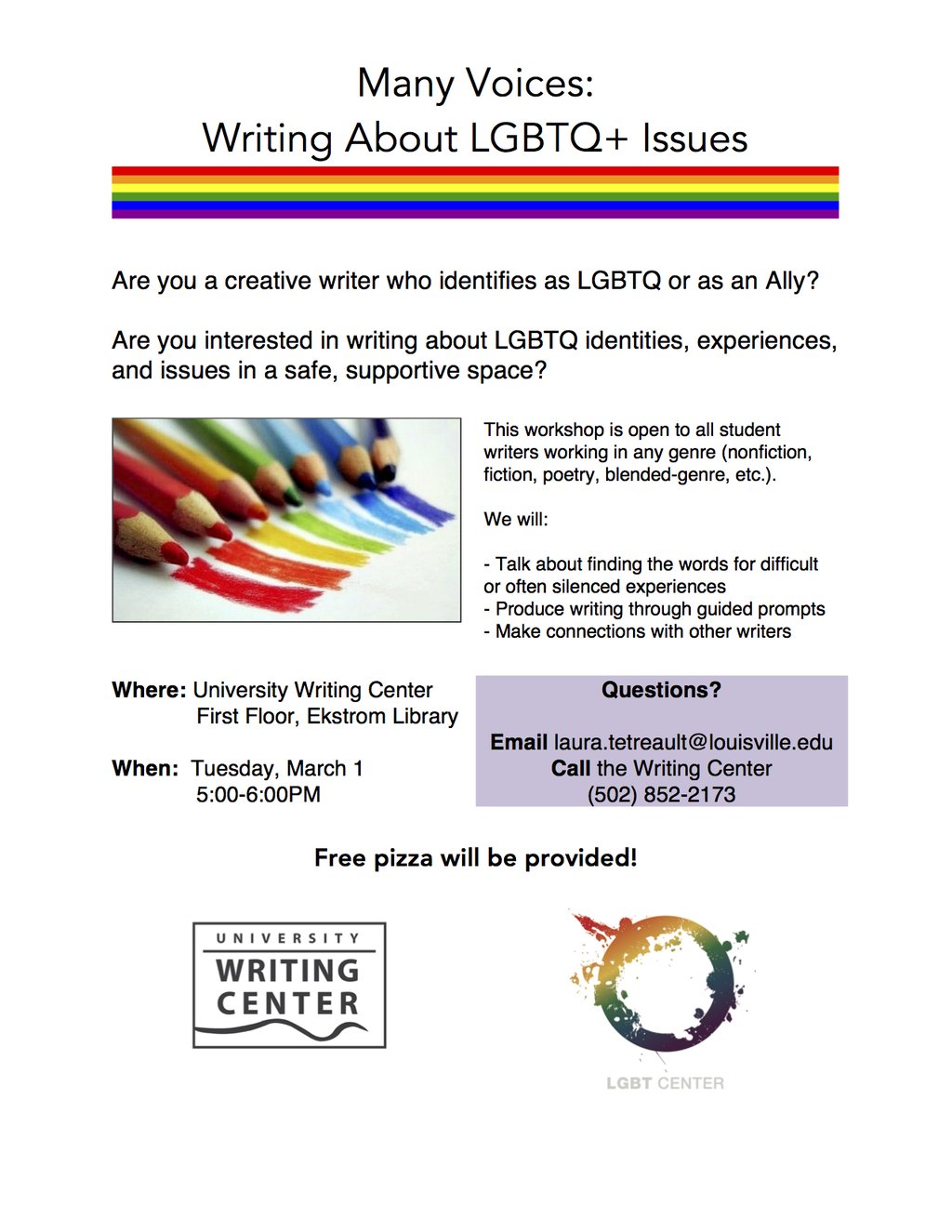
We are excited to offer an upcoming event in partnership with the LGBT Center at the University of Louisville. Details below!

CbRuVrsUcAAhsmx.jpg large

Text of flyer:

Many Voices: Writing About LGBTQ+ Issues
Tuesday, March 1
5:00-6:00 p.m.
University Writing Center, First Floor Ekstrom Library
This workshop is open to all student creative writers who identify as LGBTQ or as an ally, and will focus on writing about LGBTQ identities, experiences, and issues in a safe, supportive space. We will talk about finding the words for difficult or often silenced experiences, produce writing through guided prompts, and make connections with other writers.
Participants will not be required to share their work, although they are welcome to do so. Contact laura.tetreault@louisville.edu with any questions.

IWCW Day 5: A Culture of Writing

Our final insights for the week are from Assistant Director Laura Tetreault and consultants Karley Miller and Jessica Good. They share some ways our Center fosters a culture of writing at the University of Louisville.

Laura
“I have a lot of favorite things about working at the University Writing Center as one of the Assistant Directors: mentoring our awesome staff of consultants; planning programming and events; visiting classes in different disciplines; and working with writers from widely different backgrounds and learning about their projects during sessions. It’s a great opportunity to meet so many writers and hopefully help foster a culture of writing on campus.”

Join Laura for an upcoming Writing Center workshop: Writing About LGBTQ+ Issues
Tuesday, March 1 at 5pm in the University Writing Center, all UofL student writers welcome

Jessica
“Having the opportunity to talk writers through ‘assignment anxiety’ is probably my favorite part about working in the Writing Center. Writers often come in questioning their ability to interpret prompts, articulate ideas, or write in a new genre. The assignment has become this overwhelming thing that makes them feel powerless and alone. I like being able to emphasize that they aren’t weird or “bad” at writing, that all writers (including myself) have the same fear(s). This moment of connection enables us to focus on demystifying the assignment and renewing the writer’s sense of control. I absolutely love to watch a writer’s demeanor grow more and more confident throughout a session.”
Jessica answers: What Justin Bieber can teach us about genre?

Karley
“The best part of our writing center is Robin’s desk (and all the great people who work behind it). They take care of getting people registered, on the schedule, and to the right consultant. At UofL’s Writing Center, we work with everyone–including many people who might not feel comfortable using the online appointment system. Without Robin and her team, I don’t think we’d be nearly as accessible. Not to mention, the folks at the desk are constantly modifying the schedule to keep up with change throughout the day, and making sure as many people as possible are able to make the appointment they need.”
Karley’s suggestions for handling revision anxiety

DSCN3887
Karley meets with a writer.


IWCW Day 4: Valuing All Writers

Often we’re asked: What kind of writers visit the University Writing Center? Our honest response is always: All types. Really.

We welcome everyone in the UofL community–students, faculty and staff– and many writers a year take us up on that offer. (Side note: we tallied over 5,000 consultations last year). Today, Assistant Director Amy Nichols and consultants Emily Blair and Elizabeth Dean share how they value the writers who visit our Center.

Elizabeth
“I really love working with writers several times over the course of the semester, because I really get to know them and their work. Writers work so hard to do well in a difficult course or to perfect the details of their application, and it’s always exciting to hear that they were accepted to their dream internship or got a good grade in their hardest class. It’s so rewarding to watch their hard work pay off, and I feel like it’s a privilege for me to be a part of their process.”
Elizabeth’s Five Strategies for Citation Management

Amy
“I really enjoy watching writers experience someone taking their ideas and their writing seriously. When we start to have conversations about what a writer wants for their work, I often see questions of organization and language start to answer themselves, and those moments are so rewarding.”
Amy expands upon the “bigger picture” of writing center work, the writers (from 2013)

Emily
“I think my favorite thing about working in University of Louisville’s Writing Center is how diverse the writers are who visit us. We have writers from around the world who are working on everything from English 101 reflections to doctoral dissertations. I get to work with non-traditional students coming back to school for the first time in decades, and students who are the first people in their families to go to college. I learn from every student’s unique perspective through working with them on their writing, and I feel incredibly lucky to have the opportunity to have dialogues with so many people every day.”
Emily’s Five Tips for Successfully Rewriting

IWCW Day 3: Experiencing Writing

When we asked them about their favorite aspect of writing center work, three of our staff mentioned the opportunity to experience writing. As we continue our celebration of International Writing Center’s week, today we hear from Assistant Director of the Virtual Writing Center Jamila Kareem and consultants Deanna Babcock and Jenny Kiefer.

Jenny
“I love learning about all of the different subjects and genres writers bring in with their essays. I appreciate seeing the multitude of different ways writing can be used in many different fields. Most of all, I love being able to help these writers express their ideas and arguments.”
Jenny explains how the scientific method could help with your writing process.

Jamila
“My favorite part of working in the Writing Center has to be seeing how all of the writers we work with use written language to achieve do many different goals. As a lover of writing, working for the Writing Center gives me the opportunity to experience it across genres, contexts, and meanings while helping others become more confident writers.”
Learn more about Jamila and the Virtual Writing Center for distance students

Deanna
“My favorite part of working in the Writing Center is having the opportunity to teach writers something new. I especially love it if I see them again and they’ve used my suggestions in a new piece, indicating that they’ve learned a new skill, or that they’re at least trying it out.”
Deanna’s advice for avoiding cliches at the beginning of your paper.