
Our “How I Write” series asks writers from the University of Louisville community and beyond to respond to five questions that provide insight into their writing processes and offer advice to other writers. Through this series, we promote the idea that learning to write is an ongoing, life-long process and that all writers, from first-year students to career professionals, benefit from discussing and collaborating on their work with thoughtful and respectful readers.
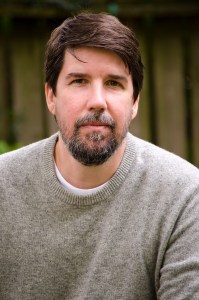 Ian Stansel is the author of the novel The Last Cowboys of San Geronimo (Houghton Mifflin Harcourt, 2017) and the short story collection Everybody’s Irish (FiveChapters, 2013), a finalist for the PEN/Robert W. Bingham Prize for Debut Fiction. His fiction and nonfiction have appeared in numerous venues such as Ploughshares, Salon,Joyland, The Cincinnati Review, and elsewhere. He holds an MFA from the Iowa Writers’ Workshop and a PhD from the University of Houston. He currently teaches creative writing at the University of Louisville. He lives in Kentucky with his wife, the writer Sarah Strickley, and their two daughters.
Current project: A new story collection and a screenplay
Currently reading: The Deadlands by Ben Percy and a large number of stories by my students
1. What type(s) of writing do you regularly engage in?
I write short stories, novels, screenplays, essays, and the occasional poem.
2. When/where/how do you write?
The joke of course is this: a person is lying on their couch, head on a pillow, eyes closed, unmoving. Someone enters the room and says, What are you doing? And the person responds, Writing. Ha ha. But see, there’s a good bit of truth to it. I say with a straight face that there are few moments in my life when I am not writing. I go to bed working out stories, and I’m back at it soon after waking. I’m thinking about a scenario or a character while I’m making my kids’ lunches. I’m working out a plot problem while driving to campus. At some point in a writing career, it’s just hard to turn it off. Or at least it is for me.
But practically speaking, I try to write—like, actually typing words—every day. Try. That doesn’t always work out, but I can say I write at least a little most days. And I’ve learned to be pretty good at writing anywhere. I can write while my daughters are watching Curious George just a few feet away. I can write in my office on campus while students chat outside my door. It’s something one has to learn to do, otherwise the words just don’t get strung together.
But on a good day I don’t have too many other pressing matters and I can spend a good four or five hours working. On those days I am home alone. I start with my laptop at the dining room table (I do have a desk but it is barely noticeable under a mountain of books and papers). I stay there until my back hurts from the chair, and then I bring my laptop to the couch, and work there until the battery gets low, at which point I move back to the table and uncomfortable chair. The dining room is also good because it doubles as our home library, so if I need a book it is usually within reach.
3. What are your writing necessities—tools, accessories, music, spaces?
I often have music specific to whatever project I’m working on. The last couple of projects have been soundtracked by country music (mainly from the 60s and 70s…the best decades for country music). But in general I write to instrumental music. A lot of ambient and minimalist stuff: Eric Satie, Brian Eno, Hauschka. Music that borders on classical, but is too weird to be firmly in that category.
Other than that, I don’t need much. For screenplays I use the software program Final Draft, which helps a lot. But I’ve done script work without it, so it isn’t a necessity.
4. What is your best tip for getting started and/or for revision?
Just start writing. You don’t know what the perfect first sentence is because you don’t know what the story is because you haven’t finished a draft yet. So don’t sweat it too much. Just start writing. You can change it later. You will change it later, most likely. If it’s a story, write scenes with a few characters, and don’t leave the scene until something interesting has happened. If you are writing a poem, write concretely. Don’t go abstract. If you are writing a play or a screenplay, establish the conflict quickly. But regardless, just start writing. And when you have a draft done and you’ve set it aside for a bit and gotten some perspective, revise without mercy.
5. What is the best writing advice you’ve received?
I don’t know if anyone has ever actually said it to me, but it has been said by someone to someone that you should write the story you want to read. I like that as a motivator. Write the story you’d want to read, not because you wrote it, but because there is some part of you wanting badly for it to exist.
Do you know someone who would be great for How I Write? Send us your recommendations!
 scene in which his character had apparently been kept awake for 72 hours, Hoffman decided that he too would stay up for three days, the idea being that this would help him get into the mind of his character—Hoffman was quite the method actor. Upon hearing this and witnessing Hoffman’s exhausted state, Olivier confronted him and asked “My dear boy… Have you tried acting?”
 paper. It taunts you. It knows you can’t do it. It erases every budding idea you have and replaces it with indecision. It’s the ultimate bully–the one who manifests your fears with more efficiency than Pennywise the Dancing Clown. You’ve lost any ability to be rational at this point. You know you’ve faced this demon before and made it through, but you’ve convinced yourself you won’t be able to do it again. This will be the end of you. This will be the first time you’ve failed to turn in a paper, or—even worse—you’ll end up stringing together an essay of words so incoherent that everyone will finally find out you’re just an imposter.
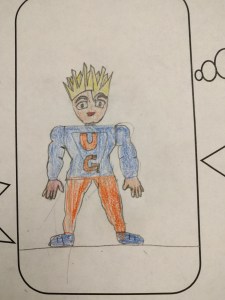
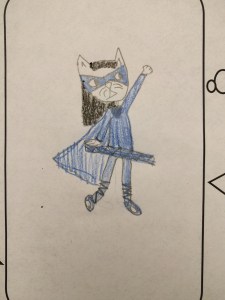

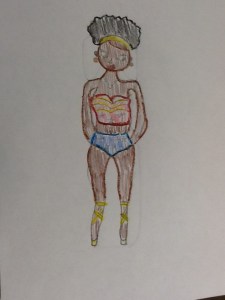
 Chris collaborated with an enthusiastic table of participants to create an entire universe of food superheroes and supervillains. At a third table, I helped participants think through their superheroes’ narratives (including things like conflict, resolution, characters and setting), and I was so impressed with the story lines and details that they come up with. I hope the participants had as great a time as I did creating superheroes (mine was Picasso Girl) and stories, and seeing what everyone else created. We could not have had such a successful series of workshops without Western Branch’s enthusiasm and support, and certainly not without the excitement and creativity of all the workshop participants.

 pond to our How I Write question prompts.
  Katie Kohls, Consultant
 University of Louisville Writing Center