Category: Creative Writing

The Places We Write: An Unfinished List

Ashly Bender, Assistant Director

Ashly_Version_3Last week, BookRiot—one of my favorite blogs for literary discussions—posted about the places people read: under a tree, at the beach, in a coffee shop, you know the places. For each place, author Jonathan Streeter rated the aesthetic appeal. For example, reading under a tree is highly aesthetic given its “classic appeal” and prominence in paintings, books, and other forms of art. (Reading “on the throne” was least aesthetic, for obvious reasons.)

Streeter’s blog post got me thinking about the places we write. Much like reading, the cultural conventions around writers and how to write are strong. For centuries, the idea of the writer conjured up images of solitary, often disagreeable, and socially inept individuals (arguably, usually men). Even now, these characteristics often persist. We see it in movies like Shakespeare in Love, where the inspired William Shakespeare runs to his small cluttered apartment to scribble down lines of his upcoming play, or in Stranger than Fiction, where Emma Thompson’s character is portrayed as difficult to get along with. On-screen or in-book writers who frequent coffee shops are just as likely to be seen as solitary. Bronwyn Williams and Amy Zenger offer more critical and thorough insight on this in their book Popular Culture and Representations of Literacy.

Given that this view of writers persists, despite repeated evidence that when we write our content most often comes from interactions with other texts and other people, I want to consider today the places we actually write.

Dorm/Home: Most people who are expecting to be doing consistent writing or studying have a space in their home to work. For many students that place probably their desk in their dorm room. Others who aren’t living in dorms might have an office in their house, or just a desk. Personally, most of the writing I do at home I do in my kitchen because my table is big enough to spread out any books or notes I want to look at while I write. Plus, the food is right there.

Cafes and Bookstores: It makes sense to begin here since I’m currently sitting in a Barnes and Noble Café. While plenty of the other customers are reading, there are at least three other people writing in some form, and based on observation over time, I’d say this is not unusual. I generally prefer coffee shops, but the town I’m in is small and doesn’t have a café that accommodates hours-long customers. The upside to coffee and book shops is that those of us who need to “get out of the house” are able to be productive while still seemingly engaging with the outside world. Plus, there’s always people watching or small talk if you get stuck or need a break.

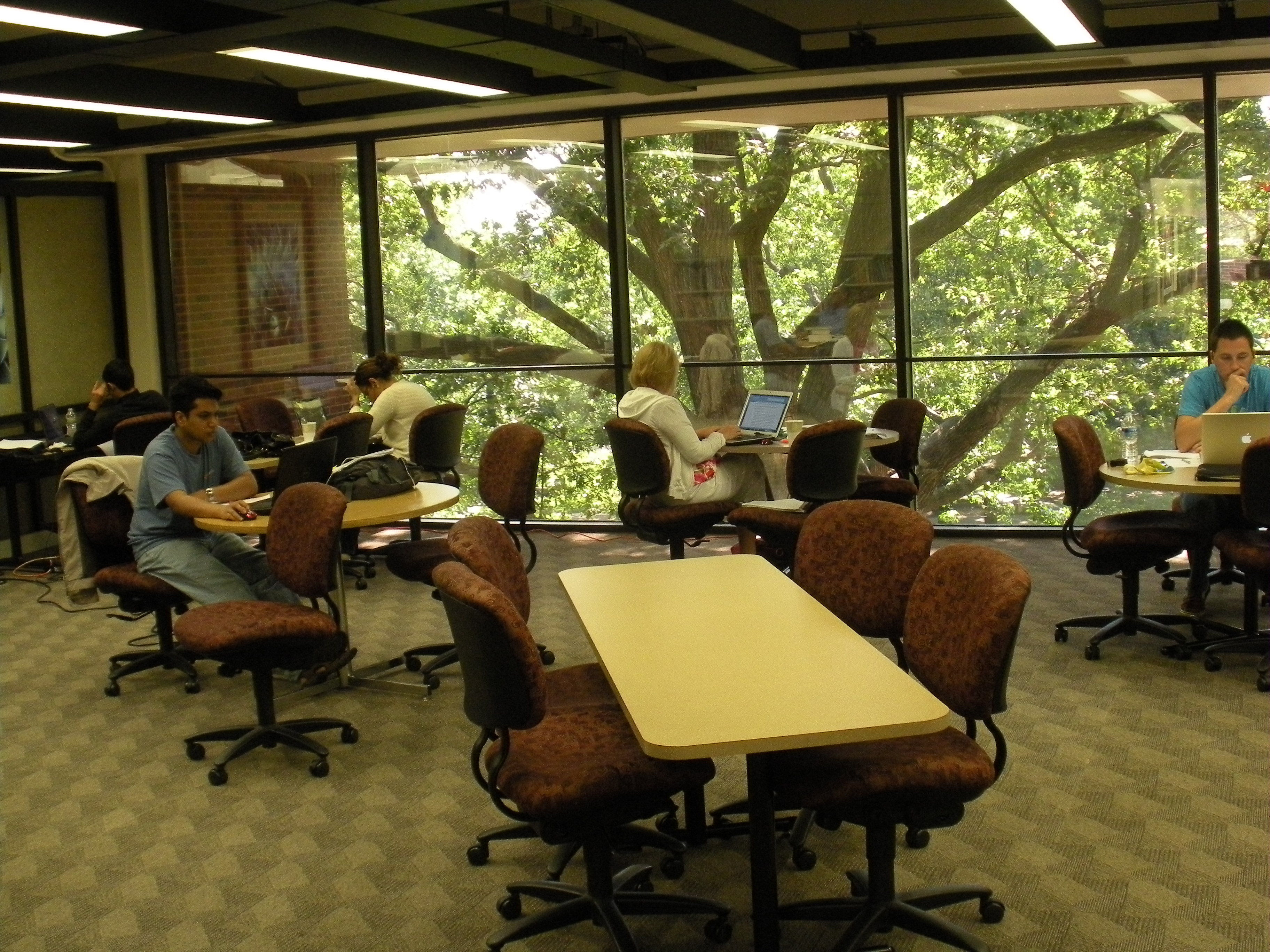
Libraries: Libraries have always had a particular atmosphere for me: quiet, studious, quiet. You may be getting a sense of why I prefer the coffee shop, but many people love the sense of focus and the lack of distraction that libraries can offer. Plus, many students living on-campus can make temporary homes and offices in the libraries at their universities. In fact, the University of Louisville’s Ekstrom Library is currently renovating to offer more of these spaces. The benefit of being in library, of course, is that if you need to look up a book or an article, you’re already there! I love wandering through the stacks. And, Ekstrom Library also houses the University Writing Center, so if you have any writing questions or want to walk-in for an appointment you don’t have to go to another building—just to the 3rd floor.

Writing Centers: Speaking of the Writing Center… Of course, most of our work is helping students with their writing in consulting appointments, but we also have computers and tables where people can just come in and write. This was one of the important benefits of our Dissertation Writing Retreat, every morning participants had at least four hours to just write before meeting with a consultant.

This list is certainly preliminary and subject to my own experiences. Where else do you write? Where is your favorite place to write? I’ve been known to write on my porch, on an airplane, and even in my car—though not while driving! If you aren’t bound by place, what things do you need to write? Let us know in the comments!

Doing More than Microwaving Alphabet Soup: Tips for Getting Better at Cooking and Writing

Ashly Bender, Assistant Director

On one now infamous afternoon many years ago, I decided to make cupcakes from box of cake mix. Following the directions on the box, I dutifully mixed the ingredients on the box: egg, oil, water. Everything was thoroughly blended, but I knew something wasn’t quite right. I looked at the cupcake papers in the pan and looked at the mix, then the papers again, then the mix. I was pretty sure the mix was too liquid-y for the papers. I checked the box again; everything on the box was in the bowl.

Still unsure, I called my best friend who regularly baked. She reasonably asked if I had followed the directions on the box. As I picked it up to read the directions to her, I realized the problem—as you, dear reader, likely already have. The cake mix itself was still in the box. I was too embarrassed to even explain what happened to my friend. I just told her I had figured it out and got off the phone.

Ashly_Version_3That’s just the most re-told story of my kitchen fails. Few remember the many, many nights I messed up Hamburger Helper. Or the time I scalded a pot when I set hot chocolate mix on fire. But since those days, I’ve learned a few things and can successfully finish both edible and enjoyable meals. I credit a lot of my growth in the kitchen to being a little more relaxed about precisely following directions, trusting my intuition a little bit more, and being ok with taking risks. It may seem odd to have such a food-themed post on a blog about writing, but my approach to cooking is somewhat influenced by my approach to writing—a skill with which I have considerably more facility and comfort.

Following directions was the first hurdle I had to conquer in the kitchen. It was the source of many of kitchen fails I mentioned above. I was so concerned with doing exactly what I was supposed to do that I would get things mixed up. I wasn’t considering the finished product. A lot of times, this is what happens when writers focus more on grammar or mechanics than the message they are trying to send. Worrying about the writing instructions governing the placement of commas, of which there may be too many to count, can keep you from finishing your sentence, your paragraph, your whole piece. Or, as was the case in my early cooking adventures, you can end up putting in too much of something, too little, or putting it in the wrong place. This is not to say that writing “instructions” like punctuation or grammar aren’t important, but they should act as guides and finishing touches rather than the main focus of piece. After all, you want to eat (or read) the finished product, not the individual ingredients.

Another important part of cooking and writing is trusting your intuition. Ever been half way through cooking a meal only to realize that you’re missing one or two ingredients? Maybe you’re better at this whole cooking thing than I have been (and sometimes still am). At times like these, you might just have to wing it and make an educated guess about what to substitute or leave out. Those small tweaks help make what you’re making your own special version—the makings of secret recipes. It’s not much different in writing, but the tweaking is more in regard to style than flavor. Writing style, sometimes it’s called voice, is often lauded as the extra bit that makes a piece unique. Often movies or other popular media suggest that this aspect of writing is some kind of gift good writers are born with. Really though, developing voice and style is largely about trying out new spices and flavors in your writing until you find the one and the amount that works. This means, after you’ve got the big pieces of the message together, pay attention to the details—add a little bit of this or that until it balances to be just right.

Whether you’re anxious about cooking or writing, relaxing the attention on producing exactly what the instructions or the instructors call for can be the first step in actually developing your style. That means taking risks, but without those risks it’s nearly impossible to get better at something. Sure, you might include too much of one ingredient and your reader or eater might object. Next time you can include less, or you can try something else. And remember, those rules that seem so strict are really just guidelines to help you make your version of piece you’re aiming for.

Time Away: One Key to Productivity

Brit Mandelo, Consultant

BritThough a variety of factors can contribute to low productivity, burn-out—minor or major—is the source of woe for many, many writers who are juggling high stress levels, large required outputs of work, and tight deadlines. I’m not talking procrastination; that’s a whole different animal. What I mean, here, is the sensation of doom and desperation, accompanied by a deep exhaustion, that can follow on the heels of a hard run of productivity. You just feel wrung out, but there’s still more to be done. Ignore the deadline for a bit, though. While it may sound counterintuitive, one of the solutions that can help is taking time away from the project in question: for ten minutes or for a day, a break offers a chance to recuperate.

Giving the brain a chance to rest is no different than giving the body a chance to rest. If you were doing a strenuous physical activity, you’d likely take a breather before moving on to the next challenge. The same principal can work to stave off burn-out, at least temporarily—long enough to rally and finish that research paper, possibly. The idea is to count in that break time as part of the process; don’t worry about the deadline while taking a break, or your stress level isn’t likely to decrease much at all.

Instead, if the half-finished sentence staring you down is giving you a headache, step away. Take a short walk, do the dishes, listen to music, go outside—whatever fits your fancy. An activity that isn’t mentally challenging offers extra breathing room, though sometimes a pleasant brain-stimulation, like a favorite movie or album, can be refreshing as well. Washing dishes or picking up around the house are a few of my preferred necessary distractions. (That way, the break also feels a little productive, too.) Don’t think about the project that’s driving you up a wall. If an idea happens, delightful. If not, don’t worry about it. Take the time to breathe, to loosen up, to let go of some of that doom.

When you return to the page after the break, it might not be easy, but it also might not be harrowing and awful.

Critiquing Creative Writers for Those Who Are Not

Katelyn Wilkinson, Consultant

While we advertise help for any kind of writing, be it an essay, resume or co-op report, students often overlook the Writing Center as a place that offers creative feedback as well. Recently, I have noticed a surge of fiction and poetry, both assigned and not, in consultations. As a creative writer myself, these pieces have been both a joy and a challenge to provide feedback for. For some of my fellow consultants these sessions may offer more challenge than joy, however, as I have often overheard them recommending students make appointments with other consultants more creatively-inclined. I realize creative writing isn’t for everyone; still, it is not impossible for those who don’t consider themselves creative writers to offer feedback on such pieces.

As academic writers themselves, all consultants are familiar with reading and critiquing academic essays. However, not every consultant is a creative writer or familiar with giving feedback to one. Given how many different genres and styles of creative writer there are, it can be difficult for even those who term themselves “creative writers” to give feedback to pieces outside of their chosen genre. I have found this to be true as a poet trying to advise students who are writing longer works of fiction. I will be the first to admit that not every session has gone perfectly – some feel more like trial-by-error – but after working consecutively with several different students, I have identified two different things that should be kept in mind in order to get the most out of creative sessions. Since many of these works must be digested in a short period of time, I think these suggestions are helpful for not only consultants who are unfamiliar with reading creative work, but students who might find themselves in peer-response situations as well.

Establish the goals of the writer.
There are many different ways you can approach a creative piece; you might dive straight in to the text, or pause to talk to the author before the reading even begins. Since most of the consultations I’ve had have dealt with works in progress, I find myself doing the latter more often than not. I find this helpful because it allows me to ask the student what I consider the most important question about the piece – What are your goals? What are you trying to achieve with this work? This is especially important to establish with pieces that do not come with an assignment or prompt from a teacher. As a consultant or a peer-reviewer, I have found it just as helpful to go into a creative piece knowing what the author wants to achieve as it is to know the prompt for an academic paper. From there, it’s easier to discuss the nitty-gritty things such as character development, point of view, dialogue, and other sentence-level issues, as well as keep the session on track so the student can get the most out of their time.

Be conscious of how you’re critiquing.
Creative writing is an extremely personal endeavor, and for many students it’s hard to share such work let alone subject it to criticism. With creative pieces especially, the line between author and narrator is often blurred, so it’s important to not conflate the two; the thoughts and experiences of one don’t necessarily belong to the other. Keeping that in mind, anyone reading creative work should also be careful to balance negative and positive feedback while remaining honest as a reader. It helps to be specific about what works and what doesn’t in a piece, as well as what could be done to strengthen the work. For example, rather than saying “you need to work on your dialogue,” pull out a specific moment in the piece that seems weak and talk about different ways the student might strengthen that moment.

KatelynFinally, it is important to remember that your opinion as the reader is subjective, and critiquing creative writing isn’t as black and white as identifying a comma splice in an academic paper and showing a student how to fix it. In my creative writing sessions, I repeatedly remind students that everything I say is simply my opinion; I find this takes the pressure and frustration off of them to feel like they must make every change I suggest. Students should remember that they, as the author, always have the final word on their piece.

How the Dissertation Writing Retreat Helped Me to See Writing Center Work in a New Light

Barrie Olson

I’ve been thinking about Writing Center work a lot lately. I attribute this reflection to two events. First, this past week marked my last week working in the University Writing Center at the University of Louisville. It is hard to believe that my two years as Assistant Director (along with Laura Detmering) have come to an end. For both of us, the Writing Center has been a second home. More importantly, our work in the Writing Center has significantly impacted the work we do as both teachers and researchers of writing. There is, however, a second reason for all this reflecting. After two years of Writing Center work, it wasn’t until this past week that I saw, really, truly saw, just how powerful the work we do in the Writing Center can be.

I should, of course, back up briefly and say that I have always felt that Writing Center work is both important and effective. In fact, I even wrote a blog post about it. Rarely, however, are we as consultants given the opportunity to see Writing Center work in its most idealized form. If consultants are lucky, they may work with the same student several times on the same paper. Really lucky consultants might see the same student throughout an entire semester working on multiple projects. What’s great about either of these scenarios is that they let us see the effects of our work. How do students implement the feedback we give them? How do ideas that manifested themselves during writing center consultations then appear in reiterations of the student’s writing? What might we do to better serve this student in the future? When you see the same client multiple times, you can begin to answer these questions and reflect on not only the work you do as a consultant, but also on the effectiveness of that work. Unfortunately, more often than not, writing consultations don’t extend past a single visit. Students might seek feedback for only one draft or come to the Writing Center to discuss writing in only one of their disciplines. While these sessions are no doubt fruitful, as consultants, we can only imagine what the students did when they got home and returned to their writing.
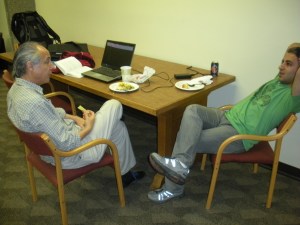
I have been a consultant for both kinds of sessions. I have been left to wonder whether I had been helpful to a student. And I have been able to see just how helpful I’ve been to students. But it wasn’t until last week, during University Writing Center’s first ever Dissertation Writing Retreat, that I was able to see just how powerful Writing Center work, in its most idealized form, can be. The Dissertation Writing Retreat was a week-long intensive writing experience for ten doctoral candidates representing five different disciplines on campus. Participants came in at 8:00 AM each day and would write for approximately 2.5 hours. They would also engage in workshops covering relevant topics such as writing a literature review or overcoming writing obstacles. Then, after a break for lunch, participants would return to writing for about another 1.5 hours before meeting with a writing consultant (like me). Consultations lasted an hour and participants met with the same consultant each day. You can begin to see here how this experience represented ideal writing center work.

First, we had time. An hour is a lot of time to discuss someone’s writing. More time is always great, but an hour gives you time to read the writing, discuss the writing, and, if the participant so desires, begin rewriting. But this is just a logistical advantage. The other advantages spoke to some of the theories of Writing Center work that I never necessarily got to see in action. For example, a common conversation in writing center scholarship revolves around discipline-specific tutors versus general tutors. While discipline-specific tutors are able, often, to speak to the content of a student’s writing, general tutors may be more limited in that area. General tutors offer the advantage, however, of needing the student writer to explain his or her content to a reader unfamiliar with the discipline. In an ideal world, the process of explaining content makes the content more clear not only to the tutor but to the student herself. In explaining the information to someone not already familiar with the content, the student might be forced to think about her content in new ways. If nothing else, she will likely have to make connections within her content far more explicit than she might with someone who is already familiar with it. And, while this all sounded good in theory, for me as a consultant, it was sometimes hard to know if it was true.

Enter the retreat. On the final day of the retreat, participants shared with one another some of the benefits from participating in the retreat. One benefit that came up repeatedly regarded just how helpful it was for them to have to talk about their projects to people outside their fields. Each participant remarked on how such conversations clarified their understanding of their projects and, by association, how they wrote about those projects.

Gaining a stronger testimony in the power of the general tutor was only the beginning. I also was able to see just what can happen when someone gets feedback on their writing not only the same day they wrote it but also on a consistent basis (in this case, daily). I had the privilege of working with two doctoral candidates from the Kent School of Social Work. Each day, we were able to meet and discuss the progress they had made. After each session, we would set goals for the following session. They would then be able to spend time writing knowing that they had goals in mind and that we would be discussing these goals. This isn’t to say that the sessions were prescriptive. At the end of the day, my job was to help these participants in whatever capacity they needed me in. However, setting goals like these meant that each day, we could start the conversation by reviewing what we had done the day before and by seeing how they had progressed based on that previous work. For the participants, this proved to be an important aspect of the retreat. Many commented on the fact that these daily sessions helped them stay on task and motivated. They were also able to discuss their writing when it was still fresh. If a consultant asked them why they made a specific choice in their writing, for instance, they probably could remember why.

But for me as a consultant, the experience was equally as valuable as it was for participants. I was able to see almost immediately which strategies I used as a consultant were working and which ones needed to be adjusted or abandoned altogether. Moreover, these strategies shifted from one participant to the next. In other words, the reflection I did as a writing consultant, while often generalizable, was also specific to the individual participant. By seeing these participants every day, I know that by the end of the week, I was a better consultant than when I started. I would like to think that during my tenure as a Writing Center tutor, I have always improved but it is hard to know for sure. Only with daily reflection in relation to a returning participant was I able to feel certain about the ways I was being either effective or ineffective.

There are certainly other ways that being a consultant during the retreat affected my views on Writing Center work but many have been, or will be, expressed by others. For example, Dr. Bronwyn Williams, Director of the University Writing Center, has already discussed some of the great things we saw come out of the retreat. Likewise, it is my hope that both participants and consultants from the retreat will be motivated to comment or write blog posts of their own. For now, let me simply end by saying this: Writing Center work works. If you don’t believe me, ask Naouel Baili, Tanvir Bhuiyan, Brynn Dombroski, LeAnn Bruce, Alex Cambron, Anis Hamdi, James Leary, Mohammadreza Negahdar, Zdravko Salipur, or Charlos Thompson—our retreat participants. Or, talk to one of the consultants: Ashly, Bender, Robin Blackett, Laura Detmering, Becky Hallman, or Jennifer Marciniak. While I am sure we all had different experiences, I am also certain that we each took something positive away from this week. While my time in the Writing Center is now up, I look forward to seeing what the future brings to the University Writing Center. My hope is that the kind of work that happened there this past week will continue and that both new clients and new consultants will have the opportunity, like I did, to see writing center work in its idealized form. It’s empowering.

Who is a Writer?

Lauren Dimmer

Today I woke up the way I normally do: too late in the afternoon and too tired for anything but a good cup of coffee. I stumbled my way into my living room, slumped down by the window, and stared at my computer with the kind of hatred usually reserved for mass murderers or bad rainstorms on the highway.

I’ve been trying to write something creative every day for the last five years.

It’s not going so well.

Obviously.

For the last five years of my life, every day starts with a big list of all the reasons that I really shouldn’t be writing. My slacks from work need to be washed, my new kitten needs her medicine to help get over some random fungus, the floor’s dirty, articles really need reading for school, my girlfriend’s getting over a root canal and needs me to make another smoothie so she can have breakfast, I need to check my facebook feed, I need to check the news.

Of course writing is hard. Of course writing is exhausting. But this morning, I started thinking: what is it, exactly, that’s burrowing into my brain whenever I reach for a pen and a keyboard?

The more I thought about it, the more complicated it became. For example: what do I really mean when I say that writing is hard? I write probably three e-mails every morning, and none of those bother me. I text my friends. I comment on some blog posts. None of that writing makes me grind my teeth the way my daily creative exercises do. I don’t try to do the laundry just to have an excuse to avoid updating my status on facebook. I don’t sweep the floor to avoid e-mailing my friends.  Is it the kind of writing I’m doing that’s so hard? What makes writing a story harder than responding to a blog post? When you’re writing a story, you can write anything you want. You can make whatever kind of sense you want, too. It’s the kind of freedom that should make you feel inspired and happy, but I still feel trapped as ever.

I think, ultimately, some of the most damaging baggage we have to shoulder whenever we try to write is really baggage about writers.

Think about it: we’re taught that “real writers” are sad, solitary, lonely creatures. “Real writers” are geniuses. Real writers are tortured. Real writers are quirky and original. Real writers drink whiskey every morning. Maybe the worst thing we’re taught about “real writers” is the way that they can just dash out an absolutely perfect first draft. I never heard about Hemingway slaving away over a single paragraph for five hours while his laundry got dirtier and dirtier. I never heard about Oscar Wilde having to practice whenever he wanted to write a new, brilliant play. They just did it, those guys, their talent was innate and spooky and hard to understand; they had a mysterious, weird, natural link to whatever “good art” was, and it just poured out of them whenever they needed it.
The end.

I write my first draft and it is crap. I write my second draft and it is also crap. I pour another cup of coffee. I write a third draft. Still crap. I sweep the floor. I talk to my girlfriend. I go to a movie. I am still working on a poem I wrote when I was sixteen years old. That poem? Crap!

And every time I do this, I make a list of why writing is stupid, and I am stupid, and I can never, never ever be a real writer. Every day, this list gets longer and longer. That list is what’s pressing into me whenever I stop and grab a few extra minutes and pick up a pen and try, try, try to write something. Anything.

But you know what? Just because no one ever bothered to tell me Hemingway went through fifty versions of “Hills Like White Elephants” doesn’t mean that he never practiced all the ways to make a tight, crystalline, tiny image in his text. Hemingway practiced. Oscar Wilde practiced. Every piece of creative work you read is just the latest draft in a huge army of incredibly crappy drafts, and maybe, if we saw some of those drafts, we wouldn’t feel so bad when our first version doesn’t measure up. Maybe studying those drafts would tell us more about writing than reading everything when it’s all perfect and polished and beautiful.

But even if you don’t believe all that, I’d like you to try to believe this, okay?

A writer is a person who writes. That’s what writer means. That’s all writer means.
The only way you’ll never ever be a real writer is if you let all those “real writers” keep you from writing.

And I have a poem to write.

Again.