Tag: writing

Writing Time, Feedback, and Momentum: The Dissertation Writing Retreat – 2016

Bronwyn T. Williams, Director

The sound of people thinking. That’s what you would have heard had you come to the University Writing Center this past week. With fourteen UofL Ph.D. students focused on  writing their dissertations. I swear that, given the intensity with which they were working, you could hear them thinking. This year marks our fifth annual spring Dissertation Writing Retreat. During the week, the schedule was the same: Writing in the morning, a short workshop and discussion on some area of20160525_104409

Dissertation Writing Retreat writers hard at work

research writing at noon (How to Write and Effective Literature Review, How to Revise and Respond to Committee Members’ Comments, How to Turn Dissertations into Publications, How to Keep Writing) , and the individual appointments with University Writing Consultants in the afternoon (and more writing…). The writers who took part in this year’s Retreat worked with a dedication and commitment that was inspiring. They came from eight different disciplines at the University: Anatomical Sciences and Neurobiology, Education, Engineering, Rhetoric and Composition, Humanities, Psychology, Public Health, and Sociology. The best way to get a sense of the experience of the Retreat and its impact on the writers who took part, however, is to hear from the participants and consultants themselves.

Participants

Amanda Pocratsky, Anatomical Sciences and Neurobiology: It’s hard to synthesize in few words how much this retreat has transformed my dissertation writing experience. As a graduate student in the biomedical sciences, I was initially concerned about how effective this retreat would for me. These concerns proved unfounded. In the span of one short week, I’ve written my dissertation abstract and a complete first chapter. I will leave here with over half my dissertation completed, a well-defined outline of my discussion, and incredible momentum to push through the final stages. Moreover, the writing skills I’ve cultivated from this experience will effectively translate throughout my scholastic career. I strongly encourage students to apply and come prepared to succeed.

Yvette Szabo, Clinical Psychology: The Dissertation Writing Retreat has been invaluable to my dissertation progress! I am still collecting data for my dissertation, so I was able to

20160527_133544
Meghan, Rene, and Yvette hold a group consultation

use this protected time to write and edit large parts of my Introduction, Method and then outline my results and discussion. Overall, I doubled the length of my dissertation and received feedback on all sections.  Typically, I shift between many roles as a graduate student, so having the quiet space to work (relatively unplugged) was necessary and much appreciated. And working with the same consultant all week allowed me to talk through presenting ideas for my complex study as well as receive feedback on organization and parallel structure. Thank you for a wonderful experience!

René Bayley-Veloso, Clinical Psychology: I would highly recommend that any graduate student who is working on their dissertation attend the Dissertation Writing Retreat. I have made substantial progress on my dissertation in a very short amount of time. The retreat also helped me organize my thoughts and questions, which allowed me to have a necessary and productive meeting with one of my committee members.  I have learned quite a bit about my own personal writing process through this experience, and will be utilizing this knowledge to maintain momentum moving forward.

Jamila Kareem, Rhetoric and Composition: The 2016 Dissertation Writing Retreat has not only been the most productive time I’ve spent on my dissertation, but it has been the most valuable. The structure of the Retreat worked well, because it allowed me to prioritize my writing and get the most crucial aspects finished while I had guaranteed feedback. The Retreat helped me develop a more structured process to stay on track and to feel rewarded when I do. I’ve had a process that has worked pretty well, but the staff at the Retreat gave
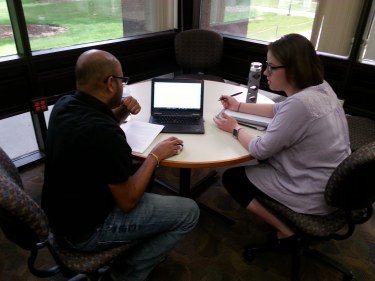
20160527_143740
Dilan and Layne work together

me strategies to build upon it and work smarter. And it’s free! Just look for professional dissertation help around the Internet—prices are crazy! I would recommend the Dissertation Writing Retreat to every doctoral student whether they are having trouble getting started or almost done. The feedback, time, and structure you receive are invaluable.

Abby Burns, Epidemiology and Population Health: The Dissertation Writing Retreat provided an encouraging environment to work quietly alongside other students who all have the same ultimate goal – completing their dissertation and graduating.  It helped hold me accountable, but more importantly helped me build momentum that I hope I can run with in the following weeks/months.

Denise Watkins, Humanities: As someone who is married, a mother, and works full-time, the benefits of this retreat can’t be adequately explained. I was able to steal away from all other responsibilities and make significant progress. In one week’s time, my outlook towards my dissertation has changed from an insurmountable “where will I ever find the time?” project to a feasible, doable task.

Heidi Williams, Sociology: The Dissertation Writing Retreat provides supportive, focused writing time, as well as workshops and advice that help participants approach and manage their work. Working with a writing consultant helped me realize I was fixating on a problem, rather than making progress in an attainable way. I learned how to breakdown my writing into manageable, daily tasks that led to tangible results – an exercise that I could not put into motion myself.

Consultants:

Laura Tetreault, Assistant Director: In my conversations during the Dissertation Writing Retreat, either with the writers I was working with or the other consultants and writing center staff, we often circled back to one idea: writing is hard. (And interesting, and fun, and exciting, but also hard a lot of the time.) As a Rhetoric and Composition PhD candidate

20160526_111711
Laura Tetreault leads a workshop discussion on turning dissertations into publications

and Assistant Director of the Writing Center, people sometimes I expect that I have this whole writing thing figured out, but the reality is that I became interested in writing teaching and writing center work because I also find writing to be really difficult a lot of the time. But instead of finding this discouraging, I actually find it comforting that most writers express at some point how difficult writing can be for them. The common experience of struggling with writing helps to diminish the inner critic that many grad students have in our heads. I can tell that critic: hey, it’s not me; writing is just hard sometimes. And it gets a lot easier for me when I can find a sense of community in the struggle.

Amy McCleese Nichols, Assistant Director: Watching writers work on their dissertations this week has reminded me why I love one-on-one writing conferences. It’s been great to talk through ideas and text with writers who have differing processes. For some, it seemed like the chance to talk through small sections of writing/thinking gave them better language to describe their overall argument and intervention by the end of the week. For others, designing study frameworks and making targeted edits to various sections of text

20160527_144856
Rose and Amy discuss Rose’s dissertation

helped them accomplish larger goals. Working the retreat has also given me a better sense of what it might look like to write my own dissertation in the future; this is definitely an event I’d like to return to as a participant next year.

Layne Gordon: As a soon-to-be second year PhD student, I was so inspired this week by the progress of the writers I was working with! At the end of each meeting, we took a couple of minutes to set some writing goals for the next day. Although sometimes those goals had to shift or be adjusted (writing requires so much flexibility!), the writers always made progress and pushed themselves to get as much done as they could. While I got to learn a lot about their respective topics, I also learned a lot about the dissertation writing process itself and the importance of just not stopping.

Brittany Kelley: I learn so much when working with others on their dissertations, especially when it comes to the writing process. This year, I learned that it’s important to create a hierarchy of goals for your dissertation. The highest/most important goal is getting words on the page. The next highest/most important goal should be your well being. After you’ve got words on the page, remember to rest. See friends. Exercise. Eat well. Most importantly, be kind to yourself. You deserve it. Always.

Ashley Ludewig: I have always enjoyed working with students of all levels on their writing projects and this week’s retreat was no different.  But, even though I participated in the retreat as a tutor, this week was also really helpful for me as someone who is also writing my dissertation.  Talking with other writers as they thought through some of the most complicated parts of their projects and reflected on their writing processes reminded me to be more accepting of my own writing process and helped me see why I was feeling stuck in my own work.  Now, instead of beating myself up over a lack of progress, I feel prepared to re-think my priorities for the next few weeks and make a plan that will actually work!

Meghan Hancock: This year at the diss retreat I was reminded of the importance of setting aside concrete time to write in a space without distractions. It seemed like many students most valued the amount of quiet work time that the retreat provided them with, and in my last consultation, we talked about how to create those kinds of spaces after leaving the retreat as well as how to continue to block out time in schedules just for writing. Though I always encourage others to maximize their productivity in these ways, I don’t always practice what I preach. Being able to see the amazing work ethic that students at the diss retreat had this year has inspired me to try harder to follow my own writing advice and to set aside more routinely scheduled quiet times for me to work on my own dissertation.

Thanks…..

It’s also important to acknowledge the people who did the hard work of organizing the Retreat – Cassie Book, our Associate Director, and Robin Blackett, our Administrative Assistant, and Assistant Directors Stephen Cohen, Amy Nichols, and Laura Tetreault. Thanks also to the fantastic consultants (themselves Ph.D. students) who do the most important work of the week in working with the writers: Layne Gordon, Meghan Hancock, Brittany Kelley, and Ashley Ludewig. And thanks to Dean Beth Boehm, of the School of Interdisciplinary and Graduate Studies for again sponsoring and supporting the Dissertation Writing Retreat.

See you next year!!!!!!
On Early Writing Advice

Jessica Winck, Assistant Director

This week’s feature was adapted from an earlier post on Jessica’s blog Daily Inventions, which focuses on writing, teaching, and the teaching of writing.

DSCN1660As I work on finishing my M.A. project, I’ve been thinking about how my views on writing were shaped when I was younger. After studying rhetoric and writing for the past two years, I’ve become more conscious of how some of my own views, behaviors, and habits suggest something I learned early on that stayed with me. In other words, I’ll become aware of something I’m doing, and I’ll say (sometimes out loud), “Where did that come from?”

Throughout my teens I saw myself as a fiction writer, and the writing of fiction was Writing to me – so people who wrote it were Writers. I got a sense of this in so many of the books about fiction writing that I read. There was a sense in these books – this discourse – that good writers have a gift. Certainly they work hard, but they have an indefinable quality, so at best, advice about writing for people who don’t have this gift can only help them artificially replicate what gifted writers possess naturally.

Now I see this as a flawed assumption, but I bought into it when I was younger. When I was 20 or 21 I showed a short story to a guy I worked with who also wrote fiction. His initial response was, “Well, you can write!” On one hand, that’s just stating the obvious. On the other hand, that’s not what he was talking about at all. He meant I had some kind of ability beyond competence.

There were consequences for this kind of view of writing and writers. Though my undergrad curriculum consisted of several creative writing workshops, collaboration wasn’t a major priority – in fact it was discouraged because it was seen as a distraction. Someone once told me that writers who work at coffee shops or with others just want distractions because they aren’t committed to their craft. Real writers toil alone, if not for concentration’s sake, then because their gift for writing – all that genius – leads to bad social skills or neuroses. The Writer/Suffering Genius was a persona more than anything else, and my peers and I all desperately ached toward it.

peter elbowClearly I disagreed with these “truths” to some extent, otherwise I wouldn’t have been so frustrated by their limitations at the time. But they weren’t my only influences. When I was in high school, I read two important writers: Peter Elbow and Natalie Goldberg. Something distinguished them from the other people I read during that time and later in undergrad: they didn’t tolerate the view of “Writing” that I’ve elaborated here. For them, improving as writers is first a matter of writing more and being more methodical about how you use your writing time (ie., scheduled or timed writing). Though I read Elbow and Goldberg early on, they stayed on my shelf all through undergrad as I worked through developing an identity as a writer. I thought that improving as a writer couldn’t possibly be a matter of persistence, which is available to everyone.

As I work on my Master’s project now, I’m realizing in really profound ways that at a fundamental level, apart from other factors and forces that bear down on me in this process, that I will finish my project in a reasonable amount of time if I just persist methodically. This isn’t to say that challenges won’t come up, or that I won’t ever feel like it’s hopeless, but it’s to say that there is plenty of evidence that says I should have faith in this process.

There are also benefits for teachers and writing consultants to examine early influences on our views of writing. This is a view of writing that leads us to assume that everyone can write, as Peter Elbow suggests, and that doing well and “being successful,” however defined, is a matter of persisting, not of innate talents or gifts.

In Search of the Perfect Paper

Ashly Bender, Assistant Director

Ashly_Version_3While working with a fellow writer this weekend, we started discussing the desire for the “perfect paper.” As each of us pour ourselves in dissertation chapters, we often unreasonably hope that the response to our drafts will be something along the lines of “This looks great; start on the next chapter”—or some other kind of confirmation that we are done with that piece and can move on. This desire is something I believe that my writing students and the many clients we see in the Writing Center are familiar with. It’s more than wanting to know that you did a good job. It’s wanting to know that you did the best job and that you can be released from further labor on a piece that certainly demands a lot of physical and mental effort. Bronwyn Williams posted earlier this year about the intensely personal aspect of writing, and how that connection—even to a writing that is seemingly impersonal—makes receiving feedback difficult. So we continue to yearn for the “perfect paper.”

The conversation this weekend forced me to wonder what the perfect paper look like. How do you know when you’ve achieved it? The most common answer seems to be that this essay would, above all else, receive no marks, nothing to mar the masterpiece the writer has created. It requires no response because it is beyond reproach. This conception of the perfect text is reinforced often in classrooms by tales of red ink and grammar-meanie teachers. Almost all of us have a story of getting back a paper that was “torn apart” by a grader, had more writing by the teacher than the writer, or had a seemingly scathing and long note attached to it. What if though, just to venture out on a limb for a moment, that the unmarked, pristine essay was not actually the “perfect paper.” I know, I know—it’s outlandish, but bear with me for a moment.

When we write, it’s always for an audience, even if that audience is just the writer herself. Writing communicates a message. It may or may not be personal. Either way, it aims to connect with the reader, to invoke a response in or from them. Writing can be compared to telling a story. If you share an experience with another person, you expect that they will demonstrate that they heard you—hopefully with words, but even a nonverbal recognition could satisfy you in some cases. If we accept that this is also be true about writing, then the “perfect paper” is not at all clean and empty of feedback.

The “perfect” piece of writing is covered with commentary from the reader, and that commentary verifies the power of your writing. It proves that your work connected with your reader, made them think, and made them want to share those thoughts with you. That feedback might be in praise or it might be contradictory, but it recognizes you as a writer worth communicating with. Isn’t that the kind of respect and recognition that we all want?

The pristine perfect piece is definitely a myth, but unfortunately the comment-filled version of perfect writing can be just as elusive. While the pristine piece is a myth because it ignores an important aspect of writing, the marked up piece is rare due to very real and practical factors. When you submit a piece to your boss or your teacher, their focus is often on improving or fixing perceived errors. Their lives are filled with many demands and priorities that can make the ideal response, which takes time and focus, sometimes difficult to achieve. For this reason, when we receive comments on a piece of our writing, especially comments that address both our text’s strengths and weaknesses, we should truly appreciate our reader and our work. It’s the closest we can really get to the perfect paper.

While the Writing Center still works under time constraints, remember that we are here to help you experience this ideal version of the perfect paper: one that receives earnest, focused feedback from a reader who wants to engage your ideas and your work. And, when you find a good reader, whether in the Writing Center or among your colleagues/mentors, remember to value them and their feedback as they help you craft and re-craft the perfect paper.

The Places We Write: An Unfinished List

Ashly Bender, Assistant Director

Ashly_Version_3Last week, BookRiot—one of my favorite blogs for literary discussions—posted about the places people read: under a tree, at the beach, in a coffee shop, you know the places. For each place, author Jonathan Streeter rated the aesthetic appeal. For example, reading under a tree is highly aesthetic given its “classic appeal” and prominence in paintings, books, and other forms of art. (Reading “on the throne” was least aesthetic, for obvious reasons.)

Streeter’s blog post got me thinking about the places we write. Much like reading, the cultural conventions around writers and how to write are strong. For centuries, the idea of the writer conjured up images of solitary, often disagreeable, and socially inept individuals (arguably, usually men). Even now, these characteristics often persist. We see it in movies like Shakespeare in Love, where the inspired William Shakespeare runs to his small cluttered apartment to scribble down lines of his upcoming play, or in Stranger than Fiction, where Emma Thompson’s character is portrayed as difficult to get along with. On-screen or in-book writers who frequent coffee shops are just as likely to be seen as solitary. Bronwyn Williams and Amy Zenger offer more critical and thorough insight on this in their book Popular Culture and Representations of Literacy.

Given that this view of writers persists, despite repeated evidence that when we write our content most often comes from interactions with other texts and other people, I want to consider today the places we actually write.

Dorm/Home: Most people who are expecting to be doing consistent writing or studying have a space in their home to work. For many students that place probably their desk in their dorm room. Others who aren’t living in dorms might have an office in their house, or just a desk. Personally, most of the writing I do at home I do in my kitchen because my table is big enough to spread out any books or notes I want to look at while I write. Plus, the food is right there.

Cafes and Bookstores: It makes sense to begin here since I’m currently sitting in a Barnes and Noble Café. While plenty of the other customers are reading, there are at least three other people writing in some form, and based on observation over time, I’d say this is not unusual. I generally prefer coffee shops, but the town I’m in is small and doesn’t have a café that accommodates hours-long customers. The upside to coffee and book shops is that those of us who need to “get out of the house” are able to be productive while still seemingly engaging with the outside world. Plus, there’s always people watching or small talk if you get stuck or need a break.

Libraries: Libraries have always had a particular atmosphere for me: quiet, studious, quiet. You may be getting a sense of why I prefer the coffee shop, but many people love the sense of focus and the lack of distraction that libraries can offer. Plus, many students living on-campus can make temporary homes and offices in the libraries at their universities. In fact, the University of Louisville’s Ekstrom Library is currently renovating to offer more of these spaces. The benefit of being in library, of course, is that if you need to look up a book or an article, you’re already there! I love wandering through the stacks. And, Ekstrom Library also houses the University Writing Center, so if you have any writing questions or want to walk-in for an appointment you don’t have to go to another building—just to the 3rd floor.

Writing Centers: Speaking of the Writing Center… Of course, most of our work is helping students with their writing in consulting appointments, but we also have computers and tables where people can just come in and write. This was one of the important benefits of our Dissertation Writing Retreat, every morning participants had at least four hours to just write before meeting with a consultant.

This list is certainly preliminary and subject to my own experiences. Where else do you write? Where is your favorite place to write? I’ve been known to write on my porch, on an airplane, and even in my car—though not while driving! If you aren’t bound by place, what things do you need to write? Let us know in the comments!

Writing, Nerves, and Gaining a Sense of Being a “Writer”

Bronwyn Williams, Director

A student in a secondary school in a small town in England tells me that it gets harder to write when he knows there is a grade hanging over the assignment.

A graduate student at an English university, at work on her Ph.D., talks about how anxious she feels while waiting for a response on a dissertation chapter she has sent to her faculty director.

A faculty member, with many published books and journal articles, asks me to read a draft of a chapter for a new book she is writing, but admits that to do so makes her nervous.

??????????This semester I have been away from the University Writing Center, though issues of writing and supporting writers have not been very far from my mind. I am writing this from England where I am currently on a Fulbright Research Fellowship at the University of Sheffield. I’ve been visiting classrooms in colleges and secondary schools here, and talking with students and teachers about the challenges – and opportunities – they find in writing and reading. The fellowship has offered me the opportunity to spend the spring conducting research in a new setting, and the chance to meet and talk with new faculty and graduate student colleagues.

In all of these settings, one of the common things I have noticed about how people talk about reading and writing, is the anxiety that often emerges when it comes time for someone else to read what a writer has written. Regardless of how experienced, or how confident, these writers may be, there are always some circumstances that make them nervous about the way others are going to respond to their writing. Maybe the piece they are writing is going to count for a large part of a course grade. Or perhaps the writing is exploring new ideas or a new genre in the piece she is working on. Or maybe the writer has been told in the past that he is not a good writer and he has come to believe that judgment. For whatever reason, when we put our writing out for others to judge we understand that we are being judged on part of ourselves – our ideas, our identities. No wonder we feel nervous.

Visitors to the University Writing Center often talk to us about feeling similar anxieties. Some people feel they have to apologize for the quality of their writing before a session begins and we’ve even had a chance to read the draft. It’s no longer a surprise to me when I read the writing of someone who has told me that her writing isn’t very good, and find strengths in the writing which the student has begun to doubt are present. Then there are the writers who feel their struggles with writing are a confirmation of the negative judgments of past teachers, when, in fact, their problems are more about having to learn to write in a new genre or about unfamiliar content. At the Writing Center we are always honest about the issues a writer has to address to produce an effective piece of writing. Yet we are also honest about recognizing writing strengths that students may not believe they possess. One of the great pleasures of working in the Writing Center, is seeing our consultants not only help writers with their immediate concerns, but also give them a new perspective on their identities as writers

One of the insights that has become clearer to me through my research this spring is how important it is to have a self-perception of competence and agency in order to be a successful writer. While a set of skills is, of course, important, students – and faculty – who doubt those skills or question their power to demonstrate their abilities, often find themselves unable to complete writing projects successfully. Unfortunately, in our system of education where short-answer, high-stakes testing has become the dominant measure of competence, there is less and less room for thoughtful, nuanced writing, even at the university level. Part of what we provide at the Writing Center is a space where writers can receive honest, constructive response without high-stakes judgment. It is, in many ways, one of the purest learning environments on campus. In this learning space, we can often help writers both with their immediate writing projects, but also help them rethink their identities as competent, confident writers.

Does this mean that that we can make all of a writer’s anxieties disappear. No, I can’t promise that. (Full disclosure: I’m nervous in writing this and sending it off to my assistant director for her feedback and then publishing it online – and I’ve been writing professionally for more than thirty years. The nerves never completely go away.) What we can do, though, is offer strategies to help an individual handle new and unfamiliar writing situations effectively. And sometimes, in the course of offering these strategies, we also help students develop a more positive, and more productive, perception of themselves as “writers.”