Katie Frankel, Writing Consultant
Paradoxical to the title of this, many people seem to enjoy creative writing because it often does not confine to the sometimes strict, regimented boundaries of an academic essay. Writing affords an allowance of freedom and imagination that sometimes feel prohibitive in the standard research paper. However, conducting some research for your creative writing can make your piece more vivid, interesting, and overall stronger than before.
In a creative writing class at my undergraduate university, my favorite professor ever required us to undergo and document research for our various pieces. Because, at the time, I was working on my now-finished historical fiction novel, I felt certain that research would bring my characters and story to life even more.
Starting at Half Priced Books, I gathered up some informative and very interesting texts that directly related to my fictional world, such as Women’s Diaries of the Westward Journey, America’s Women: 400 Years of Dolls, Drudges, Helpmates, and Heroines, Children of the Wild West, and multiple others. Many of the specific details of my writing come directly from information I have learned from these books. After beginning my collection of texts that related to my novel, I began to hunt through antique stores, looking for artifacts of the time period I was writing in to try and put myself in the scenes more. One day, I even found and purchased a McGuffey’s Primer published in the time period my characters exist.
Lastly, I began taking trips to a local museum called Log Cabin Village in Fort Worth. I nerded out every time I walked in with my pen and notebook, writing down facts I found interesting from posted information and asking the museum curators various questions, such as how a lower-class family of the time might get by (people who couldn’t afford beeswax to make candles could instead use the fat of sheep, by the way). I walked through the various set-ups and took pictures, envisioning my characters dwelling in the buildings.
Even if your creative writing work isn’t historical in nature, it can still benefit from research. If you’re writing a mystery, researching the tactics of real criminals can be insightful and also very interesting. A novel about life working in a circus can be made more believable and interesting if you read (both fiction and non-fiction) books and watch movies about circus performers. For one particular scene in my novel, my professor suggested that I go to a fire station to ask a firefighter about specific details pertaining to a house catching on fire.
When writing any type of creative piece featuring characters or events that you’re not personally familiar with, research can only serve to enhance your fictional world. Not only will you learn a tremendous amount through various forms of primary and secondary research, but you will more than likely have a great time doing it and be inspired to keep writing.
 Like many English majors and lovers of the written word, I actively search for poetry through those social media sites.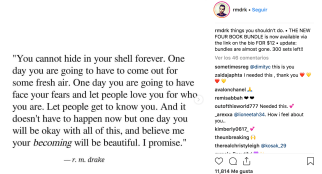


 While there are others who find themselves barely being able to string words together to make what they think is a “good” sentence, let alone, a longer piece of writing. I get it. Truly, I do.
 (We all know about senioritis) But it was the only class on my schedule that semester I was concerned about, as I didn’t know what to expect. “Advanced Composition” read as if I was going to be plunged into the icy academic waters, left to sink or swim. So, sitting in the lecture hall on the first day of class, I was surprised when the syllabus listed a narrative as the class’s first formal assignment. First, I wondered about its elementary nature, how it seemed trivial for English majors. Then I began to panic. What was I going to write? How was I going to structure it? What ways could I approach such a broad topic? How would I know if I was writing it correctly?
 (Apple, 1997)
 in this blog concerning writing, but I wanted to focus on something that would be especially useful to the future endeavors of the writing community here and at large. It’s a topic I didn’t have access to or knowledge about accessing until well into my own academic and creative writing career: submission and publication.
 writers. I also think that these strategies would be effective for writers of all experience levels—from a first year undergraduate in their first college class, to a PhD student working on their dissertation.
 for all of us if I use this the blog to offer some advice on getting through the crucible of finals.
 University of Louisville Writing Center