Category: Working in the Writing Center

University Writing Center (r)Evolution?

Cassie Book, Associate Director

Many posts here on our blog are about the writing and tutoring processes, but another important part of “who we are and what we do” is participate in scholarly conversations. This month I attended the International Writing Centers Association (IWCA) annual conference. The theme, Writing Center (r)evolutions, challenged me to rethink my own assumptions as a consultant and administrator. I’m sharing a few of the half-formed thoughts and questions. I want to invite you into my conference experience. By doing so, I hope to blur the invisible boundaries between daily practices, personal reflection, conversations, and research; I want to make our behind-the-scenes writing center conversations a bit more visible.

  • Foremost on my mind is the University Writing Center’s impending move to the first floor of the library. We’re excited to gain a more visible space and digital consultation rooms. But we’re also gaining new neighbors: the Digital Media Suite, REACH Computer Resource Center, and Research Assistance and Instruction. Stacy Rice’s presentation confronted anxieties that exist when separate centers, such as writing, speaking, digital, or communication, have somewhat overlapping missions. She challenged all centers to not attempt to divide communication into different realms and instead simply respond rhetorically to the writers and composers who seek response and feedback. Our new space and location affords us the opportunity to collaborate in ways that previously may have been difficult. Will each center embrace opportunity or retreat into our separate spheres? What are the best ways to collaborate?
  • Regardless of any (r)evolution or renovation, I think it’s safe to assume our writing center services will always include the individual consultation. Yet, writing center research still has work to do in understanding the dynamics of writing tutoring. Molly Parson’s research focuses on consultants’ perceptions of conflict during sessions. Parsons made me think about the expectations consultants and writers have for sessions. She seemed to suggest that while both sides may think “good” or “productive” sessions will be those that steer clear of conflict, but, in reality, conflict can spur ideas and those “ah-ha!” moments. Do we learn because of, not despite, conflict?
  • We work with many multilingual writers. Nicole Bailey’s presentation suggested that centers should consider providing tutoring in writers’ home languages when possible. Her ethnographic research in a multilingual university in South Africa suggests that when writers feel comfortable, they will learn more. She’s already embraced the practice at the writing center she directs. How can we bring writers’ home languages into the writing consultation?
  • All the consultants in the University Writing Center are graduate students who complete a course called Writing Center Theory and Practice. Kelsey Weyerbacher and Jack Bouchard, two undergraduate consultants, presented their experience and research data. Their perspectives challenge the (mis)conception that a tutor is just a tutor. Yet, writing centers are fruitful sites for research that informs issues of learning, writing, development process, response, space, and conversation. What happens when tutor-initiated research becomes the rule rather than the exception?
  • Matt Dowell’s presentation suggested that writing centers should pay more attention to paratexts—handwritten notes, charts, marginalia, and drawings—written or drawn during sessions. These texts may have untapped potential. In a separate presentation, Matthew Rossi argued that doodling in sessions can create opportunities for common ground and understanding that talking simply cannot.

Finally, a panel organized by Muriel Harris challenged writing centers to better use online spaces—listservs, blogs, databases, and websites—to share across centers and among local contexts. An important question that arose during the discussions was: Who do our blogs reach? Our UofL Writing Center blog had 7,541 unique visitors in 2014. We’ve had 6,263 so far in 2015. But who are you? Is there a better way to reach our target audiences?

To that end, I encourage you to be radical—comment on the blog and let us know. What are your thoughts on writing center (r)evolutions?

Rethink the New Semester Reset

Cassie Book, Associate Director

As the first two weeks of fall semester wound down on a hazy August Friday afternoon, I found a spare moment to reflect on the work already done in the University Writing Center. Typically, when I imagine writing situations early in the semester, I immediately think of getting started on class writing assignments. In fact, when I visit classes to speak about the University Writing Center, I suggest students visit at the beginning of their writing process, to brainstorm and plan. Yet, many of the writers we’ve met here in the past two weeks aren’t just getting started. What are they up to?

We’ve met writers with projects not limited by the semester timeline. Some were in the final stages of editing academic journal articles; the research likely began several years ago. Others spent the summer revising personal statements for graduate school applications and wanted more feedback before submission. Still others have returned to U of L as graduate students with a renewed commitment to improving their writing with each opportunity. These writers embrace writing as a lifelong process and practice. They haven’t pushed the “reset” button at the beginning of the semester like, I’ll admit, I tend to do.

What if you’re already in the mindset of resetting at the beginning of each semester? You’re not yet working on a personal statement for graduate school. You wouldn’t know where to start on research for a journal article. Relax. I’m not suggesting that you embark on a lengthy writing project. There are other ways to commit to building and bridging your writing skills from semester to semester. Instead of starting from scratch each semester, take stock of what you’ve already learned and know about writing and your writing process.

We learn best when we begin to integrate concepts from one class or experience with new experiences. Another way to think about it might be learning a sport, say, basketball. You first try it out—shoot hoops with friends or family. Then, you play casual one-on-one. Next, you add more players and basic guidelines, maybe parameters like a time clock or a referee. Eventually, you’ll advance to having a specialized role (guard, center, forward) and even breaking the general guidelines. Of course, the learning process is never so straightforward, structured, and sequenced. The point is you’re always learning because each game the context is slightly different. You’re constantly building on your skills, observing others, listening, and responding to the other players. Learning to write is a similar process, though the “rulebook” is much more flexible than a given sport’s.

When confronted with a “new” writing task, take a few moments to reflect on how it relates to the writing you’ve already done—any writing, for academic or personal reasons. Maybe the subject matter is different, but can you identify similarities in structure, purpose, or audience? What do you know about your process? How do your professors and peers typically respond to your writing? How do your Twitter followers respond to your writing? Though at first a writing task might seem unfamiliar, try to link it to what you’ve already accomplished. If you shift your approach and thinking now, you’ll be better prepared later to embark on more in-depth and high stakes writing with confidence.

Welcome to Fall 2014!

Bronwyn T. Williams, Director

The start of every academic year always involves new encounters. Students and faculty meet for the first time in classes, many students have new roommates, and many faculty have new colleagues. I think for everyone the anticipation – and uncertainty – is exciting and adds to the buzz around campus when the new semester begins. I always feel the excitement of the new semester when our pre-semester orientation at the University Writing Center takes place the Thursday before classes start. Writing Center Orientation is the

University Writing Center Staff - 2014-15
University Writing Center
Staff – 2014-15

day when I get to meet the new graduate students who will be working as consultants for the coming year. While I know about these new graduate students from what I’ve seen in their application files – where they went to school, for example – I don’t really know them at all. One of the things that is fun about the year ahead is getting to know these people, as people, as tutors, and as scholars. You can take a look at our website to find out about our staff for the coming academic year. It’s what I’ve yet to learn about the new consultants that will be part of what will make my year ahead interesting.

The new consultants all take a graduate course with me on Writing Center Theory and Practice and, through that I know that there are some foundational ideas about teaching writing that they will learn and use during their appointments with students. We talk about the need to work in dialogue with students and not edit their papers for them, for example, and the importance of not just helping students make their current drafts stronger, but also helping the students learn writing skills and strategies that will help with future writing challenges. Yet, while all the consultants are expected to adopt these foundational ideas, I also realize that everyone will develop an individual style as a tutor. Some consultants work quietly, others more effusively. Some consultants develop a talent for instructive metaphors, while others are masters of reaching and reassuring more reticent students. For me, seeing how these different approaches to tutoring develop is always fascinating and enjoyable. The one thing I do know, in meeting our new staff, is that all of the consultants are talented teachers who, grounded in theories of effective writing pedagogy, will provide thousands of UofL students, faculty, and staff with effective feedback and advice on their writing.

So, the University Writing Center is open for the semester. Make your appointment today and meet our great new staff in person.


Summertime, and the Planning is Busy

Bronwyn T. Williams, Director

During the summer, the pace of things at the University Writing Center does slow, but doesn’t stop. We still see students working on summer courses, or those closing in on finishing their dissertations. We also spend much of the summer planning for the next academic year. One of the big changes we’ve been working this summer is fine-tuning our new, online scheduling system. This new system not only makes it easier for people to make appointments, but also is huge leap forward in making our Virtual Writing Center more effective and easier to use. I’ll be writing more about the scheduling system in the next few weeks, but if you want to see some videos about how to make an appointment or how to use the Virtual Writing Center if you’re a distance education student, you can watch some videos and read more about it on our Appointments page.

The beginning of August also means the beginning of orientations around UofL. We’re grateful to the schools and departments around UofL that invite us to their orientations to talk about the University Writing Center. Last week was the Kent School of Social work, today we’re off to the Health Sciences Campus, and next week we’ll be visiting the School of Interdisciplinary and Graduate Studies (SIGS) orientation and several others. One of our ongoing challenges at the Writing Center is making clear to the campus community who we are and what we do. Everywhere we go, we emphasize that we work with everyone in the UofL community, including all undergraduates, graduate students, and staff and faculty. What’s more, we work with people on any kind of writing – whether for academic work or projects outside of school – at any point in the writing process. If people are just getting started, we can help with ideas and organization, and if they have drafts we can help provide feedback and advice then as well. If it’s writing, and if the writer is part of the UofL community, we’re happy to work on it. For people wanting more details on how we work, we have new Frequently Asked Questions on our webpage or you can read our Mission Statement.

We’ve also been planning our Graduate Student Workshops on Writing Issues, in collaboration with SIGS. If you’re a graduate student and would like to hear more about issues such as how to organize a large writing project such as a dissertation, or how to read and respond to graduate-level scholarship, or how to approach getting published, you can find more information and register for the workshops by visiting the SIGS PLAN website.

Finally, like many other faculty, I’m in the midst of planning my fall courses. This is the time of year we try to remind faculty that we are available to come to their classrooms this fall semester for brief 5-to-10-minute presentations about the University Writing Center. We find that, having one of our consultants come to your class, talk about the Writing Center and answer questions, is one of the best ways we have of reaching out to students at every level and in every discipline. If you want to schedule a classroom presentation, just follow this link. If you want to learn more about how we work with your students in the Writing Center, you can find answers to those questions on our website as well.

Stay tuned for more news about our plans for the coming year. And, enjoy those last warm days of August.

A Year of Success in the University Writing Center

Bronwyn T. Williams

Director, University Writing Center

In the rush to meet deadlines, turn in papers, finish grading, and all the other actions that mark the end of an academic year, we can become so focused on navigating what’s ahead of us that we lose sight of the journey we’ve completed. I always think it’s useful to look back and reflect (no surprise to those who know me). As with every year, the central mission of the Writing Center has been to work with members of the university community to help them become stronger writers. The consultants in the Writing Center have worked with thousands of students, faculty, DSCN1756and staff on everything from dissertations to lab reports to job letters to novels, and have done an amazing job from the first day of fall semester to the last day of this term. In addition to this ongoing teaching of writing, however, this year in particular has been an eventful year at the University Writing Center. It’s worth taking a moment to point to some of the accomplishments, and to talk about what they are going to allow us to do in the future.

Some of what has taken place has been new:

Writing Center Website: In February our new website went online. Not only is it easier to navigate, but we have new material online to help writers. For example, we have links to answer questions about Common Writing Situations faced by both undergraduate and graduate students. We also have up-to-date handouts on everything from strategies for revision, to writing better introductions and conclusions, to issues of grammar and style. We will be continuing to build the website in the common year to add more resources for students and to create resources for faculty writers and about the teaching of writing.

Virtual Dissertation Writing Retreat: We held our first online Dissertation Writing Retreat for distance students in January and plan to have similar events in the coming year.

Writing in the World Art Show: We held our first, juried art show focused on ideas and images about writing. Titled “Writing in the World,” and organized by Gabrielle Mayer in Fine Arts, the show opened as part of the Symposium of Student Writing in March.

“How I Write” Blog Series: Writers as varied as University President James Ramsey, sports blogger Mike Rutherford, professor and Associate Dean for Graduate and Postdoctoral Studies at the School of Medicine Tom Geoghegan, and novelist Brian Leung contributed to our new blog series on “How I Write.” Each writer offered insights into writing processes and tricks and approaches to writing. The series, the brainchild of Assistant Director Ashly Bender, will go on hiatus for the summer but return in the fall.

Some of what happened was the growth of ongoing Writing Center projects:

Writing Center Social Media: Our presence on Twitter and Facebook became more frequent and popular over the past year. And our blog not only brought ideas about writing and Writing Center work to the UofL community, but also connected to writers, teachers, and tutors around the country.

Dissertation Writing Retreats:We will continue to have our popular Dissertation Writing Retreats in the spring and fall semesters at the University Writing Center.

Workshops: Our Writing Center staff conducted a broad range of writing workshops in both courses and for student organizations on issues such as revision, writing a literature review, citation styles, and resume writing.

Finally, in addition to carrying on with these ongoing projects, there will be more changes in the year ahead:

WCOnline Scheduling Software: Starting in May the University Writing Center will move to new scheduling software. This new scheduling software will make it easier for students to make their own appointments online, and make it easier for us to coordinate and work with writers, both in person and online. If you’re planning on coming back to the Writing Center in the fall, take a look in the summer and take a moment to register with the software.

Videos about Writing: We’re planning on creating more videos that respond to student concerns about writing and writing processes.

It has been another strong year at the University Writing Center and I want to thank all the writers who made appointments with us and all the faculty who supported our work by recommending us to their students.

I also want to thank all the amazing Writing Center staff for such a great year. The positive, supporting, and productive work that takes place here, and the transformative effect it can have on students, comes from the thoughtful and dedicated work of our staff.

We will be open during the summer, starting May 12, from 9-4 every weekday. Meanwhile, take a look at our website and we hope to see you soon.


 Writing Center Staff Achievements

The University Writing Center, in addition to its teaching mission, is also an active site of scholarship about the teaching of writing. Staff from the Writing Center were engaged in a number of scholarly projects during the past year in rhetoric and composition, literature, and creative writing.

Jennifer Marciniak, Assistant Director for the Virtual Writing Center, was recognized by the Southeastern Writing Center Association as Graduate Student Tutor of the Year for 2013-14. She will be starting a job with the Writing Center at Berea College this fall.

Ashly Bender, Assistant Director of the Writing Center, published a chapter titled “Exploring Student-Veteran Expectations about Composing: Motivations, Purposes, and the Influence of Trauma on Composing Practices” in the collection Generation Vet: Composition, Student Veterans, and the Post-9/11 University.

Layne Gordon, a consultant, had her article on “Tutoring with Genre: Making Connections Between Genre Theory and Writing Center Pedagogy,” accepted for publication in Praxis: A Writing Center Journal.

And the Writing Center staff presented at a variety of conferences during this academic year.

Ashly Bender – Eastern Kentucky University Tutor Appreciation Workshop

Megen Boyett – Rhetoric Society of America and Louisville Conference on Literature and Culture

Daniel Ernst – Kentucky Philological Association; Louisville Conference on Literature and Culture

Meghan Hancock -Southeastern Writing Center Association

Jennifer Marciniak – National Conference on Peer Tutoring; Southeastern Writing Center Association

Dan McCormick – Language, Literacy, and Culture Graduate Student Conference; Louisville Conference on Literature and Culture

Jacob Robbins – Louisville Conference on Literature and Culture

Adam Robinson – Eastern Kentucky University Tutor Appreciation Workshop

Jessica Winck – Eastern Kentucky University Tutor Appreciation Workshop; Research Network Forum

Rick Wysocki – Language, Literacy, and Culture Graduate Student Conference; Louisville Conference on Literature and Culture

This summer Ashly Bender, Jessica Winck, Adam Robinson, and I will be presenting at the Council of Writing Program Administrators conference.

Finally, congratulations go to Megen Boyett and Amy Nichols for completing their MA program and to Amy for being admitted to the UofL Ph.D. in Rhetoric and Composition.


4 Resolutions for Spring 2014

Ashly Bender, Assistant Director

For many people, Ashly_Version_3January is a time for new resolutions, a time to set goals for ourselves over the next 12 months. Our director, Bronwyn Williams, has written in the past about how “new year’s resolutions” for those whose schedules are governed by the school system generally come in August. I fully agree on that count, yet this Spring semester is unique for me. Hopefully by August I will have finished and defended my dissertation—meaning this may be my last semester as a student, in the official sense. Even if I don’t manage this grand feat, this is certainly my last semester at the University Writing Center. A fact I lament, even as I put up a new Texas landscapes calendar next to my desk. Because endings are looming on the horizon, I find that this Spring, more so than those in the past, I’m thinking about the things I hope to see accomplished by myself and others in the coming months.

  1. Most of our tutors will be finishing up their first year of graduate school, and one of them will be graduating. One of the great things about working in the writing center is seeing people grow and learn, and hearing them talk about all the interesting ideas they develop. This is true with our clients and our tutors. So I’m excited to see and hear about all the projects and ambitions for the future our tutors hold.
  2. We are continuing to get more readers and followers on our blog, Twitter, and Facebook. Across our social media, the Writing Center hopes to offer resources and advice for writers at all levels, and also a bit of humor. Also, on our Twitter, we post in the afternoons about upcoming availabilities, something that is especially helpful during mid-semester and finals when we get busy. On our blog, our tutors discuss in more depth about particular writing concerns, habits, practices, and experiences. Also, we’re excited to have our first full semester of our new How I Write series, in which established professionals from a range of fields discuss their writing practices; we’ve already heard from a couple creative writers, an engineering professor, and a law professor. I hope we continue to get more readers, and that our readers spread the word about our sites.
  3. The Writing Center had a record number of appointments last year, and we’re eager to continue serving the diverse UofL population. For many semesters in a row, our number of appointments has been growing. We fill nearly every available appointment, and our Virtual Writing Center is popular as well. Our staff and tutors work hard to be responsive to our clients’ various concerns, and we’re constantly brainstorming ways in which we can be more helpful and available. Our survey results from last semester showed that:In answer to the statement: “My Writing Center consultation addressed my concerns about my writing project,” more than 97% of respondents selected “Strongly Agree” (72%) or “Agree” (25%).

    In answer to the statement: “What I learned during my Writing Center consultation will help me with future writing projects,” more than 94% of respondents selected “Strongly Agree” (64%) or “Agree” (30%).

    In answer to the statement: “I plan to use the Writing Center again,” more than 94% of respondents selected “Strongly Agree” (74%) or “Agree” (20%).

    In answer to the statement: “The Writing Center staff were welcoming and helpful,” more than 97% of respondents selected “Strongly Agree” (80%) or “Agree” (17%).

  4. Finally, no surprise, I’m looking forward to making progress on my dissertation. Writing a dissertation can be a difficult, circuitous, and sometimes just overwhelming task. Working with other graduate students in the Writing Center—at the Dissertation Writing Retreat and otherwise—has helped me to understand this process better and to just keep trying new strategies when I’m feeling stuck. Still, as with any large project, the process is marked by ups and downs. Thus, one of my major goals is to keep myself working and progressing toward my defense and being able to call myself “Doctor.”

As your Spring begins, what sorts of goals (or resolutions, if you prefer) are you hoping to achieve over the next few months? Over the next year? At the Writing Center, we are versed in developing processes, strategies, and plans for tackling writing projects, and we’re not only happy but eager to work with you on those projects. Together we can achieve our goals for this semester, this year, this/these projects.

Writing Center Talk, Part 2

Adam Robinson, Associate Director

We give writers thoughtful response and engage them in meaningful dialogue, both of which are aimed at helping writers think about their writing differently and which also hopefully provide these same writers with a bit more confidence to try new things in their writing.  I’d say that’s goal one.  But I can tell you that there are lots of other ways that we help the writers who visit us.

AdamEvery time I write one of these blogs, I can’t help but think back to when I was a student at U of L visiting the Writing Center.  After my first appointment, I was hooked.  I valued my consultant’s feedback, and I appreciated the kindness of the people working there.  But I got something else.  Probably something I didn’t really notice at the time—at least not consciously.  The Writing Center was a place where I felt like a writer, not simply a student who was asked to write something for class for a grade.  I feel like I inhabited both mindsets in college, and my chosen mindset was usually based on how invested I was in the writing I was doing at the time—and that feeling of being invested was determined by many internal and external factors.  Either way, the writing still got done.  But I do find value in being mindful of the fact that if you write, you are a writer.

I like to think that the people who visit us think of themselves as writers when they are in our space—though I hope they feel that way all the time.  We make an effort to remind them of that fact that they are writers.  Consultants treat the writing seriously; that writer’s writing is the subject of conversation.  And the craft of writing is emphasized, meaning that writing is treated as something that can be honed, played with, improved upon—where writing is considered a necessary and lifelong activity.

But I’d like to shift focus away from our consultations.  I’d like to think that students enter that writerly mindset before they even begin their consultations.  I realized this the other day.  My office is right next to the lobby where those who have signed in for appointments are waiting for their consultants to greet them.  I love being near this space.  I get to meet a lot of people and continue conversations with those who regularly visit the Writing Center.

But I also get to hear interesting conversations among students, among writers—and that’s what I want to highlight here.  One of these conversations happened the other day—and when they happen, they generally look the same: writers who don’t know each other sitting around talking about the writing they are doing.  The conversations almost always start with a “what are you here for” type of question but so often move to writers summarizing their projects for each other and sharing their ideas and frustrations.  I think the take-away for those participating in these conversations is that they are reminded that other people are writing too—and are experiencing ups and downs and moments of clarity and confusion.  And an equally important take away is that writing takes on many shapes and sizes at the university.  I’ve listened to doctoral students explain the process of writing a dissertation to a freshmen who has brought in an introduction to college writing paper.  Or an engineering major lay out the details of a technical report to an English major writing a literary analysis.  Or an international student talking about his native language to a native English speaker and sharing his experience of writing in a new language.  When I count these conversations, it makes me realize that the writers who visit talk a lot about their writing when they come—they also answer questions about their writing when they make appointments and of course talk extensively about their projects in their consultations.

I suppose this blog has me wondering how we might have more of these conversations—though the ones that happen organically are the best.  I remember thinking similar ideas when I was an academic advisor.  I’d have conversations all the time with students about their work.  What I found was that students didn’t have many opportunities for talking about the work they were doing in class—or they didn’t take the opportunity.  Among friends they may have been having conversations about what they were learning or reading—or about an interesting idea that their professor mentioned in a lecture.  But they didn’t seem too practiced in talking about their own work—their own projects—which happen to be where they do the most learning.  So I guess it goes without saying that I’m thankful we can provide space for these types of conversations.  If anyone has thoughts, please share!  Thanks.

Imagining and Developing Writing Centers: A Reflection on SWCA-KY 2013

Dan McCormick, ConsultantDSCN1636

What does a writing center look like?  Does it look like rows of tables and desks?  Couches?  Computers and projectors and marker boards? Does it look like Legos and Play-Doh and glass walls and Ab-Ex décor?

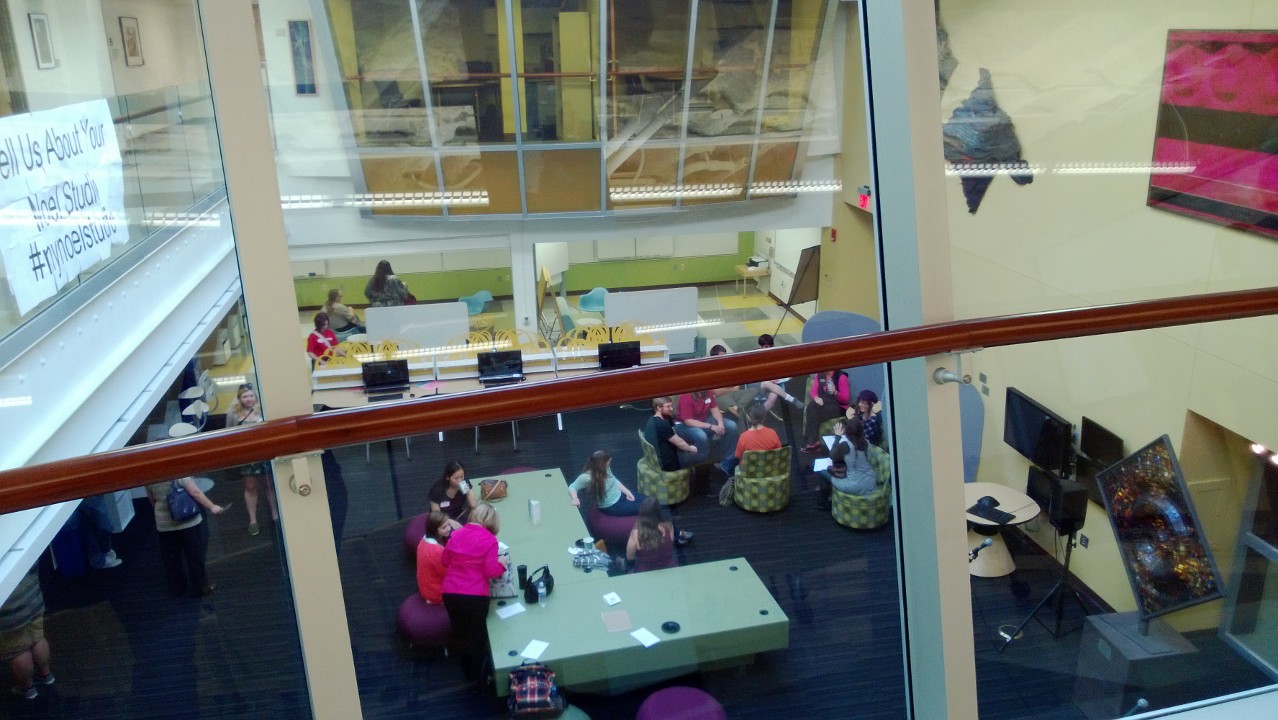
The Noel Studio at Eastern Kentucky University does.  This was the site of the SWCA-KY Statewide Fall 2013 conference, which I attended on Friday September 20th along with the rest of the U of L Writing Center delegation.  Fitting that we should spend our day in a space that brings that aforementioned question to life, because broad questions of what a writing center looks like—in terms of space, technology, methodology, and campus finance—were on everyone’s minds.

The view from above Noel Studio at EKU

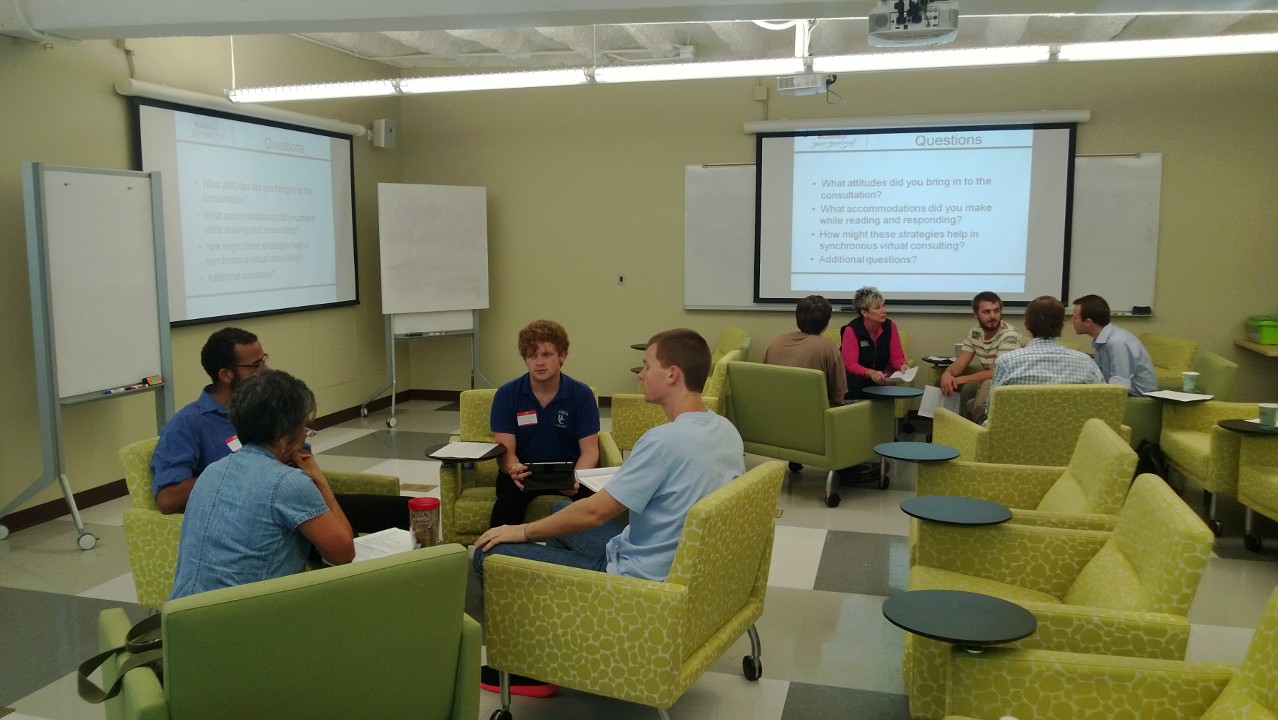
Our ADs Adam, Ashly, Jennifer, and Jessica delivered a presentation on the U of L Virtual Writing Center, which serves students and faculty via email consultation or video chat.  The description of our online pedagogy was not new to me, but it was really cool to hear staff from other centers weigh in.  We discussed the challenge of identifying and addressing each writer’s needs without seeing a face or hearing a voice. (You can read more about our VWC here.)

Participants discussing approaches to virtual consulting
Discussing approaches to virtual consulting

In another session I attended, we discussed research questions on topics such as why students visit writing centers, how to increase visitor numbers, and how to best measure writing centers’ success.  I spoke to one man who was part of team in the process of developing a writing center at Hazard Community and Technical College in Jackson, Kentucky; we discussed how a writing center can best serve the needs of students from disadvantaged economic backgrounds who are interested in trade-programs, nursing, and technical writing.  The conference administrators encouraged all of us to develop our research ideas and submit abstracts for the SWCA regional conference in February 2014.

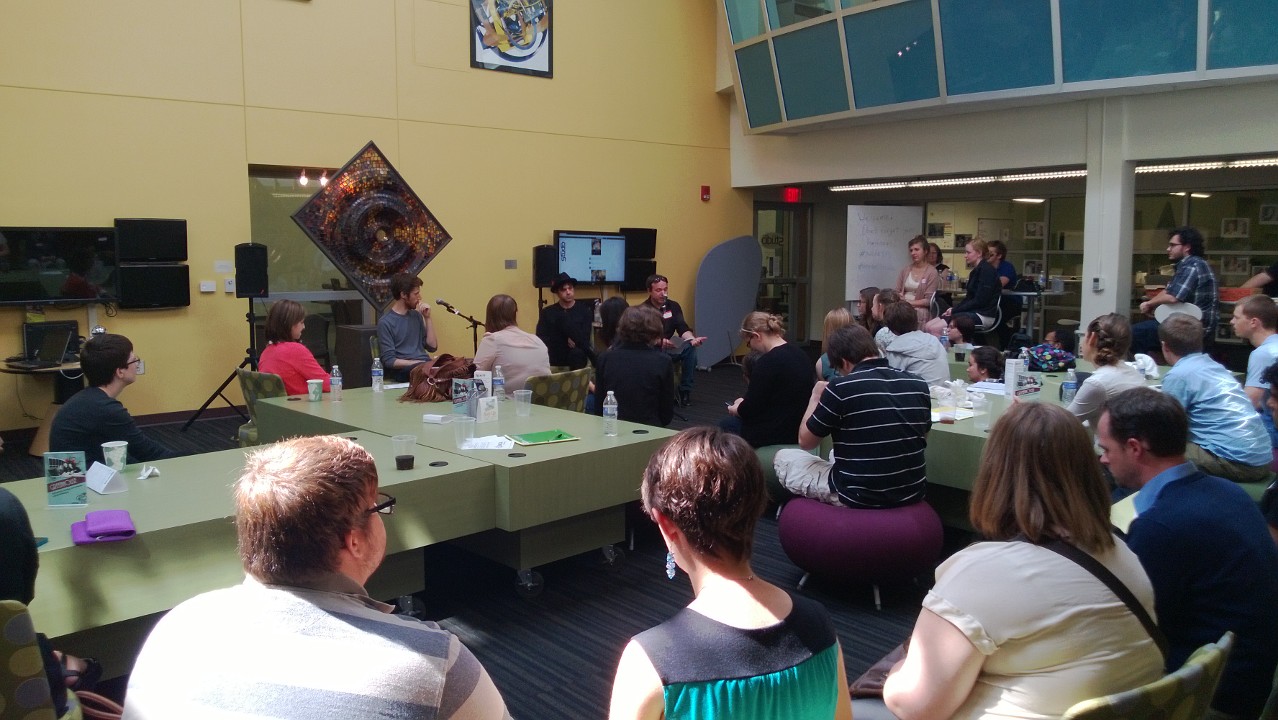
The conference’s keynote was a conversation with Kentucky singer/songwriter Daniel Martin Moore and EKU-alum/producer Duane Lundy, who discussed the collaborative aspect of creativity.  Along with a few songs, Moore shared his thoughts on what makes for the best time and space for writing.  If you’re in a hotel room in Costa Rica and the muse descends, Moore said, it’s time to clear your schedule and focus.  Lundy, on the other hand, described the importance of creating a safe environment for experimentation and creativity while making records at his studio, Shangri-La.  The two agreed that sometimes it’s best to take hold of whatever creative spark the situation offers, and sometimes it’s best to engineer the space and atmosphere to your advantage.  They also discussed how technology has made the process of creating music much easier—that could mean smart phone recording apps, pitch-shifting programs, and even moveable walls.  Drawing parallels between collaboration in the music studio and collaboration in the writing studio, Moore and Lundy emphasized that all creativity has its genesis in the bridges that art builds between people from different times, communities, and experiences.

SWCA-KY '13 Keynote Presentation
SWCA-KY ’13 Keynote Presentation

In sum, I found that writing centers all over Kentucky are asking the same question—what should a writing center look like?  How does technology fit in?  How can we ensure our place in the university’s budget?  How do we meet the needs of students from all economic backgrounds?  And, perhaps most importantly, how do we change the perception of a writing center from fix-it-shop to build-it-studio?  At EKU, it looks like comfy chairs and bright colors.  At U of L, it looks like iPads and an increasing online presence.  What does it look like at your writing center?

Looking Forward – and a Last Look Back – As We Get Ready For a New Year in the Writing Center

Bronwyn T. Williams, Director, University Writing Center

When I talk about working in the Writing Center to new consultants at our orientation, I make the point that the work we do has to be grounded in an ethic of care, an ethic of service, and respect for students. I never feel like this is a hard sell – people who didn’t already feel this way don’t usually apply to work in a Writing Center – and this year was no exception. After a day of conversation with the new group of consultants, I realized that they were all deeply committed to these ideas when they walked through the door.

DSCN1670
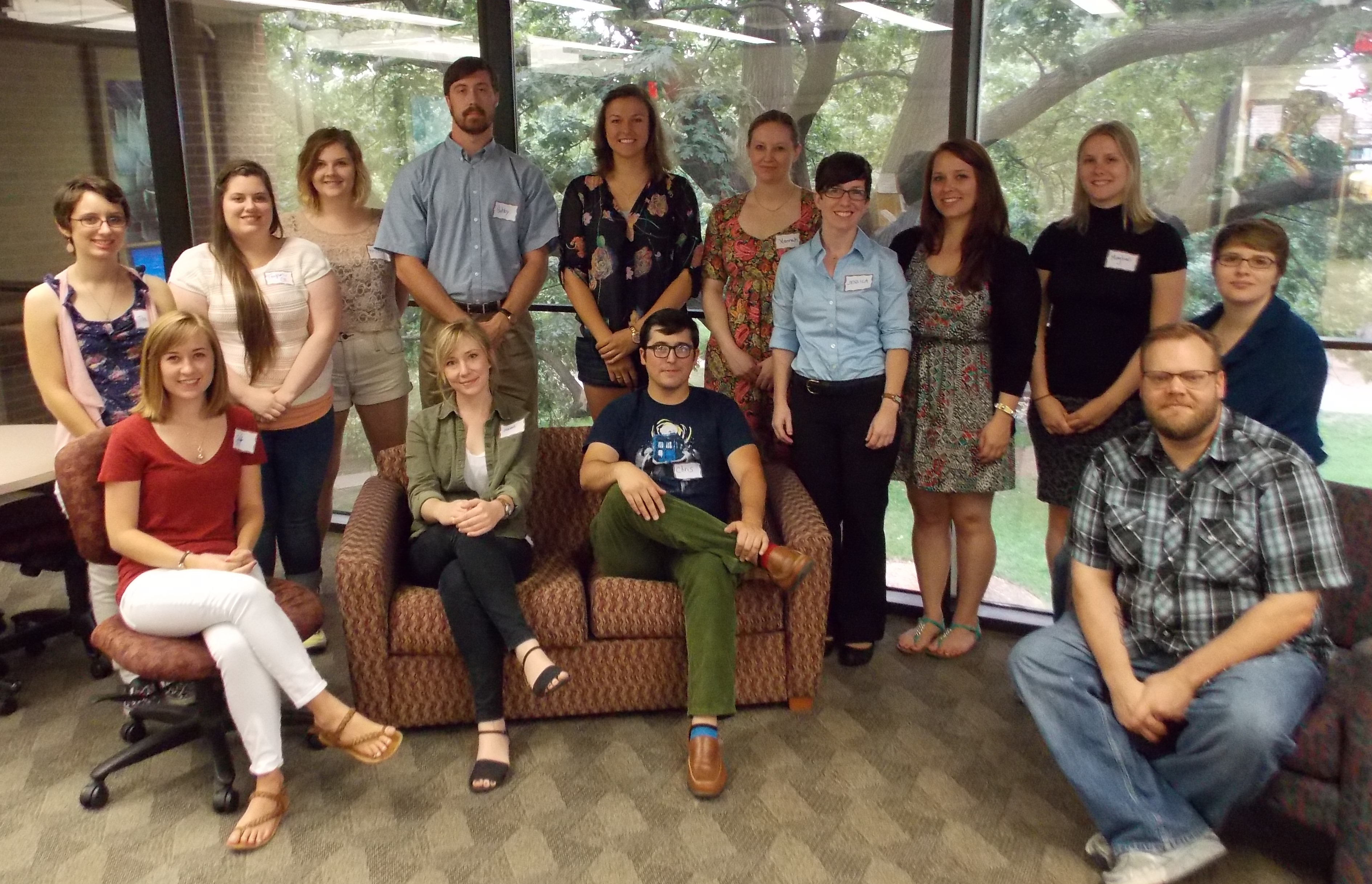
2013-14 UofL Writing Center Consultants

Working in a Writing Center is always a matter of striking balances. You need to listen to students and ask questions that help them discover for themselves how best to   improve their writing, while not withholding expertise and advice that will give them insights on how to revise their work. You need to be patient and not rush writers in a session, but you also can’t waste time and not get anything accomplished. You need to attend to the concerns writers identify during a session, but also bring up other issues you see in their work. You need to be friendly and reassuring, but also professional and honest. What struck me about the new group of consultants at our orientation was how quickly they identified these issues of balance on their own, and the productive conversation we began about how best to draw on these various qualities when working with students.

DSCN1662
Writing Center Orientation

A number of our new consultants come to us already having worked in other writing centers or as teachers, and all of them have the talent and enthusiasm necessary to be effective writing teachers. They bring a diverse set of interests and backgrounds to their work. Yet all of the new consultants understand, from the beginning, that our goal in the Writing Center is to not only help students with their immediate writing projects, but also help them develop skills and strategies writers that will benefit them throughout their university lives and beyond. Some of the new consultants are native Louisvillians, while others come from places including California to Virginia to Georgia. We talked at orientation about the ways that the Writing Center works with all writers in the UofL community – students, faculty, and staff – on any writing project, at any point in the writing process. I left orientation excited about the year ahead and confident that UofL writers will gain a great deal from visiting the Writing Center this year.

A Last Look Back

While late August is always a time of excitement as the new academic year begins, it also is a moment when we can take a last look back at the year we just completed. We had an exceptional year at the Writing Center, thanks to a great group of consultants and assistant directors and especially thanks to the work of Associate Director Adam Robinson.

A few of the highlights of the 2012-13 academic year were:

 Writing Center Consultations: The Writing Center had a successful year of more than 5,400 consultations on the Belknap and Health Science Campuses and through our Virtual Writing Center. This was a 10 percent increase in visits over the previous academic year.

 Exit Survey Results: Our exit survey indicated a high level of satisfaction with the Writing Center, by both quantitative and qualitative measures. Highlights of the survey are:

  •  In answer to the statement: “My Writing Center consultation addressed my concerns about my writing project,” more than 96% of respondents selected “Strongly Agree” (70%) or “Agree” (26%).
  •  In answer to the statement: “What I learned during my Writing Center consultation will help me with future writing projects,” more than 92% of respondents selected “Strongly Agree” (64%) or “Agree” (28%).
  •  In answer to the statement: “I plan to use the Writing Center again,” more than 96% of respondents selected “Strongly Agree” (78%) or “Agree” (18%).
  •  In answer to the statement: “The Writing Center staff were welcoming and helpful,” more than 97% of respondents selected “Strongly Agree” (78%) or “Agree” (19%).
DSCN1616
Writing Center Orientation

 Presentations and Workshops: During the academic year, Writing Center staff conducted 75 in-class workshops on writing issues (and increase of 51 over 2011-12) and 76 presentations about our services (an increase of 15 over 2011-12).

Dissertation Writing Retreats: The Writing Center held two Dissertation Writing Retreats during the spring and summer of 2013. In the May retreat, funded by SIGS, 14 Ph.D. students representing four different colleges and nine different disciplines spent a week in the Writing Center working on their dissertations. In July the Writing Center collaborated with College of Education to hold a retreat on three consecutive Saturdays, in order to provide opportunities to graduate students from that college who work full-time jobs. Nine students took part in this retreat.

 Assistant Director for Graduate Student Writing/Health Sciences Campus: In Fall 2012, the Assistant Director for Graduate Student Writing was established. This full-time GTA position (20 hours/week) is dedicated to the support of graduate students, paying particular attention to the needs of international graduate students on both the Health Sciences and Belknap Campuses.

 Writing Center Blog and Social Media: The Writing Center Blog, to which all members of the staff contribute posts during the year, was viewed more than 5,000 times in 2012-13.  In addition, the number of visits to our Facebook page and our Twitter account have both grown substantially during the past year.

 Campus Outreach: Writing Center staff worked with a number of University programs, giving presentations and conducting workshops. These programs included the Porter Scholars, A&S Advising, UofL Athletics, the Career Center, the Post-Baccalaureate Pre-Medical Program, Family Scholar House, the Delphi Center, E.S.S.E.N.C.E, Housing and Residence Life, First Year Initiatives, the Dental School, Student Affairs, Information Technology,TRIO, Ekstrom Library, and the International Center.

Now, to Look Forward

The accomplishments of the past year are things that we’re eager to repeat – and build on – in the year to come. We’re all eager for the year to get started and to work with all writers in the UofL community.

A Reminder to Myself: Seeing the Bigger Picture

Amy Nichols, Consultant

AmyI don’t know what it is about the summer – perhaps that bit of extra flexibility in my schedule has turned me towards the philosophical – but I recently had an interesting consultation with a student that left me thinking. We worked together on some organizational and grammatical changes to the paper, but had a bit of free time left at the end of the session. On the spur of the moment, I asked where he was from – he had a lovely accent, but I had never asked. He told me he was from South Sudan, and we had a great discussion about our respective home countries.

This experience started me thinking more carefully about the students I meet every day. They represent people groups from all over the world, from all walks of life – and I know that part of my training is to recognize that. But, and perhaps because of that training, it can sometimes be easy to break a patron down into an “eastern” or “western” writing style, into the component parts of their writing.

Before I was born, my dad was involved in a terrible car wreck that left him needing multiple surgeries. He was heavily sedated but remained conscious while hearing the doctors talk about fixing his hip the next day, “just the way you’d talk about fixing a car.” And I have to ask myself – do I, in some ways, reduce these students to the things in their writing that I can help them “fix,” and does that help or hamper my ability to do so? For doctors, I imagine that (at least in cases of trauma) focusing on what you can improve is an important mechanism that lets you do your job efficiently and effectively. And my father didn’t criticize his doctors for reducing him to his component parts – by doing so, they were  doing their job. But for my very different work of helping writers improve themselves, reducing an entire person to whether their writing meets certain criteria might interfere with being able to see the very things (their own creativity, the way they articulate ideas verbally rather than on paper, etc.) that will let them improve.

None of this is original thinking, of course. One of the first things we were taught at the beginning of last fall was to pay attention to students’ emotional well-being – if someone is crying because their paper is due in five hours but they’ve been away at a family funeral, the first focus is on that total person, on helping them get to a point where they can work on the paper. But in the rush of appointment after appointment and juggling life and schoolwork, it’s easy to begin to have a kind of surgical focus on papers and organizational structures. It’s easy, in short, to forget that key idea – that in front of me there is a human being with a complex existence outside of our interaction, and that paying attention to who someone really is can help me be a more effective writing consultant.