Transportation scenes are my favorite in any genre or medium. Airplane, train, automobile, boat, ferry, bus, elevators, even bridges and stations. Vehicles can function as devices in liminal spaces, transporting characters and audience between places, worlds, states of being, and can even reflect on social change. They speak volumes when a character is encountering, contemplating, or considering a change on any scale. Because traveling often involves observing or interacting with strangers, using vehicles or stations are common maneuvers for reflecting on the human condition. Transportation scenes augment the symbolism of story, allowing objects and action to serve multiple functions, enhancing the power and meaning of the text.
Think about the function of the Hogwarts Express in JK Rowling’s Harry Potter series or multiple plane rides in Neil Gaiman’s American Gods or even falling down the rabbit hole in Lewis Carrol’s Alice in Wonderland. These vehicles, stations, and modes of transportation serve as links between worlds that play to the larger themes of each work: the tension of being between those two worlds. If we narrow the scale from book series and novels to shorter works like flash fiction and poetry, transportation scenes communicate certain codes about what’s going on beneath the surface and in between the lines.
In Hemingway’s Hills Like White Elephants, two characters are sitting at a bar that lies between two train paths, one side of the tracks with lush and fertile land, the other side dry and barren. Hemingway doesn’t explicitly reveal the direction of either path or even the resolution for the tension. The emphasis is placed on the liminal space and pressure the characters feel while interacting between the two contrasting sides.
I encourage you to imagine or reflect on a time in transit or stuck between two places. Whether departing or arriving, explain the condition of the vehicle and/or station. Explore the sensory details, reveal the two worlds, and exploit the tension between them.
Our “How I Write” series asks writers from the University of Louisville community and beyond to respond to five questions that provide insights into their writing processes and offer advice to other writers. Through this series, we promote the idea that learning to write is an ongoing, life-long process and that all writers, from first-year students to career professionals, benefit from discussing and collaborating on their work with thoughtful and respectful readers.
Amy M. Miller is a writer and Administrative Coordinator for the nonprofit organization, Louisville Literary Arts. Amy’s essays have appeared in Salon, Hippocampus Magazine, [PANK], The Louisville Review, MOTIF, and Under The Gum Tree. She is a graduate of the Spalding University MFA in Writing program and holds an M.A. in English from University of Louisville. Currently, Amy is working on her first collection of essays as well as several children’s picture books. Amy lives in Louisville, Kentucky with her husband and two children.
Location: Louisville, KY
Current project:
I am drafting and revising two essays and one picture book, while simultaneously seeking representation for two other picture books. Lots of plates, constantly spinning.
Currently reading:
I’m finishing a guilty summer read, Sue Perkin’s Spectacles, a memoir from the host of The Great British Bake Off (I’m addicted). I also have a toe in Dear Mister Essay Writer Guy, by Dinty Moore, Beyond the Beautiful Forevers, by Katherine Boo, and Small Fires, by Julie Marie Wade. I’m a nonfiction writer and reader. All of the nonfiction I read informs what and how I write. That said, I love a good, engrossing novel and next up for me is Lauren Groff’s Fates and Furies and a kids’ middle grade novel my son is reading for school, Wonder, by R. J. Palacio.
1. What type(s) of writing do you regularly engage in?
Well, I’m a multi-tasker (which is a kind way to say I’m distracted). I love many different genres of literature and that is true for my writing, too. I began my MFA work in creative nonfiction, which is still my first love; however, after four years of writing personal and introspective essays, I needed to explore topics that were not about ME. I have always enjoyed the whimsical and hilarious prose of children’s picture books and have collected picture books even before I had kids of my own, so I joined the Society of Children’s Book Writers and Illustrators and have been writing books for 3-7 year-olds. It’s very freeing to write outside of my first genre, and loads of fun, too. Aside from creative writing, I work on public relations work (web content, press releases, social media campaigns), as well as contract grant writing.
2. When/where/how do you write?
I don’t have a specific time when I write because I have kids who constantly require feeding, chauffeuring, and all manner of attention, plus I work part-time. I write when I can — when my kids are in school, my workload is light, and the house is quiet. My writing spot has moved around the house. I used to make a home at the dining room table, but grew tired of moving my papers and iPad on and off the placemat. Most days, I’m parked at my desk in front of a giant screen in my hard swivel chair. When I’m brainstorming or revising, I might take the iPad or a notebook to the couch, where I sit next to my dogs. Invariably, all of my writing happens in the morning or afternoon. If I write at night, I’ll have too many ideas buzzing around my head to sleep.
3. What are your writing necessities—tools, accessories, music, spaces?
I love accessorizing — at least for writing. You cannot beat a good spiral bound notebook for notes — something that can lie flat or be folded over. For writing implements, I prefer a roller ball pen because the fluidity of ink allows me to continue writing without pause and doesn’t leave imprints in the paper. We writers are weird about our instruments. I also like odd colors of pens: purples, oranges, greens. But to be perfectly honest, I spend most of my writing time perched in front of the desktop computer, mostly because it is the most reliable device I own and I can save my work on the cloud and desktop. I also use Google Drive to share writing with critique partners. Over the years, I have moved away from listening to music while I write and prefer silence, but I always have a hot cuppa coffee and a bottle of water next to me.
4. What is your best tip for getting started and/or for revision?
I begin a piece in a variety of ways. Sometimes I have an idea while walking the dogs or sitting in carpool or taking a shower. I try to keep a small notebook in my purse or in the car, or at the least, a scrap of paper and pen nearby. Other times, I just sit at the computer and start free writing. I almost never write the full draft in one sitting. On complicated essays, in which I play with structure, I often need to break away from the writing and map out the essay as an outline. I highly recommend reverse outlining for revision. Start with your draft and outline what is on the page. Does it flow from one idea to the next? If not, move the pieces around and use the outline to direct how and where you will make changes. It feels less scary to cut and paste an outline and it’s a great way to look at the piece more objectively and holistically. Another invaluable word of advice: Always find an impartial reader who you trust to give you constructive feedback! My critique partners always see connections and glitches that I am unable to because I am too close to the piece. Lastly, read your work aloud. This is a foolproof way to find where a piece needs work.
5. What is the best writing advice you’ve received?
Be concise, cut your modifiers, and don’t hold your readers at arm’s length — invite your readers to see all of the ugly, messy truth. Readers respond to flawed narrators and non-fiction writers have a responsibility to the truth, no matter how uncomfortable that truth might be.
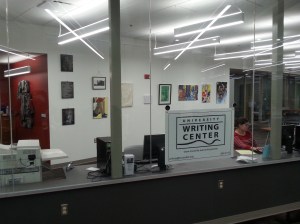
University Writing Center on the first floor of Ekstrom Library
October, it did taken us a while to figure out how the furniture worked best, get some art on the walls, and buy some new plants. Now, however, as we get ready to start the 2016-17 academic year, we are settled in and excited about the opportunities that our new surroundings offer us.
We plan to take advantage of our new space with a number of new and expanded programs and events in the coming year:
Creative Writing Groups:We are starting new creative writing groups for anyone in the UofL community interested in working on creative writing projects. The groups will meet once a month on a Tuesday during the fall semester allowing people to explore creative writing in a safe, open, and encouraging environment. Meetings will be times when people can will write, investigate issues of craft, read and respond to writing, and have fun. Any member of the UofL community is welcome – undergraduate and graduate students, faculty, and staff. We welcome any genre of writing and any level of creative writing experience—all you need is an interest in creative writing. For more details and the schedule of meetings, see our website.
Writing Center Events: We’re going to have a number of events in our new space this fall,
“Bad Love Poetry” Open Mic Night from Feb. 2016
from participation in the National Day of Writing on Oct. 2o, to a Finals’ Week Write-In to support getting final papers finished, to an open mic night on Halloween for scary stories and poems. See our Events page on our website for more details.
In addition to our Writing Center events, we also have some other new initiatives we are excited about.
New Undergraduate Tutoring Class : We have had approved a new course for undergraduates and MA students interested in learning more about teaching writing and then potentially doing internships in community literacy settings. The course, English 508 – Literacy Tutoring Across Contexts and Cultures will be offered in 2017-18. Students who take the course can then take part in tutoring internships in the community with organizations such as Family Scholar House and the Louisville Free Public Library.
Community Literacy Projects: We are also going to continue, and expand, our ongoing writing workshops and writing consultations at Family Scholar House. We view this partnerships as one of the key parts of our efforts to provide more writing consultation services to the larger Louisville community.
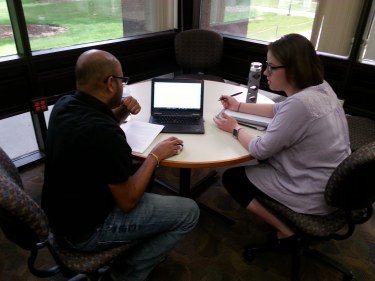
Of course, it isn’t only what is new here that is exciting. One of the most exciting things that will happen this fall is what happens here every semester. Day after day writers from across the university will bring their drafts and their questions about their writing to the University Writing Center and engage in thoughtful conversations with our consultants about how to make that work as strong as it can be. We have an excellent incoming staff of consultants who will be doing what we do best: helping writers improve the projects they are working on today, as well helping them become stronger writers in the future. On our exit surveys, more than 90 percent of respondents agree or strongly agree that their University Writing Center appointments both help them with their immediate writing concerns and that what they learn in appointments will help them with other writing projects.
The mission statement for the University Writing Center says that we believe writing is an “indispensable part of the intellectual life of the university.” We stand behind this belief and it is central to what we do. But, as the new semester begins, I think the events and programs we will offer in the year ahead will allow us to add to our mission the goal of creating and sustaining a culture of writing of all kinds, on campus and in our community.
Writing Centers – around the world – can be found in all kinds of locations, both physical and institutional. We’re fortunate at the University of Louisville to have a large and prominent new space on the ground floor of the main Library and to have the institutional support of departments and administrators across the university. Other writing centers have to find other ways to create spaces and identities for themselves when the university around them may not yet have figured out how much it needs a writing center – or even what one is. Recently, when I attended the Writing Development in Higher Education conference at Plymouth University in the United Kingdom, I had the opportunity to visit and learn about one of the more exciting and innovative approaches to creating a writing center that I have seen – The Writing Cafe.
The Writing Cafe is exactly what it sounds like. Located on the top floor of one of the
The Writing Cafe at Plymouth University
academic buildings, it is a place where writers (from both the university and community) can come to get a cup of coffee, have a writing consultation, attend a workshop, or just have a communal, social space to write. It’s a warm, welcoming space that combines the relaxed ambience of a coffee shop with conversations about writing. Even a brief visit made it clear that it was a place that was fostering and sustaining a culture of writing on campus and in the community – which is part of the essential role of any writing center. It certainly tempted me to get a coffee and hang out and write rather than going to the next conference session (but I did go to the next session….)
What makes The Writing Cafe so exciting for people doing Writing Center work, however, is not just the space itself. The story of how Helen Bowstead and Christie Pritchard created and put together The Writing Cafe is instructive – and inspiring – for people wanting to establish a writing center or just find a new way of thinking about how a writing center might inhabit a different kind of institutional and social space. Faced with a university that was reluctant to provide the space and furnishings for a writer center, they came across the abandoned cafe space and convinced the university to let them renovate and
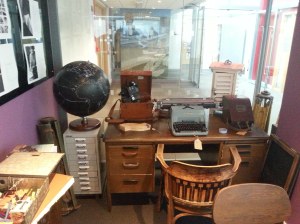
Literacy artifacts at The Writing Cafe
use it. They furnished it with cast-off tables and chairs they scavenged from around campus – as well as abandoned literacy artifacts of, such as an old typewriter, globe, and camera. Their explicit goal was to drawn on “coffee-house culture” to create a place that was social and informal, but also generative and engaging. They also had the ongoing support of the Learning Development team at Plymouth University. People coming to The Writing Cafe don’t make appointments, but just drop in to talk with the consultants who are on call at that time. Unlike some writing centers, they have decided not have appointments or keep records of consultations, so that the atmosphere and experience remains one that is more focused on nurturing a community of writers and less focused on assessment and evaluation of writing. The goal is not only to help people with their writing, but to give them an experience that helps them feel different about writing. Writing Cafe has been a huge success – primarily publicized through word of mouth among students.
Of course, this model doesn’t work for every writing center, but it is a reminder that there are other approaches and values that can be supported in writing centers in addition to
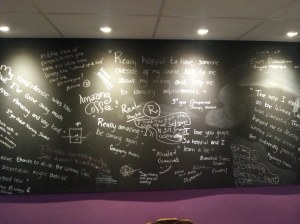
What happy writers have written on the board at The Wrting Cafe
just helping people with the draft in front of them. The idea of a space that offers writers a different emotional experience about writing, and that emphasizes the importance of conversation and the social nature of writing, is refreshing and exciting in a time when universities in many countries are increasingly focused on assessment and evaluation of writing. The Writing Cafe treats student writers – and all writers – like authors with something to say. Finally, The Writing Cafe is an example of what can be done, in a time of shrinking budgets, if you can be creative and work with what you have at hand. As someone interested in the idea of writing centers as “enclaves” of different practices, I was glad I got the chance to find out about this place.
The sound of people thinking. That’s what you would have heard had you come to the University Writing Center this past week. With fourteen UofL Ph.D. students focused on writing their dissertations. I swear that, given the intensity with which they were working, you could hear them thinking. This year marks our fifth annual spring Dissertation Writing Retreat. During the week, the schedule was the same: Writing in the morning, a short workshop and discussion on some area of
Dissertation Writing Retreat writers hard at work
research writing at noon (How to Write and Effective Literature Review, How to Revise and Respond to Committee Members’ Comments, How to Turn Dissertations into Publications, How to Keep Writing) , and the individual appointments with University Writing Consultants in the afternoon (and more writing…). The writers who took part in this year’s Retreat worked with a dedication and commitment that was inspiring. They came from eight different disciplines at the University: Anatomical Sciences and Neurobiology, Education, Engineering, Rhetoric and Composition, Humanities, Psychology, Public Health, and Sociology. The best way to get a sense of the experience of the Retreat and its impact on the writers who took part, however, is to hear from the participants and consultants themselves.
Participants
Amanda Pocratsky, Anatomical Sciences and Neurobiology: It’s hard to synthesize in few words how much this retreat has transformed my dissertation writing experience. As a graduate student in the biomedical sciences, I was initially concerned about how effective this retreat would for me. These concerns proved unfounded. In the span of one short week, I’ve written my dissertation abstract and a complete first chapter. I will leave here with over half my dissertation completed, a well-defined outline of my discussion, and incredible momentum to push through the final stages. Moreover, the writing skills I’ve cultivated from this experience will effectively translate throughout my scholastic career. I strongly encourage students to apply and come prepared to succeed.
Yvette Szabo, Clinical Psychology: The Dissertation Writing Retreat has been invaluable to my dissertation progress! I am still collecting data for my dissertation, so I was able to
Meghan, Rene, and Yvette hold a group consultation
use this protected time to write and edit large parts of my Introduction, Method and then outline my results and discussion. Overall, I doubled the length of my dissertation and received feedback on all sections. Typically, I shift between many roles as a graduate student, so having the quiet space to work (relatively unplugged) was necessary and much appreciated. And working with the same consultant all week allowed me to talk through presenting ideas for my complex study as well as receive feedback on organization and parallel structure. Thank you for a wonderful experience!
René Bayley-Veloso, Clinical Psychology: I would highly recommend that any graduate student who is working on their dissertation attend the Dissertation Writing Retreat. I have made substantial progress on my dissertation in a very short amount of time. The retreat also helped me organize my thoughts and questions, which allowed me to have a necessary and productive meeting with one of my committee members. I have learned quite a bit about my own personal writing process through this experience, and will be utilizing this knowledge to maintain momentum moving forward.
Jamila Kareem, Rhetoric and Composition: The 2016 Dissertation Writing Retreat has not only been the most productive time I’ve spent on my dissertation, but it has been the most valuable. The structure of the Retreat worked well, because it allowed me to prioritize my writing and get the most crucial aspects finished while I had guaranteed feedback. The Retreat helped me develop a more structured process to stay on track and to feel rewarded when I do. I’ve had a process that has worked pretty well, but the staff at the Retreat gave
Dilan and Layne work together
me strategies to build upon it and work smarter. And it’s free! Just look for professional dissertation help around the Internet—prices are crazy! I would recommend the Dissertation Writing Retreat to every doctoral student whether they are having trouble getting started or almost done. The feedback, time, and structure you receive are invaluable.
Abby Burns, Epidemiology and Population Health: The Dissertation Writing Retreat provided an encouraging environment to work quietly alongside other students who all have the same ultimate goal – completing their dissertation and graduating. It helped hold me accountable, but more importantly helped me build momentum that I hope I can run with in the following weeks/months.
Denise Watkins, Humanities: As someone who is married, a mother, and works full-time, the benefits of this retreat can’t be adequately explained. I was able to steal away from all other responsibilities and make significant progress. In one week’s time, my outlook towards my dissertation has changed from an insurmountable “where will I ever find the time?” project to a feasible, doable task.
Heidi Williams, Sociology: The Dissertation Writing Retreat provides supportive, focused writing time, as well as workshops and advice that help participants approach and manage their work. Working with a writing consultant helped me realize I was fixating on a problem, rather than making progress in an attainable way. I learned how to breakdown my writing into manageable, daily tasks that led to tangible results – an exercise that I could not put into motion myself.
Consultants:
Laura Tetreault, Assistant Director: In my conversations during the Dissertation Writing Retreat, either with the writers I was working with or the other consultants and writing center staff, we often circled back to one idea: writing is hard. (And interesting, and fun, and exciting, but also hard a lot of the time.) As a Rhetoric and Composition PhD candidate
Laura Tetreault leads a workshop discussion on turning dissertations into publications
and Assistant Director of the Writing Center, people sometimes I expect that I have this whole writing thing figured out, but the reality is that I became interested in writing teaching and writing center work because I also find writing to be really difficult a lot of the time. But instead of finding this discouraging, I actually find it comforting that most writers express at some point how difficult writing can be for them. The common experience of struggling with writing helps to diminish the inner critic that many grad students have in our heads. I can tell that critic: hey, it’s not me; writing is just hard sometimes. And it gets a lot easier for me when I can find a sense of community in the struggle.
Amy McCleese Nichols, Assistant Director: Watching writers work on their dissertations this week has reminded me why I love one-on-one writing conferences. It’s been great to talk through ideas and text with writers who have differing processes. For some, it seemed like the chance to talk through small sections of writing/thinking gave them better language to describe their overall argument and intervention by the end of the week. For others, designing study frameworks and making targeted edits to various sections of text
Rose and Amy discuss Rose’s dissertation
helped them accomplish larger goals. Working the retreat has also given me a better sense of what it might look like to write my own dissertation in the future; this is definitely an event I’d like to return to as a participant next year.
Layne Gordon: As a soon-to-be second year PhD student, I was so inspired this week by the progress of the writers I was working with! At the end of each meeting, we took a couple of minutes to set some writing goals for the next day. Although sometimes those goals had to shift or be adjusted (writing requires so much flexibility!), the writers always made progress and pushed themselves to get as much done as they could. While I got to learn a lot about their respective topics, I also learned a lot about the dissertation writing process itself and the importance of just not stopping.
Brittany Kelley: I learn so much when working with others on their dissertations, especially when it comes to the writing process. This year, I learned that it’s important to create a hierarchy of goals for your dissertation. The highest/most important goal is getting words on the page. The next highest/most important goal should be your well being. After you’ve got words on the page, remember to rest. See friends. Exercise. Eat well. Most importantly, be kind to yourself. You deserve it. Always.
Ashley Ludewig: I have always enjoyed working with students of all levels on their writing projects and this week’s retreat was no different. But, even though I participated in the retreat as a tutor, this week was also really helpful for me as someone who is also writing my dissertation. Talking with other writers as they thought through some of the most complicated parts of their projects and reflected on their writing processes reminded me to be more accepting of my own writing process and helped me see why I was feeling stuck in my own work. Now, instead of beating myself up over a lack of progress, I feel prepared to re-think my priorities for the next few weeks and make a plan that will actually work!
Meghan Hancock: This year at the diss retreat I was reminded of the importance of setting aside concrete time to write in a space without distractions. It seemed like many students most valued the amount of quiet work time that the retreat provided them with, and in my last consultation, we talked about how to create those kinds of spaces after leaving the retreat as well as how to continue to block out time in schedules just for writing. Though I always encourage others to maximize their productivity in these ways, I don’t always practice what I preach. Being able to see the amazing work ethic that students at the diss retreat had this year has inspired me to try harder to follow my own writing advice and to set aside more routinely scheduled quiet times for me to work on my own dissertation.
Thanks…..
It’s also important to acknowledge the people who did the hard work of organizing the Retreat – Cassie Book, our Associate Director, and Robin Blackett, our Administrative Assistant, and Assistant Directors Stephen Cohen, Amy Nichols, and Laura Tetreault. Thanks also to the fantastic consultants (themselves Ph.D. students) who do the most important work of the week in working with the writers: Layne Gordon, Meghan Hancock, Brittany Kelley, and Ashley Ludewig. And thanks to Dean Beth Boehm, of the School of Interdisciplinary and Graduate Studies for again sponsoring and supporting the Dissertation Writing Retreat.
While there is no such thing as an uneventful year at the University Writing Center, this year has been notable for the changes – and opportunities – that have taken place. The most obvious change was our move to a new space on the renovated
The New University Writing Center
first floor of Ekstrom Library. After fifteen years on the third floor, we finally moved at the end of October to our new space that we helped design. This new space is larger, more flexible, and allows us to begin to hold events that foster and celebrate a culture of writing on campus. We’re also more centrally located and can collaborate more closely with our partners in the Learning Commons, such as Library Reference.
It’s also worth noting that the amazing staff at the University Writing Center made the move in the middle of the semester without having to close for a single hour. Our staff is indeed amazing.
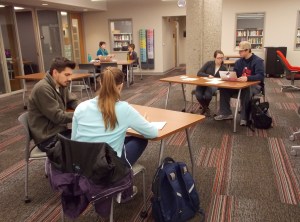
Before listing all the noteworthy accomplishments of the year, I don’t want to overlook the important, daily work the consultants here did in teaching writing. Whether working with first-year students or graduate students or faculty and staff, our writing consultants helped people with writing at every stage of the writing process. Our consultants are exceptional teachers who work with the writers who come here to make the writing stronger and the writers more confident. Just as important, our consultants have to be patient, good listeners, and respectful. We believe in starting with the writer’s concerns, working collaboratively, and focusing on learning, not grading. From our perspective it’s the way the best teaching and learning happens. There is a reason we will have more than 5,000 visits to the Writing Center by the end of the year, and that reason is our talented and dedicated staff of consultants.
I also want to thank my fantastic administrative staff who carried us through this year of change with calm, creativity, and good humor. Cassandra Book, who started this year as Associate Director, has been invaluable in every way, and is the force that keeps the Writing Center together. The four assistant directors, Stephen Cohen, Jamila Kareem, Amy Nichols, and Laura Tetreault also were indispensable in helping with the move as well as coming up with new and creative ideas for the Writing Center. Robin Blackett, with the help of our student workers Carine Basenge and Ecasia Burrus, ran the front of the Writing Center with patience and professionalism. All of them are the people who make the Writing Center work, day in and day out, and make it a positive and productive place for the UofL community.
Finally, we are all grateful for the trust placed in us by the writers who came to us to work on their writing. We are always learning from the writers we work with as they learn from us. The reciprocal and collaborative relationship is key to the work we do. I also thank all the faculty and staff who supported our work by recommending us to their students.
We will be open during the summer, starting May 9, from 9-4 every weekday. Meanwhile, take a look at our website and we hope to see you soon.
Other Reasons to Celebrate
In addition to our daily work of teaching of writing through one-on-one consultations, there are other events and activities that we organize, and other plans we are making. It’s worth taking a moment to point to some of the accomplishments, and to talk about what they are going to allow us to do in the future.
New Writing Center Projects:
Writing Center Events: One reason we are so excited about our new space is that is has allowed us to begin holding events to celebrate and
Open Mic Night with The White Squirrel Literary Magazine
promote writing in all its forms. Since our move to the first floor we’ve co-hosted an open mic poetry reading with The White Squirrel, writing group meetings in partnership with LGBT Center, a panel on how to get published as a creative writer in partnership with the Creative Writing program, and readings as part of the Celebration of Student Writing. Assistant Director Laura Tetreault led the planning and organization of these events for us. We plan to continue and expand these events in the coming year, so please keep an eye out for announcements.
Graduate Student Writing Groups: We started our first Graduate Student Writing Groups this spring, where graduate students could come and get support for their writing project through conversations and responses from their peers. Our Assistant Director for Graduate Student Writing, Stephen Cohen, will continue to facilitate these groups during the summer. Check out our website for more information.
Art in the Writing Center: We believe that the University Writing Center should foster
Looking in at our art from the Library study area.
student expression in many different forms. So, while we may be in a new location, we’ve continued our tradition of displaying student art in the Writing Center. We put out a call for art across the University and were happy to hang work by Sierra Altenstadter, Paige Goodlett, Jenny Kiefer, Ellen Lattz, Tom LeGoff, Claire Nelson, Cheyenne Nolan, and Jackson Taylor that will be on display at least through the summer. We also are excited to have Tia Wells creating paintings specifically for the Writing Center that we should be hanging during the summer.
Family Scholar House: Amy Nichols, one of the Writing Center Assistant Directors, has been holding regular writing workshops and consultations at Family Scholar House this academic year. Amy plans to continue and develop this work in the coming year as part of exciting plans to engage in more community literacy work.
New Literacy Tutoring Course: We proposed, and had approved, a new English Department course, English 508 – Literacy Tutoring Across Contexts and Cultures. This course will focus on the theory and practice of teaching writing in one-on-one and small group settings and will cover the theoretical foundations of teaching writing effectively in academic, professional, and community settings. Students will explore effective pedagogical strategies for working with writers from a variety of backgrounds in a variety of contexts. Students completing this course will be eligible for internships in community-based settings such as Family Scholar House and the Louisville Free Public Library. We will announce when the course will be offered as soon as we have that information.
Faculty Writing Groups: We continued our Faculty Writing Groups to provide support and feedback for faculty writers.
Writing Center Social Media: We continued to communicate our ideas about writing and the teaching of writing through our presence on Twitter and Facebook as well as our blog.
Dissertation Writing Retreats: Our Dissertation Writing Retreats remain popular and we are having the pleasure of seeing 90 percent of the students who attend the retreats complete their dissertations.
Workshops: Our Writing Center staff conducted a broad range of writing workshops in both courses and for student organizations on issues such as revision, writing a literature review, citation styles, and resume writing. If you would like to request a workshop, you can contact us through our website or by email.
Support for Distance Education Students: Jamila Kareem, assistant director of the Virtual Writing Center, not only continued to provide online writing consultations for students taking online courses, but also worked to include such students for the first time in the Celebration of Student Writing.
Writing Center Staff Achievements
The University Writing Center, in addition to its teaching mission, is also an active site of scholarship about the teaching of writing. Staff from the Writing Center were engaged in a number of scholarly projects during the past year in rhetoric and composition, literature, and creative writing.
Cassandra Book, Associate Director of the University Writing Center, Co-authored a chapter titled, “Tutor Observations as a Tool for Creating a Supportive and Productive Tutoring Environment,” in the editing collection, Communicating Advice: Peer Tutoring and Communication Practice. Her co-author was with Maureen McCoy, who is on the UofL REACH staff. Cassie also presented at the International Writing Center Association Conference, the Louisville Conference on Literature and Culture, and the Conference on College Composition and Communication.
Stephen Cohen, Assistant Director of Graduate Student Writing, presented at Conference on College Composition and Communication.
Jamila Kareem, Assistant Director for the Virtual Writing Center, published a chapter titled, “The Mogul Ethos and the American Dream in Contemporary Mainstream Rap.” In the edited collection, The Good Life and the Greater Good in a Global Context.
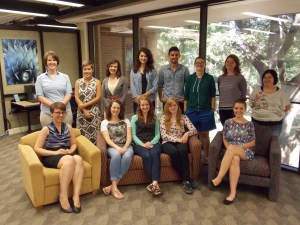
The University Writing Center Staff
Jamila also presented at the Feminisms and Rhetorics conference, the Workshop for the Transitioning to College Writing Symposium, and the Conference College Composition and Communication, where she was a recipient of a Scholars for the Dream National Travel Award.
Amy Nichols, Assistant Director of the University Writing Center, presented at the Conference on College Composition and Communication. Amy also received the English Department Creative Writing Award for Poetry.
Laura Tetreault, Assistant Director of the University Writing Center, had a coauthored article (with Bruce Horner) titled “Translation as (Global) Writing” accepted by the journal, Composition Studies. She has also had a co-edited book collection (with Bruce Horner )accepted for publication, titled: Crossing Divides: Exploring Translingual Writing Pedagogies and Programs. Laura also presented at the Feminisms and Rhetoric conference and at the Conference on College Composition and Communication.
Emily Blair presented at the Southern Studies Conference.
Rhea Crone has been accepted into the MA in English program at the University of Pittsburgh.
Cheyenne Franklin had her article, “Quintilian Education and Additive Bilingualism,” published in the journal Queen City Writers.
Jessica Good published five articles during her internship at Louisville Magazine in Spring 2016. Jess will also be the Henry James Review Graduate Teaching Assistant next year.
Anthony Gross presented at the Louisville Conference on Literature and Culture and at the Indiana University Comparative Literature Conference.
Jenny Kiefer had her poem, “Between Our Legs: On Women of the Warren County Jail,” published in the journal White Squirrel. Jenny also selected for an editorial internship at Louisville Magazine for Spring 2016 and will be the Assistant Director for Creative Writing Department next year.
Karley Miller received a Creative Writing Scholarship from the Department of English.
Are you feeling tense or anxious about an upcoming paper? Inconveniently suffering from writer’s block halfway through your assignment? Having trouble getting started, in the first place? Chances are you’ve experienced some, if not all, of these. All writers inevitably do. There is an incredible amount of helpful advice articles and blog posts about these common dilemmas circulating in the internet ethers, and therefore no shortage of discussion regarding their remedies. There is another dilemma that a markedly fewer number of sources address, however, that is no less dire than the aforementioned frustrations.
Apathy.
That’s right—it is a truth universally known yet not always acknowledged that writers sometimes simply do not care about an assignment. This does not mean they are “bad” writers, of course. They instead suffer from a deeply felt lack of interest in the topic they are writing about. This blog post will be a brief, practical guide for writers just trying to get words on paper when they would rather watch paint dry, or scroll back past the same Tumblr post for the 99th time. It will not aim to inspire, or change hearts and minds about just how rewarding the writing process can be. Rather, it will offer a few tricks and tools to get writers to the last sentence on the last page of a paper they would just as soon fold into an airplane and toss through a window. Without further ado, let’s get through this.
1. Attempt all possible means and methods of making yourself interested.
No blog post detailing ways to get through an apathetic writing venture would be complete without first suggesting that everything within reason be done to make the paper topic interesting. Try listing at least three things that are remotely intriguing about the topic in question, and writing on your topic from a different perspective. The latter suggestion can be carried out by arguing for something if you find arguing against it particularly draining, and vice versa; moreover, if the assignment in question is a research paper, this suggestion can be taken up by incorporating an unexpected, yet valid and scholarly, source.
Lack of motivation is hopefully impermanent and can be cured by an impending deadline (or two). In these cases a writer might very well find themselves in a state of panicked writing and/or blind terror regarding the poor grade a hastily written paper might receive. Sometimes, however, even with looming deadlines, writers still have no desire to compose a paper, and therefore experience no anxiety or regret. With that said: writers who simply cannot muster an ounce of interest in the subject matter they are expected to write about, the rest of this list is for you.
2. Set small goals.
If completing an entire paper seems not only boring, but daunting, try breaking the paper into small sections, and set the goal of completing one of these small sections per day, or, on a slightly larger scale, per week. Completing papers incrementally can make the composition process seem much less taxing. Indeed, sitting down to write on a topic you have no interest in is a much less painful experience when you are armed with the knowledge that you will only be composing a few paragraphs or so.
3. Set up a reward system.
Reward systems vary drastically from one writer to the next due to differences in writing style, pace, and—perhaps obviously—what different people find rewarding. Whether you are rewarding yourself for drafting a thesis statement, or getting a particularly complicated paragraph down on paper, treat yourself. For longer papers, try to set up a slightly more strenuous system: for each full page you complete, promise yourself some form of reward. This reward can be simple or extravagant, and should take on whatever (legal) form that will make it an effective means of encouragement.
4. Give yourself permission to get it done.
It goes without saying that we all want to be the best writers we can, and produce the best work we can. Sometimes, however, we’re faced with an encroaching deadline for a paper that bores us to tears, and we have to take a somewhat drastic measure. Put bluntly, we have to give ourselves permission to simply get the paper done. When getting a paper done, it is crucial—as always—to ensure that all guidelines and parameters of the assignment have been met, and that the finished essay adheres to otherwise generally accepted conventions (e.g. each paragraph includes a topic sentence, all quoted material is contextualized within the paper’s argument, etc.). In other words, produce a paper that fulfills the criteria of the assignment, submit it, and be done with it. There will be other papers; there will be other topics. This is academia, after all.
Composing essays, no matter the length, is oftentimes no easy task. Even for the most experienced scholars among us, the effort that must be put into the writing process can seem downright herculean. In the midst of attempting to make a particularly droll topic interesting, setting goals, granting yourself rewards, and gearing yourself up to simply get the paper done, try to remember: you are certainly not the first writer to stare at a blinking cursor, unable to believe how little they care about the piece of writing that must be produced. For further resources on different aspects of apathy management, feel free to peruse the following sites:
For when you do not care but think you can still be motivated:
All creative writers have likely heard the phrase “write what you know.” But fiction would be comprised of a fairly boring (though surreal) collection if authors were limited solely to experiences they had personally experienced. Historical fiction would be nonexistent. So how can you write what you know if it’s something you haven’t experienced? Research! Research probably reminds you more of writing a scholarly essay than a short story. Fiction is a made-up story, right? So why should you research for something you’re creating?
There are many reasons why research can benefit your creative writing. The main reason would be to provide verisimilitude (a fancy word for believability) and credibility. Readers can likely tell when you’re winging it, and even small errors can bring the reader out of your story. They shouldn’t believe your story actually happened, but they should believe it could have happened. Further, small, specific details can make your story entirely more believable. As a knitter, for a visual example, I immediately find fault with a movie or TV show when knitting is animated wrong. Not only am I drawn out of my immersion in the story, but I can’t help but wonder: the animators or creators couldn’t have spent ten minutes watching a video or learning what it looks like to knit?
Another reason to research is to learn more about your characters or setting. During the research project, you will probably uncover interesting and new details and facts that will improve upon your existing character or setting. (Unfortunately, sometimes a detail you wanted to include is actually incorrect and you have to put it away for later use.) Even if you don’t use every little thing you uncover–and you likely won’t need to–it will still make your story more realistic. For example, if you’re researching Air Force bombs, you might find a lot of technical information that will give you a good idea of how to write about their destruction, even if you don’t tell the reader that it fell at 600 feet per second.
So what are some methods you can use?
Internet. The internet is probably the most obvious source–but it is usually better for smaller research tasks. YouTube Videos can be useful for mechanical and technical tasks like crafts, cooking, how to load a gun, etc. Google Maps can help you see a far-away place and “walk around” by using the street view.
Documentaries can provide factual and visual information on a topic.
Memoirs can provide a personal and narrative aspect to your subject.
Newspapers can provide historical information and editorials can illuminate social opinions of certain times.
Relevant museums, places, or restaurants can give you a hands-on experience without traveling (through time or space). Eating at a French restaurant can help you describe French food, for example.
Interviews will allow you to ask specific, pointed questions about someone’s real life experience.
Research is a necessary tool when crafting a work of fiction, if you want to create a believable story. You might even end up discovering that you are having fun researching–just be sure you actually get around to writing!
This week the University Writing Center hosted an exciting event with our regional affiliate of the International Writing Center Association, the Southeastern Writing Center Association (SWCA). The event,“Directors’ Day Out,” is an opportunity for regional Writing Center Professionals to gather and discuss issues across contexts. Each Directors’ Day Out has a unique theme.
The preceding Kentucky Directors’ Day Out happened in October 2014 at Bellarmine University. Through the theme of “Writing Center Assessment,” we focused on ways to demonstrate our institutional audiences the Writing Center’s effectiveness, impact, and value. We talked about measurable goals, data, and timelines, but also how to share our stories. Scott Whiddon and Rhyan Conyers, from the Transylvania University Writing Center and Institutional Research and Effectiveness respectively, shared their experience collaborating.
Building on sharing stories, our 2016 Directors’ Day Out embraced, broadly, creating a culture of writing in our local contexts. Specifically, how can we push forward our writing center values such as interdisciplinary, writerly agency, non-evaluative response, and dialogic learning into our larger institutional structures? Bronwyn Williams presented the “Future Creating Workshop” as a model for constructing “feasible utopias.” The workshop has three parts: 1) Critique and complaining 2) Dreaming of utopias and 3) Realization and feasibility. We first pinpointed both specific problems and underlying issues. Then, we imagined institutional worlds with unlimited time, money, and influence. For instance, we proposed built-in time for writing and professional development each week, a writing center dog, and writing center satellites (“pods”) for each department across the university. Finally, we stepped back to articulate realistic steps toward our utopian visions, which is why we call it a feasible utopia. For example, one center plans to initiate collaboration with the Athletics department, while another will start the social media hashtag #MarkupMondays to share messy rough drafts.
Although creating feasible utopias was our main emphasis for the day, most also relished the opportunity to speak “our language,” i.e. writing center language. We informally shared experiences, networked, and motivated each another. We enjoyed lunch in the new University Writing Center space while chatting with the UofL writing consultants. Though we recognize that not everyone speaks “writing center language,” we’re hopeful that building community among Writing Center Professionals can help us extend our writing center values within each of our own campuses and communities.
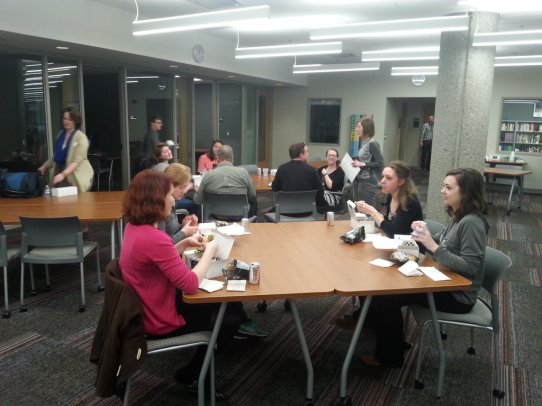
Writing Center Professionals eat lunch and chat in the new University Writing Center.
An instructor once told my class that the greatest criticism a writing can receive is that it is unclear. Although clarity does not come from any one formula, there are some tips that can help you get your message across clearly and keep you from writing the complicated texts we all hate.
1. Keep the real subject in the subject slot.
English is an SVO language. This means its basic structure runs Subject, Verb, Object. Sometimes we alter this structure to add variety, but generally readers look for the subject first and then the verb. When we provide these pieces quickly and in this order, readers are better able to focus on the message of our sentence.
Two types of structures can lose a sentence’s subject:
Passive Voice: The text was confused by the unnecessary passive voice.
Revision: The unnecessary passive voice confused the text.
You can find more information about passive voice here.
False subject there: There were two kids fighting at school.
Revision: Two kids fought at school.
In the first version of this sentence, there occupies the subject position right before the verb were. Two kids is the real subject though. The revision forms a clearer sentence with the true subject in the subject slot.
2. Cut deadweight words.
Certain valueless words enter our speech without our even realizing it. In our writing, where we have time to edit, we should always cut life-sucking deadweight that distracts from the sentence’s valuable parts.
Wordy:I believe the results clearly show obesity is a very real problem for each and every one of us, regardless of age.
Revision: I believe the results basically show obesity is a very real problem for each and every one of us, regardless of age.
Although the struck-out words seem to add intensity to the sentence, they don’t add any real meaning. In addition to overcomplicating the sentence, they weaken the statement because they appear to be trying too hard.
3. Write in manageable doses.
If a sentence extends to three lines or more, it has lots of commas/conjunctions, or contains strings of prepositions or which/that, look to see if you have stuffed too many ideas into one sentence. Just because a sentence is long, doesn’t mean it needs to be divided, but it is a good indicator. It’s good to combine ideas in a single sentence when showing a relationship between those ideas, but you need to give each idea its own attention first. This means giving each idea its own space.
Dense Sentence: If the chemicals combine, they can produce a toxic fume which can harm a human and might even kill plants and animals, presenting a serious risk and outweighing the good that such chemicals could provide in the home.
Separate ideas with connection following: If the chemicals combine, they can produce a toxic fume. This fume can harm a human and might even kill plants and animals. These dangers present a serious risk and outweigh the good that such chemicals could present in the home.
The revision splits the complicated sentence in places where which, and, or a comma was present.
4. Use the Old-New structure
The old-new structure involves both sentence and paragraph structure. It clearly strings together related ideas or steps by reusing key terms. Sentences begin with a term used in the preceding sentence (the old) and connects it to the next idea (the new). The sample sentence showing the revision of a dense sentence demonstrates this structure.
Old-New: If you turn to your right, you’ll see a yellow envelope. In that yellow envelope, you’ll find a note, and that note will give you your next instructions.
The repeated words yellow envelope and note serve as landmarks that orient readers and show connections between the old and new information. Notice that when a term is repeated, you usually place the word that/this before it.

 Ashley Taylor, Consultant
 Spalding University MFA in Writing program and holds an M.A. in English from University of Louisville. Currently, Amy is working on her first collection of essays as well as several children’s picture books. Amy lives in Louisville, Kentucky with her husband and two children.

 University Writing Center and engage in thoughtful conversations with our consultants about how to make that work as strong as it can be. We have an excellent incoming staff of consultants who will be doing what we do best: helping writers improve the projects they are working on today, as well helping them become stronger writers in the future. On our exit surveys, more than 90 percent of respondents agree or strongly agree that their University Writing Center appointments both help them with their immediate writing concerns and that what they learn in appointments will help them with other writing projects.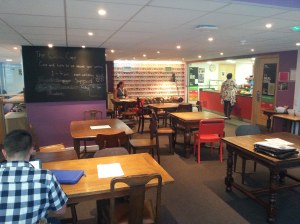




 teachers who work with the writers who come here to make the writing stronger and the writers more confident. Just as important, our consultants have to be patient, good listeners, and respectful. We believe in starting with the writer’s concerns, working collaboratively, and focusing on learning, not grading. From our perspective it’s the way the best teaching and learning happens. There is a reason we will have more than 5,000 visits to the Writing Center by the end of the year, and that reason is our talented and dedicated staff of consultants.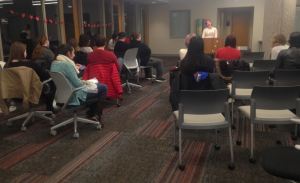


 University of Louisville Writing Center