Category: Process

How to Get Unstuck: Ways to Start Writing and Tips to Keep Going

Alex Clifton, Consultant

Writing is hard. Starting any kind of writing—or keeping it flowing—can be so difficult. Very rarely do people get out what they want to say on the first try. I should know; I just drafted the opening sentence of this blog post five or six times, going through wildly different options. It can be challenging to figure out what you initially want to say, and even harder when you feel like giving up after one or two paragraphs because the words just aren’t coming. Here are some tips to get you writing and keep you writing!

If you have trouble at the beginning of a writing session because you are thinking too much about other homework, life problems, cat pictures, etc., freewrite for five to ten minutes. It doesn’t have to be anything sophisticated; just grab a notebook and write down everything you are thinking, as it comes to you, for that short period of time. Afterwards, you’ll have cleansed those thoughts from your brain for the time being, so you can get down to working instead of wondering whether or not you’ve cleaned your aquarium.
DSCN1650

Occasionally, you might struggle to find a topic to write about. It might help to make a list of things you are interested in or want to mention in your essay. This can be especially helpful with personal narratives or persuasive essays. For example, if you’re trying to think up concrete examples to support your idea that fish are the best pets ever, you might make a list describing the pros of keeping fish as pets, another list about your experience keeping fish as pets, and another list with all the facts you know about fish that might persuade someone that fish are great. Again, these thoughts do not have to be organised perfectly; list-making is just another way to get you thinking about what you want to write about!

When working on a paper, remember that you don’t have to write everything in a linear manner—there is no rule that says you have to start with your introduction and plough through in the “right order.” If you’re really struggling to make a point, make a note of where you want it in your essay and then continue writing so you don’t lose your momentum. You can always go back and revisit different portions of your paper, and you might be able to rephrase your thoughts better after you’ve written another section.

Sometimes, it’s hard to get a rough draft out at all. One way to get you writing for blocks of time is to use an app like Write or Die (found at writeordie.com). Don’t let the name scare you: it’s a website that helps you write for however long you decide, be it fifteen minutes or an hour. It motivates partially through annoying you: on one mode, a loud pitch will play if you stop writing for too long, and on kamikaze mode, your work will begin to unwrite itself! (Kamikaze is an optional mode.) The great thing about Write or Die is that it gets you writing, and just writing, for however long you need. Think of it as freewriting for your paper; you can type in anything while you are drafting and then go back and revise it afterwards. It will help you get a draft out and may even add to your productivity, especially when you realise you’ve written for half an hour straight without constantly checking social media or your favourite news sites. I’ve found that using it has helped me learn how to write in chunks of time more effectively, so I can sit down to a half-hour writing session and get work done rather than just goofing around. (A word of warning: if you do use Write or Die, make sure that you copy, paste, and save your work in a separate word document—Write or Die will not save it for you.)

Finally, at the risk of sounding shamelessly self-promoting, come into the Writing Center! We’re here to help you with all of your writing needs at any stage of the writing process. You don’t even have to have a word on the page to make an appointment for an assignment. We can help you discuss your ideas and brainstorm possibilities, or we can read over what you have already written and help figure out where your paper will go next. Sometimes it just helps to talk it all out with someone who wants to hear about your ideas—and trust me, we definitely want to hear what you have to say.

I hope some of these strategies work for you. Try one next time you get stuck writing a paper and see if it helps!

Five Places That Make Writing Easier

Megen Boyett, Consultant

DSCN1655It’s the start of the semester, which means, it’s time again to think about research papers! I know, it’s only the second week, and yet, that paper looms ahead of you on your syllabus. It will not be ignored and it will not be denied, but it will be here in about 15 weeks. Worst of all, it’s going to need outside information and some advance planning, both things that a four-day caffeine binge during finals week won’t provide.

The worst thing about new semesters is that, once again, you have the opportunity to find out how little you know and how much you wish you knew. But take heart! The best part about new semesters is that they’re a new beginning! You’ve got time again to get things done right! And, better still, there are resources for you to use right here on campus. Here are five places to get what you need for those research papers and have a less stressful semester:

  1. The Writing Center, of course!

Are you unsure where to start an assignment? Do you need some help figuring out what it’s asking for, or what you should do next? Have you written as much as you think you possibly can on a topic, but only gotten halfway through the page requirement? Bring your assignment and whatever you have so far into the writing center. Sit and talk it over with us for a while (let’s say, up to fifty minutes). Believe me when I say, it’s oh-so-helpful to have someone to talk about your work with, especially when they aren’t giving you a grade at the end. If nothing else, you’ll leave knowing what questions to ask when you go back to class.

  1. The Research Lab at Ekstrom Library

You know the sources are out there! You just don’t know where to start looking, and it’s a little intimidating to wade through so much information on your own. Fortunately, the librarians at Ekstrom do have a good idea of where you should start. You can ask questions at the research desk (1st floor), you can set up an appointment to learn how to use databases, or you can even chat with a librarian online at http://louisville.edu/library/services/ask.html.

  1. Citation Databases

Does thinking about citation styles give you a cold sweat? Then, of course, ask your writing center consultant. We all have our favorite sites for citation help. One of the most commonly suggested is the OWL, or the Online Writing Lab at Purdue. It has quick links to citation style guides and plenty of examples. Another really good program is EndNote, which stores all your sources for you and formats bibliographies and in-text citations. Best of all, it’s free through the U of L library!

  1. Your professors

I have yet to meet a U of L professor who won’t make time during office hours for a student to talk about a paper. Your professors are valuable resources because, after all, they wrote the assignment. Not only can they answer questions about what they want you to do, they’re also good for helping you talk through ideas and suggesting potential sources. Put their expertise to use!

  1. The Writing Center, again

You’ve researched, you’ve drafted, you’ve cited to your heart’s content. You’re pretty confident that you know what your professor wants and even how to do it. Now it’s all (or almost all) down on paper, but you’re still not sure that your paper says what you want it to. Come back to the writing center and read your paper aloud with a consultant! Never underestimate the value of talking about your writing with a student who’s been trained to talk about writing. Being able to hear feedback before you hand in a paper not only gives you one last chance to make changes and turn in the paper you meant to write, it’ll with future writing assignments, too. (Plus, it’s really fun to talk about something you created with someone who wants to read it. Trust me.)

Here’s to a fabulous semester! Here’s to knowing what you’re doing and to asking when you don’t know! Here’s to caffeine headaches after something other than an all-night paper-writing-palooza, because, after all, don’t you have better reasons to stay up till 2 am?

Happy Writing!

Experiences, Advice, and Inspiration from First Year Cardinals: A Collaborative Blog

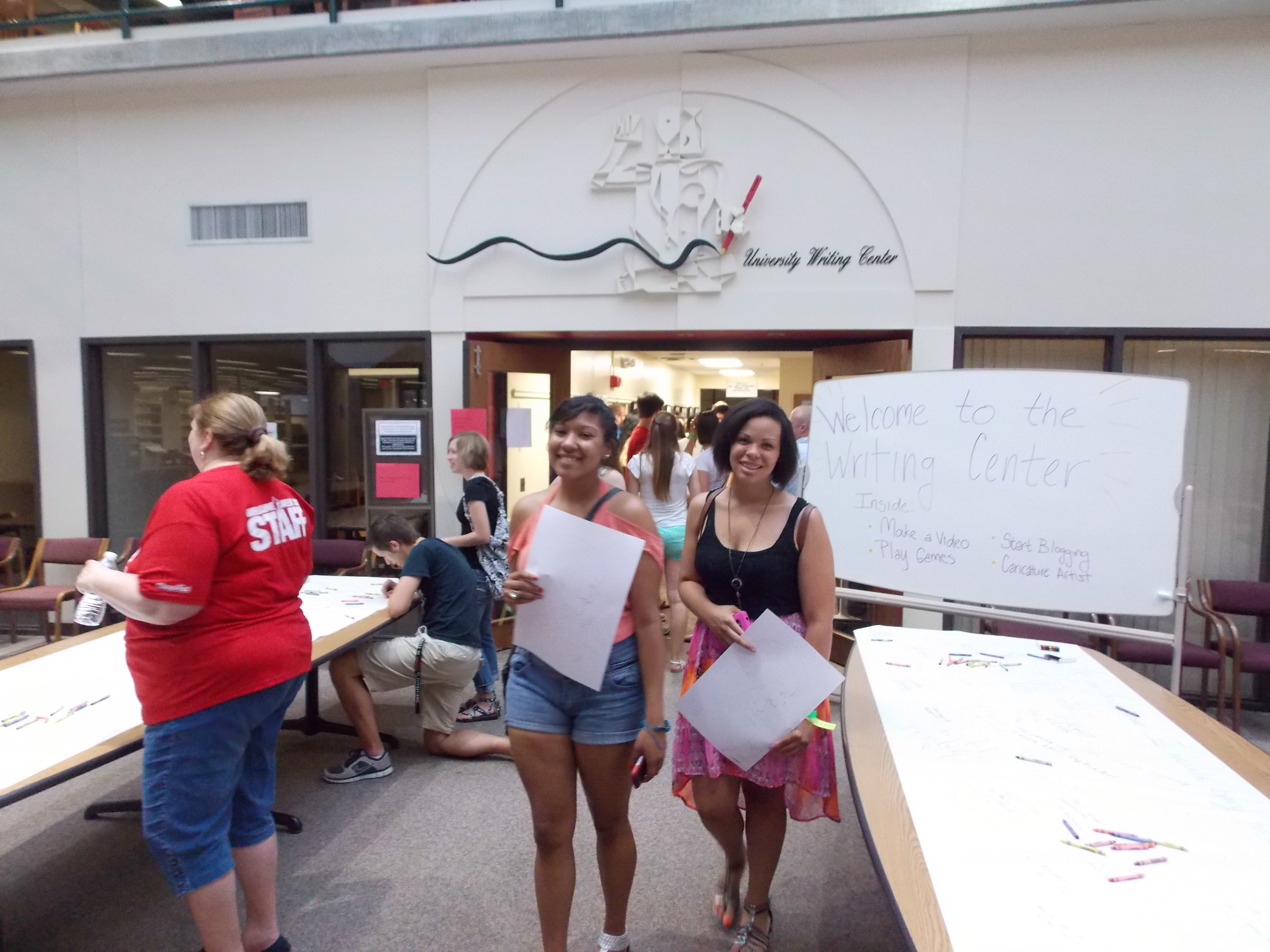
Last Thursday, the University Writing Center participated in the Office of First Year Initiatives Night at the Museum event. In the past, this event has been held at the neighboring Speed Art Museum, but since the museum is currently under construction it was moved to Ekstrom Library, where the Writing Center also happens to be located. We were excited to be involved in this event which, like many others in the week before school starts, aims to familiarize first-year students with campus, build community, and get everyone ready for the Fall semester.

There were many features available throughout the event, including a magician, a fire show, a scavenger hunt and others. DSCN1679On the 3rd floor in the Writing Center, in addition to the caricature artist, students were able to make videos about their experiences with writing, help decorate banners promoting what they believe about writing, and help write a collaborative blog post for this blog. To get the words flowing, we did offer some topic suggestions asking students to reflect on their best experiences with writing or advice about writing.

The night was filled with stories of papers, like this one:

My best writing experience was when I finished my 14 page Extended Essay for the International Baccalaureate Program in 2 freaking days. When results came in I received a 7 (the highest possible grade)!!! YAY!!!

And this one:

The best writing compliment I ever received was an accusation of plagiarism. That may sound a little mixed up, but it really was. Because what my teacher said to me wasn’t “you cheated” or “this isn’t yours” but rather “you couldn’t have possibly written this well”. And when I finally convinced him I had, he told me that it was essays like mine that showed that his class truly mattered.

By far, though, the most popular theme of the night was “best writing advice”:

Don’t use clichés!

Try as many different writing styles as possible. Try outlining, but if it doesn’t work you can always try something else! You never know when you will find a method that works for you. Most importantly, ASK FOR HELP!

When you finish a paper, read it backwards to catch spelling errors.  Then, make sure to have someone else read it.  They’ll probably see errors that you missed!

Be brief.DSCN1676

Make your diction sophisticated enough to be intelligent but simple enough to be practical.

Get rid of the fluff.

Don’t use “be” verbs!

If you use garbage words (nice, good, bad, like, ect.) I’m judging you.

Don’t use a semicolon unless you know how to use it. Seriously.

Write what you feel, when you feel it. Edit later.

In addition to the circulating stories of experiences, compliments, and advice, some students took the opportunity to listen to their inner muse and offer a demonstration of word play.

Poetry is

Like

Fight Club.

T h e r e       a r e      n o      r u l e s.

(except if it’s iambic pentameter, then there are rules. Sorry)

I wish I could speak English. I know incredibly close to no English. No English. No English. At all. Ever. 2+2=*

Everything is either everybody’s fault or nobody’s fault. Connections are limitless. Such is the madness of life and the living.

And, as ever, we should remember:

DSCN1682

Here at UofL,

The possibilities soar,

Proud to be a Card.

And:

I thank you are the best.

Compiler’s Note: The participating students all chose not to include their names. The Writing Center would like to thank all the students who visited us at the Night at the Museum event as well as those who participated in the collaborative blog, videos, and other activities. Thanks also go to First Year Initiatives for organizing this event and including us.

In Search of the Perfect Paper

Ashly Bender, Assistant Director

Ashly_Version_3While working with a fellow writer this weekend, we started discussing the desire for the “perfect paper.” As each of us pour ourselves in dissertation chapters, we often unreasonably hope that the response to our drafts will be something along the lines of “This looks great; start on the next chapter”—or some other kind of confirmation that we are done with that piece and can move on. This desire is something I believe that my writing students and the many clients we see in the Writing Center are familiar with. It’s more than wanting to know that you did a good job. It’s wanting to know that you did the best job and that you can be released from further labor on a piece that certainly demands a lot of physical and mental effort. Bronwyn Williams posted earlier this year about the intensely personal aspect of writing, and how that connection—even to a writing that is seemingly impersonal—makes receiving feedback difficult. So we continue to yearn for the “perfect paper.”

The conversation this weekend forced me to wonder what the perfect paper look like. How do you know when you’ve achieved it? The most common answer seems to be that this essay would, above all else, receive no marks, nothing to mar the masterpiece the writer has created. It requires no response because it is beyond reproach. This conception of the perfect text is reinforced often in classrooms by tales of red ink and grammar-meanie teachers. Almost all of us have a story of getting back a paper that was “torn apart” by a grader, had more writing by the teacher than the writer, or had a seemingly scathing and long note attached to it. What if though, just to venture out on a limb for a moment, that the unmarked, pristine essay was not actually the “perfect paper.” I know, I know—it’s outlandish, but bear with me for a moment.

When we write, it’s always for an audience, even if that audience is just the writer herself. Writing communicates a message. It may or may not be personal. Either way, it aims to connect with the reader, to invoke a response in or from them. Writing can be compared to telling a story. If you share an experience with another person, you expect that they will demonstrate that they heard you—hopefully with words, but even a nonverbal recognition could satisfy you in some cases. If we accept that this is also be true about writing, then the “perfect paper” is not at all clean and empty of feedback.

The “perfect” piece of writing is covered with commentary from the reader, and that commentary verifies the power of your writing. It proves that your work connected with your reader, made them think, and made them want to share those thoughts with you. That feedback might be in praise or it might be contradictory, but it recognizes you as a writer worth communicating with. Isn’t that the kind of respect and recognition that we all want?

The pristine perfect piece is definitely a myth, but unfortunately the comment-filled version of perfect writing can be just as elusive. While the pristine piece is a myth because it ignores an important aspect of writing, the marked up piece is rare due to very real and practical factors. When you submit a piece to your boss or your teacher, their focus is often on improving or fixing perceived errors. Their lives are filled with many demands and priorities that can make the ideal response, which takes time and focus, sometimes difficult to achieve. For this reason, when we receive comments on a piece of our writing, especially comments that address both our text’s strengths and weaknesses, we should truly appreciate our reader and our work. It’s the closest we can really get to the perfect paper.

While the Writing Center still works under time constraints, remember that we are here to help you experience this ideal version of the perfect paper: one that receives earnest, focused feedback from a reader who wants to engage your ideas and your work. And, when you find a good reader, whether in the Writing Center or among your colleagues/mentors, remember to value them and their feedback as they help you craft and re-craft the perfect paper.

“Good Writing” Policy: An Exploration of What It Means to “Get” Writing

Ben Bogart, Consultant

I’ve noticed a disheartening battle cry rippling through the Writing Center this summer, and it’s one that I worry might be chanted out in the world beyond our doors:  “I’m not very good at writing.”  Sometimes it’s translated as, “I’m not very good at English,” or the even more frustrated, “I just don’t get writing.”  It’s always offered with a smile, and maybe some nervous eyes fluttering around the room, as though the speaker has just confessed something shocking or controversial (I would expect the same body language from someone offering up, “I’m not really good at using my turn signal,” or “I don’t really like your Mom”).  And every time I cringe a bit.  But it’s not because of what the person has said so much as it is the feeling of defeat that they’re trying so hard to convey.  There seems to be a lot behind a statement like, “I’m not very good at writing,” and I’d like to take this opportunity to explore what I hear when each time that statement is uttered.

Bogart PictureYou just don’t get writing.  Okay, I suppose I understand.  There are a lot of things I don’t get—things like cooking and mathematics and computer programming and football.  We all have our natural talents, and if you’ve had enough life experience to warrant the claim that you simply don’t get writing, I’m guessing that it’s because you do get something else—something likely just as important.  People who tell me that they don’t get writing are usually quick to offer examples of past failures to prove to me that they really don’t get it, and so I know a fair amount of these statements are backed by solid evidence.  But more so than with any other talent that one may or may not “get,” what I generally hear when someone tells me that they don’t do well with writing is an echo of someone else telling them that they don’t do well with it.  And that bothers me.

Let me try to explain.  If you don’t have wild success in the cooking/baking world, you’re likely to know on your own:  you bake a cake, and it comes out flat and tasting of baking soda, and as you slide it forlornly into the trash you mutter to yourself, “I just don’t get baking.”  Fair enough.  That cake wasn’t your masterpiece, and if anybody wants to claim that you do get baking, you can just have them dig out a sample from the trash can and see for themselves.  Consider the opposite end of the spectrum:  you bake a cake and it’s just delicious.  You couldn’t stop licking the spoon you used to mix the batter, you had pictures up on Facebook before you’d even set the timer, and now that it’s done, you’re thinking that you might just eat the whole thing yourself.  A friend comes over and tries it, and spits it out immediately.  “Maybe you just don’t get baking,” she offers with a smile, hoping to lighten the blow.  Do you buy it?  I’m guessing (and really hoping) that the answer is, “no.”  You tasted that cake.  You fell in love with it before it was even fully done.  You know cake, and that cake, sir or m’am, that cake was good cake.  If you’re like my Aunt Sharon, you continue making that cake forever, trotting it out at birthday parties and anniversaries and holidays, and while everyone else politely folds your cake into their napkins when you’re not looking, you know deep down that that cake is pretty good cake.

And yet if we play this same scenario out with writing—particularly with scholarly writing—I don’t know that the same confidence generally plays out.  You write a paper that you love (couldn’t stop licking the spoon, posting pictures on Facebook, etc.), turn it in to a professor, and it comes back with a letter grade lower than you expected and some kind of plus/minus code that conveys to you nothing except that you “don’t get writing.”  This is where even Aunt Sharon, I believe, would falter.  She might still have confidence in the cake, but that paper that just came back to her has convinced her that she really doesn’t know what she’s doing when she tries to put words together on paper.  While she will certainly continue to bake with pride (and, ironically, to write about it on Facebook), she’s somehow been shut down as far as the writing goes.  And that’s not fair.

Before we go on, I’ll certainly admit the analogy isn’t quite perfect.  The cake respondent was just a casual friend, where the paper respondent was a professional.  Sure, you caught me.  The teacher that responded to the writing didn’t actually say Aunt Sharon didn’t “get” writing; only implied it.  Yeah, okay.  To further your point, I’ll confess that I don’t even have an aunt named Sharon.  But at a very basic level, I believe the comparison works to illuminate for us a couple of important thoughts about writing.

1.)     Most of us have more experience subjectively evaluating cake than writing.  It’s a simple fact.  There’s less at stake with a cake (this sounds like the beginning to a Wallace Stevens poem) than there might be with writing—it either tastes good or it doesn’t.  We learn very easily how to distinguish between the two.  But how do we distinguish between good writing and bad writing?  What is bad writing, even?  Anyone who’s ever been forced to read Shakespeare in high school and then try to explain why it’s so great to the teacher understands very well that taste in baking (though surely complex in its own right) is a bit easier to grasp than taste in writing.

2.)    Writing seems to be connected to our identity as people in a way that baking just isn’t.  If you bake a bad cake, you might just be impatient or distracted.  Maybe you spent more time licking the spoon than you did actually mixing the stuff.  You made a bad cake, and at the absolute worst, you have to go buy a cake from the grocery store and feel a temporary sense of failure.  But when you write a bad paper?  Well, you might as well look forward to a future of digging ditches or occupying various institutional buildings.  At best, you just don’t get writing.  At worst, you’re stupid, deficient, incapable—all words meant to designate that you don’t belong.  That’s pretty heavy for someone who just wanted to tell you about the themes they picked up in The Great Gatsby.  If we treated cakes in this way, a trip to the bakery would be the most nerve-wracking experience of one’s week.

3.)    Writing fulfills a multitude of purposes, and thus has a multitude of forms, in a way that cakes just can’t match.  I mean, I guess there are wedding cakes and birthday cakes.  You could have devil’s food or angel’s food or carrot cake or any of the other varieties that exist out there.  DQ has ice cream cake, and I’ve heard that in certain places you can even get “naughty cakes,” but at a very basic level, cake is cake, right?  The varied occasions that you can associate cake with are all very different, but usually the cake is fairly similar—just modified in color or flavoring or . . . well, shape.  But writing is way more varied than that.  There’s writing that tries to inspire, writing that tries to argue a point, writing that attempts to get people to laugh, writing that is requested by others, writing that hopes to free and entrap . . . the list goes on.  The occasions are certainly different as well:  there’s writing that is meant to be shared with close friends, writing that is meant to be shared with colleagues, writing that is directed at complete strangers, and every group in between.  And what’s important is that these forms are so wildly different that one can be quite good in one area, (say, poetry), and still have no clue what they’re doing when it comes to another (say, legal documents).  So if you get disparaging comments on your Shakespeare report, does that mean that your Facebook post from the previous night is also worthless?  No.  It really doesn’t.  What it means is simply that you have more experience reading and responding to Facebook than Shakespeare, and I believe that’s okay.

4.)    Professional opinions in writing, as in baking, are still purely subjective.  Bottom line: they’re all opinions.  As in, “Well, that’s like, your opinion, man.”  If a teacher tells you that your paper was crap, the odds are that there’s another teacher within that same area code that would disagree.  Moreover, maybe that teacher had just made the exact same comments on 15 papers before yours, and so when it got written on yours, it came out a little less than friendly.  Subjectivity, by definition, can be colored by all kinds of stimuli that you just can’t predict.  So in the same way that you should doubt the opinion of someone who just got dumped and decided to tell you your cake was bad, you should question the opinion of someone who tells you your writing is not that hot.  That person likely didn’t mean to label you for the rest of time.

I could go on and on about my great cake analogy, but I’ve probably made my case here.  The point is that, when you tell me that you’re “not very good at writing,” or that you “just don’t get English,” I’m hearing you say that you’re accepting the evaluation of someone who told you that.  They were probably older than you, and they probably said it in a really convincing way, and you just took it and decided to share it with me in the middle of the Writing Center.  And I hate that.  Because you’re not bad at writing, and even if you don’t happen to “get” it, it’s not like that’s a brand that needs to be burned into your forehead.

We all write, and increasingly because of the new media outlets that are out there (Facebook, Twitter, Reddit, Myspace, to say nothing of text messages), we write a lot.  It’s a tool that we use to communicate our thoughts, and we generally do it without much trouble.  It’s when we load writing up with all of our insecurities and past evaluations and uncertain expectations (commonly known as “writing for the academy”) that all of a sudden we start second-guessing ourselves and falling back on those old proclamations made by people who likely didn’t intend for them to become self-fulfilling prophecies.  And that’s too bad, because just like someone telling you that your cake was bad should be a thought that is easily swept away and forgotten, so too should someone telling you that you wrote a bad paper.

For all my Shakespeare and Gatsby references, it should be clear that I think this happens a lot in high school.  I’m sure it happens at the university as well.  I want to make it just as clear that I don’t think it’s any high school teacher’s intention to do that.  Maybe you had a grumpy teacher.  Or, more likely, maybe you just had a teacher you thought was grumpy, and whose comments you read as a personal attack.  Consider all those cake advisors:  feel free to save all those things they told you about oxford commas and pronouns; certainly save the uplifting and generous comments they gave you.  But please, just forget the sharp criticisms.  I hate to break this talk of naughty cakes and fictional aunts for some sappy cliché, but please keep in mind that you are the only one that can hold yourself back in life.  If you let yourself believe that your writing is bad, it may be that old, second-period English teacher whose voice you hear, but it’s you that has clung to it.

I’m declaring now, with absolutely no power to do so, that the Writing Center is only for good writers—that is, people who have the confidence to admit to themselves that they are good writers in some genre or are willing to work to be good writers.  If you’re feeling frustrated that you can’t get your thoughts out on paper in the way you planned, rest comfortably knowing that this is a feeling all “good writers” have.  I can point you to famous authors that are studied in upper-level literature courses who have felt the same way you did.  The only difference might be that they didn’t listen to those people who discouraged their ability, and you did.  You didn’t do so hot on that term paper?  Well, think about the song lyrics you wrote that one time that made you feel accomplished.  Or that report on your cat that you did in second grade—the one that got a smiley face sticker on it.  Or that Facebook post that blew up with 27 responses from your friends in just an hour.  And then try again.

What you probably mean when you say, “I’m not very good at writing” is, “I’m not comfortable with academic writing yet.”  That’s completely fine.  Your friendly neighborhood Writing Center consultant is here to help.  It takes practice, and we’ll work through it together.  It took us a long time to “get it” too.  But don’t say that you aren’t very good at writing.  Because we only take good writers here now.

Timely Tips for the Personal Statement/Application Essay

MichelleThings are pretty slow around the Writing Center this time of year, but we have had plenty of recent or soon-to-be graduates working on personal statements or applications for graduate school.
To be honest, writing a personal statement or similar application material can be a little awkward, especially when there isn’t a specific prompt beyond “Tell us about yourself and why you want to pursue a career in this field.” It can be unnatural for some people to talk about themselves in the self-appraising manner of this genre of writing. The openness of the requirements—combined with the necessity of “selling yourself” as an applicant to a committee of people you’ve never met—leaves many clients in the Writing Center unsure of whether they’ve written something unique and compelling or ordinary and boring.
Below is some of the most common advice I have given to clients lately:
1. Prove it. Don’t just say you want to be a doctor because you love to help people (or whatever your motivation is). Give the application committee some evidence to believe that. For example, show the committee that you’ve already been trying to help people, as evidence that you’ll continue to be motivated to do that in the future. What has caused you to want to help people, how have you been doing that already, and why do you want to continue helping in the future?
Also, you can move from recounting your resume of past activities to talking about the specifics of your plan for the future. For example, I recently had a client applying to dental school who described a program he plans to implement in his own dental practice one day. Maybe you haven’t thought quite that far ahead, but you should still be able to prove to your committee that you have thought about how your motivations will play out in future action.
2. Connect experiences/activities you’ve done to who you are as an applicant. I often have clients who include compelling personal stories separated from a seemingly disconnected list of qualifications. They start off telling about growing up in poverty and how it has motivated them to be social workers for the disadvantaged, but then spend several paragraphs listing off every organization or job they participated in during college.
However, who you are and the things you have done shouldn’t be divorced from each other in your personal statement. If you’re going to include a significant job experience or volunteer opportunity in your personal statement, make sure to connect it back to how it has contributed to the person you are that’s applying to the program you want to be a part of. If the relevance seems flimsy, perhaps that activity is better fit for your resume or CV than your personal statement. Stick to activities that are more than qualifications; you want to use activities/experiences that fit in with the larger story you’re telling about who you are and why you want to be a lawyer, doctor, professor, social worker etc.
3. Watch transitions between paragraphs. Sometimes clients have a good handle on selecting and connecting experiences that have contributed to the people and professionals they are and are becoming. Instead, what seems disconnected in their writing is the relationship between those experiences. These personal statements jump from one internship, volunteer activity, or life experience to the next without demonstrating to the reader how those activities come together as a whole. Often that’s because it can be hard to reflect on the connections between seemingly discrete life events; however, working to create transitions between paragraphs are essential for helping the reader understand a cohesive picture of the message of your personal statement.
Purdue’s Online Writing Lab (OWL) offers lots of help with transitioning between paragraphs at the following link: http://owl.english.purdue.edu/owl/resource/574/1/. But sometimes, the most effective method of working on transitions is to discuss it with someone else who can help you identify and verbalize the connections between your paragraphs.
4. Find someone in your field who can read over your personal statement for you. We can give you lots of tips and things to think about here in the Writing Center, but it also helps to find a professional in your desired field who has already been admitted to and completed law school, dental school, etc. They’ve already been through the application process successfully and are often more in tune with the writing conventions of their field than other people. Also, they’re often happy to help potential future colleagues.
There are many web pages that offer other advice for personal statements or statements of purpose that often go along with graduate school applications. Here are a few helpful resources:

Doing More than Microwaving Alphabet Soup: Tips for Getting Better at Cooking and Writing

Ashly Bender, Assistant Director

On one now infamous afternoon many years ago, I decided to make cupcakes from box of cake mix. Following the directions on the box, I dutifully mixed the ingredients on the box: egg, oil, water. Everything was thoroughly blended, but I knew something wasn’t quite right. I looked at the cupcake papers in the pan and looked at the mix, then the papers again, then the mix. I was pretty sure the mix was too liquid-y for the papers. I checked the box again; everything on the box was in the bowl.

Still unsure, I called my best friend who regularly baked. She reasonably asked if I had followed the directions on the box. As I picked it up to read the directions to her, I realized the problem—as you, dear reader, likely already have. The cake mix itself was still in the box. I was too embarrassed to even explain what happened to my friend. I just told her I had figured it out and got off the phone.

Ashly_Version_3That’s just the most re-told story of my kitchen fails. Few remember the many, many nights I messed up Hamburger Helper. Or the time I scalded a pot when I set hot chocolate mix on fire. But since those days, I’ve learned a few things and can successfully finish both edible and enjoyable meals. I credit a lot of my growth in the kitchen to being a little more relaxed about precisely following directions, trusting my intuition a little bit more, and being ok with taking risks. It may seem odd to have such a food-themed post on a blog about writing, but my approach to cooking is somewhat influenced by my approach to writing—a skill with which I have considerably more facility and comfort.

Following directions was the first hurdle I had to conquer in the kitchen. It was the source of many of kitchen fails I mentioned above. I was so concerned with doing exactly what I was supposed to do that I would get things mixed up. I wasn’t considering the finished product. A lot of times, this is what happens when writers focus more on grammar or mechanics than the message they are trying to send. Worrying about the writing instructions governing the placement of commas, of which there may be too many to count, can keep you from finishing your sentence, your paragraph, your whole piece. Or, as was the case in my early cooking adventures, you can end up putting in too much of something, too little, or putting it in the wrong place. This is not to say that writing “instructions” like punctuation or grammar aren’t important, but they should act as guides and finishing touches rather than the main focus of piece. After all, you want to eat (or read) the finished product, not the individual ingredients.

Another important part of cooking and writing is trusting your intuition. Ever been half way through cooking a meal only to realize that you’re missing one or two ingredients? Maybe you’re better at this whole cooking thing than I have been (and sometimes still am). At times like these, you might just have to wing it and make an educated guess about what to substitute or leave out. Those small tweaks help make what you’re making your own special version—the makings of secret recipes. It’s not much different in writing, but the tweaking is more in regard to style than flavor. Writing style, sometimes it’s called voice, is often lauded as the extra bit that makes a piece unique. Often movies or other popular media suggest that this aspect of writing is some kind of gift good writers are born with. Really though, developing voice and style is largely about trying out new spices and flavors in your writing until you find the one and the amount that works. This means, after you’ve got the big pieces of the message together, pay attention to the details—add a little bit of this or that until it balances to be just right.

Whether you’re anxious about cooking or writing, relaxing the attention on producing exactly what the instructions or the instructors call for can be the first step in actually developing your style. That means taking risks, but without those risks it’s nearly impossible to get better at something. Sure, you might include too much of one ingredient and your reader or eater might object. Next time you can include less, or you can try something else. And remember, those rules that seem so strict are really just guidelines to help you make your version of piece you’re aiming for.

Giving Thoughtful Feedback, or The Challenge of Being a Reader

Ashly Bender, Assistant Director

Last week, our director Bronwyn Williams wrote about the anxiety many writers feel when they share their work with others. In the Writing Center, consultants often hear about those anxieties. Part of our work is to help writers develop the confidence and positive self-perception that lessens those anxieties. Reading Bronwyn’s post made me think, though, about the other side of the situation: the pressure a reader can feel to offer insightful and productive feedback.

Ashly_Version_3Bronwyn mentioned that he was nervous to send his post to his assistant director, me. I was just as anxious to offer him feedback and suggestions. I mean, he is the director (both of the Writing Center and of my dissertation), and he has been writing successfully for years. While my nervousness is informed somewhat by those facts, it is more so the result of my belief that giving thoughtful feedback is a demonstration of respect—for the writer, the text, and the relationship between the writer and the reviewer.

As Bronwyn explained, writers often feel as though their work is a part of themselves. This is important for readers to remember because their feedback has the potential to shape the writer’s perception of his work and his self. Many of us are familiar with the overly critical grader that has marked up our writing to the point where we wonder why we bothered. This is one of the many places those writing anxieties come from. But many of us are also familiar with the feeling we get when a reader says, “This is good” or even “great” but doesn’t give any examples or mark any places on the text. It gives the feeling that the reader didn’t even bother to really read it. In this case, we may be left wondering, “How do you know? Did you even read it?”

This is why thoughtful feedback that is supported by examples from the piece is so important. It sends the message that the writing is important and valuable; it is worth the time of everyone involved in the creation of that piece. As a reader, I’m trying to discover the main goals of a piece of writing and how the content in the version I’m reading is supporting those goals. I consider as I’m reading what could be elaborated on or what might be missing in the writer’s effort to achieve those goals. Also, I want to be sure that I’m considering the writer’s anxieties—if the writer is unhappy with his piece, why might he be feeling that way? Sometimes those nervous feelings originate outside of the text, but sometimes a writer knows something isn’t quite working in the current draft but can’t identify or articulate the problem. I want to help the writer identify those places so he can revise them for the next draft.

It is my hope as a reader that these kinds of responses communicate to the writer that I appreciate the leap of faith he has taken in letting me read his work and that I take his work seriously. That can be a tall order for a reader sometimes, but it is the challenge that writing center consultants rise to every day they walk into work. As nervous as it may make us some days, those of us at the University Writing Center find it exciting and inspiring to be included in the crafting process of so many writers’ work, which some of our tutors have already discussed in previous posts.

While writing center consultants are always aiming for thoughtful feedback, it can sometimes be difficult to do in the 50 minute sessions we offer, especially with longer texts. There are some things clients can do to help consultants give that thoughtful feedback. The main thing is helping us become more familiar with their writing. Some ways to do this are to help us understand the context for the writing (the assignment, the class, etc), to tell us their goals for the piece, and to share their concerns. Also, we cannot stress enough the value of visiting the Writing Center multiple times. By doing this, as Brit Mandelo has discussed before, the client can find a consultant that he works best with, and they can develop a relationship that allows more time to focus on the writing in each session.

Ultimately, Bronwyn’s post and the process of giving him feedback made me think about the collaborative process between writers and readers. Often readers are anxious like the writer, even if those feelings develop for different reasons. In some ways, that anxiety is productive because it encourages the reader to be more invested and encourages the writer to be more open. Together these perspectives lead to better writing and better individual pieces.

Writing, Nerves, and Gaining a Sense of Being a “Writer”

Bronwyn Williams, Director

A student in a secondary school in a small town in England tells me that it gets harder to write when he knows there is a grade hanging over the assignment.

A graduate student at an English university, at work on her Ph.D., talks about how anxious she feels while waiting for a response on a dissertation chapter she has sent to her faculty director.

A faculty member, with many published books and journal articles, asks me to read a draft of a chapter for a new book she is writing, but admits that to do so makes her nervous.

??????????This semester I have been away from the University Writing Center, though issues of writing and supporting writers have not been very far from my mind. I am writing this from England where I am currently on a Fulbright Research Fellowship at the University of Sheffield. I’ve been visiting classrooms in colleges and secondary schools here, and talking with students and teachers about the challenges – and opportunities – they find in writing and reading. The fellowship has offered me the opportunity to spend the spring conducting research in a new setting, and the chance to meet and talk with new faculty and graduate student colleagues.

In all of these settings, one of the common things I have noticed about how people talk about reading and writing, is the anxiety that often emerges when it comes time for someone else to read what a writer has written. Regardless of how experienced, or how confident, these writers may be, there are always some circumstances that make them nervous about the way others are going to respond to their writing. Maybe the piece they are writing is going to count for a large part of a course grade. Or perhaps the writing is exploring new ideas or a new genre in the piece she is working on. Or maybe the writer has been told in the past that he is not a good writer and he has come to believe that judgment. For whatever reason, when we put our writing out for others to judge we understand that we are being judged on part of ourselves – our ideas, our identities. No wonder we feel nervous.

Visitors to the University Writing Center often talk to us about feeling similar anxieties. Some people feel they have to apologize for the quality of their writing before a session begins and we’ve even had a chance to read the draft. It’s no longer a surprise to me when I read the writing of someone who has told me that her writing isn’t very good, and find strengths in the writing which the student has begun to doubt are present. Then there are the writers who feel their struggles with writing are a confirmation of the negative judgments of past teachers, when, in fact, their problems are more about having to learn to write in a new genre or about unfamiliar content. At the Writing Center we are always honest about the issues a writer has to address to produce an effective piece of writing. Yet we are also honest about recognizing writing strengths that students may not believe they possess. One of the great pleasures of working in the Writing Center, is seeing our consultants not only help writers with their immediate concerns, but also give them a new perspective on their identities as writers

One of the insights that has become clearer to me through my research this spring is how important it is to have a self-perception of competence and agency in order to be a successful writer. While a set of skills is, of course, important, students – and faculty – who doubt those skills or question their power to demonstrate their abilities, often find themselves unable to complete writing projects successfully. Unfortunately, in our system of education where short-answer, high-stakes testing has become the dominant measure of competence, there is less and less room for thoughtful, nuanced writing, even at the university level. Part of what we provide at the Writing Center is a space where writers can receive honest, constructive response without high-stakes judgment. It is, in many ways, one of the purest learning environments on campus. In this learning space, we can often help writers both with their immediate writing projects, but also help them rethink their identities as competent, confident writers.

Does this mean that that we can make all of a writer’s anxieties disappear. No, I can’t promise that. (Full disclosure: I’m nervous in writing this and sending it off to my assistant director for her feedback and then publishing it online – and I’ve been writing professionally for more than thirty years. The nerves never completely go away.) What we can do, though, is offer strategies to help an individual handle new and unfamiliar writing situations effectively. And sometimes, in the course of offering these strategies, we also help students develop a more positive, and more productive, perception of themselves as “writers.”

Time Away: One Key to Productivity

Brit Mandelo, Consultant

BritThough a variety of factors can contribute to low productivity, burn-out—minor or major—is the source of woe for many, many writers who are juggling high stress levels, large required outputs of work, and tight deadlines. I’m not talking procrastination; that’s a whole different animal. What I mean, here, is the sensation of doom and desperation, accompanied by a deep exhaustion, that can follow on the heels of a hard run of productivity. You just feel wrung out, but there’s still more to be done. Ignore the deadline for a bit, though. While it may sound counterintuitive, one of the solutions that can help is taking time away from the project in question: for ten minutes or for a day, a break offers a chance to recuperate.

Giving the brain a chance to rest is no different than giving the body a chance to rest. If you were doing a strenuous physical activity, you’d likely take a breather before moving on to the next challenge. The same principal can work to stave off burn-out, at least temporarily—long enough to rally and finish that research paper, possibly. The idea is to count in that break time as part of the process; don’t worry about the deadline while taking a break, or your stress level isn’t likely to decrease much at all.

Instead, if the half-finished sentence staring you down is giving you a headache, step away. Take a short walk, do the dishes, listen to music, go outside—whatever fits your fancy. An activity that isn’t mentally challenging offers extra breathing room, though sometimes a pleasant brain-stimulation, like a favorite movie or album, can be refreshing as well. Washing dishes or picking up around the house are a few of my preferred necessary distractions. (That way, the break also feels a little productive, too.) Don’t think about the project that’s driving you up a wall. If an idea happens, delightful. If not, don’t worry about it. Take the time to breathe, to loosen up, to let go of some of that doom.

When you return to the page after the break, it might not be easy, but it also might not be harrowing and awful.