Here at the Writing Center, we religiously emphasize addressing the needs of the writer over the needs of the writing. In an ideal session, the written work serves only to illuminate the so-called “higher order” needs of the writer such that we can directly help the writer improve not just the piece itself, but also the strategies he or she employs. However, as any writing consultant with a modicum of experience knows, one must often wade through a great deal of apprehension about “lower order” concerns before broaching larger concerns. So many students’ attitudes (including my own) about writing are saturated and informed by the red, deleterious ink of overzealous instructors. By virtue of my past instructors’ methodology, I knew what I was doing incorrectly long before I knew what I was doing well.
There are a great number of relatively minor mistakes whose over inflation causes anxiety in writers of all stages. Perhaps the greatest offender, though, is the failure (perceived or real) to use commas correctly. The number of students who come to the Writing Center seeking guidance on comma usage tells me that I am far from alone when it comes to my difficulties. Their papers bear corrections scolding their comma use, but rarely point out when the student has correctly utilized commas, giving them little understanding of their mistakes.
In fact, it is difficult to outline the rules of comma usage because the term itself is a misnomer. Laws do not govern comma use; rather, it is governed almost exclusively by convention. Correct comma use was never legislated into the English language. Instead, we depend on those who came before us to point the way, and a larger academic community to affirm these revered progenitors. As such, there is no such thing as incorrect comma use in the strictest sense. This is not to say that incorrect comma use is by any means impossible. However, achieving this understanding helps us think of commas as tools of effective communication, rather than obstacles to it. This small, semantic piece of information has helped me a great deal in my struggle to overcome the fear of comma misuse, and sharing this with those I tutor seems to help them in much the same way. Indeed, my experience leads me to believe that reading aloud best helps with understanding comma use, and is certainly far better than barraging students with technical jargon which I barely understand myself. Along with helping the student recognize their own voice, reading aloud is necessarily an exercise that indicates pauses throughout when the student naturally stops to breathe. Pointing these out to the students as opportunities to separate their ideas with commas and let the reader breathe help make comma use far less intimidating.
Outline is an unusual word in the world of writing; in normal usage it suggests a lack of substance, a mere shape of something larger. We use the word because it is supposed to represent the shape of things to come in our work. Yet in the process of writing an outline can sometimes feel limiting, because it can be a commitment to a direction for an essay or story. An outline can be a big help in the early planning stages of writing however, and I would like to share a few tips I’ve picked up on creating an outline. The first tip is not to stress out about an outline, because it is supposed to be a helpful map and not a constraint.
Imagine it like this: you are deep in the middle of a paragraph, and have put your best ideas down on the paper but you still feel like it’s a bit of a mess. Where do you go next? Pull out your trusty outline you made earlier and let it guide you. You can review the important concepts you wanted to cover, see what the next topic you planned to discuss, and then you are right back on track without any wandering about. The key is what you include in your outline, to give yourself guidance later.
Let’s start with two important parts of the introduction: the audience information, and the thesis. Your introduction is usually the best place to clue your reader into information they may not know but is important to your topic. You should note down anything you feel you might have to explain such as technical information, acronyms, or concepts. In creative works you might consider a character’s back-story or important information about where the story takes place. Not everything you write down in the outline has to be used later. If you writing a creative work you may not need a thesis either, but it is still a good place to record your original plan for the plot. If you producing other academic work however, you will definitely want a thesis. There is lots of help available on making a good thesis, including on the Purdue OWL, but as long as it summarizes the central point of your paper well you are on good ground.
The next section is sometimes referred to as the body, but I like to think of it more like a skeleton. You want to get the central ideas of your work sectioned out, and then you can break them down into smaller easier to plan steps. So pick major concepts and give each one its own section. In a creative work you might list the scenes you plan to write, so you can get a feel for the shape and flow of the plot. In a class paper you could review the major topics or issues related to your argument. If you have already done your research for the paper, an outline can help you space out your citations and ensure that you cover everything important before moving on to the next source. You want the sections to follow each other in an order that makes sense, so by looking at it in the large scale abstract you can better see where you might need transitions added to your text.
When you have covered all your main points and noted all the important details to your paper it’s time for an ending. Regardless of if you call it a conclusion or an epilogue, a good work leaves it reader with a proper send off. This is your last chance as a writer to leave a good impression on your reader. Luckily a conclusion in an academic paper is like a mirror of the introduction: you review the important points of your argument briefly, and similar to your earlier thesis it should contain a clear and concise statement of your position. Creative writers are still stuck crafting sappy endings or killing off everyone’s favorite characters, but that’s the job you signed up for. Either way you’ll know by now if you followed your earlier road map or set off into the unknown, but at least you brought directions.
I hope these few short tips about outlines help someone out, and don’t forget that you can come by the Writing Center. We not only can help you with brainstorming and planning your first outline, but with all the fun stuff that comes after. Good luck with your writing!
Writing is hard. Starting any kind of writing—or keeping it flowing—can be so difficult. Very rarely do people get out what they want to say on the first try. I should know; I just drafted the opening sentence of this blog post five or six times, going through wildly different options. It can be challenging to figure out what you initially want to say, and even harder when you feel like giving up after one or two paragraphs because the words just aren’t coming. Here are some tips to get you writing and keep you writing!
If you have trouble at the beginning of a writing session because you are thinking too much about other homework, life problems, cat pictures, etc., freewrite for five to ten minutes. It doesn’t have to be anything sophisticated; just grab a notebook and write down everything you are thinking, as it comes to you, for that short period of time. Afterwards, you’ll have cleansed those thoughts from your brain for the time being, so you can get down to working instead of wondering whether or not you’ve cleaned your aquarium.
Occasionally, you might struggle to find a topic to write about. It might help to make a list of things you are interested in or want to mention in your essay. This can be especially helpful with personal narratives or persuasive essays. For example, if you’re trying to think up concrete examples to support your idea that fish are the best pets ever, you might make a list describing the pros of keeping fish as pets, another list about your experience keeping fish as pets, and another list with all the facts you know about fish that might persuade someone that fish are great. Again, these thoughts do not have to be organised perfectly; list-making is just another way to get you thinking about what you want to write about!
When working on a paper, remember that you don’t have to write everything in a linear manner—there is no rule that says you have to start with your introduction and plough through in the “right order.” If you’re really struggling to make a point, make a note of where you want it in your essay and then continue writing so you don’t lose your momentum. You can always go back and revisit different portions of your paper, and you might be able to rephrase your thoughts better after you’ve written another section.
Sometimes, it’s hard to get a rough draft out at all. One way to get you writing for blocks of time is to use an app like Write or Die (found at writeordie.com). Don’t let the name scare you: it’s a website that helps you write for however long you decide, be it fifteen minutes or an hour. It motivates partially through annoying you: on one mode, a loud pitch will play if you stop writing for too long, and on kamikaze mode, your work will begin to unwrite itself! (Kamikaze is an optional mode.) The great thing about Write or Die is that it gets you writing, and just writing, for however long you need. Think of it as freewriting for your paper; you can type in anything while you are drafting and then go back and revise it afterwards. It will help you get a draft out and may even add to your productivity, especially when you realise you’ve written for half an hour straight without constantly checking social media or your favourite news sites. I’ve found that using it has helped me learn how to write in chunks of time more effectively, so I can sit down to a half-hour writing session and get work done rather than just goofing around. (A word of warning: if you do use Write or Die, make sure that you copy, paste, and save your work in a separate word document—Write or Die will not save it for you.)
Finally, at the risk of sounding shamelessly self-promoting, come into the Writing Center! We’re here to help you with all of your writing needs at any stage of the writing process. You don’t even have to have a word on the page to make an appointment for an assignment. We can help you discuss your ideas and brainstorm possibilities, or we can read over what you have already written and help figure out where your paper will go next. Sometimes it just helps to talk it all out with someone who wants to hear about your ideas—and trust me, we definitely want to hear what you have to say.
I hope some of these strategies work for you. Try one next time you get stuck writing a paper and see if it helps!
It’s the start of the semester, which means, it’s time again to think about research papers! I know, it’s only the second week, and yet, that paper looms ahead of you on your syllabus. It will not be ignored and it will not be denied, but it will be here in about 15 weeks. Worst of all, it’s going to need outside information and some advance planning, both things that a four-day caffeine binge during finals week won’t provide.
The worst thing about new semesters is that, once again, you have the opportunity to find out how little you know and how much you wish you knew. But take heart! The best part about new semesters is that they’re a new beginning! You’ve got time again to get things done right! And, better still, there are resources for you to use right here on campus. Here are five places to get what you need for those research papers and have a less stressful semester:
The Writing Center, of course!
Are you unsure where to start an assignment? Do you need some help figuring out what it’s asking for, or what you should do next? Have you written as much as you think you possibly can on a topic, but only gotten halfway through the page requirement? Bring your assignment and whatever you have so far into the writing center. Sit and talk it over with us for a while (let’s say, up to fifty minutes). Believe me when I say, it’s oh-so-helpful to have someone to talk about your work with, especially when they aren’t giving you a grade at the end. If nothing else, you’ll leave knowing what questions to ask when you go back to class.
The Research Lab at Ekstrom Library
You know the sources are out there! You just don’t know where to start looking, and it’s a little intimidating to wade through so much information on your own. Fortunately, the librarians at Ekstrom do have a good idea of where you should start. You can ask questions at the research desk (1st floor), you can set up an appointment to learn how to use databases, or you can even chat with a librarian online at http://louisville.edu/library/services/ask.html.
Citation Databases
Does thinking about citation styles give you a cold sweat? Then, of course, ask your writing center consultant. We all have our favorite sites for citation help. One of the most commonly suggested is the OWL, or the Online Writing Lab at Purdue. It has quick links to citation style guides and plenty of examples. Another really good program is EndNote, which stores all your sources for you and formats bibliographies and in-text citations. Best of all, it’s free through the U of L library!
Your professors
I have yet to meet a U of L professor who won’t make time during office hours for a student to talk about a paper. Your professors are valuable resources because, after all, they wrote the assignment. Not only can they answer questions about what they want you to do, they’re also good for helping you talk through ideas and suggesting potential sources. Put their expertise to use!
The Writing Center, again
You’ve researched, you’ve drafted, you’ve cited to your heart’s content. You’re pretty confident that you know what your professor wants and even how to do it. Now it’s all (or almost all) down on paper, but you’re still not sure that your paper says what you want it to. Come back to the writing center and read your paper aloud with a consultant! Never underestimate the value of talking about your writing with a student who’s been trained to talk about writing. Being able to hear feedback before you hand in a paper not only gives you one last chance to make changes and turn in the paper you meant to write, it’ll with future writing assignments, too. (Plus, it’s really fun to talk about something you created with someone who wants to read it. Trust me.)
Here’s to a fabulous semester! Here’s to knowing what you’re doing and to asking when you don’t know! Here’s to caffeine headaches after something other than an all-night paper-writing-palooza, because, after all, don’t you have better reasons to stay up till 2 am?
Bronwyn T. Williams, Director, University Writing Center
When I talk about working in the Writing Center to new consultants at our orientation, I make the point that the work we do has to be grounded in an ethic of care, an ethic of service, and respect for students. I never feel like this is a hard sell – people who didn’t already feel this way don’t usually apply to work in a Writing Center – and this year was no exception. After a day of conversation with the new group of consultants, I realized that they were all deeply committed to these ideas when they walked through the door.
2013-14 UofL Writing Center Consultants
Working in a Writing Center is always a matter of striking balances. You need to listen to students and ask questions that help them discover for themselves how best to improve their writing, while not withholding expertise and advice that will give them insights on how to revise their work. You need to be patient and not rush writers in a session, but you also can’t waste time and not get anything accomplished. You need to attend to the concerns writers identify during a session, but also bring up other issues you see in their work. You need to be friendly and reassuring, but also professional and honest. What struck me about the new group of consultants at our orientation was how quickly they identified these issues of balance on their own, and the productive conversation we began about how best to draw on these various qualities when working with students.
Writing Center Orientation
A number of our new consultants come to us already having worked in other writing centers or as teachers, and all of them have the talent and enthusiasm necessary to be effective writing teachers. They bring a diverse set of interests and backgrounds to their work. Yet all of the new consultants understand, from the beginning, that our goal in the Writing Center is to not only help students with their immediate writing projects, but also help them develop skills and strategies writers that will benefit them throughout their university lives and beyond. Some of the new consultants are native Louisvillians, while others come from places including California to Virginia to Georgia. We talked at orientation about the ways that the Writing Center works with all writers in the UofL community – students, faculty, and staff – on any writing project, at any point in the writing process. I left orientation excited about the year ahead and confident that UofL writers will gain a great deal from visiting the Writing Center this year.
A Last Look Back
While late August is always a time of excitement as the new academic year begins, it also is a moment when we can take a last look back at the year we just completed. We had an exceptional year at the Writing Center, thanks to a great group of consultants and assistant directors and especially thanks to the work of Associate Director Adam Robinson.
A few of the highlights of the 2012-13 academic year were:
Writing Center Consultations: The Writing Center had a successful year of more than 5,400 consultations on the Belknap and Health Science Campuses and through our Virtual Writing Center. This was a 10 percent increase in visits over the previous academic year.
Exit Survey Results: Our exit survey indicated a high level of satisfaction with the Writing Center, by both quantitative and qualitative measures. Highlights of the survey are:
In answer to the statement: “My Writing Center consultation addressed my concerns about my writing project,” more than 96% of respondents selected “Strongly Agree” (70%) or “Agree” (26%).
In answer to the statement: “What I learned during my Writing Center consultation will help me with future writing projects,” more than 92% of respondents selected “Strongly Agree” (64%) or “Agree” (28%).
In answer to the statement: “I plan to use the Writing Center again,” more than 96% of respondents selected “Strongly Agree” (78%) or “Agree” (18%).
In answer to the statement: “The Writing Center staff were welcoming and helpful,” more than 97% of respondents selected “Strongly Agree” (78%) or “Agree” (19%).
Writing Center Orientation
Presentations and Workshops: During the academic year, Writing Center staff conducted 75 in-class workshops on writing issues (and increase of 51 over 2011-12) and 76 presentations about our services (an increase of 15 over 2011-12).
Dissertation Writing Retreats: The Writing Center held two Dissertation Writing Retreats during the spring and summer of 2013. In the May retreat, funded by SIGS, 14 Ph.D. students representing four different colleges and nine different disciplines spent a week in the Writing Center working on their dissertations. In July the Writing Center collaborated with College of Education to hold a retreat on three consecutive Saturdays, in order to provide opportunities to graduate students from that college who work full-time jobs. Nine students took part in this retreat.
Assistant Director for Graduate Student Writing/Health Sciences Campus: In Fall 2012, the Assistant Director for Graduate Student Writing was established. This full-time GTA position (20 hours/week) is dedicated to the support of graduate students, paying particular attention to the needs of international graduate students on both the Health Sciences and Belknap Campuses.
Writing Center Blog and Social Media: The Writing Center Blog, to which all members of the staff contribute posts during the year, was viewed more than 5,000 times in 2012-13. In addition, the number of visits to our Facebook page and our Twitter account have both grown substantially during the past year.
Campus Outreach: Writing Center staff worked with a number of University programs, giving presentations and conducting workshops. These programs included the Porter Scholars, A&S Advising, UofL Athletics, the Career Center, the Post-Baccalaureate Pre-Medical Program, Family Scholar House, the Delphi Center, E.S.S.E.N.C.E, Housing and Residence Life, First Year Initiatives, the Dental School, Student Affairs, Information Technology,TRIO, Ekstrom Library, and the International Center.
Now, to Look Forward
The accomplishments of the past year are things that we’re eager to repeat – and build on – in the year to come. We’re all eager for the year to get started and to work with all writers in the UofL community.
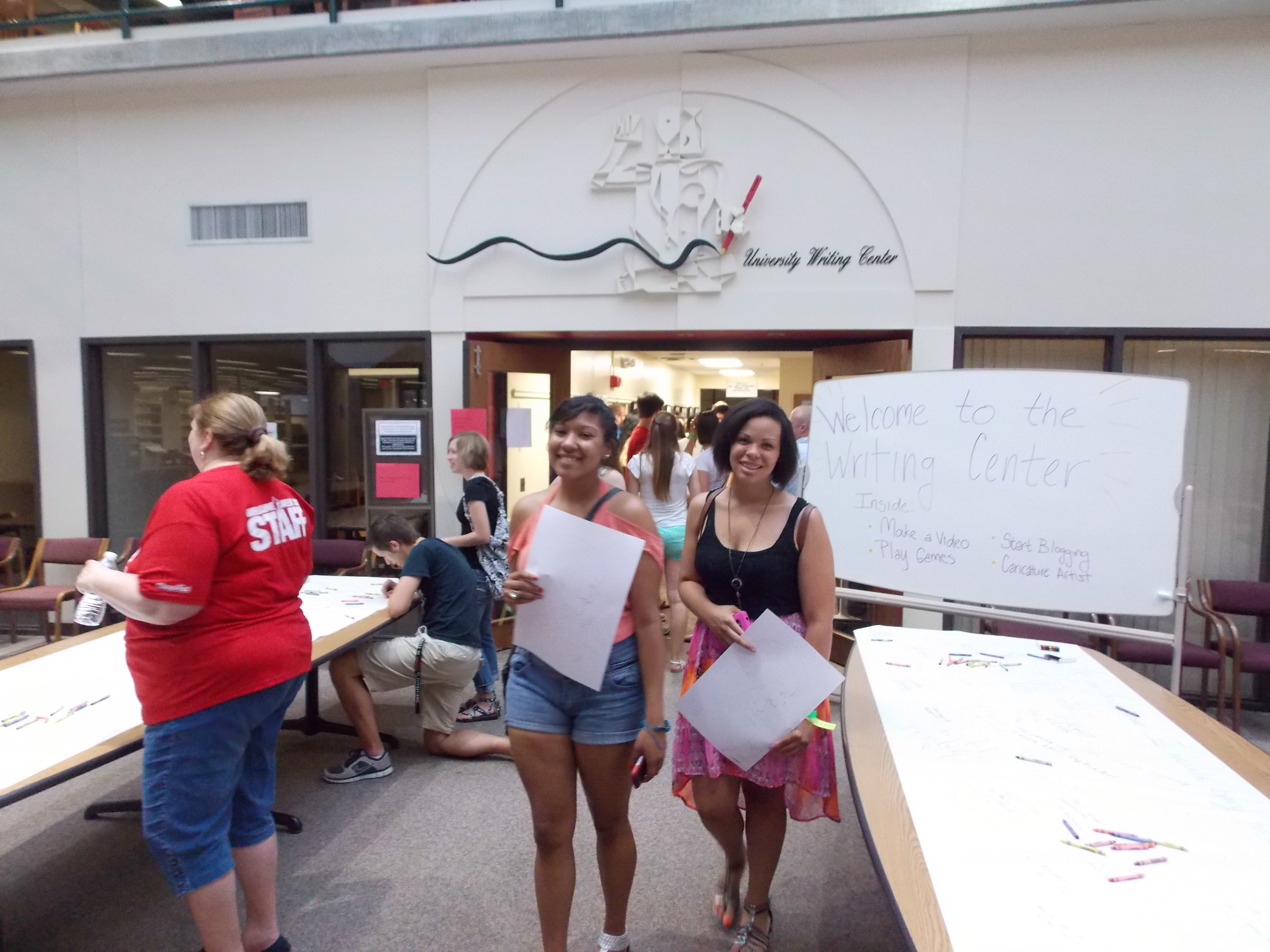
Last Thursday, the University Writing Center participated in the Office of First Year Initiatives Night at the Museum event. In the past, this event has been held at the neighboring Speed Art Museum, but since the museum is currently under construction it was moved to Ekstrom Library, where the Writing Center also happens to be located. We were excited to be involved in this event which, like many others in the week before school starts, aims to familiarize first-year students with campus, build community, and get everyone ready for the Fall semester.
There were many features available throughout the event, including a magician, a fire show, a scavenger hunt and others. On the 3rd floor in the Writing Center, in addition to the caricature artist, students were able to make videos about their experiences with writing, help decorate banners promoting what they believe about writing, and help write a collaborative blog post for this blog. To get the words flowing, we did offer some topic suggestions asking students to reflect on their best experiences with writing or advice about writing.
The night was filled with stories of papers, like this one:
My best writing experience was when I finished my 14 page Extended Essay for the International Baccalaureate Program in 2 freaking days. When results came in I received a 7 (the highest possible grade)!!! YAY!!!
And this one:
The best writing compliment I ever received was an accusation of plagiarism. That may sound a little mixed up, but it really was. Because what my teacher said to me wasn’t “you cheated” or “this isn’t yours” but rather “you couldn’t have possibly written this well”. And when I finally convinced him I had, he told me that it was essays like mine that showed that his class truly mattered.
By far, though, the most popular theme of the night was “best writing advice”:
Don’t use clichés!
Try as many different writing styles as possible. Try outlining, but if it doesn’t work you can always try something else! You never know when you will find a method that works for you. Most importantly, ASK FOR HELP!
When you finish a paper, read it backwards to catch spelling errors. Then, make sure to have someone else read it. They’ll probably see errors that you missed!
Be brief.
Make your diction sophisticated enough to be intelligent but simple enough to be practical.
Get rid of the fluff.
Don’t use “be” verbs!
If you use garbage words (nice, good, bad, like, ect.) I’m judging you.
Don’t use a semicolon unless you know how to use it. Seriously.
Write what you feel, when you feel it. Edit later.
In addition to the circulating stories of experiences, compliments, and advice, some students took the opportunity to listen to their inner muse and offer a demonstration of word play.
Poetry is
Like
Fight Club.
T h e r e a r e n o r u l e s.
(except if it’s iambic pentameter, then there are rules. Sorry)
I wish I could speak English. I know incredibly close to no English. No English. No English. At all. Ever. 2+2=*
Everything is either everybody’s fault or nobody’s fault. Connections are limitless. Such is the madness of life and the living.
And, as ever, we should remember:
Here at UofL,
The possibilities soar,
Proud to be a Card.
And:
I thank you are the best.
Compiler’s Note: The participating students all chose not to include their names. The Writing Center would like to thank all the students who visited us at the Night at the Museum event as well as those who participated in the collaborative blog, videos, and other activities. Thanks also go to First Year Initiatives for organizing this event and including us.
Last weekend the Writing Center wrapped up our third Dissertation Writing Retreat. Much like the previous twodissertation retreats we’ve held, this one offered doctoral candidates the opportunity to have dedicated writing time and resources as well as time each day with a writing consultant. Unlike our previous retreats, we did not meet every day for a week; instead we met three Saturdays in a row. The difference in scheduling offered a unique experience that offered a different set of advantages than the week-long retreat.
First, the week-long retreat—which is a common model for these kinds of events—is useful to writers because it can be particularly helpful for breaking out of a rut and for developing daily writing habits. Our director, Bronwyn Williams, wrote during our first retreat about what the week-long model can offer. Some of our clients for the May retreats came in with the goal of finally wrapping up a chapter or with starting a chapter. Writer’s block is a common concern. In fact, this past May when I served as a consultant for the retreat that is exactly the place I was in, and I was hoping that like our writers I would be able to find the key with scheduled time each morning to write. We also work with writers during the week to develop daily goals or practices that will encourage them to do some writing every day. Hopefully these practices will continue once the week is over.
Certainly we have had good feedback from participants in the past two retreats. We’ve heard repeated calls for more retreats and more support for doctoral candidates in the form of writing groups and writing spaces. The School of Interdisciplinary and Graduate Studies has responded to some of these call, as this semester they are starting Dissertation Writing Accountability groups. And, of course, the Writing Center always welcomes those who simply want to use the space to write or work during our open hours.
While we’ve had good feedback about the week-long retreat, and plan to continue offering them, sometimes circumstances call for some flexibility. A number of those interested in the May retreat were unable to attend because they work full-time jobs during the week. Many of these students were candidates in the College of Education and Human Development, and with the support of their college, we are able to design a Dissertation Writing Retreat that would meet all day for three Saturday in a row. Like our previous retreats, participants wrote in the morning and then, just before lunch, a short presentation was given on a dissertation writing strategy. In the afternoon, participants met with a consultant to talk about parts of their dissertation, writing strategies, or other writing related topics.
The biggest advantage to meeting across three weeks—in this consultant’s opinion—was that there was a higher likelihood of developing habits. One hope of the week-long retreat is that repeated practice for five days, with support and peer supervision, will plant the seed of a habit. For the participants in this retreat, they had at least two weeks to practice and then report back about their effectiveness. There wasn’t as much direct support, but the accountability for progress was a little higher since they had a week to make progress between meetings rather than just an evening. One habit that I worked on with two of the participants was the practice of doing some writing or work every day that related to the dissertation. These women had busy lives—teaching, raising families, and other commitments—but they also worked hard to do even fifteen minutes of dissertation work every day. Of course, it wasn’t easy and some days that fifteen minutes didn’t happen. For the most part it did though, and I have confidence that they will be able to keep it up.
This is certainly not to say that one scheduling style for a dissertation writing retreat is better than another. Instead, I would argue here that each schedule works toward a different set of goals and has different expectations. Perhaps the week-long model is better for getting a burst of motivation and production that can get the ball rolling (again, sometimes) while the three-week model is more effective for establishing not just sparking habits. As the Writing Center moves forward and continues to host these retreats, we will be exploring these early thoughts and more. So, stay tuned; there’s more to come.
While working with a fellow writer this weekend, we started discussing the desire for the “perfect paper.” As each of us pour ourselves in dissertation chapters, we often unreasonably hope that the response to our drafts will be something along the lines of “This looks great; start on the next chapter”—or some other kind of confirmation that we are done with that piece and can move on. This desire is something I believe that my writing students and the many clients we see in the Writing Center are familiar with. It’s more than wanting to know that you did a good job. It’s wanting to know that you did the best job and that you can be released from further labor on a piece that certainly demands a lot of physical and mental effort. Bronwyn Williams posted earlier this year about the intensely personal aspect of writing, and how that connection—even to a writing that is seemingly impersonal—makes receiving feedback difficult. So we continue to yearn for the “perfect paper.”
The conversation this weekend forced me to wonder what the perfect paper look like. How do you know when you’ve achieved it? The most common answer seems to be that this essay would, above all else, receive no marks, nothing to mar the masterpiece the writer has created. It requires no response because it is beyond reproach. This conception of the perfect text is reinforced often in classrooms by tales of red ink and grammar-meanie teachers. Almost all of us have a story of getting back a paper that was “torn apart” by a grader, had more writing by the teacher than the writer, or had a seemingly scathing and long note attached to it. What if though, just to venture out on a limb for a moment, that the unmarked, pristine essay was not actually the “perfect paper.” I know, I know—it’s outlandish, but bear with me for a moment.
When we write, it’s always for an audience, even if that audience is just the writer herself. Writing communicates a message. It may or may not be personal. Either way, it aims to connect with the reader, to invoke a response in or from them. Writing can be compared to telling a story. If you share an experience with another person, you expect that they will demonstrate that they heard you—hopefully with words, but even a nonverbal recognition could satisfy you in some cases. If we accept that this is also be true about writing, then the “perfect paper” is not at all clean and empty of feedback.
The “perfect” piece of writing is covered with commentary from the reader, and that commentary verifies the power of your writing. It proves that your work connected with your reader, made them think, and made them want to share those thoughts with you. That feedback might be in praise or it might be contradictory, but it recognizes you as a writer worth communicating with. Isn’t that the kind of respect and recognition that we all want?
The pristine perfect piece is definitely a myth, but unfortunately the comment-filled version of perfect writing can be just as elusive. While the pristine piece is a myth because it ignores an important aspect of writing, the marked up piece is rare due to very real and practical factors. When you submit a piece to your boss or your teacher, their focus is often on improving or fixing perceived errors. Their lives are filled with many demands and priorities that can make the ideal response, which takes time and focus, sometimes difficult to achieve. For this reason, when we receive comments on a piece of our writing, especially comments that address both our text’s strengths and weaknesses, we should truly appreciate our reader and our work. It’s the closest we can really get to the perfect paper.
While the Writing Center still works under time constraints, remember that we are here to help you experience this ideal version of the perfect paper: one that receives earnest, focused feedback from a reader who wants to engage your ideas and your work. And, when you find a good reader, whether in the Writing Center or among your colleagues/mentors, remember to value them and their feedback as they help you craft and re-craft the perfect paper.
I don’t know what it is about the summer – perhaps that bit of extra flexibility in my schedule has turned me towards the philosophical – but I recently had an interesting consultation with a student that left me thinking. We worked together on some organizational and grammatical changes to the paper, but had a bit of free time left at the end of the session. On the spur of the moment, I asked where he was from – he had a lovely accent, but I had never asked. He told me he was from South Sudan, and we had a great discussion about our respective home countries.
This experience started me thinking more carefully about the students I meet every day. They represent people groups from all over the world, from all walks of life – and I know that part of my training is to recognize that. But, and perhaps because of that training, it can sometimes be easy to break a patron down into an “eastern” or “western” writing style, into the component parts of their writing.
Before I was born, my dad was involved in a terrible car wreck that left him needing multiple surgeries. He was heavily sedated but remained conscious while hearing the doctors talk about fixing his hip the next day, “just the way you’d talk about fixing a car.” And I have to ask myself – do I, in some ways, reduce these students to the things in their writing that I can help them “fix,” and does that help or hamper my ability to do so? For doctors, I imagine that (at least in cases of trauma) focusing on what you can improve is an important mechanism that lets you do your job efficiently and effectively. And my father didn’t criticize his doctors for reducing him to his component parts – by doing so, they were doing their job. But for my very different work of helping writers improve themselves, reducing an entire person to whether their writing meets certain criteria might interfere with being able to see the very things (their own creativity, the way they articulate ideas verbally rather than on paper, etc.) that will let them improve.
None of this is original thinking, of course. One of the first things we were taught at the beginning of last fall was to pay attention to students’ emotional well-being – if someone is crying because their paper is due in five hours but they’ve been away at a family funeral, the first focus is on that total person, on helping them get to a point where they can work on the paper. But in the rush of appointment after appointment and juggling life and schoolwork, it’s easy to begin to have a kind of surgical focus on papers and organizational structures. It’s easy, in short, to forget that key idea – that in front of me there is a human being with a complex existence outside of our interaction, and that paying attention to who someone really is can help me be a more effective writing consultant.
By 2013, the Order of Words—of letters even—could no longer hide the fractures running through its structure. Some words remained strong by latching on to other words to create powerful cultural phrases. Other words adopted new meanings, or they went under penknife for to add or remove letters. Some particularly unfortunate words just fade and disappear; their ghosts haunting old pages and high school students.
In the beginning, the deteriorating words were blamed on the infamous kids-these-days and new-technology. Well intentioned figures like Twitter and Facebook were turned into evil villains. They were accused of stealing letters, breaking down the cornerstones of complete sentences, and misusing punctuation! Evidence of their positive effects on word-smithing was covered up or ignored.
While language academies and even some teachers fought to hold onto the old Order, other recognized the vitality possible in the changing letters and words. Many knew that some words had been lurking in the shadows of the order and hoped these words would add a new texture to the tapestry of available communication. Leading this fight was the Caped Word Smith. No, not the caped Will Smith—Word Smith.
The mission of our loquacious hero was to forge new paths for young words who were just trying to make a name for themselves and to protect them on their journeys from the dreaded Grammar Meanies. Word Smith would traverse the many interconnected strands of the World Wide Web standing up to grammar bullies, but always trying to show them the way to acceptance and better understanding. She even appeared in the printed worlds of Newspapers and Books. On the most anticipated occasions, Word Smith visited students in their classrooms to share with them the possibilities of Words, Letters, and Punctuation—spreading love and appreciation in all their young hearts.
Of course, not all young words always behaved responsibly—sometimes staying out too late or hanging around with the wrong letters or words. With an eye to the future, Word Smith would encourage them to look inside themselves to find their true path forward. She would challenge them to think about the places and times in which they could be most effective. Did they really belong in this status post, or did they aspire to the offices of textual bureaucracy? She helped them see and seek their dreams.
Perhaps the most inspiring thing Word Smith did for the world though was the creation of the WordCorps. The Writers of the WordCorps were just everyday people who knew the power of Words but also that Words should not be boxed in and controlled. They worked to spread the respect for Words and their ability to change over time. Writers were encouraged to choose their own genres and locations for sharing the WordCorps message. Some worked with those old vilified figures—Twitter, Facebook, and Texting—to rebuild the world’s understanding of how new platforms can inspire growth as opposed to destruction. Others wrote longer texts that they shared with their classmates, coworkers, and friends—always aiming to use Words in new and effective ways. Adventurous Writers even took words into videos and other formats to give them a new kind of movement.
While the WordCorps makes good progress, they always need more Writers to spread the message. It is the dream of Word Smith and the WordCorps to enlist everyone into their organization so that all Words can reach their full potential without fear of bullies or meanies. Will you fight with the Caped Word Smith? Take up your keyboard, your pen, your pencil, whatever you need—and fight the good fight for the Words and Letters and Punctuations! Will you join us, will you be a Writer?






 University of Louisville Writing Center