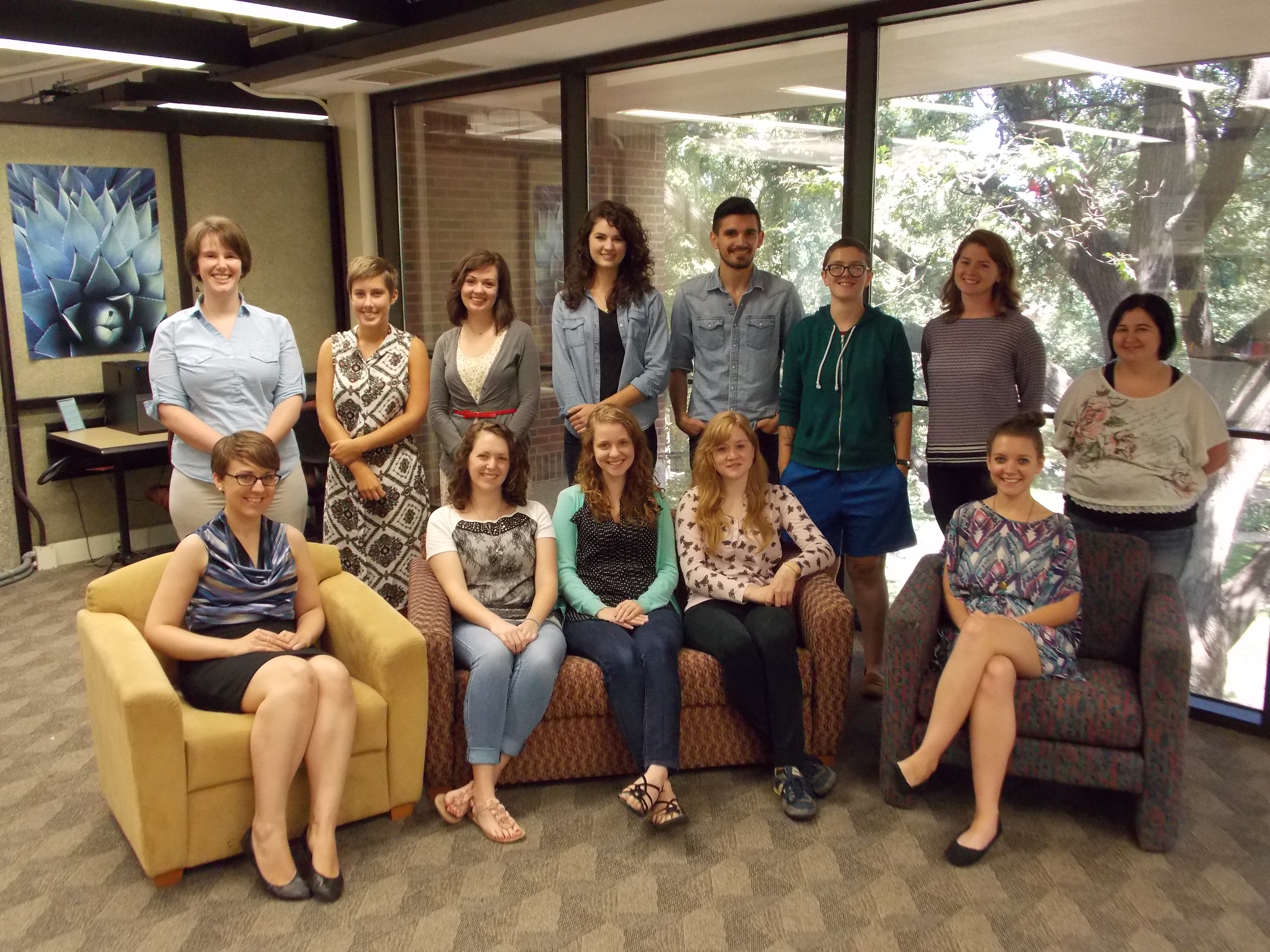
In some ways, this semester is starting like many others at the University Writing Center. We gathered as a staff for the first time at our Orientation last week and started to get to know each other. We have a great new group of consultants, as well as new faces as Associate and Assistant Directors.
University Writing Center Staff, 2015-16
With the start of classes this week we’ve been busy meeting with students and doing presentations about the Writing Center for classes and student organizations. If you want to make an appointment, we are open for business and happy to meet with you. In the year to come we will also continue with the programs we have established in recent years such as our Dissertation Writing Retreats,Junior Faculty Writing Groups, and workshops about Graduate Student Writing concerns. There is a great deal of anticipation about the year ahead. The photo of this year’s staff is in the familiar setting in front of the windows on the Third Floor of Ekstrom Library. So, yes, in some ways this year feels like many others.
Under Construction – The University Writing Center space on the First Floor of Ekstrom Library
And yet, two floors below us, is the evidence how much is about to change. On the first floor of the Library the construction continues on the new space for the University Writing Center. At the moment it’s still a work in progress, but in the skeleton of wall frames and electrical wires you can see our new space taking shape. Sometime, then, near the beginning of October, we’ll be moving into our brand new space.
What’s exciting about the new space (besides getting new furniture), is that we will be much easier to find, as well as have more space in which to meet with students. What’s more, we’ll have digital consulting rooms that will make it easier for us to help writers with multimodal projects and to do online video chat appointments with distance education students. Our new location will also allow us to collaborate more easily with reference librarians, REACH, and the Digital Media Suite.
We also want to use the move to the first floor as an opportunity to do
What You Will See When You Enter the East Doors of the Library
more to make the University Writing Center a place where we develop and sustain a culture of writing on campus. So keep an eye out for announcements of other kinds of programming about writing to come in the year ahead. We’ll keep blogging about the changes and new programs in the year ahead and will be posting about it on our Twitter and Facebook pages as well.
We wish everyone a successful semester and we hope people will let us help them make their writing as effective, engaging, and creative as possible.
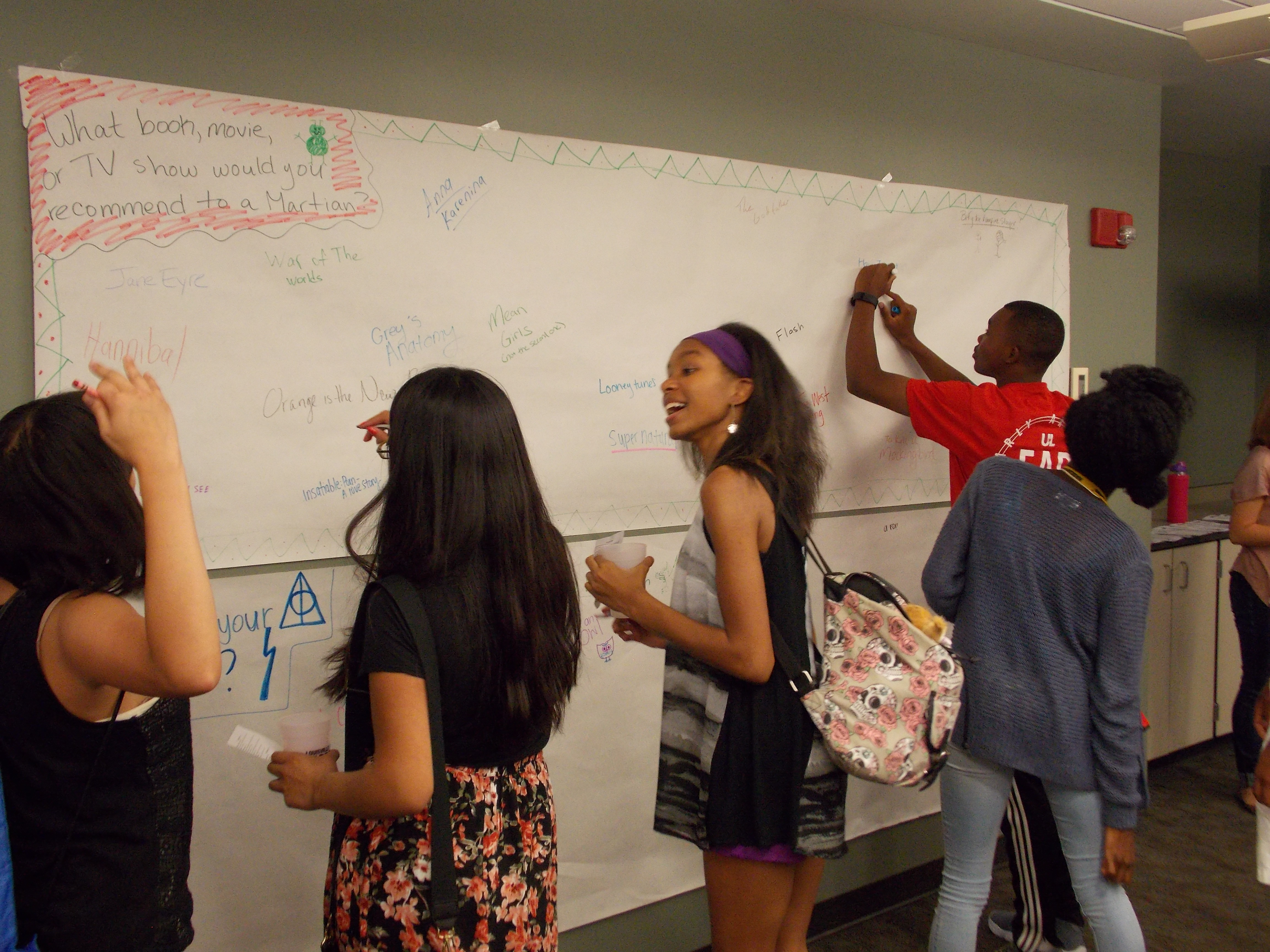
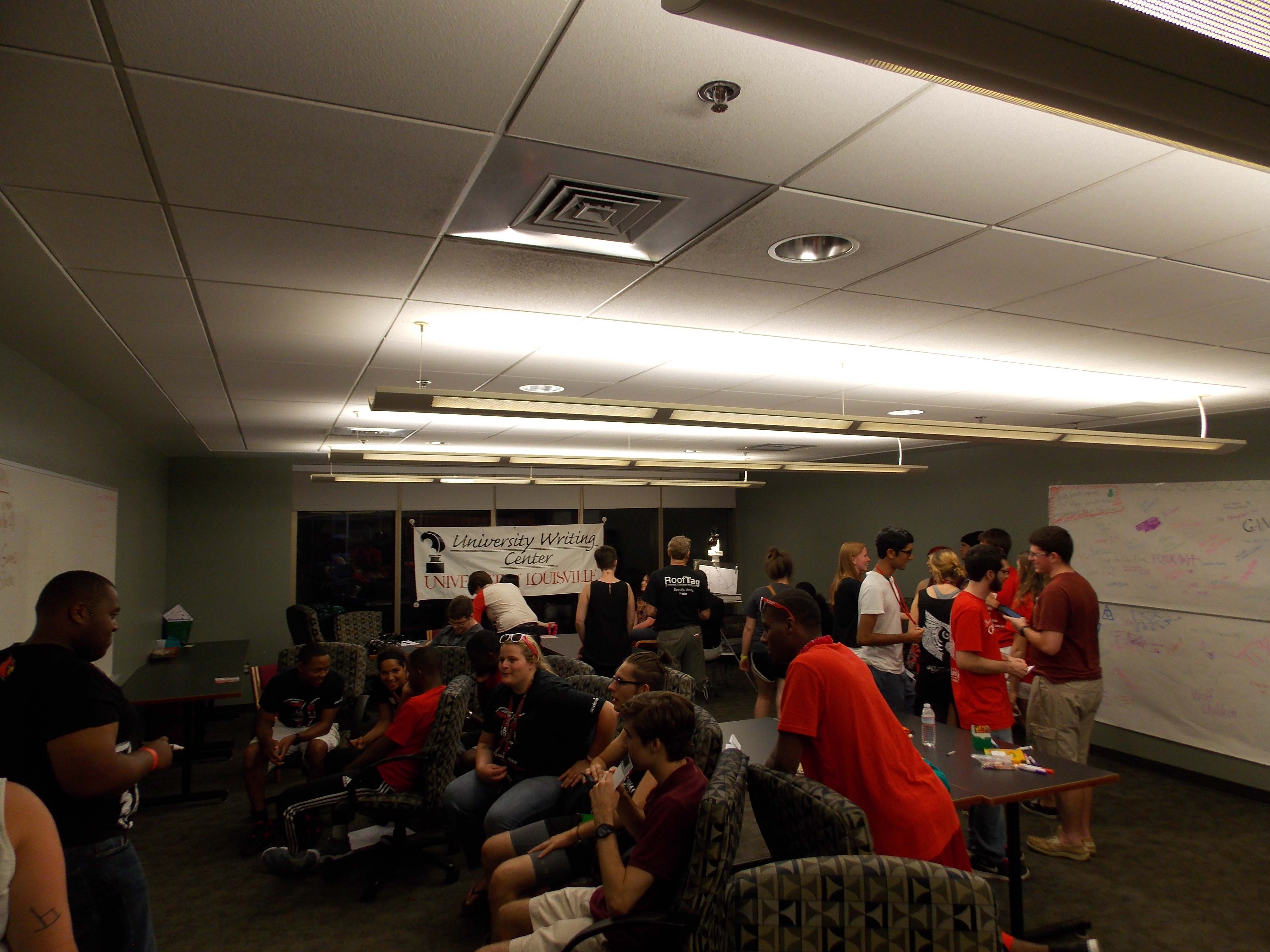
On the annual Kick Back in the Stacks night the University Writing Center had to find a temporary space to welcome new UofL students (though we ARE still open on the Third Floor of Ekstrom Library as our new First Floor space is completed!). But we still found a way to have a great time with the hundreds of new people we met. Along with the games and the art, we had a blog open for new students to contribute to and here is what some of them had to say to some of our questions.
Meanwhile, come see us on the Third Floor to get feedback and help with your writing!
What are you most excited about for your first year at UofL?
Meeting new people!
Being in a cool and rad environment
Trying new things I’ve never done before and new clubs!
Getting Free Food
Branching Out, I want new experiences and to explore new opportunities
I am excited to learn and take on the challenges that may come my way.
Living on my own
Going easy like a breeze until I hit so high no one can see me
About the UofL traditions and spirits of all C-A-R-D-S CARDS!!! 🙂
What is your favorite thing about writing?
It calms me down
I like writing to get my thoughts out on paper.
It is challenging but rewarding.
Explaining and expressing your feelings and cool stuff like that
I like writing because it allows me to express my feelings without being judged
I love to write my thoughts and perspectives on the world around me and then listen to the ideas that others may have.
It allows me to have my thoughts brought together in one place.
It allows me to gather my own ideas and argue viewpoints with their own thoughts
What is your favorite genre (poetry, short story, analysis etc.) to write? Why?
Poetry: It’s a very “to the point” way of getting to your feelings.
Mythical, romance, even dark things if I’m in the right mood.
I love historical fiction!!!!!!
Analysis: It’s what I’m most comfortable with and brings in my thoughts on a subject most thoroughly
Fiction, because I really like how stories are not always true and even realities.
We just finished our spring Dissertation Writing Retreat at the University Writing Center. Last week, May 18-22, several writers from various disciplines met every day to push their dissertation projects forward – and to learn some new things about writing practices and strategies at the same time. Some of the DWR participants were in the early stages of their projects, working on dissertation proposals or their first chapters. Others were nearly finished with their dissertations. The retreat provided them with the time and space to write as well as feedback on their writing in daily consultations. In addition, the DWR hosted daily workshops on topics such as organizing a large writing project, writing a literature review, and leveraging dissertations for future uses.
The consultants who work during the Dissertation Writing Retreat are experienced writing teachers who are also PhD students currently working on their dissertations. After the 2014 DWR, the consultants offered some insightful reflections, and here is what this year’s consultants had to say:
On being in the company of other writers:
The dissertation writing retreat this year reminded me of the power of surrounding yourself with other writers. I’m always so impressed by the camaraderie across the disciplines that happens during the retreat, but also by how much more work these writers are able to get done in this space simply by being around other writers who are all going through the same process. Some writers at the retreat used this opportunity to give each other feedback, comments, and share advice, but there were also times when sitting in silence together was just as productive. Whether you use the time around other writers as a chance to share ideas or as a quiet work time to be around others in order to keep focused, writing groups are valuable opportunities to grow as a writer as well as a great way to keep yourself accountable.
–Meghan Hancock
On goal-setting and rewards:
As always, this past week at the Dissertation Writing Retreat was a true joy. My fellow dissertating comrades and I talked deeply about how to stay on track with the book-length project that is “THE Dissertation.” We were really focused on how to negotiate and renegotiate the kinds of working routines necessary to get through this seeming behemoth. We talked about a few really important ideas:
Set a low goal that keeps you motivated but that is easy to reach, like – “Write 100 words per day,” or “Read1 article per day.”
Then, when you reach the goal, give yourself a gold star (or even a Teenage Mutant Ninja Turtles sticker) – just something to acknowledge the success!
Periodically revisit what you see as the whole scope of the dissertation, but don’t worry if that scope changes dramatically.
Figure out how to work effectively with each individual committee member, and the committee as a whole. Make sure to develop a comfortable working relationship with your director, above all.
Remember, it’s your dissertation!
And, finally, always take some time off for self-care!
It was a wonderful week, and I’m feeling fully energized to get back to my dissertation, 100 words at a time.
–Brittany Kelley
On habit-building:
The Dissertation Writing Retreat espouses many of the principles that writing centers value, among them making writing a daily habit. This principle resonated with me while I talked to DWR participants last week, especially because I am writing my own dissertation and working on meeting word count goals every day. If writing is a habit – and by writing I mean sitting down, opening a new document or one in progress, and making words in a row happen – then it is like brushing my teeth, looking over my shoulder before I change lanes, or feeding my cat in the morning. I don’t even think about whether writing will happen if it’s a habit. This is one reason why the DWR is a valuable experience for those participating in it. The retreat can teach the habit of daily writing, such that participants go on to continue the practice of writing every day even after the retreat ends.
–Jessica Winck
On being a member of the graduate community:
Over the last week, I’ve been thinking about mentoring. I had the privilege of working with two students in the Biology program who were at very different stages of the process at this year’s Dissertation Writing Retreat. One student was working on drafting her introduction while the other had completed and revised all of her chapters, and was working on further revision to turn one chapter into an article. While I learned a great deal about the growth of invasive honeysuckle plants in our area and colonies of bacteria, I learned even more about the value of mentoring. Throughout our time together, I was able to help the student who was further along with revising her article about bacteria, and she in turn was able to provide insight into the expectations that faculty in the department would have for an introduction on invasive honeysuckle. In this way, we all spent the week learning from each other, and I was reminded what a great opportunity graduate school is to be in a community of scholars, and that valuable help and advice is available from my advisor and committee, yes, but also from others who are at different stages of the process.
–Stephen Cohen
On commitment to our projects:
It’s hard to believe this is the 4th time I’ve consulted for the week-long Dissertation Writing Retreat. I’m thrilled that the Writing Center has been able to consistently offer this resource thanks to the support of many offices and departments across campus. While I’ve always been impressed with the work the writers do during the retreat, this year, perhaps more than any other, I was lucky to work with two writers who blew me away with their commitment to producing good work every day. Each took advantage of the writing time, guest talks, consultations, and other resources so that they were able to walk away with tangible progress on their projects. Their commitment was inspiring and reminded me of how much can be accomplished with a bit of consistent focus. It is my hope that they recognize the hard work they did this week and that it inspires them to keep writing just as much as it inspired me to return my own projects.
When we get to the end of an academic year, we always feel there is a lot to be proud of at the University Writing Center. We can look back over a year in which we’ve worked with members of every college in the university, on both campuses, ranging from first-year students to faculty. If you can imagine a day where, in the course of three hours you might work with writers on an English 101 paper, an engineering dissertation, and a business plan assignment – and be able to help all three writers with their projects – you can understand the talent and flexibility of our consultants. By the end of the academic year we will have had more than 5,000 visits to the University Writing Center. The consultants here do great, great work, every day. We may be a bit tired by the end of the spring semester, but we enjoy the work and feel as if we’ve worked hard to help develop better writing and better writers at UofL.
I want to take a moment to thank the writers who came to us to work on their writing and also all the faculty and staff who supported our work by recommending us to their students.
We will be open during the summer, starting May 11, from 9-4 every weekday. Meanwhile, take a look at our website and we hope to see you soon.
Other Reasons to Celebrate
In addition to our daily work of teaching of writing through one-on-one consultations, there are other events and activities that we organize, and other plans we are making. It’s worth taking a moment to point to some of the accomplishments, and to talk about what they are going to allow us to do in the future.
New Writing Center Projects:
Our Move to the First Floor of the Library: During the summer, as part of the renovation of the first floor of Ekstrom Library, the University Writing Center will be moving from the third floor down to the first. This new location will make us much more visible (and easier to find) and allow us to create new programs and initiatives that will help us develop and sustain a culture of writing in the University. To see a video about the move, see this previous blog post.
WCOnline Scheduling Software: We are finishing the first year of using our new scheduling software and we’ve found it has been a significant improvement in making it easier for students to make their own appointments online. The software has also made our online, Virtual Writing Center Appointments more effective. To make an appointment, follow this link to our website.
Faculty Writing Groups: This year we organized our first faculty writing groups, one in science/engineering/mathematics and one in humanities/social sciences. These groups have gone very well and we plan to keep them going next year. If you’re interested in taking part, contact the Writing Center.
Writing Center Social Media: We continued to communicate our ideas about writing and the teaching of writing through our presence on Twitter and Facebook as well as our blog.
Dissertation Writing Retreats: Our Dissertation Writing Retreats remain popular and we are having the pleasure of seeing 90 percent of the students who attend the retreats complete their dissertations.
Workshops: Our Writing Center staff conducted a broad range of writing workshops in both courses and for student organizations on issues such as revision, writing a literature review, citation styles, and resume writing.
Writing Center Staff Achievements
The University Writing Center, in addition to its teaching mission, is also an active site of scholarship about the teaching of writing. Staff from the Writing Center were engaged in a number of scholarly projects during the past year in rhetoric and composition, literature, and creative writing.
Mariah Douglas – Internship at Louisville Magazine with 11 published pieces.
Joanna Englert – Published poems in the Miracle Monocle and the Kentucky Poetry Festival and presented at the Louisville Conference on Literature and Culture
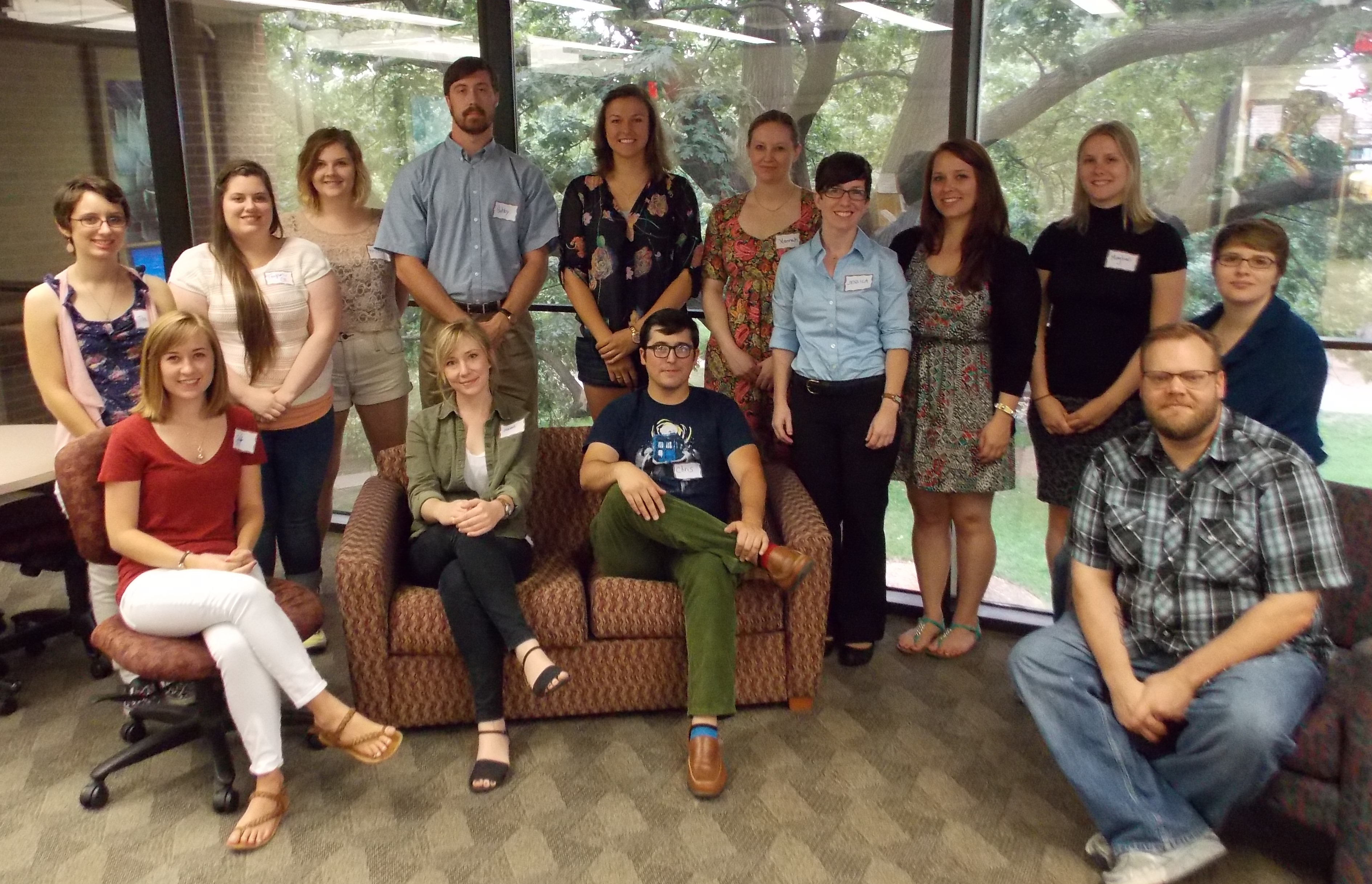
University Writing Center Staff – 2014-15
Harley Ferris – Co-editor and writer of KairosCast for the journal Kairos. Presented at Computers and Writing. Forthcoming publication in Computers and Composition Online.
Taylor Gathof – Presented at the Louisville Conference on Literature and Culture
Meghan Hancock – Presented at National Conference on Peer Tutors and Writing/International Writing Center Association Conference; the Conference on College Composition and Communication; and Pop Culture Association/American Culture Association Conference
Kristin Hatten – Presented at the Louisville Conference on Literature and Culture; Internship with Commonwealth Center for the Humanities.
Jamila Kareem – Presented at ACES Symposium; Conference on College Composition and Communication; Forthcoming chapter in the collection: The Good Life and the Greater Good in a Global Context
Tara Lawson – Presented at Southeastern Writing Center Association
Ashley Ludewig – Presented at the Watson Conference on Rhetoric and Composition; The Western States Rhetoric and Literacy Conference; and the Research Network Forum at the Conference on College Composition and Communication
Amy Nichols – Presented at Conference on College Composition and Communication.
Haley Petcher – Presented at Southeastern Writing Center Association Conference
Bobby Rich – Published poems in Hobart Magazine and the Kentucky Poetry Festival; Internship/Poetry Editor of Miracle Monocle
Adam Robinson – Council of Writing Program Administrators Conference
Chris Scheidler – Presented at Southeastern Writing Center Association Conference; Association of Professional and Technical Writers Undergraduate Conference, Computers and Writing, and Conference on Community Writing
Stephanie Weaver – Watson Conference on Rhetoric and Composition; Conference on College Composition and Communication
Jessica Winck – Co-authored publication in Kairos. Presented at National Council of Teachers of English Conference; Council of Writing Program Administrators Conference.
This spring marks more than just the end of another academic year at the University Writing Center. After fifteen years, this will be the last year the University Writing Center will be located on the third floor of Ekstrom Library. During the summer we will move down to the first floor of the Library as part of the renovations to the East Wing of Ekstrom Library. While we all do feel a bit nostalgic for our beautiful view on the third floor, we are even more excited about the opportunities we’ll have in our new location. The central location, just to the left of the elevators on the first floor, will not only make us easy to find and allow us to collaborate with Library and other services, but it also will provide a clear statement about the importance of writing within the University. The architects have designed an innovative space for us that will allow us to grow and hold more writing consultations with students, faculty, and staff. This video gives you a look at the new vision for the first floor, including shots of the outside of our new University Writing Center space.
In addition, we will now have new multimedia consulting rooms where we can work with multimodal assignments as well as conduct online, video consultations with distance education students. We hope to build on the success we’ve had in the past fifteen years, and use the space to promote and nurture a culture of writing at UofL.
Once we’ve made the move downstairs, look for a announcements of an event celebrating the opening of our new space. Be sure to come see us and let us work with you on your writing. In the meantime, we’ll be posting updates and photos here during the summer.
Learning to brainstorm is—in my humble opinion—one of the most important aspects of learning to write. This may seem obvious, but I think the further we progress into our writing careers, the more we tend to skip a good, solid brainstorming session. I, for one, am extremely guilty of this—especially since I started graduate school; I get overwhelmed with the project at hand, and, instead of proceeding calmly and strategically, I barrel forward into my paper, despite the fact that I know better. So, here, I want to outline some steps that I plan to walk myself through in order to avoid this “snowball-style” writing style, in hopes that they will be helpful to you as well!
First, freewrite! Freewriting is a great way to start a brainstorming session because you can do it however you want! Freewriting may consist of a rough outline, a chart, boxes with arrows pointing from one piece of information to another, or a typed or written page(s) of stream of consciousness commentary. Whatever it may be, it will only be helpful in getting you started on your paper.
Second, now that you have completed the freewriting stage, remove yourself a bit from the actual content of the project, and focus on the research methods that will be necessary. Here, list out some keywords you think may be useful to you during your process, and list any of the sources you may have already acquired. Also, poke around on the library’s online catalogue and make a list of possible sources from there. This will surely help you further organize your thoughts as well as help you flesh our your ideas. (Sometimes, depending on how deep you are into your project, this may be useful as step one!)
If you have trouble getting started with freewriting, try to talk out your ideas to a peer, a friend, a University Writing Center consultant (!!), or a professor. In some of the most effective brainstorming sessions I have had with clients, about 75% of the brainstorming session has consisted of the client talking through his/her ideas and me taking notes. In these instances, the client oftentimes realizes that his/her ideas were more organized and succinct than originally thought. So find a buddy and talk it out, y’all! It’ll help, I swear.
Finally, understand that brainstorming does not only happen before you write a paper. Allow yourself to brainstorm throughout your writing and research process. So, what does this look like? When you are reading and analyzing your research materials, respond directly to each source (right after you finish reading each) using your most effective freewriting method. Once you move into integrating these source materials and responses into your paper, it is to be expected that you may get stuck or need to re-organize your papers. These moments serve as yet another place where freewriting or reading and responding can come in handy.
In short, don’t panic! Sit down, get a cup of coffee, and write down what you know so you can figure out what you don’t know. Oh! And don’t forget, carry your brainstorming methods throughout the entire paper!
I first read Shel Silverstein’s poetry when I was in elementary school. I loved his doodles, and I loved his rhymes. When I got older, I loved his cleverness. Silverstein could tell a good story in only a few words and could capture the minds and hearts of children and adults alike while doing so.
Maybe you’ve heard that Silverstein’s writing is childish or not up to par with the poetry greats, like Yeats or Shakespeare, but I’m here to show you that he can actually tell us quite a bit about writing. Let’s start by looking at one of his poems about a writer.
The poem, paired with a sketch of a young child staring at his computer screen and waiting for something to happen, is very clearly about computers and writing. I don’t know about you, but often when I write, this is a pretty accurate representation of me. Even though I’m in grad school, I feel like a kid who has no idea what she’s doing, and sometimes I stare at the screen, hoping for a miracle.
We could go down many rabbit holes about using or not using “standard English” or about all of the rhetorical choices Silverstein makes in his argument that computers are actually not the key to writing, but this time we’re going to focus on the following:
What computers can and can’t do
Creative license in syntax
What the writing center can help you accomplish
The narrator says that he doesn’t “need no writin’ tutor” because the computer can do it all. It can check spelling by showing you the ominous red squiggly line and grammar by showing you the questioning green squiggly line. Sometimes these lines are useful and alert you of typos or sentence fragments. But other times they’re wrong. And sometimes they don’t catch the mistakes. For example, my computer did not use a green squiggly line for my previous two sentences, even though they are technically fragments. Those sentences are examples of using your “creative license” to make a point by putting more emphasis on the sentence.
Silverstein uses his creative license in most of his poetry. A few examples in his poem are, “It can sort and it can spell,/It can punctuate as well,” which the computer doesn’t mark but is a run-on sentence, and “(Just as soon as it can think of what to write),” which the computer does mark as a fragment. Both of these examples rely on their syntax to create the rhythm of the poem, or how we hear and read it. Try reading it aloud while paying close attention to the syntax. (Remember to use longer pauses for periods than for commas.) If Silverstein paid too much attention to the computer, he wouldn’t have been able to create this rhythm or achieve his meaning.
My favorite part of “Writer Waiting” is my second example of Silverstein’s use of creative license. It is the last line, which is in parentheses as if it’s an afterthought or something the narrator doesn’t want to admit. It reads, “(Just as soon as it can think of what to write).” Two words in this line are key: “it” and “what.” “It” puts an emphasis on the computer, while “what” brings our attention to the content of the paper, though the poem mostly focused on the mechanics, like punctuating and spelling. The computer, of course, cannot create the content for us, even though we want it to. Writing is not just about the tools you use; it is about you and your thoughts.
Writing also does not have to be a solitary act. In fact, I think writing is more fun when you talk to other people about it. Here at the University Writing Center, we can help you decide if the squiggly lines offer the best choice, if you should deviate from the computer’s options, and if it’s the best time and place for you to use your creative license in writing to make your point. Most importantly, we can discuss your ideas for your paper. The writing center is here to help you not look and feel like the kid in Silverstein’s drawing.
As writers, we often struggle with what to do with a paper after we have finished saying all that we want to say. This stage can happen at any point in the writing process, from having 3 pages done and needing 5, to needing a conclusion, to just hitting a dead end with the paper. This moment, commonly referred to as writer’s block, is quite infuriating. However, one of the best ways to combat this moment is by redefining how you see writing.
Most people see writing as a solitary act, one where the writer is stoically sitting for hours on end in front of a computer, unmoving except for one’s fingers across the keyboard. There has been a new emphasis on collaboration as part of the process today, which makes writing slightly more active, but not by much. However, what I wish to propose with this piece is that writing can be a very active process, and some techniques can help rejuvenate new work.
The main goal of writing is to capture that which is innately human. We wish to persuade others, to encourage them, to communicate with them in an intriguing and interesting way. Writers do this visually, by using the words on the page, but we also share ideas through our other senses. For example, many people compose while listening to music because the combination of the various notes will put us in a specific mood and encourage certain words to come to mind. Other people feel the need to write in busy areas, like coffee shops, so that the flow of conversation is in our ears. In this regard, writing is listening.
Writing can also draw on physical activity to some degree. Research is a major component of any writing project, but some articles can be really difficult to understand. Often, in order to understand what I am writing, I have to act out what I have read in some way. If I have to read a description of what someone is doing, I mimic what is described on the page until I understand it. Other times, I draw a map or a flow chart to connect major ideas. Techniques like these help with reading comprehension and provide ways for writers to organize their reactions to various works.
Also, I have worked with many people who, when brainstorming, need a way to channel their stress. That is the moment where I bring out the Legos or Play-Doh! Doing something with your hands while talking about your writing can help the feeling of being fidgety, without adding the stress of needing to write something down. Although putting words on paper is a key component of the writing process, the most important step is finding something to say. For this, I highly recommend grabbing Legos, a slinky, or even a coloring book, and meeting up with a friend for a conversation about what you are working on. It allows writers to feel active and productive, without the paralyzing fear of not writing something down.
Another way to be active while writing is to grab a pen and paper and go for a walk. The fresh air helps foster creativity, while the exercise is just as industrious as writing. Walking also allows writers to observe their surroundings and generate new ways to add detail to a paper. It also helps me find new ways to add clarity to my paper. If I watch the different ways people run, I can determine which verb I want to use describe the same moment in my own paper—sometimes it’s a sprint, other times a jog, still others a quick dart.
Finally, my biggest recommendation for getting out of a writing rut is to experiment with the writing process. What are your strengths? How can you use them in your writing? If you can’t, can you use them to inspire your writing? And don’t give up hope. There have been many times that I have tried something new and it hasn’t worked. The great thing about experimentation is that you can always just try something else. In the words of the famous author E.M. Forster, “How can I tell what I think until I see what I say?”
It’s a week from spring break, and I know—one of my feet is already out the door, too. But even though we would rather focus our to-do lists around packing up our suitcases to go home or buying a new swimsuit to rush off to some actual sunny weather (what is this weather we’ve been having?!), let’s take a step back into this figurative door-frame and do ourselves a favor.
After spring break, it always seems like a sprint to the finish with all the assignments and papers and projects, yadda yadda yadda…but this semester, glorious spring 2015, let’s try to make it a little less stressful on ourselves. Let’s set some optimistic accountability markers (some may mistake these as self-deadlines, but that term is all too scary. These are much nicer). What do you say? This’ll take less than 10 minutes of time, and I promise, our future selves will thank us.
You need just a few things to get started: your syllabi for your classes (whether paper or on Blackboard—wherever the schedule for upcoming classes is laid out), a calendar/planner, potentially a pen (unless you’re going all techy on me with a digital calendar), and an optimistic but determined state of mind. Got ‘em? Great!
Now, the first step is the hardest, but necessary. So, deep breath. Ready? Let’s mark down in our calendars the due date of our bigger end-of-semester projects. I know this seems daunting, but it only gets easier from here, I promise! It’s just like jumping into a cold pool—it warms up after the initial chill. But take 2 minutes, go through each of the final weeks of your syllabi and put them all into that calendar, preferably marking them by class and assignment name.
Okay—you’ve made it this far, my friend. I know it looks like a lot to do in a short amount of time, but that’s where these next steps come in to make it a whole lot easier and actually doable.
Now zero in on one of your classes—whichever one, any one will do—and think about that final assignment. Is it a bigger paper? How many pages? Is it an accumulative exam? Whatever it is, think back to last semester. Did you have something like this before? Now be honest with yourself—to do well on this assignment, what are the steps you need to take? Jot down just a rough draft of the steps you think you’ll need to take to get there. Here’s an example:
Assignment: 5-7 page paper, using 5 sources, about such-and-such a topic.
And then, I need to read those 5 sources, highlighting parts that seem relevant to the such-and-such topic, so I actually know what I’m going to be writing about.
And then I need to brainstorm and mentally organize my paper a bit, before I sit down to start writing.
From that, I can probably put together a rough draft of about 3 pages.
Then I definitely want to come back to my draft with fresh eyes to revise, because my papers are always better when I revisit them and polish/clarify my ideas. And let’s say I get stuck at something like 4 pages—I’ll include a little buffer time to make a visit to the writing center (and I might as well make that appointment now and get ahead of schedule—I can always cancel it if I don’t need to use it, but it’ll just be another optimistic accountability marker to hopefully get where I want to be!)
Then I can work on adding the finishing touches. Done. Submit. Adios such-and-such paper!
So six steps? That’s totally doable, right? Better than one larger looming paper. And breaking it down like that can give you an idea of how long each step might take.
So the next step, after drafting that list—yours might only be a few words per step—write on/type in your calendar when you think you can doably complete steps 1 through [insert your own number here]. But remember, the key here is to be optimistic and a go-getter, but not unrealistic. We have 5 weeks left, and then finals week after spring break; I know it’ll fly by, but realistically, if we space out our mini-optimistic accountability marker steps, it’s completely doable! And you won’t be super stressed, I-am-only-surviving-on-caffeine during finals week!
Oh! And two nice things about these optimistic accountability markers? Checking them off on a to-do list feels super! AND they are revisable—if you realize you’ve been a bit too optimistic with one of your markers, reevaluate. They’re your markers, and they’re there to help out your future self (:
If you were on social media last week you probably noticed a thing or two about a dress that, to embrace the hyperbole, “broke the internet.” I’ll leave the dress debate to the designers and physicists but I would like to draw your attention to the act of interpretation; specifically, I’d like to focus on interpreting assignment prompts.
We often take interpretation for granted. We interpret every day. Sometimes interpretation is straightforward: for instance, when your friend says, “Pass the mustard.” Other times, interpretation requires a bit more navigation, such as when your parent asks, “Did you do the dishes?” A blunt “no,” if your family is anything like mine, is probably not an advisable answer. We interpret so often that we sometimes forget that we’re doing it. In many ways, we’ve all become experts at interpreting.
But if the dress debate demonstrates anything, it is that we occasionally get our interpretations wrong. Our ability to interpret is not infallible. When we’re reading assignment prompts, the context, our previous experiences, and other elements all shape the way we interpret the prompt. If a two-tone dress can break the internet, how can we agree on what our professor expects from our assignments?
Don’t fret! Interpretation can be tricky but there are at least four helpful strategies that I recommend.
1. Visit the University Writing Center. Whether you’re just beginning an assignment or further along in the process we’re here to help. We tutors have years of experience interpreting not only assignment prompts but also texts in general. Sometimes just talking it out with another person can help. Which is why, if you don’t have time for an appointment you can:
2. Reach out to other students. Your peers have likely asked themselves the same question about what the assignment means. Ask them how they’re interpreting the prompt and you might find that you all agree on an interpretation or that there is some difference in interpretations. If you, like the Internet on the dress, can’t reach a consensus you can always:
3. Examine the keywords in the prompt. Is the professor asking you to analyze, annotate, summarize, synthesize, or something entirely different? The University Writing Center has a wonderful blog post dedicated to deciphering keywords – check it out! If the keywords are giving you trouble you can always:
4. Speak with the professor. Ask the professor in class or consult with the syllabus to see how your professor prefers to be contacted. If you’re emailing the professor, begin with a professional salutation and end with a professional signoff. If you’re nervous about contacting your professor you can always stop in at the University Writing Center and we can help you compose an email.











 University of Louisville Writing Center