So, you’re about to head into the writing center. You’re going to your first appointment (or maybe it’s your fifth) and you’re wondering: what can I do to ensure that I leave my appointment feeling empowered, confident and ready to tackle my writing? In other words, how can you make the most of your writing center consultation?
By committing to these three things, you can make certain your next writing center session is your best yet:
Invest in the session: When you enter your consultation, try to center both your focus and your positive energy on it. Devote the entire 50-minute block to your writing. It might be challenging, but put distractions aside, and do your best to disengage from unrelated troubles for the time being. If you’re feeling frustrated with your writing, or uncomfortable with the session, attempt to embrace a positive mindset. You will make progress in these fifty minutes, even if you’re not sure how yet.
Communicate your needs: Communication is absolutely vital in a writing center consultation. When you express your needs to your consultant, you offer us an opportunity to help you. Throughout your appointment, do your best to voice how you are feeling. If you’re not comfortable, or you think you may be hitting a wall, say so! Likewise, if something is working very well, it helps to mention that.
Be prepared to take initiative: In a writing center consultation, you will ideally play the lead role: your concerns, needs and desires dictate what we work on. As consultants, we aspire to act as guides. Depending on your needs, we may offer you our perspectives, but for the most part, we will dedicate our time to understanding your intentions as a writer. This may require some give and take in our conversation. Although you should be prepared to take the wheel, know you’re not going at it alone: we’ll work together until we find the balance that works for us.
This consultation is a partnership. Just as you commit to taking initiative and communicating, we commit to seeking out and listening to your perspective. Likewise, we will invest, just as you will, in the productivity and power of your consultation.
I hope that these steps succeed in offering you a feeling of agency when you enter the University Writing Center. I’ll be there, in the back, excited to sit down beside you and get to work.
My father, who spent his working life in schools, used to say, “Education is an optimist’s racket.” Certainly there has been news on every level around us that could lead people to feel exhausted and disheartened – and I have felt that as well. Yet a new academic year never fails to bring out the optimist in me. I find meaning and hope in all the new students on campus and the anticipation, by both those students and their instructors, in the learning that can happen in the weeks ahead. Looking around the University of
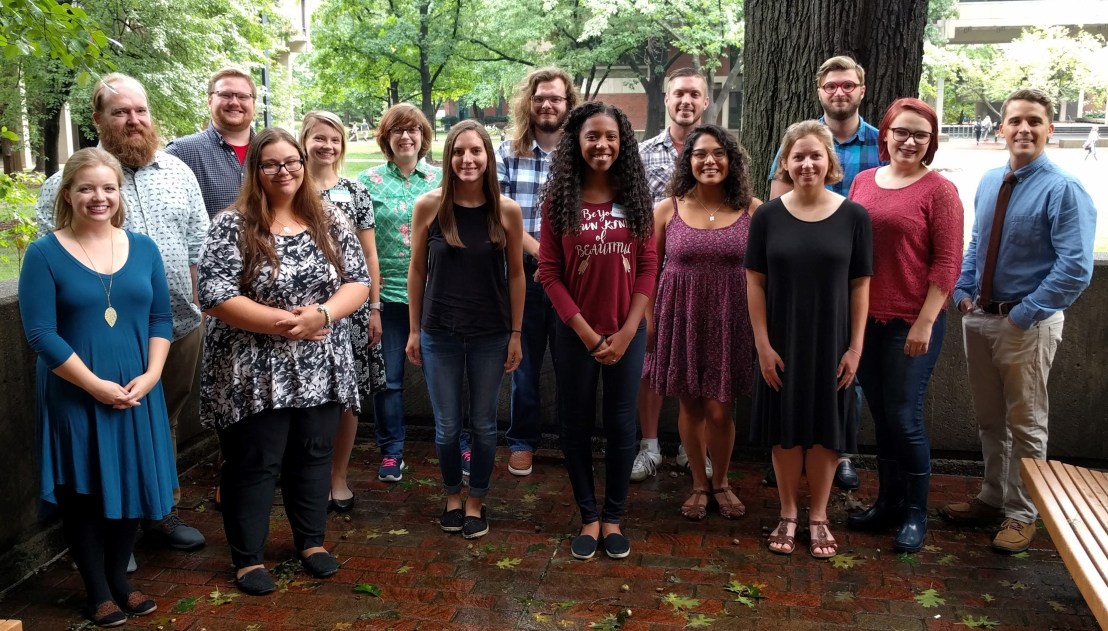
The University Writing Center Staff for 2018-19
Louisville campus, as the academic year begins, there is a lot that is notably new. It is heartening to hear new UofL President Neeli Bendapudi talk of her commitment to student learning and engagement, and, at the same time, see the opening of a new, modern building on campus that is also dedicated solely to student learning.
This year, like every year, University Writing Center welcomed a new group of consultants who will spend the next year working with writers from across the UofL community. They have moved to UofL from across the country with a varied range of interests and backgrounds. Every group of consultants brings a new set of personalities, insights, and experiences to the University Writing Center. Every year the consultants form their own distinctive community of teacher/tutors here. Yet, this year, as in the years before, I am also confident that they will demonstrate a dedication to student learning that is equal to any on campus. What will not change is their eagerness to work with any writer on campus – student, faculty, or staff – on any kind of writing, at any point in the writing process. They will accomplish this in the same way as those that have preceded them, through collaborative conversations with writers. They will respond to the writers’ concerns, offer their own insights into how writers’ drafts could be made stronger, and help the writers formulate plans for revision. In doing so they will not only help the writers with individual drafts, but will offer insights to help them to navigate more confidently the writing challenges they will face in the future. I have no doubt the new consultants will find individual and distinctive ways to do this, but it will happen again in the University Writing Center.
Our commitment, to working with students ongoing dialogue, is central to what we do and will not change. We will continue also to teach without grading, to work with students as often as they want our help, to treat every writer with respect, and to base our pedagogical approaches on the most recent research in Writing and Literacy Studies.
Education is not a panacea, but it matters now more than ever, in every way. I’m grateful to have another crack it this year. I wish everyone a year of resolute and passionate teaching and learning.
Last week I attended the University of Louisville’s commencement ceremony for doctoral students. As I looked through the program I noted the names of eleven of the graduates who had previously attended one of our University Writing Center Dissertation Writing Retreats. Several of them came up to me afterward to tell me again how valuable they found the experience of the writing retreat and the significant difference it made to them in their progress toward their degrees. As we talked about the jobs they were moving on to and their plans for future scholarship, it was gratifying to think that we had played some useful role in their graduate education.
This past week we once again were host to 14 Ph.D. students who participated in our spring Dissertation Writing Retreat. This is the seventh year we have held a week-long writing retreat in May during which the participants spending their days writing and having daily individual writing consultations with members of the Writing Center staff. Every day we also have small-group discussions about various issues of dissertation writing (Ways to Structure Chapters, Strategies for Self-Editing, How to Revise Work for Other Purposes, and How to Approach Literature Reviews). We also keep everyone well-fed throughout the week with snacks and lunch.
The writers who participated in this year’s retreat represented eight different disciplines at the University: Education, Engineering, Nursing, Rhetoric and Composition, Pan-African Studies, Pharmacology, Psychology, and Social Work. The best way to get a sense of the experience of the retreat and its impact on the writers who took part, however, is to hear from the participants and consultants themselves.
WRITERS
Tammi Alvey Thomas, Social Work. By far a fantastic experience! I would recommend this for anyone writing their dissertation. The staff at the Writing Center are extremely helpful and great to work with. Don’t miss out on this opportunity! I left the retreat much more organized, focused and energized.
Imelda Wright, Nursing. I had the privilege of attending the Dissertation Writing Retreat in May 2018. It was well structured with plenty of space for the occupants to write at their own pace without interruption. There was adequate support and structure throughout the day to help with specific questions. In addition, a personal writing consultant was assigned to each participant daily to assist with content, technique, and overall structure of writing.
Overall, the retreat was terrific. It was enriching and productive to be in a space surrounded by like-minded people with similar goals to each other. There was a cohesive sense of camaraderie and great ideas were shared. In addition, I loved that lunch and snacks were provided; this allowed and encouraged participants to remain in the general vicinity during the day.
CONSULTANTS
Edward English, Ph.D. Student in Rhetoric and Composition and Incoming Assistant Director of the University Writing Center. This year’s dissertation writing retreat was energizing and helpful for me on a number of levels. I’ve just finished the first year of my PhD in English Composition and Rhetoric and when the Spring semester ended, my mind and body craved anything unrelated to school. I immediately took solace in long naps and hours of Netflix, in addition to enjoying trips like visiting the Red River Gorge and having one too many mint juleps at a very odd rainy Derby.
After a couple weeks of this leisure, however, I needed something manageable to get me back into the momentum of productivity. The dissertation writing retreat ended up being a wonderful balance of summer fun meets academic growth.
Interestingly, though I was the consultant, offering assistance to two awesome Experimental Psych. PhDs, I felt like I was the one who learned so much. Not having even started my own dissertation, reading through others’ work helped familiarize me with the types of challenges and rewards I can likely expect when I start running this academic marathon. What’s more, my two consultees were eager to absorb whatever questions or constructive criticism I had to offer—giving this Comp. 1 & 2 writing instructor a powerful (and much needed) inflation to his teacher ego and the satisfaction of feeling like he was truly helpful. I’m looking forward to being a consultant again next year, and am thankful that I’ll have this dissertation writing retreat available to me when I’ll need guidance and instruction on how to work through my own piece.
Layne Gordon, Assistant Director of the University Writing Center and Ph.D. Candidate in Rhetoric and Composition. Having helped facilitate the Dissertation Writing Retreat in 2016 and 2017, I came into this week knowing that I could look forward to the excitement and energy that’s created when a group of writers come together. Each year, it’s so motivating to see people enjoy the shared experience of using writing to work through their ideas and scholarly identities. What starts on Monday as a gathering of individuals, each immersed in their own projects and challenges, ends on Friday as an interdisciplinary community of writers. What I noticed this time around, though, was how productive this interdisciplinarity can be–and, selfishly, how helpful it was for me as someone who is also working on my dissertation. Both of the writers I worked with this week were genuinely interested in hearing about my dissertation progress and offered feedback and resources that were so helpful. I walked away from each consultation feeling supported and valued by the writers I was working with, even though we were in different disciplines with different methods, theories, and goals. I was really reminded this week of what reciprocity looks and feels like, and how much we (writers) all have in common when we are approaching challenging–and rewarding–writing projects.
Jessica Newman, Assistant Director of the University Writing Center and Ph.D. Candidate in Rhetoric and Composition. I’ve had the pleasure of helping to facilitate the Dissertation Writing Retreat both this year and last year. This year, as before, I was impressed with the writers as individuals (their commitment to sit down at 8 am each morning and write, and then continue to write) and as a community (supporting and learning from each other). But now that I am further in my own dissertation, the Retreat took on an even deeper resonance, and I appreciated the opportunity to myself take part—during group discussions, lunch and consultations—in the exchange of suggestions, ideas, commiseration and support. This sharing ranged from reviews of data analysis software to tips on how to use the vocabulary of your field to the often strong emotions evoked by writing those pesky lit reviews. I look forward to seeing the support, accountability and productivity from the Dissertation Writing Retreat continue in the Writing Center weekly Faculty and Graduate Student Writing Groups this summer and this fall.
Caitlin Ray, Assistant Director for Graduate Student Writing and Ph.D. Candidate in Rhetoric and Composition. As a consultant for the Dissertation Writing Retreat, I found that, in addition to helping writers, I personally got a lot out of the week. I was reminded of the power of talking about writing, working as a community of writers, and the importance of sharing research in an interdisciplinary context. My favorite parts of the week were the moments at lunch, or during workshops, when we got to chat about our research. Even when we were tired (or hungry) I still saw our eyes light up when talking about our research, and how often we found commonalities between research interests or methodology questions even when our fields were quite different from one another. I think that sometimes the frustration and daily grind of dissertation writing makes us forget that our research projects are really cool, and have the potential to make real impact on the world.
Rachel Rodriguez, Ph.D. Student in Rhetoric and Composition and Incoming Assistant Director of the University Writing Center. This week I had the opportunity to work with two writers from my own program, and our shared base of disciplinary knowledge helped us fast-forward into conversations about how knowledge is made and who “counts” as knowledge producers in the contexts of their research. Since both writers were focusing on the organization of their data chapters, we spent time playing with various options, envisioning how each schema might impact their overall message. I found myself getting really absorbed in the work they are doing, and our collective excitement made for a fun atmosphere where ideas could build off of each other as the week progressed. Getting a glimpse into both of their writing processes as well as strategies for goal-setting was personally rewarding, reminding me how attuned we are to our own way of writing, but how much we can learn by talking about how we write with others.
THANKS FOR ALL WHO MADE THIS POSSIBLE
It is important to acknowledge the people who did the hard work of organizing the Retreat – Cassie Book, our Associate Director, and Robin Blackett, our Administrative Assistant, and Assistant Directors Layne Gordon, Jessica Newman, Caitlin Ray, and Christopher Stuck as well as the other fantastic consultants (themselves Ph.D. students) who worked with the writers: Edward English, Rachel Rodriguez, and Rick Wysocki. And thanks to Dean Beth Boehm, of the School of Interdisciplinary and Graduate Studies, for again sponsoring and supporting the Dissertation Writing Retreat.
All the signs point to the fact that the academic year is coming to a close. Writers are focused on finishing their final papers, faculty are focused on finishing their grading, even the puppies have returned to the Library to help people reduce their stress. Yet, even as everyone pushes to complete the final tasks of the semester, it’s important to take a moment to mark the accomplishments and events that took place in the University Writing Center during past year.
Our central accomplishment of the past year is the one that is simultaneously the most common, but one that is never routine or taken for granted. Once again our consultants have worked, in individual appointments, with more than 5,000 students, faculty, and
University Writing Center Staff, 2017-18
staff on writing projects ranging from literacy narratives to lab reports to dissertations to scholarship applications. Hour after hour, day after day, they have worked collaboratively with writers to help them with their concerns about the drafts in front of them, but also to help them become stronger, flexible, and more confident writers. The positive and productive work that takes place here, and the transformative effect it can have on writers, comes from the thoughtful and dedicated work of our staff. Yet I also want to thank all the writers who trusted us with their work and all the faculty who supported our work by recommending us to their students.
In addition to our ongoing work with writers at UofL, however, we also work to create and sustain a culture of writing on campus and in the community. Here are a few examples of what we done in the past year toward that goal.
Workshops, Writing Groups, and Dissertation Writing Retreats: We have reached more than 750 students at UofL through workshops about writing that took place both in and out of classroom settings. Our popular Creative Writing, LGBTQ+ and Faculty and Graduate Student Writing Groups continued to provide safe, supportive, and productive spaces for UofL writers. Also, in addition to our annual spring Dissertation Writing Retreat in May, we held our first Dissertation Writing Mini-Retreat in January. We will be continuing all of these groups and workshops, so be sure to check our our website for information and dates.
Writing Events: New writing-focused events this year included a faculty roundtable discussion about “Engaging Diverse Voices in Writing and Reading,” an open-mic night
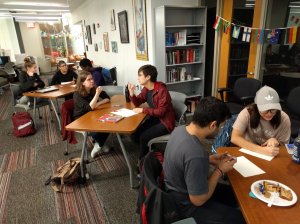
Our celebration of International Mother Language Day
for the Miracle Monocle Literary Magazine, and a reading in the Axton Creative Writing Reading Series. At the same time we once again held our Halloween Scary Stories Open Mic Night, participated in the Celebration of Student Writing and Kick Back in the Stacks, and celebrated International Mother Language Day.
Writing Center Blog and Social Media: Our blog not only brought ideas about writing and writing center work to the UofL community, but also connected to writers, teachers, and tutors around the country, and our presence on Twitter, Facebook, and Instagram continued to grow and connect with writers and writing scholars.
Community Writing: As we have written about several times on the blog this year, our community work with Family Scholar House and the Western Branch of the Louisville
Thanks to the Best Writing Center Staff around: These accomplishments are the result of the tireless, creative, and thoughtful work of the staff of the University Writing Center. It is their inspired work that allows us to support UofL writers and create a culture of writing on campus and off. They also make this a fun place to work. Thanks go to Associate Director Cassandra Book, Assistant Directors, Layne Gordon, Jessica Newman, Christopher Stuck, and Caitlin Ray; consultants Brent Coughenour, Emily Cousins, Nicole Dugan, Reid Elsea, Taryn Hall, Beau Kilpatrick, Rachel Knowles, Isaac Marvel, Mitzi Phelan, Tim Phelps, Keaton Price, and Mary-Kate Smith, and student workers Brianna McIntyre, Jency Trejo, and Dhyani Vashi.
Farewell: Finally, we are marking the retirement this year of Robin Blackett from her job running the front desk – and so much more – of the University Writing Center. For more than 12 years Robin has not only been the first person everyone meets when they come to an appointment, but she has personified the ethos of care and attention to student needs that we value here. Robin has greeted writers with warmth and professionalism, reassuring people who were often feeling upset and anxious, that they would be able get support for their writing at the University Writing Center. Robin has been integral to our success and growth over the years and, though we wish her well in new adventures, we will miss her dearly.
We will be open during the summer, starting May 7, from 9-4 every weekday. Meanwhile, take a look at our website and we hope to see you soon.
Writing Center Staff Achievements
The University Writing Center is also an active site of scholarship about the teaching of writing. Staff from the Writing Center were engaged in a number of scholarly projects during the past year in rhetoric and composition, literature, and creative writing.
Cassandra Book, Associate Director of the University Writing Center, presented at the Southeastern Writing Center Association Conference (SWCA) and SWCA also awarded her the Gary Olsen Travel Award Scholarship. She also presented at the Conference on College Composition and Communication. She also successfully defended her dissertation prospectus.
Layne Gordon, Assistant Director for the University Writing Center, presented at the National Women’s Studies Association Conference. She also successfully defended her dissertation prospectus.
Jessica Newman, Assistant Director for the University Writing Center, presented at the national Conference on Community Writing. She also had a piece, titled “Mariella,” published in the Miracle Monocle and won the Miracle Monocle Award for “Ambitious Student Writing.” She also successfully defended her dissertation prospectus.
Caitlin Ray, Assistant Director for Graduate Student Writing, published the article “On Your Feet!”: Addressing Ableism in Theatre of the Oppressed Facilitation.” in the Pedagogy and Theatre of the Oppressed Journal. She also presented at the 2017 Medical Rhetoric Symposium, the Conference on College Composition and Communication, the Chicago Disability Studies Conference, and the Rhetorical Society of America Conference. She was also selected to be a Rare Disease Legislative Advocate and attended events in Washington, D.C. during the National Institute of Health during Rare Disease Week. She also successfully defended her dissertation prospectus.
Brent Coughenour had stories accepted for publication in The White Squirrel and the anthology Kentucky’s Emerging Writers. He also served as a graduate student intern for the Miracle Monocleliterary magazine and began a creative writing podcast with fellow consultant Nicole Dugan. He will be the Assistant Director for the Creative Writing program next year as well as an English Graduate Organization Peer Mentor Coordinator.
Nicole Dugan served as a graduate student intern for the The Miracle Monocle literary magazine and began a creative writing podcast with fellow consultant Brent Coughenour. She will be an English Graduate Organization Peer Mentor Coordinator next year.
Reid Elsea presented at the Louisville Conference on Literature and Culture. Next year he will be the Morton Endowed Chair Research Assistant and the co-president of the English Graduate Organization.
Taryn Hall was accepted to present at the national Popular Culture Association/American Culture Association Conference and will be an English Graduate Organization Peer Mentor Coordinator next year.
Beau Kilpatrick will be an English Graduate Organization Peer Mentor Coordinator next year.
Rachel Knowles will be a co-president of the English Graduate Organization next year.
Mitzi Phelan completed her MA with her Culminating Project, “The Beloved Black Body: Investigating Toni Morrison’s use of Biblical Rhetoric to Rewrite Christianity on the Black Body.”
Tim Phelps was awarded the Department of English Scholarship Award for Excellence in Creative Writing, and the Sara-Jean McDowell Award for Excellence in Fiction.
Keaton Price completed her MA with her Culminating Project, “Disguised Language in John Milton’s Paradise Lost“.
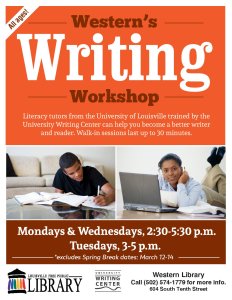
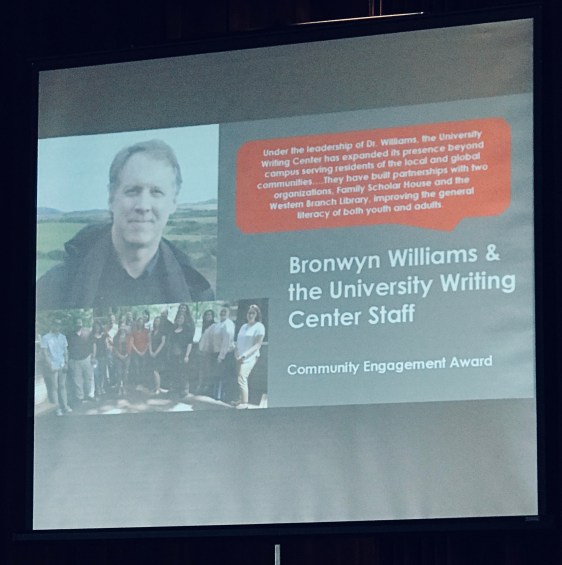
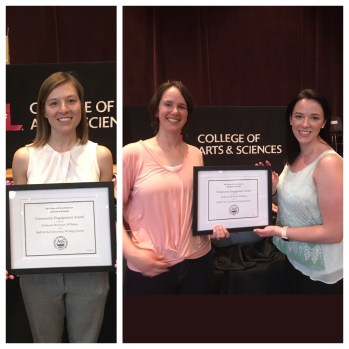
If you follow us on social media, you may have already heard the exciting news that the University Writing Center received the College of Arts and Sciences Community Engagement Award for 2017-2018. Among other projects, the Award Committee recognized the Writing Center’s partnerships with Family Scholar House and the Western branch of the Louisville Free Public Library. While these partnerships are still growing and evolving, we are fortunate to now be in our third year of working with Family Scholar House to offer writing tutoring on-site for their participants, and we are entering our second year of working at the Western branch with primarily K-12 writers.
Display at the Celebration of Excellence, Friday, April 13thAt the Celebration of Excellence (from left to right): Associate Director Cassie Book, former Assistant Director Amy Nichols, and Assistant Director Layne Gordon
As some of our previous blog posts discuss, the Writing Center developed these partnerships as part of its ongoing commitment to fostering a culture of writing both on campus and off. Through the hard work of Writing Center administration, excellent leadership at the community organizations, and a large group of undergraduate interns and graduate student volunteers, we have been able to create sustainable, meaningful relationships with these community partners. This academic year alone, our interns and volunteers have already had over 200 consultations with writers in the community. In addition to weekly one-on-one tutoring, the workshops and events we hold at these sites are designed to communicate an understanding of writing as a recursive, social process.
If you’re interested in learning more about how these partnerships have evolved and what we’ve been working on, check out some of our previous posts on our spring updates and last summer’s comic writing workshop at the Western branch. And, if you are a member of the U of L community and you’re interested in getting involved with our community literacy projects as an undergraduate intern or as a volunteer, please contact us at (502) 852-2173 or writing@louisville.edu.
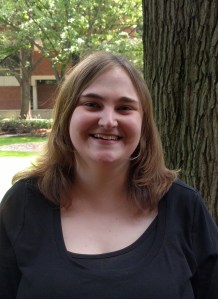
Caitlin Ray, Assistant Director for Graduate Student Writing
As the Assistant Director for Graduate Student Writing, I work with a lot of graduate students on a variety of writing projects. Many of the writers who see me are writing a new genre, whether that be a personal statement, a long-form seminar paper, or a grant proposal. Despite the wide array of genres I see, I often give very similar advice to writers. I also think that these strategies would be effective for writers of all experience levels—from a first year undergraduate in their first college class, to a PhD student working on their dissertation.
The genres I am talking about, though, are not just the weird ones that we might only come across if we are in higher education (literature reviews, for example, are not a genre common outside the walls of the university). This could also be something as simple as an email. For example, we may take it for granted that everyone can write an effective email. However, we all know that some emails are more successful than others. To move our own email writing practices to those exemplary ones, we may look at what others are doing (What do I look for when I receive an email? What do I respond to?) and then we emulate that. We also have a ton of practice writing emails, so we can learn quickly in the variety of drafts we create what is effective and what isn’t. The same principles can be applied to all writing.
The following strategies are ones I encourage writers to use when they are unfamiliar with a genre they are bringing to me. These are strategies I would encourage everyone to employ to master any genre that comes your way:
Examine the assignment. This may seem like a given, but many people read assignment descriptions uncritically. Additionally, assignment prompts or questions can be extremely detailed or very vague. Let’s take a look at an example I see quite often. The Association of American Medical Colleges (AAMC) asks for a personal statement when applicants submit materials for medical residency. This prompt is simply, “Use the space provided to explain why you want to go to medical school,” and allows 5,300 characters. This is as vague as it gets. However, you can still tell several things. The readers clearly value brevity (you are limited to about a page and a half), and you are crafting an argument (why do you want to go to medical school?) Embedded in this question is the need for evidence. How does the reader believe what you are telling them? The context is also specific: why do you want to go to medical school? What is medical school to you, and what will you get out of it? How does it meet your goals? Suddenly, you can see lots of questions to answer that were simply implied in the prompt itself.
Find examples. This is something I recommend to all levels of writers. It is very difficult to write an abstract, a literature review, or a personal statement, without knowing what successful ones look like. Once you get in the habit, you will automatically begin reading like a writer and will notice successful examples of writing everywhere you go. One piece of advice I have gotten as I move into writing my own dissertation, for example, is to seek out other dissertations (they are usually publically available). Further, find dissertations that were chaired by the same chair of your own committee. Finding examples can help you figure out what the unwritten expectations of certain genres may be.
Ask an expert. “Expert” could mean an expert in the content area you are writing in, or an expert in writing itself. I often suggest that people writing very discipline-specific writing (like, maybe a review article for a journal) talk with their advisor or other trusted professors and get feedback. Those folks are great resources to talk about methods and field-specific questions that the University Writing Center may not have knowledge about. Then, you can also seek out a writing expert (like the consultants in the University Writing Center) so that you clarify your ideas and translate them into an effective piece of writing.
Ask a peer. This is something I wish I had learned much earlier in college. You are surrounded by great resources in your classes and your major, or even down the hall in the dorms. The people in your classes are future professionals, and may even be your colleagues later on. Get together with someone, or a few people, and exchange writing! One of the best things I have found in graduate school myself is finding a few trusted people that I can send my “shitty first drafts” to without judgment (see Ann Lamott’s excellent essay “Shitty First Drafts”).
Often, when faced with a daunting writing task that we don’t quite know how to tackle, we can easily get in our heads. That “editor” voice (which I imagine as my 7th grade English teacher for some reason) is one of the biggest reasons we get writer’s block. The biggest antidote to being stuck before even beginning the writing task is to simply freewrite everything that you know or think you know about a topic. Just write, and worry about the genre conventions later. Many times we figure out how to do something by doing it (See Reid’s “Getting Going” blog for more useful tips to get started!).
The best way to learn a new genre is to simply keep writing in that genre until you are comfortable. Back to my original example of email writing, the more emails we send, the faster and more comfortable we are in composing them. While perhaps obvious, the reason for this is because we spend so much time writing emails and thus get a ton of practice. This is true for any piece of writing. You might take a really long time writing your first abstract, for example, but a few years later of practicing that skill and you will be able to write effective abstracts more quickly. See more strategies for practicing and developing writing habits in Isaac’s “Getting Started with Genre” or Michael’s “Can Someone Hold My Hair While I Word Vomit?”
Lastly, I think the biggest hurdle when faced with new genres is the uncertainty it causes in us. We think “I don’t know this…should I know this? Does everyone know this but me?” This connects to the most insidious experience of higher education—imposter syndrome. Imposter syndrome is the idea that everyone knows what they are doing and are very successful at that work, and that you are merely “faking” it. However, everyone experiences imposter syndrome, and one of the biggest ways to combat this feeling is talking about your experiences and the writing process more. Tackling a new genre can be intimidating and stressful, but hopefully these strategies can help you be successful, no matter the writing task before you!
The weather is not the only sign that spring is finally (kinda) here. The schedule at the University Writing Center is booked solid most days, and the pressure of the “final paper” is nearly palpable. First off, you got this! Secondly, I thought it might be helpful for all of us if I use this the blog to offer some advice on getting through the crucible of finals.
The first step, and one of the hardest (especially for me) steps, is getting started. One useful strategy for getting into to the process is setting aside time for purposeful writing. In her article on writing your first research paper, Elena Kallestinova suggests to “choose from 1- to 2-hour blocks in your daily work schedule and consider them as non-cancellable appointments” (182). For me, the best time to do this is in the morning. Its important to try out a few different times in order to figure out what works best for your personal schedule. Another way to do this is to make University Writing Center appointments. You can use these as personal deadlines for papers, which can help your time management. Having a set schedule, one that works for you, does not only help you to avoid the dreaded “all-nighter,” but it can also make the writing process more enjoyable, which helps to improve your writing as a whole.
Now that you have your time scheduled, you have found a place that feels good to be and write in, its time to start. The first step is often outlining. Kallestinova notes, “This outline will be similar to a template for your paper. Initially, the outline will form a structure for your paper; it will help you generate ideas and formulate hypotheses” (182). The outline described here is different from the traditional idea of an outline. Often we think of the outline as just a plan for the paper. This outlining is more active. It allows you a space to brainstorm and take notes. One way I like to do this is through “double-entry note taking.” While this sounds like some complex method, it is just the process of taking notes with a couple extra pens. The way this takes shape for me is I use three pens (three different colors): one for page numbers and quotes, one for why these are significant or how I plan to use them, and finally one for questions I have or tangential ideas. Some of the time these notes make their way directly into my writing.
So, you have all your outlining and note taking done, your writing schedule (rather than a chore) has become comfortable, and so now it is time to get that paper written. At this point, I sometimes find myself not feeling ready. I have pages and pages of notes, I have written and rewritten my outlines, but nevertheless I just cannot get the words on the page. Typically, I have the feeling that I just haven’t read enough, or that I still need to read, or find, that one (more) perfect source. It is important to remember all the work you have done up to this point. You have put in the time and are ready to write that paper. The process of research and writing research papers is an act of joining the “scholarly discussion.” As the writer, you become a voice in the conversation that you have been listening to (in research) and forming your ideas about. Your goal is to make your voice heard in the conversation, not to end it. This means that, at a point, you have to realize that your paper will not be perfect, or answer every question. You are helping a conversation continue, contributing new and exciting ideas, and providing fertile spaces for others to respond to your ideas and questions.
PS: You can do it!
Kallestinova, Elena D. “How to Write Your First Research Paper.” Yale Journal of Biology and Medicine, vol. 84, 2011, pp. 181-190.
Have you experienced getting into your car, and while driving to a familiar destination you start thinking about all the things you need to do, or even just start daydreaming? Suddenly, you snap back to the present and realize you are at your intended location but have no recollection of the actual drive. It’s amazing how we can become so familiar with the way we do something that we can actually can execute the activity on autopilot. Our brains are amazing objects that can run millions of processes at once. While one “system” is working through our schedule, another is thinking about summer vacation, and yet another is executing turns down familiar streets (hopefully one is watching for pedestrians). When the path we are navigating is so familiar to us, we can easily “switch off” and let the brain make all the decisions in default mode. But, if we are checked out of the process, are we really getting the best experience?
I gave the above example as a way to talk about the process of writing. By the time you have reached the level in academia where you would be interested in reading this blogpost, you have most likely been asked to do a lot of writing. Often, we are given a writing task and, just like driving, we set our brain to autopilot, or “writing mode,” and let come what may. We see our end destination (our “completed writing task”), hop in our mental smart cars, activate cruise control, and are on our way. The problem with this is that we only have one way of getting to the destination programmed into our mental maps. When we only allow for only one way of doing things, we ultimately produce the same type of writing, just with different topics. This doesn’t only apply to class papers–we can fall into the same rut with our creative writing as well.
To be completely honest, in the busy world of academia, writing on autopilot is convenient. It always gets us safely to our destination and conserves our valuable brain energy for the thousands of other demands that come on a daily basis. However, it does not help us develop into better writers. To produce better work, we have to mentally show up for the process. We have to switch off the autopilot and challenge ourselves to consider that there are valuable alternative routes to getting to our final destinations. Understand, however, that the goal in switching off autopilot and taking control of the wheel is not necessarily to get to the destination more quickly, although that may happen, but rather to truly immerse yourself in the writing process and gain insight to tools that you may be missing out on.
If you are like me, my cruise control looks like this: I get an idea for a paper, lock on to it with a death grip, think about it until the night before its due, word vomit on the paper, and then spend the wee hours of the morning its due making revisions. This process works for me and I am comfortable with it; however, I have realized that I am cheating myself out of being a better writer by not exploring other processes. Recently I have been trying to add practices that other writers use into my repertoire. I started with reverse outlining, now I’m committing myself to writing down my favorite thesis and then writing two more possible theses that either invert or challenge the original as a way to enhance my critical thinking of the topic. This has been immensely beneficial and has positively affected my writing skills.
If you feel like your writing has become stale, or that you are not meeting your full potential as a writer, I challenge you to see if you are still in the driver’s seat. Consider pulling out your old writing guidebooks and going back to the basics. Look to other writers for inspiration. Take time to go through the process. You’ll be amazed at how much of the beautiful scenery you have been missing.
If your situation is anything like mine at this point in the semester, you are struggling to keep up with class readings as you begin drafting your final papers, and of course, this has you dreaming about summer. Summer when, yes, you still have to work (we are all adults here, after all), but when you also have time to dedicate to fun activities that you don’t get to do during the semester – like actually sleeping!
While doing “nothing” can seem like an enticing way to spend your three-month vacation from academia, this time can be much better spent on improving yourself in some way – and the best part is that YOU get to choose what this looks like. For some, it’s finding time to be active, and for others, it’s getting through a reading wish list. But for most of my peers studying English at UofL, summer is a time for writing.
As I have gotten older, I have struggled increasingly to find time to free write and, as a consequence, I sometimes feel out of practice when writing outside of academic genres. Summer gives me the chance to really stretch and work those creative muscles that, if we’re being honest, are often bound up by the constraints of higher education. In the summer, I get to write about what I want, how I want to: no prompts, no criteria, and no deadlines.
Like anything else, writing takes on a different tone, a new pleasure, when it is done out of inspiration and free will, rather than in answer to requirement and obligation. Yes, it can be a lot of work, but it doesn’t have to be. All it takes is finding something you’re passionate about. And thanks to digital and new media, it’s easier than ever for you to share your passions. The greatest thing about this technological age is that people now have the power to connect to one another from across the globe, but most people don’t realize that this link is often forged through (you guessed it!) writing.
Even if you don’t plan on sharing your personal thoughts with the world, there are still plenty of benefits to writing. I for one sometimes need a private place to vent, and journaling (which I wrote about in my last blog post) is a convenient and safe place for me to get any stresses off my chest. And the best part is that paper can’t grade (or judge) you!
So, while it may seem too early to start thinking about it and perhaps even exhausting considering current circumstances, I would encourage you to find excuses to write this summer: take note when an intriguing thought strikes you, record your dreams (or nightmares), write a drinking chant, compose a goofy poem, or describe the feeling of the sun on your skin, lest you forget it when the cold snow returns.
Most importantly, have fun while you write and have a great summer!
Our “How I Write” series asks writers from the University of Louisville community and beyond to respond to five questions that provide insight into their writing processes and offer advice to other writers. Through this series, we promote the idea that learning to write is an ongoing, life-long process and that all writers, from first-year students to career professionals, benefit from discussing and collaborating on their work with thoughtful and respectful readers.
Katherine Massoth is an Assistant Professor in the Department of History. She received her PhD and Master’s from the University of Iowa and Bachelor’s degrees from the University of California at Irvine. Her research specialty is the history of women and gender in the U.S.-Mexico borderlands. As a historian of the Americas, she teaches history courses on women and gender, borderlands, the American West, and chicanx/latinx studies. Her most recent publication analyzes how women’s cookbooks became a borderland for defining the appropriate type of “Mexican” food that could be incorporated into U.S. appetite – “‘Mexican Cookery that belongs to the United States’: Evolving Boundaries of Whiteness in New Mexican Kitchens,” in the edited volume Food Across Borders, Rutgers University Press, 2017.
Location: Louisville, Kentucky
Current project: I am currently revising my doctoral dissertation into a book manuscript. I am writing a history of women’s domestic and private lives in the U.S.-Mexico borderlands, specifically Arizona and New Mexico. The project reconstructs how women, across ethnic groups, reacted to the transition from Mexican to U.S. control after the U.S. colonized the region in 1848. I am trying to retell the larger political history of the transition of power by focusing on women’s lives, such as their cooking, housekeeping and childrearing. I argue that these daily activities tell us more about the larger political process because we see how women were (or were not) affected.
Currently reading: Karen Roybal’s Archives of Dispossession: Recovering the Testimonios of Mexican American Herederas, 1848–1960 and Helen Sword’s Stylish Academic Writing. I am also reading Julian Lim’s Porous Borders: Multiracial Migrations and the Law in the U.S.-Mexico Borderlands to review for an academic journal.
1. What type(s) of writing do you regularly engage in?
I write non-fiction/history. I am currently focusing on revising, which I am slowly learning is a completely different type of writing than putting words down. It is more than proofreading or reorganizing. Revising a dissertation to a book manuscript is a process they do not teach in graduate school and is completely daunting because there are no advisers hovering or demanding words. It also means taking a piece of work that I thought was complete and reworking the piece not from a blank slate but from 350 pages. I spend most of my writing time on thinking and less on writing. Right now, I am focusing on how to restructure my narrative, condense sections, cut dissertation jargon, and tell a cohesive and engaging history. I am also trying to find my voice. While writing my dissertation, my voice got lost because I had to follow the strict dissertation guidelines and provide background and theory to establish my study. Now that I have defended the value of this history, I can focus on telling it in my own style.
2. When/where/how do you write?
My writing location depends on where I am in the process. If I am revising or brainstorming, I tend I write in coffee shops with the ambient noise of people shuffling about. If I am putting fresh words down, I typically need to be alone in the library or my office. Most of my writing takes place in the afternoon, evening, or even late at night. I have never been a morning writer. I have to get all my tasks done before I can write. Otherwise, I am distracted. I write on my computer but I outline in a spiral notebook and take notes on hardcopies of my writing. I typically print out what I have written and make notes on the paper then I take it to the computer.
3. What are your writing necessities—tools, accessories, music, spaces?
I need my writing uniform – leggings and a baggy sweater and shawl. My headphones are an absolute necessity because I listen to my “writing music” playlist of some tunes that I am so familiar with that they become ambient noise in the background. I wrote my entire dissertation listening to Sylvan Esso and Bon Iver on a loop. I also need my water bottle, coffee, computer, research and archival files, and notes. I have a set of erasable colored pens, one black pen, and a pencil that I always have. Each writing implement has a different purpose in my process. I also need time. I never developed the ability to write in short intervals. If I do not have at least 2 hours for writing, then I cannot sit down and do it. I like to dedicate large chunks of time to the process so I do not feel harried.
4. What is your best tip for getting started and/or for revision?
I am a tactile person – I have to touch things to process fully everything. When I find it difficult to revise, cut words or repetition, or reorder sections, I print out the document or paragraph. Then I cut each sentence apart or cut each paragraph apart. I lay out the pieces on the floor and just start piecing everything together like a puzzle. This works for cutting sentences because if when I am done I find one sentence lying to the side, then I know it was not necessary. This is especially useful for finding where I repeat myself. If I am reworking a larger section, I often find that once I take the paragraphs out of the full document the structure completely changes. I often suggest this to students who have a difficult time revising because it takes the pressure of a word document off. It also works because it does not feel permanent.
5. What is the best writing advice you’ve received?
Make writing an appointment in your calendar just like a doctor’s appointment or meeting, and stick to it. Do not schedule anything during that time and if people ask for that time, say you have an appointment. During that appointment, set a maximum of three goals to achieve. If you achieve all three, then great, and if you achieve only one, then you know what you are working on next time. Then when your appointment is done, make your three goals for the next session so you know where you are starting.


 Every day we also have small-group discussions about various issues of dissertation writing (Ways to Structure Chapters, Strategies for Self-Editing, How to Revise Work for Other Purposes, and How to Approach Literature Reviews). We also keep everyone well-fed throughout the week with snacks and lunch.
 Tammi Alvey Thomas, Social Work. By far a fantastic experience! I would recommend this for anyone writing their dissertation. The staff at the Writing Center are extremely helpful and great to work with. Don’t miss out on this opportunity! I left the retreat much more organized, focused and energized.
 software to tips on how to use the vocabulary of your field to the often strong emotions evoked by writing those pesky lit reviews. I look forward to seeing the support, accountability and productivity from the Dissertation Writing Retreat continue in the Writing Center weekly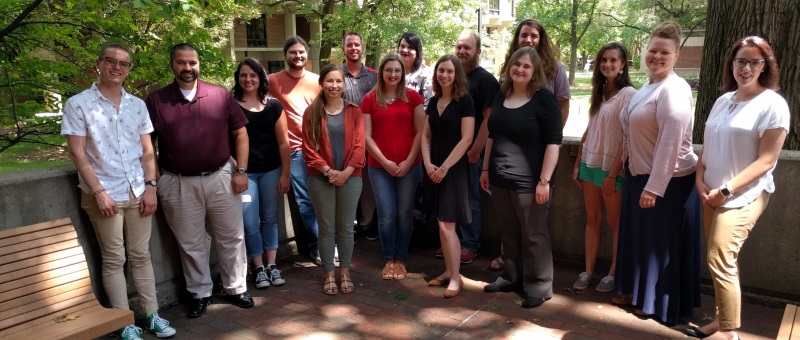
 than 12 years Robin has not only been the first person everyone meets when they come to an appointment, but she has personified the ethos of care and attention to student needs that we value here. Robin has greeted writers with warmth and professionalism, reassuring people who were often feeling upset and anxious, that they would be able get support for their writing at the University Writing Center. Robin has been integral to our success and growth over the years and, though we wish her well in new adventures, we will miss her dearly.
 writers. I also think that these strategies would be effective for writers of all experience levels—from a first year undergraduate in their first college class, to a PhD student working on their dissertation.
 for all of us if I use this the blog to offer some advice on getting through the crucible of finals.
 have no recollection of the actual drive. It’s amazing how we can become so familiar with the way we do something that we can actually can execute the activity on autopilot. Our brains are amazing objects that can run millions of processes at once. While one “system” is working through our schedule, another is thinking about summer vacation, and yet another is executing turns down familiar streets (hopefully one is watching for pedestrians). When the path we are navigating is so familiar to us, we can easily “switch off” and let the brain make all the decisions in default mode. But, if we are checked out of the process, are we really getting the best experience?
 don’t get to do during the semester – like actually sleeping!
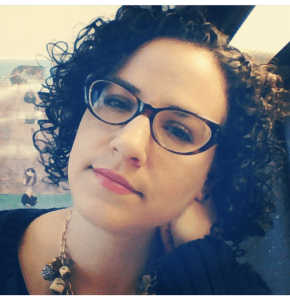 University of California at Irvine. Her research specialty is the history of women and gender in the U.S.-Mexico borderlands. As a historian of the Americas, she teaches history courses on women and gender, borderlands, the American West, and chicanx/latinx studies. Her most recent publication analyzes how women’s cookbooks became a borderland for defining the appropriate type of “Mexican” food that could be incorporated into U.S. appetite – “‘Mexican Cookery that belongs to the United States’: Evolving Boundaries of Whiteness in New Mexican Kitchens,” in the edited volume Food Across Borders, Rutgers University Press, 2017.
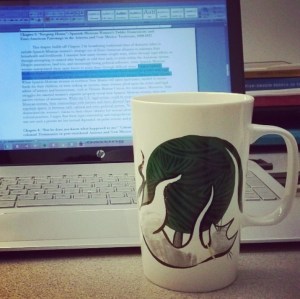 bottle, coffee, computer, research and archival files, and notes. I have a set of erasable colored pens, one black pen, and a pencil that I always have. Each writing implement has a different purpose in my process. I also need time. I never developed the ability to write in short intervals. If I do not have at least 2 hours for writing, then I cannot sit down and do it. I like to dedicate large chunks of time to the process so I do not feel harried.
 University of Louisville Writing Center