Month: April 2022

Charting the UWC’s Path in a Changing World: News and Accomplishments in Academic Year 2021-2022

Cassandra Book, Acting Director

August 23, 2021. It was a big day for us. After seventeen (yes, I counted) months of 100% online services, the University Writing Center opened its doors again for in-person consultations for the Fall 2021 semester. While we were hesitant about what consultations would be like with masks, social distancing, hand sanitizer, and disinfectant spray, we soon found that the opportunity to talk to writers face-to-face was worth the stress of figuring out how to come together.

Hopefully it goes without saying that our proudest accomplishment this year is our successful transition (back) to in-person consultations in the midst of the ebb and flow of COVID-19 cases and our feelings of personal and collective safety. In other words, this year’s consultants didn’t miss a beat in jumping in to work with writers, both in-person and online. Our staff maintained a shared commitment to working with a wide range of UofL writers. They were first-year composition students hesitantly writing their first annotated bibliographies. They were Southern Police Institute students composing academic research papers after many years away from the classroom. They were seniors writing essays for Fulbright applications (that they would later receive). They were pre-nursing students writing personal statements for their nursing applications. They were PhD students getting started on their dissertations in Education, Engineering, Business and Public Health. They were even a few elementary school students writing poems about unicorns and universes. They were all writers whom we served this year.
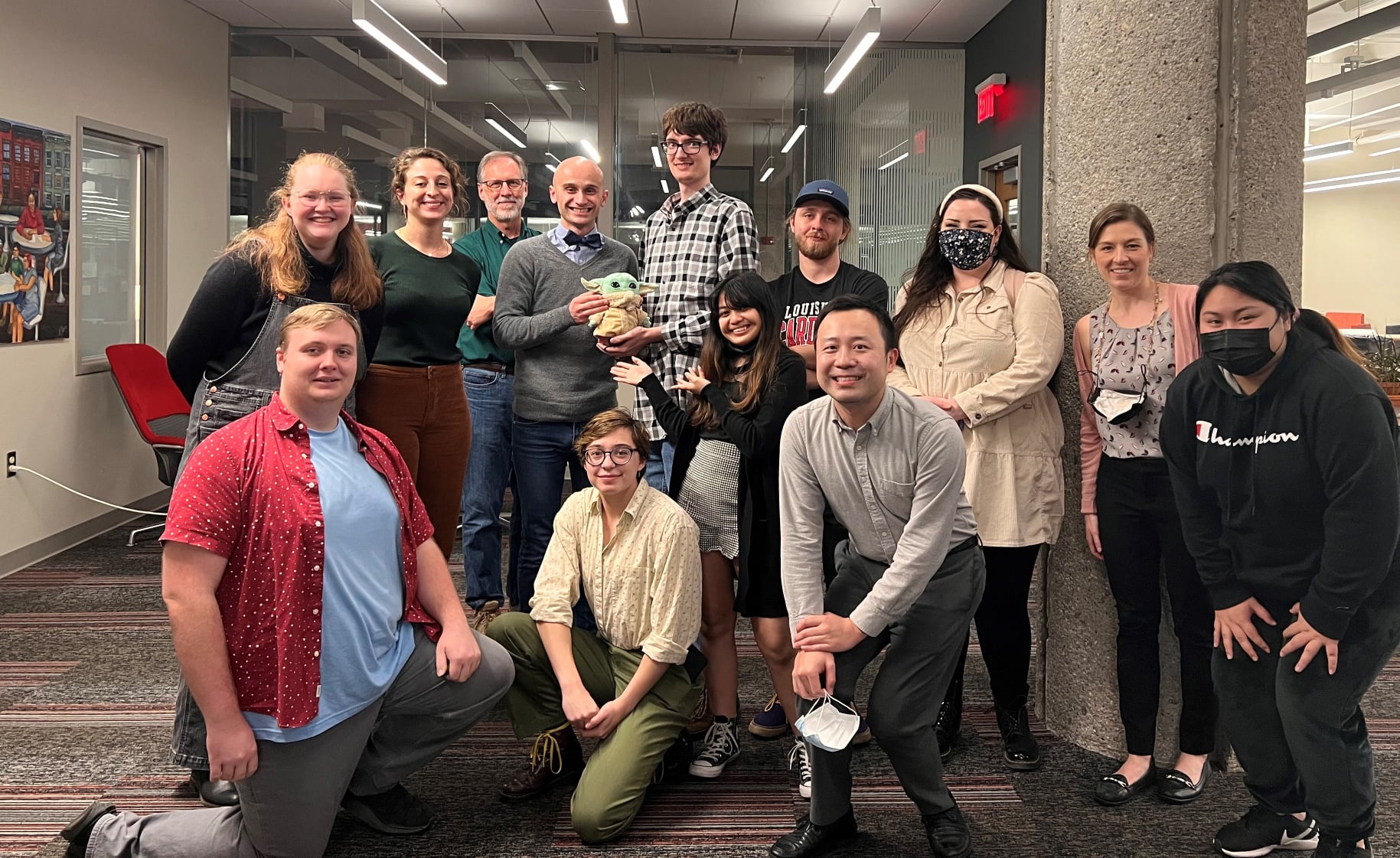
University Writing Center staff in December 2021. Top row (from left) Kylee Auten, Eli Megibben, Bronwyn Williams, Brice Montgomery, (Grogu), Curtis Ehrich, Mikaela Smith, Ben Poe, Maddy Decker, Cassie Book, Melanie Tang. Bottom row (from left) Justin Sturgeon, Zoë Donovan, Yuan Zhao. Not pictured: Tobias Lee, Derrick Neese, Olalekan Adepoju, Todd Richardson, Michael Benjamin, Elizabeth Soule

News and Accomplishments in Academic Year 2021-2022

Staffing Updates

In November, after the departure of Amber Yocum for the School of Education, we welcomed Maddy Decker as the Program Assistant, Senior! Since she started, Maddy has been indispensable in keeping our appointments and front desk running smoothly. She has kept our appointment schedule up to date, often making last-minute adjustments for sick consultants and constantly monitoring the virtual schedule. She is often the first face or voice that writers interact with; she provides a calming and reassuring presence daily to consultants and writers. We are so happy she decided to join our team!

Bronwyn Williams earned a sabbatical for the Spring 2022 semester. He is working on a book about the experiences of university students during the pandemic and is a visiting scholar at the School of Education at the University of Bristol. I (Cassandra Book) am currently serving as the Acting Director during Bronwyn’s sabbatical. As one consultant kindly put it, I am “keeping the ship upright and sailing smoothly through the general upheaval of these times.”

Beyond Tutoring – Writing Groups, Community Writing, and More

Our work extends beyond the writing consultation. Our administrators, like Maddy, help create the logistical infrastructure and supportive environment so that our consultants can do their jobs. In addition, our administrative staff leads outreach, including conducting presentations, facilitating workshops, leading writing groups, maintaining community partnerships. Our Assistant Directors, Olalekan Adepoju, Elizabeth Soule, Todd Richardson, and Michael Benjamin helped to ensure that mentoring and outreach work happened professionally and with a strong disciplinary base.

Our popular LGBTQ+Faculty and Graduate Student, and Creative Writing writing groups continued to give UofL writers supportive communities through which they could create and talk about writing. A big thanks to Elizabeth Soule and Aubrie Cox for volunteering their time to support LGBTQ+ and Creative Writing Groups this year. Olalekan Adepoju, as the Assistant Director for Graduate Student Writing, has led the Graduate and Faculty Writing Group for the past two years and will pass on the baton in June.

Our commitment to community writing remains strong at the University Writing Center. This year Elizabeth Soule led our collaborations with the Western Branch of the Louisville Free Public Library (LFPL) and Family Scholar House. Once again we are grateful for the participatory and collaborative partnerships with these organizations. You can find out more about these community writing projects, including how to get involved with them, on our website.

We worked with our partners at Family Scholar House to offer their participants an online writing laboratory. This would not have been possible without both the constant correspondence and support from our partners at Family Scholar House, in particular Nia Boyd. Additionally, it was only due to the kind contributions of this year’s volunteers that we were able to offer these hours. Thank you to: Ayaat Ismail, Emma Turner, Morgan Blair, Cecilia Durbin and Michael Benjamin. The time that you committed to working with students means a lot to all of us.

We also worked with the Western Branch of the LFPL to organize and hold the 2022 Cotter Cup, a K-12 poetry contest. Last year, we worked with Western Branch to revive the 100-year old tradition. University Writing Center volunteers worked with K-12 writers to brainstorm, draft and revise their poems for the contest. Over the course of two weeks, our volunteers worked with 28 separate individuals in 30-minute sessions. A cast of all-star judges are reviewing poems as we speak, and we look forward to finding out the winners in May. We’re grateful to the contributions of our volunteers: Eli Megibben, Maddy Decker, Aubrie Cox, Brice Montgomery, Cassie Book, Kylee Auten, Yuan Zhao, Zoë Donovan, Ayaat Ismail and Liz Soule. 

We are also proud of the work our staff does as academics, professionals, researchers, and, honestly, people, beyond the University Writing Center. Please take a moment to read over their individual professional accomplishments and, if you see them or know them, congratulate them on their hard work!

Olalekan Adepoju presented at both the 2021 National Conference on Peer Tutoring in Writing and International Writing Centers Association conferences. He received an Academic Merit Award from the National Conference on Peer Tutoring in Writing. He also chaired a panel session at the 2022 Louisville Conference on Literature and Culture since 1900. Finally, Olalekan was accepted into the class of 2022 Bedford New Scholars Advisory Board and reviewed proposals for 2022 National Council of Teachers of English Annual Convention.  

Kylee Auten presented “Waves of Friendship: Posthumanism in Jules VS. the Ocean and Swashby and the Sea” at the 2022 Louisville Conference on Literature and Culture Since 1900 . She also accepted an internship with the Children’s Literature academic journal.

Michael J. Benjamin presented “Antiracist and Inclusive Conferencing: Co-Constructing Access, Attending to Power, and Practicing Accountability” at the 2022 College Composition and Communication Conference and “Modal Responsivity: Ethical Pivots to Meet Pandemic-Induced Distance Education Challenges” at the 2022 Computers and Writing Conference. He also served as the inaugural 2021-2022 The Big Rhetorical Podcast Fellow, his work discussed in Episode 92.

Cassie Book presented at the 2021 International Writing Centers Association conference (with Bronwyn Williams, Ayaat Ismail, and Amber Yocum) and the UofL Engaged Scholarship Symposium (with Elizabeth Soule).

Tobias Lee presented “Composing Decoloniality: Translingualism in Transnational Composition” at the 2021 conference for the Latin American Association for the Study of Writing in Higher Education and Professional Contexts.  

Derrick Neese accepted the position of Assistant Director of Creative Writing in the University of Louisville English’s department for 2022-23.

Eli Megibben published an article an a book review in the Miracle Monocle.

Ben Poe chaired two panels at the 2022 Louisville Conference on Literature and Culture Since 1900, represented the English department on the Graduate School Council, and served as the student representative on the School of Art’s and Sciences’ Faculty Assembly.

Melissa Rothman received a position as a library specialist for undergraduate research with Ekstrom library.

Mikaela Smith earned a summer internship with the IT department at Humana. She also served in a leadership role with the UofL Chinese Scholars Union (CSU), hosing various successful events. She has been elected Vice President of the CSU for 2022-2023.

Justin Sturgeon presented “Jumping Over the Wall: How Lanchester’s The Wall Calls for New Perspectives on Boarders in an Era Dominated by Climate Change” at the 2022 Louisville Conference on Literature and Culture Since 190 and “Postmemory As Cigarettes in MAUS” at the 2022 Sigma Tau Delta International Convention.

In addition to his sabbatical projects, Bronwyn Williams will be presenting at the 2022 European Writing Centers Association Conference. He also published “Writing Center Consultations as Emotional Experiences: How Different Learning Experiences Shape Student Perceptions of Agency.” In Pedagogical Perspectives on Cognition and Writing.

Yuan Zhao chaired the session “D6 -Constructing Art” at the 2022 Louisville Conference On Literature & Culture Since 1900. He also published one Chinese essay about the movie “Columbus (2017),” titled “Becoming Father, Becoming Mother” in P-articles, a Hong Kong-based literature online platform.

We will be open during the summer, starting May 9, from 9-4 every weekday. In May, we will again hold our spring Dissertation Writing Retreat; it will be in-person for the first time since 2019. You can find out more on our website. You can also follow us on our blog and on TwitterFacebook, and Instagram.

Positive Vibrations

Tobias Lee, PhD Candidate and Writing Consultant

One of the things I love about working in the University Writing Center is the exposure I get to so much fascinating and important work.  I’ve read about entrepreneurship among Rohingya refugees, the impact of sexual health on longevity, green building practices in sports venues, what Afrofuturism tells us about our history….  Pardon my childlike gushing, but it’s so cool!  This is why I love academia.  People are creating knowledge here!  Aaaand that leads me to what I’ve been writing about.  Yep, knowledge.

What, really, does it mean to create new knowledge?  What is knowledge?  Wait!  Don’t go away yet!  I promise, it’ll be interesting.  I won’t put you to sleep.  Well I might… but you’ve been needing to catch up on sleep, haven’t you?  Knowledge… well, let’s begin with a bromide: they say “knowledge is power.”  Get the knowledge, then you’ll have power.  Go to school, learn some stuff, and now you’re Captain America.  We all want to feel powerful.  Nobody’s angling to be powerless.  Well yes maybe but…  But let’s think this through a bit.  Power is the ability to do something, it’s potential.  You learn some stuff to empower yourself to do things.  But it won’t mean much if you don’t actually ever do.  So it’s the doing that matters.  You might “know” some things, but it’s what that does, it’s how that shapes your behavior and creates material effects in the world, that has any importance or value.  You might know what the capital of Georgia is or how to juggle five balls, but unless and until that brings you glory at your local pub quiz or impresses everybody at the party including that certain someone, it’s uh, purely academic.  It’s just information, neutral and inert, until its usage has material effects.  And the imperfect predictability of these results and the results of those results and of everything is what elevates knowledge over information.  

So maybe the phrase, “knowledge is power,” while pithy, doesn’t quite get us there.  A focus on material effects, on application, urges us toward a different understanding of knowledge.  I think Wanda Orlikowski (2002, 2006) gets it right when she talks about knowledge as practice.  Ah.  So it’s doing something.  It’s in the doing.  Knowing about car engines versus actually getting that car right there to run again.  Knowing physics versus actually getting someone to the moon.  

Orlikowski elaborates.  “Know-how” is a capability generated through action.  And this requires repeated actions.  These sustain the “know-how” while also, of course, adapting it, improving it, expanding it, in some way changing it.  So the idea that knowledge is some inert, stable thing or repository of things is an illusion.  It looks that way because we keep repeating it.  It’s a bit like how a movie looks real because our mind does that little trick of stitching all those individual images together into a fluid whole.  Except in this case the individual images are events, actions, each very similar yet slightly different from the last.  Or it’s like how an insect wing looks like it’s not moving but is actually flapping a zillion times a second.  Just remember that the wing itself is not stable either.  It’s also changing, growing, aging.  Did you know that trees vibrate?  Knowledge, then, is like a tree, always changing, or okay but really more accurately, knowledge, as practice, is change.  There is nor was there ever no stable thing that then changes slightly.  It’s always changing.  Indeed, this is how we know change, and recognizing change is how we mark time, and for that matter, space.  How you like them apples?  But let’s not bite off more than we can chew in one blog post…

What does this mean for knowing how to write?  That’s what you tuned in for, right?  I thought knowing how to write was, basically, you know, learning some vocabulary and nailing down the grammatical rules.  That would be nice.  Then it’d be a simple matter of collect all twelve!  Buy the Happy Meal, get the toy, put it on your shelf, repeat.  Trade them with your friends.  Trade them for money!  But surely thou didst know that language changeth over time and space.  Aye, ’tis ne’er so stable a thing as me lord thus willeth thou what okay nevermind.  No it doesn’t work that way.  The rules are mere conventions, and dig a little and you’ll find considerable disagreement about and variation even within those conventions.  Word meanings are always changing (read the etymology of your favorite word on the OED or spend five minutes browsing the Urban Dictionary), sustained through practice and but also thereby always changing.  This isn’t a movie, no nice tidy plots.  Knowing how to write, like all knowing, is an “ongoing social accomplishment, constituted and reconstituted in everyday practice” (Orlikowski, 2002, p252).  

So when you’re learning to write (or more accurately, when you’re writing), you’re participating in and contributing to the way things are (more accurately, appear to be) for a given context (or to be fancy, discourse community), such as your discipline.  An interesting little thought exercise, no?  It calls into question all sorts of things that we take for granted, and it’s massively inconvenient.  It gums up the works.  How do we know what’s right any more?  Goodness me.  But on the other hand and at the very least, it also means you should stop berating yourself, if indeed you were.  That whole impostor syndrome.  That anxiety.  That feeling of inferiority.  You can dial that back a bit.  You’re not “bad at writing” and they are not always and everywhere good at it.  You’re joining a community (such a nice-sounding word), and that community has a way of doing things.  They’re a bit anxious to keep it that way ’cause it seems to work, to produce some desirable results.  But it is nevertheless changing, a living thing, and it lives, in part, because of you.  


References

Orlikowski, W. (2002). Knowing in practice: Enacting a collective capability in distributed organizing. Organization Science, 13(3), 249-273.


Orlikowski, W. (2006). Material knowing: The scaffolding of human knowledgeability. European Journal of Information Systems, 15, 460-466.

Listening to Learn: Tutoring Unfamiliar Writing Genres

Olalekan Adepoju, Assistant Director for Graduate Student Writing

“The job of writing centers is to produce better writers, not better writing.” This assertion by Stephen North is, surely, a familiar maxim to most writing center practitioners. But, has anyone also considered how writers can help writing centers produce better tutors? I believe the goal of every tutor is to develop their tutoring skill using every available means; that is why I think, as consultants, by listening to learn from writers, especially those writing in genres we are unfamiliar with, we have the unique opportunity develop our tutoring skills.

Listening is paramount to the tutorial work we do in the writing center. Generally, the tutor tends to listen to several things during tutoring session: you passively listening to your inner thoughts about the draft and, more importantly, listening to the writer’s comments or questions. Moreover, writing center scholars and practitioners admit that listening is essential to achieving an efficient tutoring in the writing center. They submit that listening is not only a means of developing a tutor’s understanding of the current session but also a means for working from, with, and across differences, becoming increasingly aware of those differences rather than flattening or ignoring them. This submission means that listening is a tool for making tutors become better at their tutoring craft. Hence, tutors interested in advancing their craft must be open and willing to listen to learn (from the writers) specific ways to develop their level of awareness.

In listening to learn, we move beyond attempting to adjust our knowledge of the generic needs of writers, especially when dealing with unfamiliar writing genre, to learning to become more aware of this unfamiliar writing genre in efforts to achieve a successful tutoring session. Listening to learn does not entail knowing (or pretending to know) about the subject matter. Rather, listening to learn helps the tutor to achieve meaningful awareness of subject matter necessary for some sense of comfort during the session. Such subject matter awareness would, for instance, help to clear up certain confusions; move past genre-specific jargons and develop interpretive questions, thereby ensuring that the goals of the tutoring session are efficiently met.

In my work with science writers, for example, I continue to practice the ‘listen-to-learn’ approach because I want to be more aware of the means to navigate the seemingly unfamiliar writing genre. From these writers, I have learned ways to not only guide them effectively during their session but also become a better tutor for future work with scientific or related writing genre. For instance, one of the science writers I work with always provides an overview of their essay using visual aids such as diagrams. My sense is that the writer assumes I’m not a specialist in science-related concepts and describing their work in abstract terms might confuse me, and indirectly lead to a tutoring breakdown. So, to make me aware of the subject matter of their writing project, the writer explained concepts to me with the aid of diagrams. While they do not expect me to become knowledgeable of the topic, by listening to the writer’s explanatory context, this subject-matter awareness afforded me a good level of confidence to meaningfully engage the writer and their writing. Additionally, beyond subject-matter awareness, tutors can also become better tutors by being learning to be interculturally aware, especially when working with multilingual writers. Intercultural awareness helps the tutor become more sensitive to processes, situated contexts, and particular situations that influence what and how a writer writes.

Ultimately, while our goal as writing tutors is to utilize every available strategy to help writers hone their writing ability and become better writers, we should not disregard how writers can make us better tutors. As we prioritize listening to learn about the subject matter of the writer’s writing project or non-writing related information the writer willingly shares with us, we generally become more aware of the best means to approach these seemingly unfamiliar genres of writing.

Navigating Burnout

Eli Megibben, Writing Consultant

Hi, my name is Eli and I am burnt out. I hear my alarm go off in the morning and I say “no”. My loved ones ask me how much work I have to do before the end of the semester and I say, “I’m not comfortable answering that question right now”. As much as I want to lay down right this very minute and take a big fat nap for five or six or seven days, that’s not really an option right now. Instead, I have to write. I like writing. I’m good at writing. As a general rule, writing brings me joy. At this moment in my life, writing has become a chore. My joy from and talent for writing are still there, but I’m having a hard time sifting through the stress and exhaustion from a particularly rough semester (both academically and personally) to find them. As much as I don’t want to write today, but I have to. It’s nonnegotiable. In the spirit of this, I thought I’d take this blogging opportunity to share three ways I try to manage my own burn out and get writing done even when I don’t feel like it:

  1. Pace yourself with structured work time and break time.

 When I’m staring down the barrel of a very homework-y day, I organize my time in 20- or 30-minute chunks. 20-30 minutes of reading for class, 20-30 minutes of reading for fun. 20-30 minutes of writing an outline, 20-30 minutes doodling. 20-30 minutes of writing a blog post for the University Writing Center website, 20-30 minutes of taking a walk. Pacing myself and strictly limiting both my work and break time helps me keep my energy up for the day. Also notice that I didn’t say anything about “20-30 minutes on Facebook reading about that person from high school’s really messy breakup” or “20-30 minutes of looking up ‘how long until they finish cloning that Wooly Mammoth they found in Siberia last year?””. I know that once I start goofing off on the internet, then all of the nice discipline I’ve observed throughout the day will go out the window and suddenly four hours will have elapsed, and I’ll still be texting my friends screenshots of articles quoting arrogant biologists claiming that we shouldn’t try to bring back prehistoric mammals with the caption “can you believe this chump?’” And then I will wonder where my day has gone and why I haven’t gotten anything done. Maybe you’re better than me and know how to use the internet in moderation when tasked with something you don’t have the energy to do. Or maybe you and I are more alike than either of us want to admit.

2. Establish physical boundaries between you and your work

Ah, “boundaries”. My second-favorite “b-word”. I don’t know about you, but I love a good boundary. Whether its boundaries with work, friends, or even the cashier at CVS who felt compelled to tell me about what life was like leading up to her most recent colonoscopy, I use boundaries to protect my (waning) energy and (frail) emotions a lot these days. Unfortunately, this this current cultural moment doesn’t really support my affection for boundaries. And that pesky plague we’ve all been surviving for almost 25 months has made the issue worse. Possibly the most effective boundary I have with work is determining where I do my work. I let myself work on the computer or read wherever I’m comfortable –in my office, in my yard, at a coffee shop, even on the couch if that’s what I need that day— while also establishing a few spaces as “no work zones”. My bedroom is one of those places. By making my room a “rest only” area, it is easier for me to shift out of work mode and have more meaningful and effective rest. I know some folks don’t have the luxury of being able to spread out enough to make their entire bedroom a “no work zone”, and when I was in that position as an undergraduate, I made my bed the “no work zone”. Even in a cramped dorm room, I made these boundaries work by dropping $30 on trampoline chair that I could fold up and slide into a corner when not in use. Separating work spaces from break spaces is a trick I have employed since I was in high school and it has helped me to make the most out of my rest, even when I am not getting very much of it.

3. Let yourself be kind of a smart aleck

The other two tips are pretty general “navigate burnout” tips. This one is specifically for writing. Have you ever found yourself staring glassy-eyed at the blinking cursor of a blank Microsoft Word document wondering how the hell you are going to write a paper about an assigned reading that you absolutely despised? A reading that made your stomach spasm a little? A reading that made you question if learning how to read was even worth it? I know I’ve had plenty of those readings in my life as a student and they usually leave me with nothing nice to say. And in those cases, I let the bitterness out. I write the snarkiest intro paragraph I can muster. And by the time I have something vile written down, I’m not staring at a blank Word Document anymore and I’m able to proceed with the paper. Being a smart aleck during the preliminary writing stages doesn’t necessarily get you any closer to hitting your page count, but it will help you exorcise some of your frustration and can help you power through and get it done.

*Please note that your smart-aleck interludes should not be included in your final draft. Do not turn in something rude and unpleasant to your professor. It’s not cute and they are not paid enough to deal with that.


Burnout is a monster. It is also transient and won’t last forever. When I am at the very end of my rope, I like to remind myself (or, more often, let someone else remind me) that being in school is a blessing. An education is one of the few things in the world that nobody can take from you. It is an investment in yourself. This experience is stressful and overwhelming, and we are all so tired. And it’s manageable. Pace yourself, make you physical spaces work and rest-friendly, trust the process and don’t be afraid to indulge in some silliness along the way. Friendly reminder that you’re here for a reason, even if that reason isn’t clear yet. Read your readings, write your papers, and manage your burnout the best you can. I’m right there with you, and I’m rooting for you.