Month: February 2022

You May Hate It, But There’s a Reason for All This: Co-Writing about Co-Writing Part 1

This post is the first in a two-part series on co-authorship from different perspectives. In this first post, we’ll discuss key cognitive and pedagogical considerations in co-writing projects. The second part will both address ways to use writing center sessions as a model for negotiating the co-writing process and reflect on the experience of co-writing this blog. 
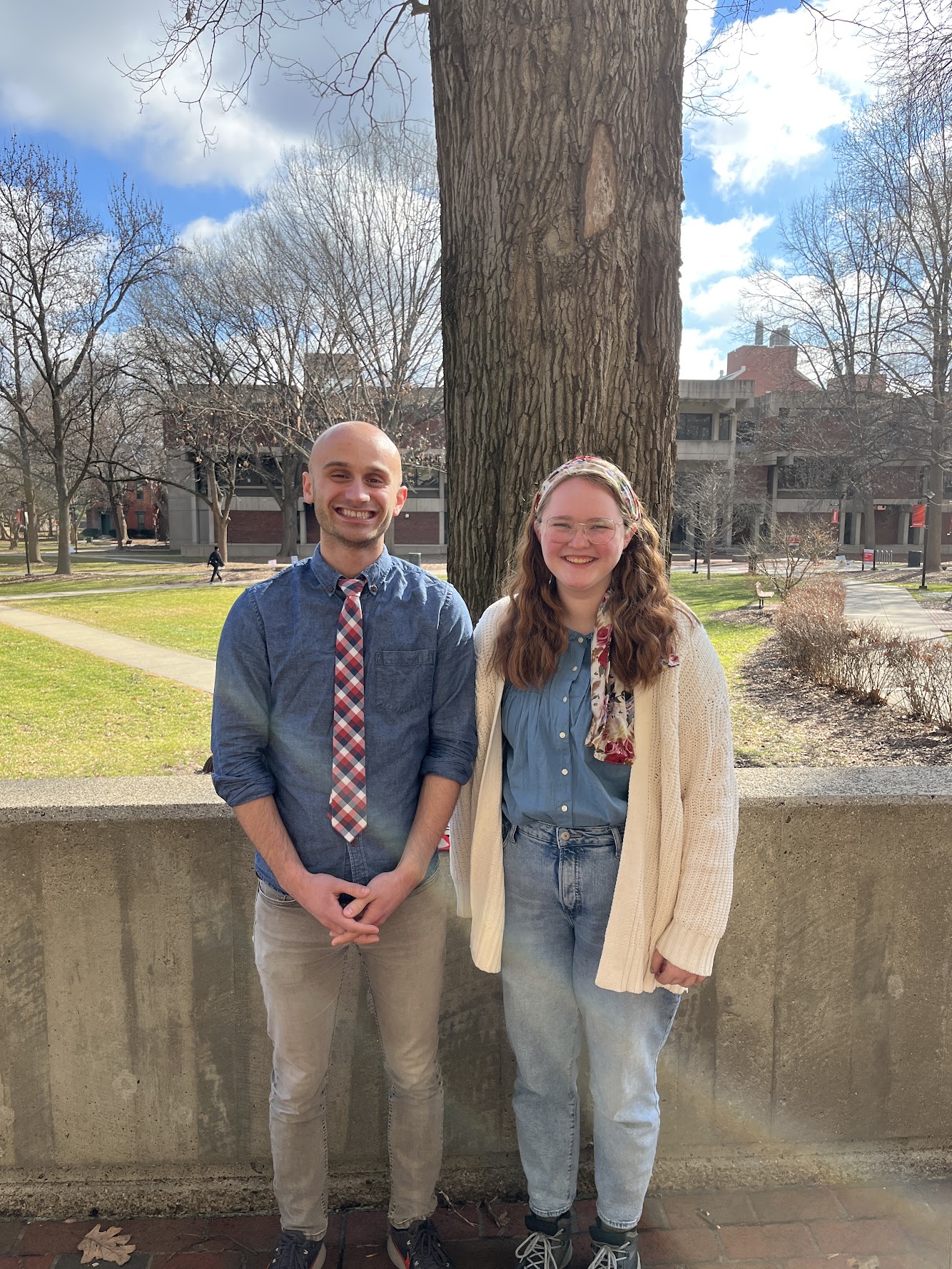
From right to left: Brice Montgomery, Writing Consultant; and
Kylee Auten, Writing Consultant

Ah, the dreaded group project, known for its ubiquity and the frustration it inspires. Few assignments elicit opinions as strong as those which require co-writing, but through this post, we’ll argue that the severity of those opinions—while perhaps not unavoidable—can be softened by recognizing features of co-writing projects.

To go about this task, we have opted to get a little meta in our approach and co-write about co-authorship. Using both external research and the lessons learned from our experience, we hope to shed some light on several considerations to keep in mind when approaching a co-authoring project, whether you are a student, instructor, or potential co-writer.

1.   Co-authoring is valuable. No, really!

First, it’s necessary to answer the question on every student’s mind—“Is there even a point to all of this?” Research suggests the answer is yes, and not just because it makes grading easier for a TA. 

James Reither and Douglas Vipond found that collaborative writing is a complex social process, and beyond the surface-level act of writing something down, it offers a unique form of “knowledge making,” positioning collaborative texts not as a product, but as a testament to the collaborative process. Unfortunately, despite other research indicating similar values, the average instructor may be hard-pressed to explain why they use group writing projects. For frustrated students, vague discourse on the importance of collaboration may not feel like sufficient justification for these exercises. Thankfully, there are several other reasons to value the practice.

2.     The co-authoring process is procedurally different from a solo write.

During the process of writing this blog, we found that co-writing is anything but linear. Even though we chose this project of our own volition, the initial enthusiasm waned, and early meetings resulted in a great deal of work from Kylee and a few stray sentences from Brice. The project moved forward in fits and starts, and it became clear that the effort would be weighted towards planning and revision, with the initial draft quickly becoming an afterthought. Suffice it to say, our anecdotal experience suggests co-writing requires a different set of metacognitive skills, and research agrees.

Helen Dale found that in student co-authoring assignments, the additional input from peers created a kind of feedback loop that eliminated the archetypical brainstorm-draft-edit process. Projects also had more logical structures because it was necessary for co-writers to plan in detail before beginning, simply to maintain coherence. Ultimately, co-writing can be a more extensive and intensive writing process, but it has the potential to transform what ends up on the page.

3. Collaboration succeeds when collaboration is the point. 

 Louth et al. compared both student scores and attitudes on individual papers and collaborative papers in a college freshman English course, and while they found no statistically significant difference between the scores, there was a markedly positive difference in attitude, with collaborative groups being more satisfied than their individual counterparts. The authors suggest that dissatisfaction arises when collaboration is elevated as a pedagogical value rather than a theoretical one; it works when the focus is on what is gained through the collaborative process.

In the case of this blog project, is the writing inherently better? Not necessarily, but it did push our approach in directions that might otherwise have gone unexplored. In the early stages, we riffed and asked each other questions about possible ways to broach the subject of co-authoring, and we challenged each other’s expectations about the goals and parameters of the project. For example, the initial draft of this post was specifically directed towards instructors planning co-writing assignments, but Kylee wisely pointed out that it was too narrow of a focus to be very helpful, and it negated the relevance of our own co-writing process. By shifting our attention to more general principles, the post opened out into something more accessible for different types of readers. 

4.     Successful collaboration as a learning process may largely be a matter of personality. 

If you’re one of the many individuals who resents collaborative writing, fret not—research indicates that group work will not be universally beneficial or enjoyable for everyone. Utilizing attachment theory, Shiri Lavy studied whether there was a correlation between personality types and performance in group projects. While it’s difficult to say how metacognitively beneficial the practice was, Lavy found that students’ self-reported satisfaction was influenced by their attachment style, with anxious and avoidant students both expressing dissatisfaction with group work compared to individual work, despite performing well. Some people just won’t enjoy collaboration, and that’s okay.

Ultimately, group projects aren’t going anywhere, and while it may seem reductive to point out that co-writing may not be for everyone, recognizing that reality may help reluctant co-authors re-evaluate their approach.  

Check back next week for a deep dive into the lessons we learned by co-writing as well as how writing center sessions can model the skills necessary to be effective co-authors. 


Works Cited

Dale, Helen. “The Influence of Co-Authoring on the Writing Process.” Journal of Teaching Writing, vol. 15, no. 1, 1996, pp. 65-79, https://journals.iupui.edu/index.php/teachingwriting/article/view/1194/1154.

Lavy, Shiri. “Who Benefits from Group Work in Higher Education? An Attachment Theory Perspective.” Higher Education, vol. 73, no. 2, 2017, pp. 175-187, JSTOR, https://www.jstor.org/stable/26447599.

Louth, Richard, et al. “The Effects of Collaborative Writing Techniques on Freshmen Writing and Attitudes.” The Journal of Experimental Education, vol. 61, no. 3, 1993, pp. 215-224, JSTOR, https://www.jstor.org/stable/20152373.

Reither, James, and Douglas Vipond. “Writing as Collaboration.” College English, vol. 51, no. 8, 1989, pp. 855-867, JSTOR, https://www.jstor.org/stable/378091.

Wrestling with the Blank Page

Zoe Donovan, Writing Consultant

One of the most daunting things to a writer or student is the blank page. While thinking on the topic of this specific blog post I found myself paralyzed by choice. “A short blog about writing” could mean anything. I started writing, erased the first line, started over. Editing as a I went, I found myself held back from what the point of this was, that I was getting caught up in the minutiae of writing instead of actually writing.

 I am, of course, being somewhat hyperbolic in the above paragraph, but it isn’t far off from my experience engaging with past and current writing projects. We tend to get caught up in the sentence we are constructing rather than the point of the piece.  

I find that taking a step back from that detail-oriented nature can do more good than letting an inner editor take over constantly. Instead, try to focus on getting something on the page. Prohibit yourself from using the backspace, repeat your points and repeat yourself in different ways. This type of repetition can be monotonous in a final draft, but a mock-up first draft can provide a writer with options when returning to the piece.

Then, once you have created something, step back, make a cup of tea, meander over your thoughts. Take the evening, day or week. Then use this piece that is what I lovingly refer to as a “word explosion” to create an outline and reorganize your thoughts. Returning to it with a fresh head can prevent you from becoming fatigued over a specific project or idea. From there, you can make edits, rewrite sections, omit unnecessary information, reorganize your thoughts, and fully flesh out points in your future drafts.

It is impossible to edit a blank document. Good writing takes multiple attempts, revisions, and proofreading. Half the battle is getting something on the page. In addition to this, it is exceptionally difficult to fully edit an unfinished piece, because you don’t know what additional context you need to provide, you can’t know how to transition into or from a paragraph or idea that you don’t yet have on the page.

Silencing my inner editor during my initial draft has become my go-to in the last few years. In the past, I have often been struck with choice paralysis or perfectionist desire. I feel that every piece I put out should be perfect as soon as it first hits the page. This is not a healthy or productive writing strategy. It creates this false narrative in early writers, (and late writers) that revision is not a key step in the process.

Instead, your first draft should be passionate. Why does this matter to you, why is it important that it is said, and what is your evidence to further support these claims? Writing is about growth, about changing the way the audience sees something or approaches a topic. Along that same vein, writing is process in which you can discover yourself and your arguments about a piece.

If you’re constantly dissecting every word or sentence you put on the page, then you can become overwhelmed and lose the motivation to continue writing. Instead, just focus on getting words on the page. They don’t need to be good. They don’t need to be ready for publication or submission–get your thoughts down without hesitation and with total freedom to put whatever you want. This early draft isn’t what you are sending in, it is for you and you alone as the writer to better understand yourself, your process, and your approach to this particular piece you are writing.

I know this strategy doesn’t work for everyone, but it can be something that works for writers who struggle with starting. I find that in my own writing, starting with a loose thesis works best. You can always come back to the thesis and make it stronger, or, if after writing you decide that the evidence you’re presenting doesn’t fit, then there’s no harm in returning to the drawing board on your thesis statement. Revisit your writing, what are you trying to accomplish in your stream of consciousness? Hone in on those points and fully articulate them. If you can argue it in a fully-fledged piece, then don’t be afraid to change it and make it your own.

Shutting off that critic side of your brain and just putting words on the page in a stream of consciousness style can help to create a framework for yourself during the writing process. You might discover that your initial thesis doesn’t quite fit, that a certain piece of evidence doesn’t hold as much weight as you originally thought or that you need additional information or research to fully set your argument. Giving yourself and piece a space to grow without an internal critic can lead you down a path that may be different from your initial intent and provide you a better understanding of your argument.

While it is important to be critical of your own work and edit that work, within the writing process that internal criticism can detrimental and create a sort of choice paralysis and inhibit us from actually engaging within the writing process. So, instead I encourage you write your first drafts like no one is watching and shut out the editor.   

For The Love of Writing

Michael Benjamin, Assistant Director and Writing Consultant

It’s not lost on me that this is being posted on Valentine’s Day, 2022. So I’m going to try and stick to the day’s theme: love.

Love is hard. Complex. It’s a feeling, sure, but it’s also an action. These days I’ve been conceptualizing love within the framework of care. Caring about ourselves, our dearest ones, our community, our larger world. Care can be shooting a text to a friend you haven’t heard from in a week or two or volunteering at the local community literacy center. Care takes energy but is always worth it even though it usually comes with little to no reward. In an affective economy, care is a currency. Tying love and care together begins to make visible all of the little acts we do. It pushes us to be thoughtful and reflective and, frankly, better people.

I realize this probably feels like it’s going off of the rails, but please bear with me.

I think I can speak for everyone at the writing center. We care about writing at the here because we care about our UofL community. And we know that we have a unique opportunity to spread the joy of a love for writing.

Here’s a quick story: it was my first month of my undergraduate career and I’d gotten a lower grade than desired on an assignment. I went to the writing center, not really knowing what to expect, hoping that I’d come back with a better text to bump my grade up. What I got was an experience that has powered my academic career for the past decade. My consultant smiled at me and told me Play with your writing. Find the joy in it. Keep caring and putting love into it. That experience was so transformative for me that seven months later I was working in that writing center. I’m sure it has something to do with my pedagogical ethos, too. That consultant cared about me, showed a love for her work and writing and the writers she worked with in a way that was so infectious and powerful that I needed to take action, to pass it along.

I write this as a call for all of us to radiate that love and care throughout our worlds. I also write this as a way to urge us to use the written word as a means of care.

Next week, we are hosting an event for International Mother Language Day. I’m excited to see y’all UofL community members show a love for writing through all of these guest blog posts written in your mother tongues. I’m even more excited to fill out these notecards for recent immigrants and refugees. Handwritten letters of simple words of encouragement are an act of care. Taking the time out of your day, in the middle of what has been a brutal semester, to stop and focus writing something for someone you don’t know in your best handwriting won’t show up on your CV or transcript, but it’s a loving act that can have a world of meaning. I’m personally excited for our little writing center community to show love to all of the multilinguists and polyglots amongst us.

I know today is viewed as a day or romantic love. A day you spend with your partner, showing them how much you appreciate them. I implore you to show that care to everyone. What if you jotted a little note of appreciation for the wait staff at the restaurant? Sent a couple coworkers/colleagues/classmates a small compliment? Took 10 minutes to yourself to journal what and who you love and care for? Care for you? What if you went completely old school and snail mailed your folks? Words are powerful and cost nothing. Write them. Share them. Care for and with them.

Why Can’t I Write Like Derrida?

Yuan Zhao, Writing Consultant

The other day, I had a discussion with our acting director on what are the standards for good writing. As a graduate student, I have witnessed numerous writing styles published in academic journals. Some are written in straightforward plain English; some are less accessible to read, as those written by Derrida, Lacan, Spivak, and Homi Bhabha. Whenever I attempt to read these great thinkers, I would often find myself trying to single out the main arguments from their obscure styles—convoluted syntax, jargon with special connotations, and complicated sentence structures. I have heard people complain about these authors: “Their writings are too incomprehensible!” “Why can’t they write in a more reader-friendly way?” My discussion with the acting director on the standards of good English writing remained unresolved. We were uncertain whether it is appropriate for us to decide if these great thinkers compose good writings, but we agreed without any doubts that these authors are super intelligent.

Bearing in mind the question of what makes good writing, I started to read one of Barbara Johnson’s essays “Bad Writing.” In this short article, Johnson defends at least three types of “bad writings.”  One of these “bad” qualities lies in obscurity—that readers assume a text to be bad if it is difficult to read. “‘Don’t understand!’ becomes an accusation,” and readers blame the “incomprehensible writing” as “the cause of incomprehension” (Johnson 160). However, Johnson argues, it is unfair to critique authors simply because their works are difficult to read. Readers can at least suspend their judgment and reflect more on their own reading attitudes, skills and strategies (Johnson 160). Johnson notes, “[a]fter the theory revolution it is no longer possible so serenely to separate style from thinking, idea from language” (162). In other words, complex theoretical thoughts sometimes require convoluted expressions. Style and thoughts are in a unity. Reading thus becomes demanding. To appreciate such complexity needs a set of advanced reading skills that readers can hardly achieve unless they are properly trained. No other way out.

Therefore, obscure works are not a result of bad writings. They are just difficult to read, foreign to our established mindsets. To read them needs time and reflection. Johnson notes “[u]nderstanding the conceptual breakthrough … depends on pausing there long enough” (164). She also points out, “[t]hought as a break is different from thought as a chain” (165). Whenever we pause and attempt to comprehend the obscure writings, the fluency of reading is surely to be interrupted, but the breaks are also chances for our mindsets to welcome transitions. To digest new and complex knowledge cannot be an easy task. It needs time and effort.

Last semester, a course instructor criticized my writing style as convoluted and complex. She also mentioned that I failed to follow the spirit of Barbara Johnson who can express complicated arguments in a clear and accessible way. Such accusations made me feel so anxious to the extent that I started to deliberately avoid composing complex sentences. I was disappointed that she did not appreciate the designs I embedded in the selection of words and paragraph organizations that were intended to respond to the main arguments and to relate the resources I read. I understood that my reader-instructor expected a style of clarity. But what if my arguments are complicated and they need complex organizations? Does a student assignment have to be explicit direct and simple-minded? Does it mean a complicated student assignment can only be marked as a product of bad writing? After reading Johnson’s essay, I might challenge the instructor’s critique: why can’t the instructor follow the spirit of Barbara Johnson to read—to pause and reflect when reading a student’s assignment?

Should the instructor respond to me, she might say it is both impossible and unnecessary to invest so much time in reading a student’s assignment. If a student has complicated ideas, they have to be expressed in an explicitly direct manner so that instructors can comprehend them at first glance. I can understand this excuse. Nowadays, instructors are often so fully occupied with teaching duties, research tasks and administrative jobs that they can hardly spend more time than necessary on reading students’ assignments. Within the limited time, instructors don’t expect to encounter obscure works at the student level. Otherwise, they might tend to assume the convoluted writings are a product when students fail to try harder to express in a clearer way. However, in the meantime, we will find instructors tend to spend hours readings the obscure works of Derrida and Lacan. Why can’t they spare more time on the obscure students’ writings? The disparities in writers’ academic achievements and social status are another factor to affect instructors’ reading attitudes and expectations. As Johnson notes, most obscure works will keep being condemned by most readers until they enter into the canon, and only since then, readers can attempt to appreciate the poetic genius in the obscurity (160). As for students’ works, they are far from being recognized by academia, not to mention the canon. No wonder instructors tend to underestimate the possible significance and academic contributions in students’ writings. At the student level, writing styles are supposed to yield to the expectations of their readers.

Cruel reality, isn’t it? What can we do? Can we still write like Derrida if we have complicated thoughts to express? The strategy I propose is to keep writing. Keep writing the way colonized writers “write back” to colonizing powers in postcolonial studies. Like them, we can use writing to issue our subaltern voices when we practice complicated thoughts. Keep writing in the spirit of Derrida’s “as if.” Write as if we are complicated scholars, who always attempt to develop sharp arguments while balancing between complex ideas and the accessibility for readers. Keep writing with a consciousness to look for potential quality readers in academia—compose quality papers, send them to journals, respond to feedback from editors and reviewers, and try to get them published.

Now, we can repeat the question “Why can’t I write like Derrida?” in a plain tone, without agitation or anxiety. Repeat it as a rhetorical question because it no longer is an unsolved problem. I can write like Derrida, but sometimes, I choose not to. Now, I will consider the factors, such as context, reader and genre, before I make the decision whether it is necessary to write like Derrida.