Month: April 2020

It Has Been a Year Like No Other – Yet Some Things Have Not Changed

Bronwyn T. Williams, Director

This is the time of year, when the dogwoods are in bloom and classes are drawing to a close, that I usually draft up a blog post to look back on our University Writing Center accomplishments over the previous year. If you read over those posts from the past, you’ll find some common threads about what we value and what we’ve done. This year, however, though the dogwood in front of my house is reliably spectacular, this end-of-year blog post is unlike any of the others I have done in the past decade. As with all of us, the COVID-19 pandemic turned our world upside down – or at least sideways – in the middle of the spring semester. In two days we had to turn our entire University Writing Center operation, with two physical locations and one virtual schedule providing hundreds of appointments each week, into one, large integrated online Writing Center. What’s more, we had to develop a system to coordinate the daily work of a staff of almost 20 people who would now all be working at home. At the same time, our consultants, all students themselves, and our writers were all scrambling to adjust to a new environment of online learning and sheltering in place.

Staff copy 1
University Writing Center Staff, 2019-20

Yet, when people ask why I say we have the best Writing Center staff in the business, it is for moments like these. Cassie Book, our associate director, and Amber Yocum, our administrative associate, worked fast and flawlessly to make the transition to the online schedule made for writers making appointments and for our tutoring staff. We didn’t miss a single appointment in the transition to the online schedule. Since that transition, our consultants, all working from home and balancing family and their own courses, have continued to provide exceptional feedback to writers from across multiple departments and disciplines. I am always proud of the people who work in the University Writing Center, but this year’s staff has been something special. I feel so fortunate to have been able to work with them and the University community has been fortunate to have them to help support and strengthen writing at UofL.

Even with the disruptions that have affected all of us in the past six weeks, however, much of what we have done, and continue to do, has not changed. Our consultants have continued to offer insightful advice about writing, as well as thoughtful support and suggestions about how to navigate the challenges of writing in such a rapidly changing and deeply unsettling time. We continued to believe that not only is every person who writes a “writer,” but that careful listening, thoughtful response, and creative collaboration can make everyone a more effective and confident writer. And, as always, we appreciate the trust that writers from across the UofL community display in letting us work with them.

We will be open during the summer, starting May 11, from 9-4 every weekday. You can find out more on our website. You can also follow us on our blog and on Twitter, Facebook, and Instagram.

Beyond Tutoring – Events and Community Writing

Before the pandemic, we once again worked to fulfill our commitment to supporting a culture of writing on campus and in the community.

Writing Groups, and Dissertation Writing Retreats: Our popular Creative Writing, LGBTQ+ and Faculty and Graduate Student Writing Groups continued to give UofL writers supportive communities through which they could create and talk about writing. We again held our annual spring Dissertation Writing Retreat in May. We will be holding the Retreat next month as a fully virtual Retreat. We plan next year to continue all of these groups, so be sure to check our website for information and dates.

Writing Events: Once again we hosted or took part in a range of writing-related events, including our Halloween Scary Stories Open Mic Night, Kick Back in the Stacks, a

IMG_20200221_121150
International Mother Language Day Celebration

Valentine’s Day Open Mic and International Mother Language Day. The open mic nights were thanks to our ongoing partnership with the Miracle Monocle Literary Magazine.

Community Writing: We also continued our work with our community partners, the Western Branch of the Louisville Free Public Library and Family Scholar House. Once again we are grateful for the participatory and collaborative partnerships with these organizations. You can find out more about these community writing projects, including how to get involved with them, on our website.

The Best Writing Center Staff in the Business

I am proud of our staff every day. They work consistently with care and intellectual insight to support the work of writers in the University. They also make me laugh and enjoy coming to work each day. Thanks go to Associate Director Cassie Book, Administrative Associate Amber Yocum, and Assistant Directors, Megen Boyett, Aubrie Cox, Edward English, and Rachel Rodriguez. Also special thanks go to Writing Center Intern and HSC Consultant Liz Soule. Our consultants this year have been Olalekan Adepoju, Ash Bittner, Michelle Buntain, Tristan DeWitt, Rose Dyar, Kendyl Harmeling, Kelby Gibson, Catherine Lange, Shiva Mainaly, Lauren Plumlee, Hayley Salo, Cat Sar, and Kayla Sweeney. Our student workers were and Milaela Smith and Jency Trejo.

Writing Center Staff Achievements

The University Writing Center is also an active site of scholarship about the teaching of writing. Staff from the Writing Center were engaged in a number of scholarly projects during the past year in rhetoric and composition, literature, and creative writing.

Cassandra Book, Associate Director, is now Dr. Cassandra Book after defending her dissertation “Students at a Crossroads: TA Development Across Pedagogical and Curricular Contexts” from Old Dominion University. In addition she was awarded the 2020 UofL College of Arts & Sciences Outstanding Performance Award for Staff. She presented at the International Writing Centers Association Conference and was accepted for the College Conference on Composition and Communication (which was cancelled because of the pandemic).

Megen Boyett, Assistant Director for Graduate Student Writing, was accepted at the Conference on Community Writing and the Conference on College Composition and Communication (that were cancelled because of the pandemic).

Aubrie Cox, Assistant Director for the Virtual Writing Center published “Reparative Leanings of Haiku Aesthetics: Ways of Knowing and Reading in Eve Kosofsky Sedgwick’s A Dialogue on Love,Juxtapositions: A Journal of Haiku Research and Scholarship Issue 5, December 2019. Two poems in ANOTHER TRIP AROUND THE SUN: 365 Days of Haiku for Children Young and Old. Brooks Books, 2019. Three poems in All the Way Home: Aging in Haiku. Middle Island Press, 2019.

Edward English, Assistant Director of the University Writing Center was accepted at the Conference on College Composition and Communication (cancelled because of the pandemic).

Rachel Rodriguez, Assistant Director of the University Writing Center presented at the IWCA Ideas Exchange and was accepted to present at the Conference on College Composition and Communication and the Rhetoric Society of America (both canceled due to COVID19). She co-authored a CompPile WPA Bibliography on Translingualism and published “The Unique Affordances of Plainness in George Eliot’s Silas Marner and Middlemarch,” in the forthcoming volume 72, no. 1 of George Eliot-George Henry Lewes Studies.

Consultants

Ash Bittner, defended his MA Thesis Long for Death will enter the UofL Humanities Ph.D. program in the fall on a University Fellowship.

Michelle Buntain, did a reading of her poetry at the Bard’s Town in Louisville.

Tristan DeWitt, chaired a panel at the Louisville Conference on Literature and Culture.

Rose Dyar, was accepted to present at the AEPL’s summer conference.

Catherine Lange presented at the Conference on College Composition and Communication Virtual Conference.

Hayley Salo, will be the Morton Chair Research Assistant for Dr. Deborah Lutz next year.

Cat Sar, was awarded a Department of English Creative Writing Scholarship

Liz Soule, presented at the International Writing Centers Association Conference in October and will enter the UofL Rhetoric and Composition Ph.D. Program next year on a University Fellowship.

Jency Trejo, one of our student workers, also passed her U.S. Citizenship Exam.


99% Invisible: APA 7th Edition & the Work of Academic Citation Styles

99% Invisible: APA 7th Edition & the Work of Academic Citation Styles

By: Cassie Book, Associate Director

Over the past few months, we’ve been educating ourselves and updating our resources for the latest edition of the American Psychological Association Publication Manual (7th Edition).

two photos, stacked horizontally. Top photo is of a portable screen with a Power Point slide that says "Out with the Old, In with the New." Bottom photo is taken from the back of the room with the screen. A woman stands in front of horse shoe arranged tables with six people watching her
In February, Cassie educated our staff on the major changes from APA 6th to 7th edition. Because we serve the entire University community, switching from one edition of a style guide to another isn’t as simple as throwing away the old and embracing the new. Our consultants are now able to assist writers with both 6th and 7th editions.

This update from APA seemed like a good time to reflect upon the role of citation and academic style in writing. This blog post overviews the major changes introduced by APA 7th edition, while at the same time explaining a bit about the role and purpose of these components. For more details and visuals, watch our video on the changes, which is a great companion to this post.

Title page(s)

A title page is the first part of your paper that your reader will see. Even though the saying goes you “should not judge a book by its cover,” everyone knows that readers will draw conclusions about writing based on a book cover, or a paper’s title page. In essence, formatting is a type of visual rhetoric. Correctly adhering to an academic formatting style demonstrates that your writing is part of a community. You speak the language of the insiders. Not following the formatting guidelines can, unfortunately, flag you as an outsider.

APA 6th edition’s title page included the anger-inducing “Running head” in the page header. The frustrating aspect was that the title page header was different than the rest of the pages. 7th edition actually has two options for a title page, student and professional. In both versions, the running head is the same on every page, including the title page. For students, the only element in the header is the page number!

Level Headings

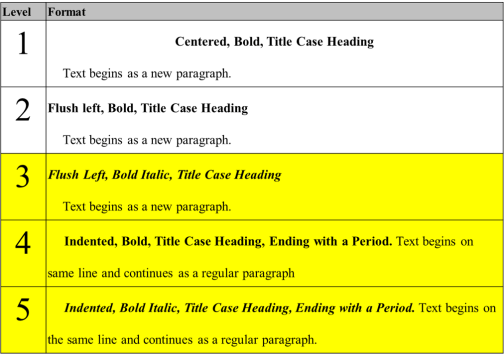
Level headings are another aspect of APA that often gives writers a headache. However, level headings are super useful for transitioning from one part of a paper to another and giving a paper a logical order. And again, they contribute to the visual rhetoric of an APA formatted paper, keeping it looking orderly and standardized. If you want to divide up your paper into sections (e.g. methods, results, discussion), you must follow APA’s formatting guidelines to label the sections. Here is an example of a circumstance in which a writer would employ level one and two headings:  A writer divides the methodology section, a level one heading, into subsections, such as participant recruitment, sample size, and instruments. The subsections would be level two headings. APA has changed the formatting for level headings for levels 3-5. This is the new chart with the changes highlighted:

Level Headings
The formatting for levels 3-5 has changed from APA 6th to 7th edition. Click here to access a screen-reader accessible chart.

However, perhaps the biggest change is that the level one heading format, which looks like this,

Centered, Bold, Title Case 

is now the format for the title on your title page, label for “Abstract” on the abstract page (if you need one), title of your paper on the first body page, and the label for “References” on the References Page.

In-Text Citation

In-text citation is so important because it uniformly gives others’ credit for their words, ideas, and research and allows you, as a writer, to engage actively and ethically with others’ ideas. APA 7th edition has made an important change to in-text citation guidelines. When citing a source that has three or more authors, write use the first author’s name plus “et al.” In 6th edition, APA instructed writers to include all authors, up to five, the first time the source was used. Some journals, like Technical Communication Quarterly, have pushed back against this change because, they argue, it erases important contributions of important authors.

This is probably a good time to remind you to always follow any instructions from your professor or journal that differ from the official style guide. It is quite common for professors and journals to want you to do something different than the style guide.

Reference Entries

Your references page is where you list all the sources you cited in the body of your paper. The purpose is to give your readers the complete information about a source, so they can learn about what kinds of sources you’re using and potentially locate those sources themselves. And, again, it credits those sources for their work.

The reason why the requirements for reference entries seems to be constantly changing is because digital sources and the internet constantly challenge existing templates, which were often based on qualities of print sources. I recommend using our APA 7th edition handout on in-text citation and references to learn exactly how 7th edition affects websites, Digital Object Identifiers (DOIs), publisher location, and multiple authors.

Pronouns

The 2019 Word of the Year from Merriam-Webster was “they!” Why? Although “they” has been used as a singular pronoun for centuries, many individuals and organizations have recently advocated for broader acceptance of “they” as a singular pronoun. APA is officially joining the chorus, which is a big deal. APA points out that using “they” as singular is a question of bias-free language. And, I would add, using it maintains a respectful stance toward any humans referenced in your writing. Here’s exactly how APA puts it:

When referring to individuals whose identified pronouns are not known or when the gender of a generic or hypothetical person is irrelevant within the context, use the singular ‘they’ to avoid making assumptions about an individual’s gender. (APA, 2020, p. 140)

Conclusion

Citation styles, especially APA, can certainly be frustrating because of what seem like endless tedious details. (And then they change on you!) However, knowing the reasons that such guidelines exist, and why they change, may help ease the citation and formatting burden a bit. Plus, you always have friendly writing center consultants and administrators here to guide you.

References

American Psychological Association (2020). Publication manual of the American Psychological Association (7th Ed.). https://doi.org/10.1037/0000165-000

American Psychological Association (2009). Publication manual of the American Psychological Association (6th Ed.).

Writing for Sanity’s Sake: A Quarantine Companion

IMG_3633Edward English, Assistant Director 

When considering strategies for staying emotionally and physically healthy during these times of closed borders, social distancing, and toilet paper depletion, for most people writing would be an unlikely choice. Writing does, after all, carry a reputation for being a solitary enterprise.  I do, however, believe that writing offers great potential to help many navigate these tough times and here’s why.

The importance of having projects. For those with an ample amount of free time, having a project, or projects, can be a fun and rewarding way to learn and stay occupied. My wife, a junior high science teacher now instructing entirely online, has a loom and is in a weaving frenzy.  I’ve started gardening a bit and trying to get better at home repairs.  It seems I’m not alone in taking on these tasks either—yesterday while driving around, I noticed what seemed to be a Louisvillian ghost town suddenly transform into a dense expanse of cars parked in front of Lowe’s.

For many attracted to writing, the biggest obstacles can be a perceived lack of time and difficulty overcoming writer’s block.  Now, however, free-time is no longer in short supply for the bulk of us.  Also, for myself, I feel that writer’s block is often a product of feeling overwhelmed at the enormity of a project.  Perhaps now is the time for you to start that novel you always wanted to write, but something of a more manageable size might be a better strategy: a short story, a screenplay, or a thoughtfully crafted letter or e-mail to connect with loved ones, offer consultation to those in a difficult place, or express appreciation to those who are working so hard and acting bravely—particularly those in the medical field.

Additionally, it’s worth noting that writing can often be an activity that requires slowing down and thoughtfully managing your time, as former writing consultant Abby Wills explains: Slow Writing: 5 Ways to Rebel against the Culture of Urgency

The importance of working through emotions—especially uncomfortable ones.  These are anxious times—especially to someone in tune with the current headlines.  As many people have little communication with others during this unprecedented time, it might be challenging to process through difficult emotions. For some in these and similar situations, writing can serve as an outlet. In my own life, I’ve found that writing, especially journaling and poetry, can be an excellent way to give definition and clarity to fears, questions, and concerns.  And while these steps don’t necessarily eliminate problems, more often than not they help foster much clearer, and more pleasant, headspace.

For fun insight into journaling, check out former writing consultant Rachel Knowles’ piece: The Writing Center Diaries: Dispelling Myths About Journaling

The importance of exercise and creativity.

If you have the ability to responsibly exercise, jog, or take walks, it’s likely a good idea. The benefits are numerous: physical health, increased serotonin levels, vitamin D to name a few.  But also consider that exercise could be a great way to improve your writing quality and overall experience.

In a recent interview, acclaimed fiction writer Chuck Palahniuk (Invisible MonstersChoke, Fight Club) detailed how much of his writing process actually revolves around lifting weights—arguing that the physical movement and circulation were conducive to helping him feel creative and organize his thoughts. While weight lifting might be a limited option for most—particularly with the closure of gyms—the sentiment is clear, and alternative ways of exercising indoors abound with a simple Google search.

Along similar lines, a few years back Psychology Today published “To Become a Better Writer, Be a Frequent Walker” exploring significant benefits walking can give to writers.  As the article explains, avid walkers abound among great literary figures like Virginia Woolf, Charles Dickens, William Wordsworth and Henry David Thoreau.  Furthermore, walking can lead to increased creativity, provide inspiration, and hone one’s observational skills.

The importance of staying connected.

While a successful writer is frequently imagined as sitting hunched over a laptop typing away in a disheveled apartment, sterile office, or library, more often than not some of the most successful writers I have met put great effort into figuring out alternative and creative methods that work better for them, and this often incorporates social connection as a significant part of their writing process.

And, as many are discovering creative ways of connecting online, it might be worth considering that writing could be a useful means to get feedback or just brainstorm ideas with friends or people with similar interests online.  If you happen to be a faculty member or graduate student at the UofL and are interested, we are still our offering writing group online.  For more details, check out: Faculty and Graduate Student Writing Group

For many, these various options and suggestions might not be feasible. But either way, we at the University Writing Center hope you stay safe, healthy, and connected.  So happy writing…or whatever it is you do to help during these strange times.

Works Cited

“To Become a Better Writer, Be a Frequent Walker.” Psychology Today, Sussex Publishers, 28 Mar. 2016, http://www.psychologytoday.com/us/blog/minding-the-body/201603/become-better-writer-be-frequent-walker.