
Bronwyn T. Williams, Director
The sound of people thinking. That’s what you would have heard had you come to the University Writing Center this past week. With fourteen UofL Ph.D. students focused on writing their dissertations. I swear that, given the intensity with which they were working, you could hear them thinking. This year marks our fifth annual spring Dissertation Writing Retreat. During the week, the schedule was the same: Writing in the morning, a short workshop and discussion on some area of
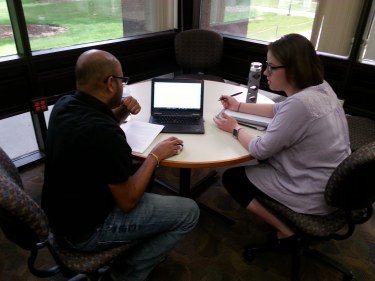
Dissertation Writing Retreat writers hard at work
research writing at noon (How to Write and Effective Literature Review, How to Revise and Respond to Committee Members’ Comments, How to Turn Dissertations into Publications, How to Keep Writing) , and the individual appointments with University Writing Consultants in the afternoon (and more writing…). The writers who took part in this year’s Retreat worked with a dedication and commitment that was inspiring. They came from eight different disciplines at the University: Anatomical Sciences and Neurobiology, Education, Engineering, Rhetoric and Composition, Humanities, Psychology, Public Health, and Sociology. The best way to get a sense of the experience of the Retreat and its impact on the writers who took part, however, is to hear from the participants and consultants themselves.
Participants
Amanda Pocratsky, Anatomical Sciences and Neurobiology: It’s hard to synthesize in few words how much this retreat has transformed my dissertation writing experience. As a graduate student in the biomedical sciences, I was initially concerned about how effective this retreat would for me. These concerns proved unfounded. In the span of one short week, I’ve written my dissertation abstract and a complete first chapter. I will leave here with over half my dissertation completed, a well-defined outline of my discussion, and incredible momentum to push through the final stages. Moreover, the writing skills I’ve cultivated from this experience will effectively translate throughout my scholastic career. I strongly encourage students to apply and come prepared to succeed.
Yvette Szabo, Clinical Psychology: The Dissertation Writing Retreat has been invaluable to my dissertation progress! I am still collecting data for my dissertation, so I was able to

use this protected time to write and edit large parts of my Introduction, Method and then outline my results and discussion. Overall, I doubled the length of my dissertation and received feedback on all sections. Typically, I shift between many roles as a graduate student, so having the quiet space to work (relatively unplugged) was necessary and much appreciated. And working with the same consultant all week allowed me to talk through presenting ideas for my complex study as well as receive feedback on organization and parallel structure. Thank you for a wonderful experience!
René Bayley-Veloso, Clinical Psychology: I would highly recommend that any graduate student who is working on their dissertation attend the Dissertation Writing Retreat. I have made substantial progress on my dissertation in a very short amount of time. The retreat also helped me organize my thoughts and questions, which allowed me to have a necessary and productive meeting with one of my committee members. I have learned quite a bit about my own personal writing process through this experience, and will be utilizing this knowledge to maintain momentum moving forward.
Jamila Kareem, Rhetoric and Composition: The 2016 Dissertation Writing Retreat has not only been the most productive time I’ve spent on my dissertation, but it has been the most valuable. The structure of the Retreat worked well, because it allowed me to prioritize my writing and get the most crucial aspects finished while I had guaranteed feedback. The Retreat helped me develop a more structured process to stay on track and to feel rewarded when I do. I’ve had a process that has worked pretty well, but the staff at the Retreat gave
me strategies to build upon it and work smarter. And it’s free! Just look for professional dissertation help around the Internet—prices are crazy! I would recommend the Dissertation Writing Retreat to every doctoral student whether they are having trouble getting started or almost done. The feedback, time, and structure you receive are invaluable.
Abby Burns, Epidemiology and Population Health: The Dissertation Writing Retreat provided an encouraging environment to work quietly alongside other students who all have the same ultimate goal – completing their dissertation and graduating. It helped hold me accountable, but more importantly helped me build momentum that I hope I can run with in the following weeks/months.
Denise Watkins, Humanities: As someone who is married, a mother, and works full-time, the benefits of this retreat can’t be adequately explained. I was able to steal away from all other responsibilities and make significant progress. In one week’s time, my outlook towards my dissertation has changed from an insurmountable “where will I ever find the time?” project to a feasible, doable task.
Heidi Williams, Sociology: The Dissertation Writing Retreat provides supportive, focused writing time, as well as workshops and advice that help participants approach and manage their work. Working with a writing consultant helped me realize I was fixating on a problem, rather than making progress in an attainable way. I learned how to breakdown my writing into manageable, daily tasks that led to tangible results – an exercise that I could not put into motion myself.
Consultants:
Laura Tetreault, Assistant Director: In my conversations during the Dissertation Writing Retreat, either with the writers I was working with or the other consultants and writing center staff, we often circled back to one idea: writing is hard. (And interesting, and fun, and exciting, but also hard a lot of the time.) As a Rhetoric and Composition PhD candidate

and Assistant Director of the Writing Center, people sometimes I expect that I have this whole writing thing figured out, but the reality is that I became interested in writing teaching and writing center work because I also find writing to be really difficult a lot of the time. But instead of finding this discouraging, I actually find it comforting that most writers express at some point how difficult writing can be for them. The common experience of struggling with writing helps to diminish the inner critic that many grad students have in our heads. I can tell that critic: hey, it’s not me; writing is just hard sometimes. And it gets a lot easier for me when I can find a sense of community in the struggle.
Amy McCleese Nichols, Assistant Director: Watching writers work on their dissertations this week has reminded me why I love one-on-one writing conferences. It’s been great to talk through ideas and text with writers who have differing processes. For some, it seemed like the chance to talk through small sections of writing/thinking gave them better language to describe their overall argument and intervention by the end of the week. For others, designing study frameworks and making targeted edits to various sections of text

helped them accomplish larger goals. Working the retreat has also given me a better sense of what it might look like to write my own dissertation in the future; this is definitely an event I’d like to return to as a participant next year.
Layne Gordon: As a soon-to-be second year PhD student, I was so inspired this week by the progress of the writers I was working with! At the end of each meeting, we took a couple of minutes to set some writing goals for the next day. Although sometimes those goals had to shift or be adjusted (writing requires so much flexibility!), the writers always made progress and pushed themselves to get as much done as they could. While I got to learn a lot about their respective topics, I also learned a lot about the dissertation writing process itself and the importance of just not stopping.
Brittany Kelley: I learn so much when working with others on their dissertations, especially when it comes to the writing process. This year, I learned that it’s important to create a hierarchy of goals for your dissertation. The highest/most important goal is getting words on the page. The next highest/most important goal should be your well being. After you’ve got words on the page, remember to rest. See friends. Exercise. Eat well. Most importantly, be kind to yourself. You deserve it. Always.
Ashley Ludewig: I have always enjoyed working with students of all levels on their writing projects and this week’s retreat was no different. But, even though I participated in the retreat as a tutor, this week was also really helpful for me as someone who is also writing my dissertation. Talking with other writers as they thought through some of the most complicated parts of their projects and reflected on their writing processes reminded me to be more accepting of my own writing process and helped me see why I was feeling stuck in my own work. Now, instead of beating myself up over a lack of progress, I feel prepared to re-think my priorities for the next few weeks and make a plan that will actually work!
Meghan Hancock: This year at the diss retreat I was reminded of the importance of setting aside concrete time to write in a space without distractions. It seemed like many students most valued the amount of quiet work time that the retreat provided them with, and in my last consultation, we talked about how to create those kinds of spaces after leaving the retreat as well as how to continue to block out time in schedules just for writing. Though I always encourage others to maximize their productivity in these ways, I don’t always practice what I preach. Being able to see the amazing work ethic that students at the diss retreat had this year has inspired me to try harder to follow my own writing advice and to set aside more routinely scheduled quiet times for me to work on my own dissertation.
Thanks…..
It’s also important to acknowledge the people who did the hard work of organizing the Retreat – Cassie Book, our Associate Director, and Robin Blackett, our Administrative Assistant, and Assistant Directors Stephen Cohen, Amy Nichols, and Laura Tetreault. Thanks also to the fantastic consultants (themselves Ph.D. students) who do the most important work of the week in working with the writers: Layne Gordon, Meghan Hancock, Brittany Kelley, and Ashley Ludewig. And thanks to Dean Beth Boehm, of the School of Interdisciplinary and Graduate Studies for again sponsoring and supporting the Dissertation Writing Retreat.
See you next year!!!!!!


 University of Louisville Writing Center