Tag: Process

Creating Art: A Painter’s Journey Into the World of Writing

Mary Sherafati, Writing Consultant

Our staff often engage in other creative processes as part of their learning and writing. In this week’s blog post, Mary Sherafati discusses how she finds practicing her painting skills similar to the process of becoming a stronger writer. Check out her journey and her paintings below!

Before beginning my academic journey into the world of writing, I tried to improve my painting as I have always dreamed of being a good painter. I therefore took my first painting classes in 2015. First, I was in a hurry to make a name for myself as a good painter; however, gradually I reckoned that in order to become a good painter not only do I need to be more and more patient but also I need time. I need time to learn, to practice, and to make mistakes several times. I also learned that to be a good painter, I should not be afraid of receiving feedback, either positive or negative.

One of the most important processes in creating a picture is brainstorming. At first, I could not do it alone. For example, I looked at a flower, and wanted to draw it, but I did not know how to start, I felt stressed out and started to blame myself thinking that I’m the least talented person in painting. Since I loved painting and felt enthusiastic to progress, I talked to my painting teacher. She helped me, then, with brainstorming. For example, she taught me a technique through which I first see the pictures in geometric shapes including circles, squares, triangles as well as rectangles. Through this technique, my fear was removed gradually. She continued teaching this way to assist me in making an outline before the main step of painting. She wanted me to draw all the geometric shapes that I saw in the picture on my paper without being worried about the result. It was awesome, as through this way of outlining, I learned how to paint.

I learned that brainstorming and outlining are so important. For example, if I wanted to paint a bird, I draw its head as a circle, its body as a triangle, and its tail as a rectangle. Then, I learned that to make a good picture, I need to receive feedback and I need to draw the same picture several times to make one of the best pictures. I learned that I need to be patient and trust time to improve my painting by experiencing it. I also learned that I should know the genres as well as the techniques for painting and follow specific strategies. For example, for painting with collage technique, you have the combination of reality with painting, or combine a real picture with your painting. In the following picture, the flowers are real, the bird is the amalgamation of my painting and a real picture, and the context and the small pictures on the corners are my own painting:

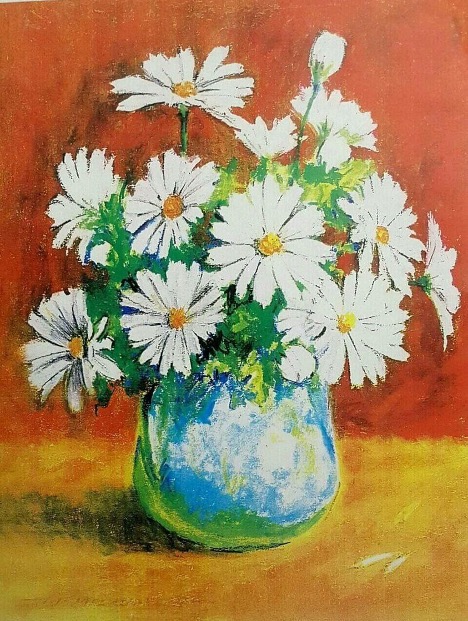
 For cubism and imperialism, on the other hand, I learned that the combination of colors make the picture. It needs lots of practice to recognize how to create art just by mixing the colors. Sometimes, when you look at the picture close by, you might not understand the power of the colors and the painting might look strange, but when you step back, and look at the picture from a little bit far distance, you feel how amazing the picture is. Like the following picture:
When I started my academic journey in writing, my experience of painting helped me a lot. To me, writing and painting follow the same processes. For example, I learned that like painting, I need to brainstorm and create a picture of what I am going to write about. I, moreover, was in the habit of making an outline for my writing. At first, I could not make my outline alone, so I asked for help from my writing teacher. I learned that for making my outline, I should know the genre as well as the context of my writing, and follow a specific technique based on that. These were all tasks I practiced before through my painting classes.

For example, I learned that for some tests like IELTS, I need to write my writing based on the types of questions, and depending upon the types of questions, my writing style should be different, my body paragraphs should be different, and more. For direct questions in IELTS writing tests, I need four paragraphs, whereas for argumentative questions for the IELTS test, I need to have five paragraphs. Gradually, I also learned how to write for class assignments, how to write an article, a book review, or a conference paper. Additionally, what has made my writing and painting experience similar was the process of receiving feedback from more experienced writers and painters, and having several drafts. I learned that to be a good writer, I need to revise my paper several times based on the feedback that I receive. I learned that feedbacks might be positive or negative, but both have been constructive for me so far.

Parallels between painting and writing:

In order to show you how good writing as well as a good painting will be created by being patient and  by practicing a lot, I will give you some examples through which I discuss and analyze one of my paintings as well as my writings from my first draft to the final one. During my drafts, I received feedback from my instructors and peer colleagues as well as fellow students.

Here is my first draft of painting in which I tried to paint some flowers in a vase:
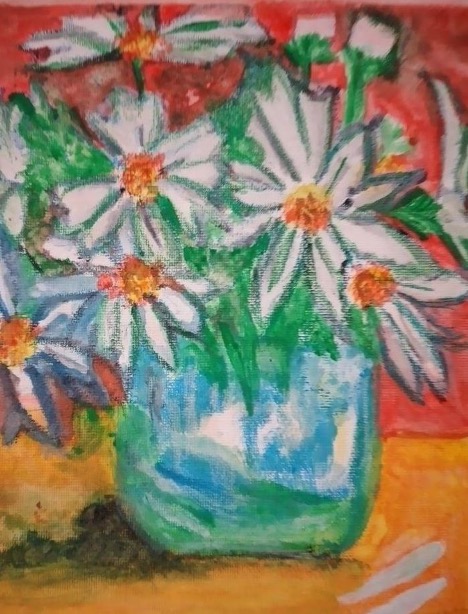
This draft made my painting teacher frustrated, and she wanted me to paint again. At first, I got frustrated and stopped painting for three weeks; however, I love painting, so I tried to listen to my teacher and go for my second draft:

In my second draft, the vase looks good, but the flowers were not still acceptable. This time, both my teacher and I wanted to see what my third draft would be like:
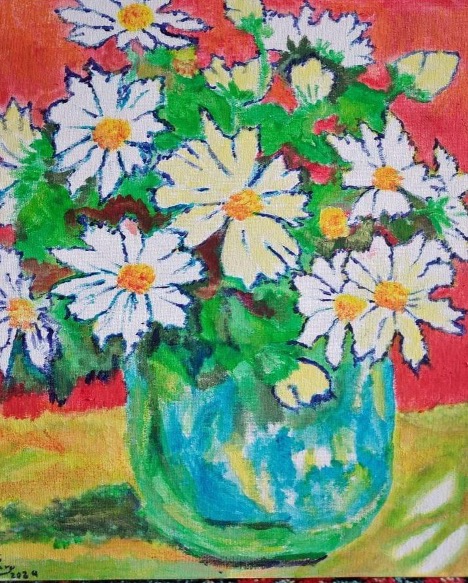
In my third draft, the flowers were seemed better, but the vase was not my favorite. I went for two more drafts as well . Although my teacher could see my progress, she encouraged me to practice more and more and trust time. I started painting the vase and flowers in January, and here is the result of my practice, and being patient and trusting time in March:

As you see, the final version looks much better.

The same also occurred for my writing assignment. I had to write a conference paper. It was about a proper type of feedback in writing in a translingual context. This process of drafting, getting feedback, and revising happened three times before I finally landed on an innovative approach, and I reckoned that I have been the first person to discuss the approach I wrote about in my paper.

As a result, these types of practicing, and having several drafts for my writing and revising my papers based on the feedback I received and my further studying not only helped me achieve an A in my course subject but also made me creative and helped me create something totally new and beneficial. The same is also true for my painting. In the following painting, my teacher only asked me to draw the banana, but I like birds, so I tried to be creative and paint it on top of the banana. I also love the flowers, so I tried to have them all in one picture:

Isn’t my painting interesting?

Conclusion:

In my opinion, and based on my experience as a writer and a painter, in order to be great artists and writers, we need to practice a lot. We should learn that we need to trust the process. We should start with brainstorming, continue with outlining, and then try to cover some drafts. Also, in order to become a good writer, we need to be self-confident and trust time, as my experience shows that if we gradually practice and not give up, we will improve. During our journey, we should not feel ourselves alone and take the role of receiving feedback a lot more seriously. In my opinion, great artists and writers are the ones that share their work with others and ask for feedback. This is why we have art exhibits.  This is why we have the Writing Center!

Come see us and share your writing as well as writing concerns with us! I’m sure you will enjoy your meeting with us and see your improvement in writing via the feedback you receive from us.

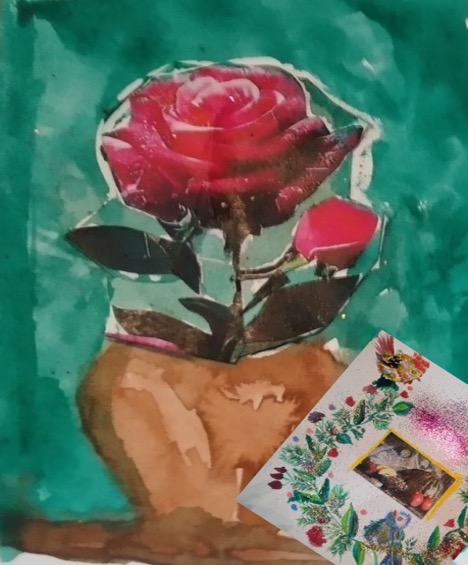
Enjoy some of my other paintings please:
A Sisyphean Task

Zoë Donovan, Writing Consultant

There is a quote from the Tenth Anniversary Edition of American Gods by Neil Gaiman in the introduction that at the time I first read it in 2016 seemed trivial, unimportant and just a bit pretentious.

“I remember when it [American Gods] was all done in first draft telling Gene Wolfe, who is the wisest writer I know and has written more excellent novels than any man I’ve met, that I thought I had now learned how to write a novel. Gene looked at me, and smiled kindly. “You never learn how to write a novel,” he told me. “You only learn to write the novel you’re on.”He was right. I’d learned to write the novel I was writing, and nothing more.” – Neil Gaiman American Gods (Tenth Anniversary Edition)

Since reading those words I have written an innumerable amount of novellas, short stories, poems, audio dramas, plays, and of course essays. Looking back, I’ve found that in every piece of writing, no matter how similar the subject material it may be to other previous works, this statement stands true.

                And yet, every time I finished a project I would find myself in the same line of thinking that Gaiman had at the end of the first draft. “I’ve finally figured out how to write!” And yet, every time I’d start a new project I would crumple into an agonizing state of imposter syndrome. Suddenly, it’s hard again and the words don’t fit right, the flow is off, my characters are stock image facsimiles of how I imagined, the page is blank, erased over and over again or scratched out ,and I can’t shut off the never ending rant telling me I’ve been deluding myself the entire time. I would find myself asking, how can I even consider myself a writer if it’s always this difficult for me.

                Since then, I have come to believe that it is a myth that someone can be a good writer or a bad writer. Throughout my experience I have found that Gaiman and Wolfe, in true fashion of their profession, stated something fundamental to the writing process. I only really grasped the weight of what this meant to me as a writer upon a reread of the book in 2020. We learn to write the things that we are working on. We learn to hone it into something that the intended audience will understand. No project will ever be the same, and you don’t ever really learn how to “Write”.

 Writing is a Sisyphean task. It is a grueling process that can at times be quite enjoyable, but at other times can feel like walking across broken glass. With the start of every new project, the boulder has rolled back down the hill and you find yourself cursing the writing gods for your own hubris. I say it’s a myth to be a good writer but a caveat is needed. The only thing that I believe separates a good writer and a bad writer is perseverance. Whether that perseverance looks like 100 words a day or 5,000 words a day, putting pen to paper is what matters, whether a project takes you ten hours or ten years, when it is finished you will have learned how to write that piece. No project will ever be the same as the last. You can bring in existing knowledge and skills, but at the end of the day you won’t know how to write that paper until you’ve already written it. 

                You will never know where to begin, where to end, and what exactly happens in between until you actually the piece. There will be tears, frustration and so much revision. But these stages help you, and you take something onto the next project that you didn’t know before, though as writers we are always growing, and it will never be exactly the same process.

Patience and Productivity: What I’ve Learned About Writing and Working During the Pandemic

Spenser Secrest, Writing Consultant

Everyone knows that writing is difficult. And writing, especially creative writing, has become quite difficult during the COVID-19 pandemic. Writing during the pandemic has posed several different challenges, and this still feels unusual to me. Every aspect of our lives has seemingly been interrupted or altered due to the outbreak of COVID-19, so why should writing be any different? For me, writing during the pandemic has become more difficult because there is no end in sight and every related action becomes increasingly polarized in the news each week. Writing is the last thing I can think about right now, and access to support networks is gone. While the pandemic has posed a unique challenge, it also offers us the opportunity to help us grow, hopefully both as writers and as people.

Although the act of writing is usually thought of as being done in solitude, which can, obviously, be done during the pandemic, this still feels as though certain aspects of the writing process are being left out. I have always viewed getting feedback as a vital part of writing – from friends, colleagues, and peers,for any piece of writing that I do, whether that is a piece of academic or creative writing.  While emails, texts and other forms of long distance communication have been beneficial, this is still not a substitute for discussions of the piece as a whole in person with someone whose thoughts and opinions I value. Even this very blog post, I intend to have someone proofread.

            The COVID-19 pandemic has affected other aspects of writing as well. It is now much more difficult to write with anyone and in any public space. Although these difficulties are the result of measurements taken for our safety, knowledge of this fact does not make these challenges any less difficult to work with. In fact, knowing that some people have openly violated such measurements has, for me, at times, made focusing on the prospect of writing all the more difficult. When thinking about how the pandemic has disrupted life and how long it has lasted, to see or hear of someone openly not care about precautions for one’s own safety, as well as the safety of those around them, can add another topic of distraction from any activity, including writing of any kind.

            Creative writing can also function as a therapeutic act. However, as the pandemic has continued, with no end in sight due to the U.S. government’s current administration’s lack of leadership on this issue, this raises the question as to what writing during the pandemic can accomplish, as the pandemic is still ongoing and all of the trials and tribulations will continue, even after one has finished writing something. If writing can be seen as a potential way to come to terms with something or to make sense of something, what can be accomplished when the circumstances keep changing due to the pandemic?Ideally, any act of creative writing would provide some form of catharsis, even if the difficult circumstances under which that writing was produced continue for the foreseeable future.

            Working as a Writing Center consultant for the first time, I have found that, despite any technological issues and doubts that the writers have had with their writings, they still desire feedback from the consultants. This has shown, to me, that all writers value feedback, even if this feedback is for assignments and academic writing. Something that I had not expected was that working with other writers, from a variety of different areas, and in different stages of drafting, has improved my own academic writing skills.  I’ve found that working with other writers can be beneficial to both the writer and the consultant. As a consultant works with a writer to improve their draft, so too does the consultant’s understanding of the strengths and weaknesses of writing.

            Finally, since I have been in graduate school, I have found patience to be the greatest asset to writing during the pandemic. Whether this be patience with technology working or patience in waiting for inspiration in writing, the pandemic has shown that patience is an incredibly valuable character trait to have during this time. The pandemic has led to us all making adaptations in our work and patience is a necessary component when learning something in an environment that is new to everyone. Additionally, developing more patience is something that would seem to be only to one’s benefit. Hopefully, everyone has developed more patience since the outbreak of COVID-19.

A Penny For Your Thoughts: The Real Value of Writing in a World That Prioritizes Capital

By: Chuck Glover, Writing Consultant

There is nothing capitalistic about the process of education for an individual. Education, of course, takes time, and time is money that could be well-spent. What is capitalistic is education’s outcome: the skills to participate as a cog in the machine that is society, and therefore attribute some monetary value to yourself and the economy. What happens between birth and that participation is simply preparation, to be completed as swiftly and mess-free as possible.

            These values — whether we like them or not — are internalized by writers. We write and rewrite until we find satisfaction, and maybe even eventually pride, only to look back on our work years later and feel embarrassed by it. We frustrate ourselves for not writing enough, or for writing too much of what we perceive to be garbage; we attempt over and over to emulate writers we want to (but can never) be. The problem lies in the fact that writing never stops being an education in and of itself. Writing relies on you being the best you are in the moment; and, because we are human beings who grow and learn and change, your best will vary day to day.  There is no equation to becoming the next Shakespeare. And, because writing also functions as an ongoing education, no writer will ever wake up and suddenly be the best they will ever be. (Even if they did, it’s not like they would know it.)

            Writing is so rarely about capital gain (if it is, it almost never starts that way). Yet, we continue to maintain capitalistic values when looking at our own. How many years has that novel been a work in progress? How long have you been struggling with that essay? How many times have you rewritten that poem? When we have not moved from Point A to Point B with efficiency, when we have not produced content we deem “good enough,” it is frustrating at best; a perceived waste of time at worst. Key word: perceived

            How do we change that perception? Well, the question we should really be asking ourselves is: why do we write? I write to feel joy. I write to inhabit new worlds. I write to feel heard, even if nobody else reads it. Maybe those aren’t the reasons you write; that’s okay, too. Whatever the reason, I think the key to engaging our students and ourselves in writing is to emphasize it as a process, not a product. Writing has inherent value because of the labor that was put into it — because of the voice that lies within it — because of the skills learned in its making. How exciting it is to see each new page as an opportunity to be better, as opposed to far more daunting steps to completion.

            We put so much pressure on ourselves to participate in our writing the same way we are pressured to participate in society: with blinders to the finish line. But, outside of the deadlines we face in academia and our careers, there is no real finish line to the writing process. You will never be Shakespeare. You will never wake up and suddenly be the best writer you will ever be. (Even if you do, you won’t know it.)

            So why, pray tell, do you write?

Writers & Consultants: Meeting in a Virtual World

By: Amber Yocum

Today marks the third week of the semester and so much of how we operate – as a university, as a writing center, as faculty, staff, students, and humans  –  has changed and continues to change as everyone adapts to different teaching and resource modalities.

This semester, along with many other university resources like REACH, the Career Center, and the Counseling Center, we decided to offer virtual appointments in order to keep you and our staff safe. Admittedly, it’s been difficult for us because seeing you as individuals and writers and getting to interact and collaborate with you in-person is one of the aspects of writing center culture we value so much.

Our goal this fall is to ensure that you, as writers and members of the university community, do not lose that connection. And to continue to assist you with your writing and writing processes in ways that reflect our consultants’ commitment to provide individualized feedback.

Whether you visit the Writing Center one time or multiple times over the course of your academic and professional careers, our consultants are here to learn about you as writers and people, as well as to help you with your writing. So much of their own academic and professional experiences, as well as interests, contribute to that process. As you navigate how to adjust to a more virtual environment, we hope that you take the time to get to know our consultants whose aims are the same as if we were meeting you in-person: to listen and to help you become a better writer.

Decker
Maddy Decker

Writing Tip: “Write with the mindset of telling a story, even if you’re working on something like a research paper. Finding the story you are telling is often an approachable way to work through your own thinking, and it can help you make sure that your reader will follow the argument and reasoning in your writing.”

Madelaine “Maddy’ Decker is interested in producing fiction as well as researching topics related to 18th century literature and African American literature. She earned her BA in English and Anthropology from the University of Kentucky. Her favorite book is The Thief Lord, and her outside interests include knitting, Irish archaeology, 2010’s pop punk, and the Muppets.

Writing Tip: “Try not to make unreasonable rules about what your process should look like or how long a piece of writing should take you to finish.”

Amanda Dolan

Amanda Dolan is a second year MA student whose research interests include memory, literature and other art forms, and the syncretization of myth. Prior to her return to academia, she worked in education research.

Glover
Shelbi “Chuck” Glover 

Writing Tip: “Just start writing. you can always improve it later, but if you spend all of your energy worrying that it will be bad, you’re cheating yourself.”

Chuck Glover completed her BA in English at the University of Louisville. Her academic interests include creative writing, screenwriting, and the study of feminist, socialist, and LGBT literature. Her favorite TV shows are King of the Hill and It’s Always Sunny in Philadelphia, and her favorite movies are Parasite and Gone Girl.

Hays
Ian Hays 

Ian views language as the practical analogue to conceptual expression, and, while working toward his degree, hopes to expand his understanding of the relationship between rhetoric and world view. His interests include low-fiction, creative non-fiction, and identity as defined in a media saturated age. Outside of university, Ian enjoys biking, hiking, and writing essays on contemporary culture; as well conversations with everyday people throughout whichever community he finds himself in.

Hutto
Andrew Hutto

Writing Tip: ‘Write every day. Even if it is just a few lines, the practice will pay dividends.”

Andrew received his BA in English from the University of Louisville. His critical research focuses on 17th-century British literature as well as René Girard’s theory of mimetic desire. Presently he serves on the Pine Row Press editorial board. His poetry appears in Thrush Poetry Journal, Cathexis Northwest Press, Math Magazine, Poet Lore, High-Shelf Press, Twyckenham Notes, and elsewhere.

Ismail
Ayaat Ismail

Writing Tip: “After getting the assignment and starting your writing process (whatever that might be) jot down all the thoughts you have forming in your head on to the paper. I say this because it is astonishing how many of those quick ideas will become improved concepts later in your paper.”

Ayaat received her BA in English from the University of Louisville. Her interests are in sociolinguistics and British Literature with a focus in feminism and social class. Her love of language was developed at a young age having been raised in a bilingual household. She is from Chicago, Illinois and loves watching baseball as an avid Cubs fan, and spends the rest of her free time reading and writing.

Litzenberg
Zoë Litzenberg

Writing Tip: “Your best friend in the writing process is time. There are a few exceptions, but in general more time you spend on a project (and the sooner you start it!), the less stressful it is to work on it and the better your work ends up. Sometimes I procrastinate because I don’t know where to start; that’s where talking with a friend or visiting the writing center to flesh out your ideas is a great use of time!”

Zoë, a San Diego native, is joining the Writing Center with a background in Humanities and Creative Writing. A true enthusiast for all facets of academia, Zoë loves how the writing process can empower and embolden any student of any discipline to be more effective in their field. Right now, her research interests include children’s literature, the pedagogy of leadership, the writing theory for the student-athlete. When not in the Writing Center, Zoë is probably working out, dancing, watching movies, laughing, or doing all of four at the same time.

Minnick-Tucker
Demetrius Minnick-Tucker

Demetrius hales from Atlanta, GA and received his undergraduate degree from Boyce College. He loves reading the literature classics and played college basketball. Friendships are really important to him. His favorite event in Louisville is attending summer-time Shakespeare in the Park plays. His favorite books are the Chronicles of Narnia by C. S. Lewis. His favorite line in poetry is from George Herbert: “Love Bade Me Welcome/ Yet guilty of dust and sin I drew back.”

Secrest
Spenser Secrest

Writing Tip: “Do not doubt yourself, as even the best writers need to edit and revise their works.”

 Spenser is from Lancaster, PA and received a BA in English with a history minor from McDaniel College in 2019. While at McDaniel, he served as an editor for both the college’s newspaper and literary magazine. His areas of interest include modernism, 20th Century American literature, and Marxism, with an emphasis on cultural hegemony. Outside of the classroom he enjoys reading, creative writing, hiking, and binge watching movies on Netflix.

Turner
Emma Turner 

Writing Tip: “Try to invest yourself in whatever you are writing about. Whether you love or hate the topic, find a way to connect to it so it’s more than just an assignment.”  

Emma received her BA in English and Women’s and Gender Studies from Lindsey Wilson College in May 2020. From 2018-2020, Emma served as a peer Writing Center Consultant in the Writing Center at her undergraduate institution and began to develop an ever-growing writing pedagogy. During this same time, Emma published several papers in undergraduate research journals on topics ranging from Greek literature, Wuthering Heights, “The Yellow Wallpaper,” and Dolly Parton. Her research interests have continually been a mixed bag; however, she always loves what she is studying.