Tag: education

International Mother Language Day 2024

Abigail Anderson, Writing Consultant

Last Wednesday, February 21st, the University Writing Center hosted our annual celebration of International Mother Language Day. Recognized by the United Nations, International Mother Language Day honors linguistic and cultural diversity around the world and highlights the importance of multilingual education. According to UNESCO, “globally 40 per cent of the population does not have access to an education in a language they speak or understand,” so the topic of language education becomes increasingly relevant to our modern world. As a result, the goal of our event was to celebrate the myriad languages spoken on campus and in our wider Louisville community, and to provide resources, activities, and opportunities to learn about one of the most vital cultural tools at our disposal: language.

In planning this event, one of our administrators, Kylee, and I were very lucky to work with a number of different organizations, programs, and community members. Our collaborators included Kentucky Refugee Ministries, Professor Ming Wu from the department of Classical and Modern Languages, Tzuhan Tung, Yuan Zhao, Professor Gerard Willinger from the Physics department, Professor Csaba Biro from the Mathematics department, and Omar Sadi Sarkar and the members of the Bangladeshi Student Association. We were so thankful to have these partners in this event, as well as help from my fellow consultants Jameson Reid, Jennings Collins, Jolie Finley, and Caden Holbrook.

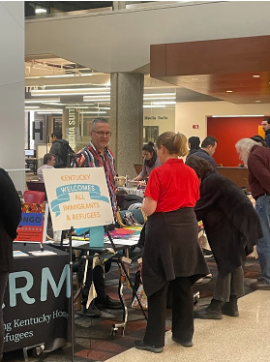
Held in the Learning Commons of the Ekstrom Library, this year’s International Mother Language Day celebration was a great success. Though the heightened visibility of being in a public space undeniably helped to attract passers-by to our tables, I credit so much of the event’s success to the dedication of the faculty, students, and organizations who collaborated with us. Because of the amazing materials, activities, and resources they brought to the table, as well as their own knowledge and enthusiasm, there was an infectious, inquisitive energy to the space that drew so many students and faculty in.

In addition to providing language resources, curious event-goers also had the opportunity to learn about the history of International Mother Language Day. As the Bangladeshi Student Association shared at their table, International Mother Language Day began as Language Martyrs Day in Bangladesh, formerly East Pakistan. This holiday commemorates protestors who were killed at the University of Dhaka on February 21, 1952 during ongoing political rallies against the Pakistani government’s decision to remove Bangla, one of the most common languages spoken in the region, as one of Pakistan’s national languages. First recognized by the UN in 1999 and celebrated as an international holiday since 2000, the origins of International Mother Language Day undoubtedly illustrate the importance of the right to speak one’s mother language and have that language be respected and valued in one’s community.

Indeed, throughout all of the other tables in this event, attendees could engage in authentic experiences of multilingual education or outreach, highlighting a sampling of our diverse community on campus and in the city of Louisville more broadly. Attendees had the opportunity to write letters or make cards for incoming refugees with Kentucky Refugee Ministries, and learn more about the work they do to help refugees in Louisville. They could also engage in activities curated by UofL faculty: learning to write Chinese characters, and sampling a selection of Hungarian books, art, and music. In the process of planning and hosting this event, it was heart-warming for me to see the excitement present in both our multilingual presenters and our event-goers, students, faculty, and community members alike, who showed an eagerness to learn, try new things, and engage authentically with others around them.
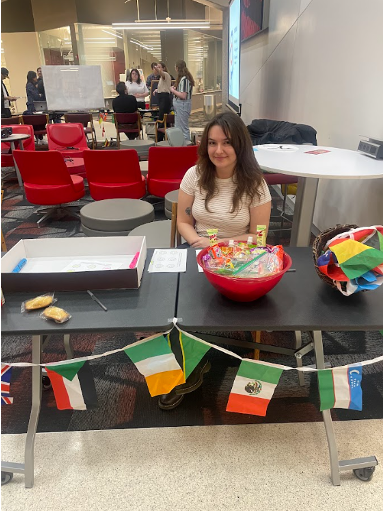
I personally worked at the table where attendees would ideally start their International Mother Language Day journey. As a starting place, I fielded the questions of, “What is all this?” or “What are you all doing?” or “Is this candy free to take?” With every inquisitive look from someone just passing through, I hoped they would stick around to see more of what we had to offer, and what our hosts had taken such care to prepare.

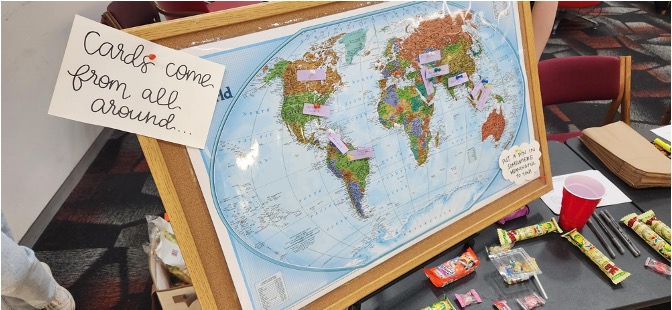
At my table also sat a bulletin board with a map of the world on it, onto which people could place a pin and note to indicate somewhere meaningful to them. Some students marked places they had traveled or studied abroad, while others marked their home countries. On the pieces of paper, many attendees also wrote small greetings or messages in their mother languages, which created beautiful moments of connection in the moments where people saw themselves or their language already represented on the map. The tactile and visual nature of this activity was meaningful for me as a host because it was a physical manifestation of how global UofL’s campus community truly is.
Understanding the importance of International Mother Language Day and seeing the impacts of multilingual education in action underscore the importance of prioritizing linguistic diversity in academic settings. Certainly, language is one of the most important tools we possess, and not simply in terms of communication; I sincerely hope that, for our attendees, this event invited them to think about language as a tool for conveying culture, traditions, and history in uniquely valuable ways. For me, it also emphasized the importance of valuing multilingualism in specifically our writing center practices. At the start of our event, I struck up a conversation with some students passing by. After I had described some of our offerings, one of the students told me, “I can’t stay because I have to run to class, but I really hope you all do this next year!” Though we may only host this event once a year, it is my hope that we can make the commitment to incorporating more multilingual elements into our pedagogies, to show that this appreciation for other languages and cultures is not simply a once-a-year occurrence.

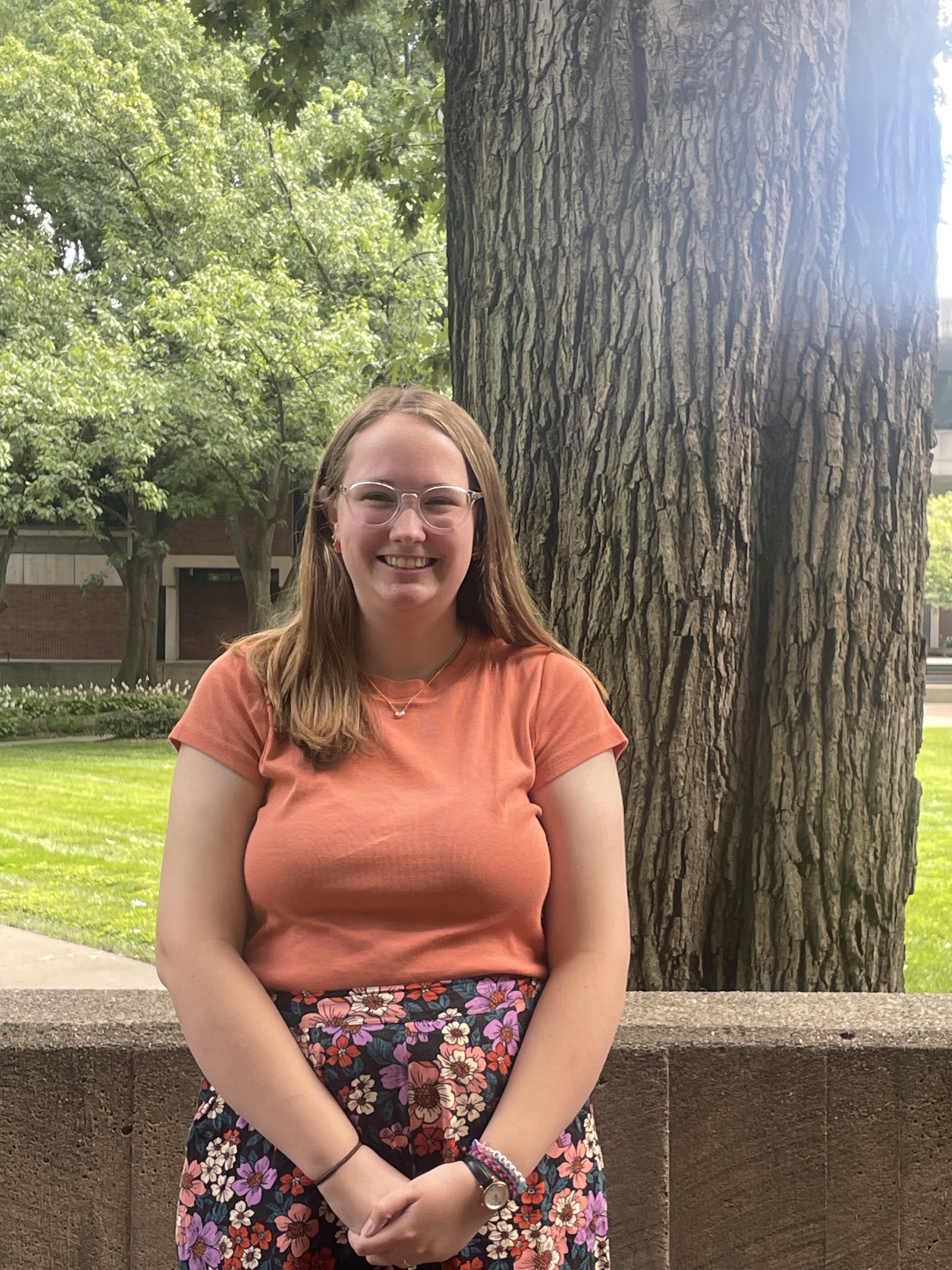
For Experienced Teachers, How is Teaching Different from Writing Center Consulting?

Jennings Collins and Abigail Anderson – Writing Consultants

Introduction

For those that aren’t aware, all Graduate Teaching Assistants undergo a multi-day training before each semester begins to prepare us for the new responsibility of teaching at the college level. Writing Center consultants go through a more specific orientation where we discuss our process, and the specifics of Writing Center pedagogy. We have a whole class about it, Writing Center Studies (ENGL 604), where we spend the whole semester asking important questions about pedagogy and the development of the Writing Center as a practice.

The unique perspective we both bring to this course, and to our work in the Writing Center overall, is our experiences working in the field of education, specifically early childhood education and secondary education. To borrow a common teacherly phrase, we have different tools in our toolbox than many of our peers, simply as a result of our work experiences and educational backgrounds. Learning how to be Writing Center consultants does not entail gaining the tools needed for the job, but rather learning how to use the tools we already have in a different setting. Alongside this period of adjustment, we also have to learn to balance our schoolwork as graduate students and the mental and emotional labor of our everyday jobs. Though our different backgrounds give us slightly different perspectives, we both try to be conscious, reflective, and constantly improving teachers, regardless of if our students are toddlers or undergraduates.

Reflections from a Middle & Upper Grade Educator (Jennings)

As consultants, we deal with a different workload and are in a different position in the web of university’s instructional design. We arrive somewhere in the middle as tutors. We do not get the opportunity to design the assignment any particular student is working on, or have the knowledge to bring the student towards the destination that someone in a teacher’s position would have designed. So in some scenarios, the consultant is in the awkward position of trying to deduce exactly what the writer’s instructor is asking for by parsing course directions and other course documents. We are still able to discuss writing skills and strategies in a manner that is beneficial to students across curriculum, which is a new angle for someone with an educational background.

The indirect university web also means we see students from a bevy of backgrounds, all with their own educational experiences which informs their own writing. Students have different levels of experience with things like MLA Style and academic research practices, things that we can interrogate during a session as part of getting to know a writer and what they need from a writing center session. One hour we are working with students who have just moved from high school to college working on a 500 word essay about their history with literacy, and the next hour we could be reading a 20 page study of the history of scientific literature around postpartum depression from a doctoral candidate.

I am much more comfortable with the former. In secondary education you are often the one shaping a person’s understanding of the English language as they enter adulthood. If a student is struggling, you have a whole year of lessons, lectures and assignments to reshape them to the best of your ability as an instructor. Often as a writing center consultant, we are asked to meet the writer where they are, and that comes with a new short-term approach to guidance. A student wanting to learn more about writing practices may do so at the Writing Center, but often our focus is directed towards the improvement of a piece, and not the student who wrote it.

Reflections from An Early Childhood Educator (Abigail)

Although my certification is in secondary education, and I student taught eighth graders for a semester during the pandemic, my work experience is mostly in the field of early childhood education. The majority of my childcare work was with two and three-year-olds, so the gap between my old students and my current clients might seem enormous. Certainly, working with young children requires a different form of emotional labor than working with other adults, but helping people is never an emotional-labor-free job. With my transition from teaching preschool to working with undergraduate and graduate students, I’m getting used to the shift in how much I have to do for someone else. My preschoolers required a lot of effort from me to help them manage their emotions, perform simple daily tasks, and grow into little, independent humans. My writers now need help gaining or refining an entirely different set of skills, though they might need just as much emotional support from me as a teacher or mentor in their writing process.

Indeed, my biggest takeaways from working with young children are that no two students learn exactly the same way and that progress is often non-linear. This term, I have seen many writers who come to the Writing Center for help, and sometimes feel discouraged or like they are “a bad writer” because of their past experiences with writing. In these sessions, I try to remind these writers that they are capable of developing their ideas and their skills, and that they have already begun that process by asking for help. It might take a variety of different strategies to learn what works for them, and that can be messy and difficult. However, I also try to emphasize that just because they have not achieved a goal yet, in their writing or in their personal lives, that does not mean they never will. This is a valuable lesson for learners of any age to remember, internalize, and carry with them throughout their education.

The main challenge of this work, for me, has been balancing when to “give people the answer” and when to step back and allow them to learn for themselves. And sometimes that means letting people make mistakes! Part of being an educator, regardless of the age of your students, means recognizing that you do not always have the answers and will not always do everything right. Again, in that way, working with adults is not so different from working with children; sometimes both need you to take a step back so they can learn to fly.

Conclusion

Teaching gave us a unique perspective on the way that the writing center operates, and the myriad of ways that students like us use campus resources. Our time as writing center consultants is a part of our educational journey, just as coming to the Writing Center is for any student. By next year we will be teaching courses as part of our graduate teaching assistantships, putting us at a different part of the institutional web than we are now. The biggest thing we hope to take from this experience is a nuanced perspective on the diversity that this university has in its student body, and how best to meet the needs of each student that comes to us as a part of their own journey.

Traveling Through Education

By Ben Poe, Writing Consultant

Returning to school terrified me. When I walked into my first undergraduate course at a local community college, I was certain I would fail, that I would not be able to act smart enough, or learn how to use the language of academia. Coming back to college was a lot like visiting a new location: it was similar to traveling to a new place, where I did not know the language, culture, and customs of the people. How does someone learn to live in a place they have never been before? By learning from their fellow travelers and the citizens who already reside there.

Education is not an individual experience, which judging by the number of times the first person “I” is used in the second sentence of this essay, is the way I perceived the endeavor when first returning to school. American academics, and American culture more generally, values individual effort and self-reliance. However, individuality only exists in relation to its difference from community: there is no “I” that exists without relation to the “we.” Thus, traveling through education means learning from your fellow passengers: it entails learning from the students who are traversing the new landscape with you. The relationships I built with my peers during my undergraduate journey—and now during my graduate travels—were possibly more important than much of the “education” I received from my classes. Indeed, lectures were important, but the real learning happened during conversations with others: a traveler can only read so many tourist pamphlets before asking someone what they know about the area. By creating study groups and book clubs with my classmates, my fellow travelers and I created communities that shared knowledge and put ideas into practice. It is these interactions, when I can articulate my thoughts in dialogue with other people, where I learn the most. Talking with fellow students, creating a dialogue between associate travelers, allows ideas and knowledge to collide into new forms of perception.

When arriving in a new location, the citizens who already reside there are the most knowledgeable of the culture. Building relationships with professors, tutors, and academic staff like librarians, not only made my travels through college easier, but showed me the “secret” venues that characterize the local experience: actively participating in the academic culture, instead of passively taking the necessary courses and exams—which resemble the cheesy tourist attractions in the travel analogy I am using—gave me a broader experience of college and the citizens (literally) living in it. During my journey at the local community college, I started visiting my favorite instructor’s office every chance I could. My relationship with my professor taught me the value of building academic relationships with faculty because our meetings introduced me to unique opportunities and made me feel like I was part of the campus community. Visiting with a tutor or meeting an instructor during their office hours, even only one time, can reshape intellectual interests and motivate new curiosities. Therefore, getting to know the colleges inhabitants, learning from who they are and not only what they know, makes the traveling expenses worth their value because the relationships create supportive, critical, and creative communities that will benefit any student in their travels that follow.

We hope that you will visit the University Writing Center and take away a souvenir that will last a lifetime.

A Penny For Your Thoughts: The Real Value of Writing in a World That Prioritizes Capital

By: Chuck Glover, Writing Consultant

There is nothing capitalistic about the process of education for an individual. Education, of course, takes time, and time is money that could be well-spent. What is capitalistic is education’s outcome: the skills to participate as a cog in the machine that is society, and therefore attribute some monetary value to yourself and the economy. What happens between birth and that participation is simply preparation, to be completed as swiftly and mess-free as possible.

            These values — whether we like them or not — are internalized by writers. We write and rewrite until we find satisfaction, and maybe even eventually pride, only to look back on our work years later and feel embarrassed by it. We frustrate ourselves for not writing enough, or for writing too much of what we perceive to be garbage; we attempt over and over to emulate writers we want to (but can never) be. The problem lies in the fact that writing never stops being an education in and of itself. Writing relies on you being the best you are in the moment; and, because we are human beings who grow and learn and change, your best will vary day to day.  There is no equation to becoming the next Shakespeare. And, because writing also functions as an ongoing education, no writer will ever wake up and suddenly be the best they will ever be. (Even if they did, it’s not like they would know it.)

            Writing is so rarely about capital gain (if it is, it almost never starts that way). Yet, we continue to maintain capitalistic values when looking at our own. How many years has that novel been a work in progress? How long have you been struggling with that essay? How many times have you rewritten that poem? When we have not moved from Point A to Point B with efficiency, when we have not produced content we deem “good enough,” it is frustrating at best; a perceived waste of time at worst. Key word: perceived

            How do we change that perception? Well, the question we should really be asking ourselves is: why do we write? I write to feel joy. I write to inhabit new worlds. I write to feel heard, even if nobody else reads it. Maybe those aren’t the reasons you write; that’s okay, too. Whatever the reason, I think the key to engaging our students and ourselves in writing is to emphasize it as a process, not a product. Writing has inherent value because of the labor that was put into it — because of the voice that lies within it — because of the skills learned in its making. How exciting it is to see each new page as an opportunity to be better, as opposed to far more daunting steps to completion.

            We put so much pressure on ourselves to participate in our writing the same way we are pressured to participate in society: with blinders to the finish line. But, outside of the deadlines we face in academia and our careers, there is no real finish line to the writing process. You will never be Shakespeare. You will never wake up and suddenly be the best writer you will ever be. (Even if you do, you won’t know it.)

            So why, pray tell, do you write?