
Bronwyn T. Williams, Director
All the signs point to the fact that the academic year is coming to a close. Writers are focused on finishing their final papers, faculty are focused on finishing their grading, even the puppies have returned to the Library to help people reduce their stress. Yet, even as everyone pushes to complete the final tasks of the semester, it’s important to take a moment to mark the accomplishments and events that took place in the University Writing Center during past year.
Our central accomplishment of the past year is the one that is simultaneously the most common, but one that is never routine or taken for granted. Once again our consultants have worked, in individual appointments, with more than 5,000 students, faculty, and
staff on writing projects ranging from literacy narratives to lab reports to dissertations to scholarship applications. Hour after hour, day after day, they have worked collaboratively with writers to help them with their concerns about the drafts in front of them, but also to help them become stronger, flexible, and more confident writers. The positive and productive work that takes place here, and the transformative effect it can have on writers, comes from the thoughtful and dedicated work of our staff. Yet I also want to thank all the writers who trusted us with their work and all the faculty who supported our work by recommending us to their students.
In addition to our ongoing work with writers at UofL, however, we also work to create and sustain a culture of writing on campus and in the community. Here are a few examples of what we done in the past year toward that goal.
Workshops, Writing Groups, and Dissertation Writing Retreats: We have reached more than 750 students at UofL through workshops about writing that took place both in and out of classroom settings. Our popular Creative Writing, LGBTQ+ and Faculty and Graduate Student Writing Groups continued to provide safe, supportive, and productive spaces for UofL writers. Also, in addition to our annual spring Dissertation Writing Retreat in May, we held our first Dissertation Writing Mini-Retreat in January. We will be continuing all of these groups and workshops, so be sure to check our our website for information and dates.
Writing Events: New writing-focused events this year included a faculty roundtable discussion about “Engaging Diverse Voices in Writing and Reading,” an open-mic night
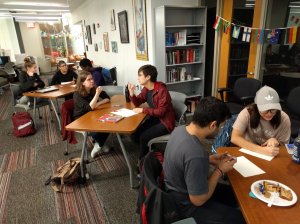
for the Miracle Monocle Literary Magazine, and a reading in the Axton Creative Writing Reading Series. At the same time we once again held our Halloween Scary Stories Open Mic Night, participated in the Celebration of Student Writing and Kick Back in the Stacks, and celebrated International Mother Language Day.
Video Workshops on APA, MLA, and Using Sources Effectively: We revised our video workshops on APA and MLA Citation Styles and on Using Sources Effectively and avoiding plagiarism. These are available on the University Writing Center YouTube page and join our other extensive online resources of Handouts and Writing FAQs.
Writing Center Blog and Social Media: Our blog not only brought ideas about writing and writing center work to the UofL community, but also connected to writers, teachers, and tutors around the country, and our presence on Twitter, Facebook, and Instagram continued to grow and connect with writers and writing scholars.
Community Writing: As we have written about several times on the blog this year, our community work with Family Scholar House and the Western Branch of the Louisville
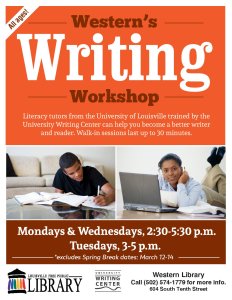
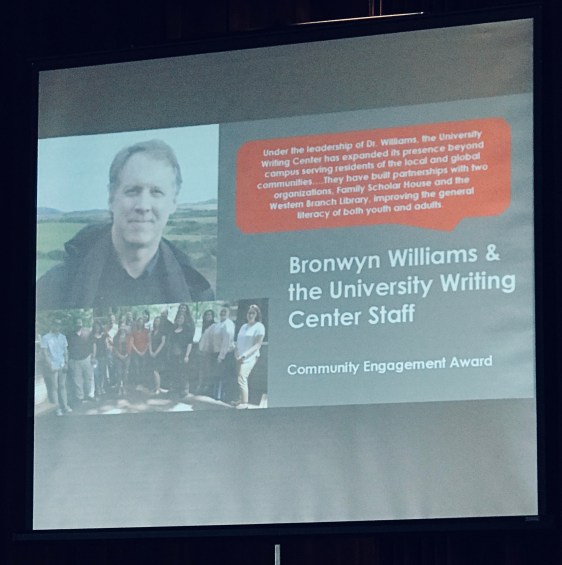
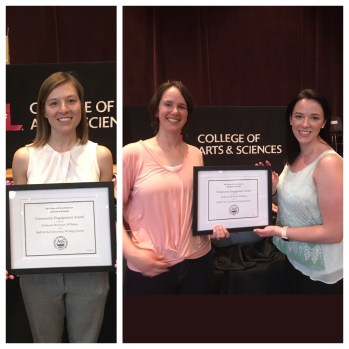
Free Public Library continues to grow and evolved through a collaborative and participatory partnership involving these organizations, UofL students and faculty, and the University Writing Center staff. This work was recognized recently with the College of Arts and Sciences Community Service Award.
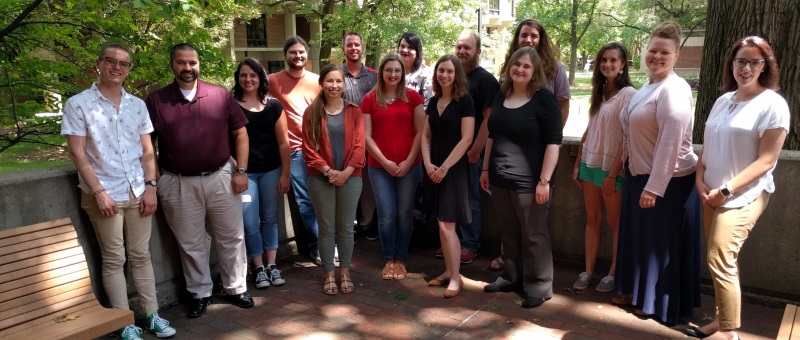
Thanks to the Best Writing Center Staff around: These accomplishments are the result of the tireless, creative, and thoughtful work of the staff of the University Writing Center. It is their inspired work that allows us to support UofL writers and create a culture of writing on campus and off. They also make this a fun place to work. Thanks go to Associate Director Cassandra Book, Assistant Directors, Layne Gordon, Jessica Newman, Christopher Stuck, and Caitlin Ray; consultants Brent Coughenour, Emily Cousins, Nicole Dugan, Reid Elsea, Taryn Hall, Beau Kilpatrick, Rachel Knowles, Isaac Marvel, Mitzi Phelan, Tim Phelps, Keaton Price, and Mary-Kate Smith, and student workers Brianna McIntyre, Jency Trejo, and Dhyani Vashi.
Farewell: Finally, we are marking the retirement this year of Robin Blackett from her job running the front desk – and so much more – of the University Writing Center. For more than 12 years Robin has not only been the first person everyone meets when they come to an appointment, but she has personified the ethos of care and attention to student needs that we value here. Robin has greeted writers with warmth and professionalism, reassuring people who were often feeling upset and anxious, that they would be able get support for their writing at the University Writing Center. Robin has been integral to our success and growth over the years and, though we wish her well in new adventures, we will miss her dearly.
We will be open during the summer, starting May 7, from 9-4 every weekday. Meanwhile, take a look at our website and we hope to see you soon.
Writing Center Staff Achievements
The University Writing Center is also an active site of scholarship about the teaching of writing. Staff from the Writing Center were engaged in a number of scholarly projects during the past year in rhetoric and composition, literature, and creative writing.
Cassandra Book, Associate Director of the University Writing Center, presented at the Southeastern Writing Center Association Conference (SWCA) and SWCA also awarded her the Gary Olsen Travel Award Scholarship. She also presented at the Conference on College Composition and Communication. She also successfully defended her dissertation prospectus.
Layne Gordon, Assistant Director for the University Writing Center, presented at the National Women’s Studies Association Conference. She also successfully defended her dissertation prospectus.
Jessica Newman, Assistant Director for the University Writing Center, presented at the national Conference on Community Writing. She also had a piece, titled “Mariella,” published in the Miracle Monocle and won the Miracle Monocle Award for “Ambitious Student Writing.” She also successfully defended her dissertation prospectus.
Caitlin Ray, Assistant Director for Graduate Student Writing, published the article “On Your Feet!”: Addressing Ableism in Theatre of the Oppressed Facilitation.” in the Pedagogy and Theatre of the Oppressed Journal. She also presented at the 2017 Medical Rhetoric Symposium, the Conference on College Composition and Communication, the Chicago Disability Studies Conference, and the Rhetorical Society of America Conference. She was also selected to be a Rare Disease Legislative Advocate and attended events in Washington, D.C. during the National Institute of Health during Rare Disease Week. She also successfully defended her dissertation prospectus.
Brent Coughenour had stories accepted for publication in The White Squirrel and the anthology Kentucky’s Emerging Writers. He also served as a graduate student intern for the Miracle Monocle literary magazine and began a creative writing podcast with fellow consultant Nicole Dugan. He will be the Assistant Director for the Creative Writing program next year as well as an English Graduate Organization Peer Mentor Coordinator.
Nicole Dugan served as a graduate student intern for the The Miracle Monocle literary magazine and began a creative writing podcast with fellow consultant Brent Coughenour. She will be an English Graduate Organization Peer Mentor Coordinator next year.
Reid Elsea presented at the Louisville Conference on Literature and Culture. Next year he will be the Morton Endowed Chair Research Assistant and the co-president of the English Graduate Organization.
Taryn Hall was accepted to present at the national Popular Culture Association/American Culture Association Conference and will be an English Graduate Organization Peer Mentor Coordinator next year.
Beau Kilpatrick will be an English Graduate Organization Peer Mentor Coordinator next year.
Rachel Knowles will be a co-president of the English Graduate Organization next year.
Mitzi Phelan completed her MA with her Culminating Project, “The Beloved Black Body: Investigating Toni Morrison’s use of Biblical Rhetoric to Rewrite Christianity on the Black Body.”
Tim Phelps was awarded the Department of English Scholarship Award for Excellence in Creative Writing, and the Sara-Jean McDowell Award for Excellence in Fiction.
Keaton Price completed her MA with her Culminating Project, “Disguised Language in John Milton’s Paradise Lost“.
 considered the gravity of its meaning. Oxford Dictionaries’ 2016 word of the year, post-truth refers generally to the idea that facts have become less significant in the public opinion—and in policy making—than political appeals to emotion (Wang). It’s a pretty postmodern idea, right?
  suggestions about organization or revision or grammar and usage. Yet we also believe that writing well involves more than just mastering a set of skills. The writing processes we use, as well as how confident and motivated we feel to work on a piece of writing, can be crucial to how successfully any writer navigates new writing challenges.
 Practices and Perceptions of Agency: Composing Identities
 naturally feature their tumultuous love lives and frequent brushes with death.
 scheduling. Somehow, this is the last week of October. I have a 12 page conference paper and presentation due Wednesday night. The good news: I have a stack of superb scholarly journals related to my subject matter. I also have a stack of 8 books checked out from the library that will lend a wealth of intellect to the research I am working on. The bad news: I have only read one of the journals and none of the books. So somehow I am going to need to synthesize all of that material into that conference paper in a very short amount of time. This is only one of the three papers that I need to make serious progress on before this semester ends in a few short weeks. So, am I mentally engaged in this class right now? No. I’m not. Do I want to be? Yes, absolutely. The information being discussed is vital to my chosen field. Also, college is expensive. It is costing me not only financially but time-wise as well. I miss evenings of going home and just hanging out with my family without a pending assignment looming over me. It is frustrating at times to find myself and my life dictated by due dates and deadlines. So what, you may ask, does this have to do with you? If you have never had an experience like the one described or felt the pressure of college closing in, then nothing. If you have, then everything.
 door, his eyes set on her. She turned and met his gaze before I did, and I felt the car shake when she jumped. Brianna yelped, and I looked over just as the man bent down to get a closer look into the car. He was bearded—a misshapen and half-shaved beard, but a beard nonetheless—and wore a dark pair of coveralls like some sort of blue collar worker would. He spoke to us—at us—but we couldn’t hear what he was saying; it almost looked like he were lip-syncing the Prince song, which was still playing as I had been too shocked to turn it off: “maybe I’m just like my father, too bold.”
 because I have a deadline to meet. However, when I begin a project with plenty of time to brainstorm, outline, draft, and revise, I often find it more difficult to start. I think this is a common problem that leads many of us to wait until the last minute to put pen to paper (fingers to keyboard). As Tim pointed out in his
  brain likes to periodically revisit this moment. This seems to be the sort of mental dwelling most of us do, and we are usually trying to escape that memory rather than relive it a hundred times. Embarrassing memories from 7th grade are not the most pleasant places to dwell, and we don’t think of them as useful. However, dwelling can be productive if placed in the right context.
 arrive; however, when it did finally make it to my house, I would excitedly tear open the parcel and eagerly scan all of the pages for my homeroom details. The wait was over, and I could stop stalking the mailman.
 University of Louisville Writing Center