Category: Process

5 Tips for Productivity: The Secret to Success

Arielle Ulrich, Consultant

DSCN1639Now that we’re nearly a month into the semester, you’re hopefully starting to get the hang of your classes. You’ve gone to a few classes, you’ve turned in some assignments, and you’ve probably just taken your first exam or written your first paper. This is the point in the semester where I typically lose steam because, after all, the end of the semester seems so far away. It’s not until later in the semester, when I’m struggling to write three papers at the same time, that I realize how much time I wasted at the beginning of the semester and wish I could go back in time and slap myself.

However, instead of starting to work on that time machine, I recommend something a little more practical (and doable): invest some thought into raising your productivity level. As a graduate student, I can’t emphasize enough the importance of utilizing your time in an efficient way. If you’re struggling to get all your school work done, it’s not enough to simply work harder, you also need to work smarter. Hence, I’ve put together some tips that should get you started and hopefully serve you well throughout the semester as you plan for success.

  1. Be honest with how you’re spending your time. Take a few days to track how you spend every hour of the day. By finding these gaps in your day and filling them instead with productive activities, you’ll get more done in the day without changing anything else in your schedule. I recommend using this sheet to track your time throughout the day:  http://getbuttonedup.com/tools2/free_printable_time_management_sheet_template.pdf
  2. To-do lists are a must. However, sometimes to-do lists can be easy to ignore if you add too many tasks onto it. I recommend a to-do list that separates your tasks into quadrants based on importance or necessity. Throughout the day, you work through the quadrants, starting with tasks that are urgent and important, and eventually move down to tasks that are neither. Using this method, you are sure to complete the most important tasks of your day without wasting time on busywork.tumblr_mz6f66jtzF1qdjs4ao1_500
  3. Use a scheduling tool like Google Calendar to remind yourself of exams, due dates, and meetings. By adding these events to your phone immediately, you’ll be able to schedule reminders so that you’re sure to remember the important deadlines for the semester.
  4. Don’t forget to take breaks! I often try to work for 30-60 minutes at a time, and then I take a 10 minute break to let the information settle in. Breaks not only give your brain a chance to rest, but they also increase productivity by ensuring that you don’t overwork yourself. If you don’t have a timer, you can use software to remind yourself to take breaks. Try a website like http://www.pomodoro.me/ that can give you desktop notifications.
  5. Lastly, seek help when necessary. If doing your homework takes hours and you’re still failing, seek out a tutor who will be able to give you study tips. REACH offers a range of tutoring opportunities as well as workshops on other college survival techniques. If you never seem to be able to start a paper, schedule a Writing Center appointment for brainstorming tips or to go over a draft. Never forget to ask other people how they stay productive!

I hope you find these tips helpful as you go into the rest of the semester. Happy writing!

Five Tips for Writing a Killer Personal Statement

Megen Boyett, Consultant

DSCN1655More than any other month, January seems to be the time to write personal statements. You’re thinking about summer internships, fall graduate programs, and real world jobs, and application deadlines are just around the corner. You don’t want to brag, but you do want to stand out from the crowd. You want to showcase how hard you work, but you aren’t quite sure what committees look for. You have so much to say, but only 1000 words to say it in!

Sound familiar? You’re in good company. Plenty of other students are expressing the same concerns every week in the writing center. Here are five tips for writing an interesting, clear personal statement in 1000 words or less!

1. Don’t take it personally; it’s just business.

“Personal” is really the wrong word for this kind of writing. Acceptance committees want to know about your interest in the program or position you’re applying for as well as any experience you already have. Thus, you want to leave out childhood anecdotes, high school jobs, or stories about overcoming fears. Those say a lot about your work ethic, passion and character, but they don’t necessarily explain why you’re a good fit for your chosen profession or program.  Instead, think about your experiences in or related to the field that you’re hoping to get a position in. What interesting experiences have you already had working or volunteering in this field? Focus on one or two significant experiences that have shaped your views of the field or helped develop a particular interest. Instances that exemplify your interests or strengths in the field help a committee see who you are as a potential employee or program member.

2. Talk about your plan.

Where do you see yourself in a year? Five years? Ten? How will this position or program help you reach those goals? You don’t have to have all the details figured out yet, and you can certainly change directions later, but being able to clearly articulate what you want from the program or position will help an acceptance committee know what you hope to get from the program as well as what interests and skills you’re bringing in with you. This kind of detailed, practical planning may also help you think about why you want to be part of the program or company you’re applying for.

3. Do your research.

What do you know about the program or position you’re applying for? What do they value or put emphasis on? How do your goals or values fit with that of the company or school? Again, this will help you narrow your focus and think critically about your plans for the future. Talking about your values or goals in a way that reflects those of the program also show that you care enough about the job to do your homework and that your interests are in line with what the program or company see as their own goals. You might also talk about specific professors or researchers you want to work with. A personal statement is a good time to mention how your interests intersect with theirs. If you’ve been able to work with them already, you might mention that work as particularly influential or shaping.

4. Don’t think of it as bragging.

Obviously you have a lot to learn still about the field you’re going into. Obviously you want to appear humble and eager to learn. Instead of thinking of a personal statement as bragging, think of it as telling a potential employer or program director what you have to offer the team you’d be joining. What needs might you fulfill within the program? What has your unique background and set of experiences prepared you for? What research are you interested in or already working on? When you couple this with discussion of your goals and what you hope to learn from the program, a committee can start to visualize your place within their program or team.

5. Put it away and come back later.

Once you’ve finished drafting and you think you’ve got a pretty solid personal statement, close the document. If you have time, take a day or two before you go back to it. Then, read it aloud, looking for typos. You might print it out and mark changes you want to make in pen if you’re having trouble focusing on a computer screen. Looking at your writing in a different environment can help you catch typos or think about your word choice in a new way.

Of course, we at the writing center will be happy to help at any stage of the process, from brainstorming to drafting to helping you revise before you send it off. Make an appointment to bring by your personal statement. Having someone to talk about your writing with not only relieves some stress, it’s also pretty fun.

Happy Writing! And if you need more tips before you come see us, check out our earlier post!

5 Strategies for Picking a Paper Topic

Alex Clifton, Consultant

It’s never too early in the semester to start thinking about paper topics. Trust me, it’s much easier to write your essays in March or April when you’ve already thought about and researched a topic over the course of weeks, rather than deciding to write about something three days before it’s due. I’ve done the latter, and it’s produced some sleepless nights and shoddy writing—something you definitely want to avoid! However, it can be difficult to determine what exactly you want to write about. The following strategies will, hopefully, jumpstart some thought and give you ideas for any classes you’re struggling in!

Make a list. If you look over the syllabus of a course and realize that nothing quite “speaks” to you immediately, make a list of subject areas you know you’re interested in. Are you into feminist theory? Do you enjoy researching murders in South America? Are you more interested in the political or economic aspects of the Russian Revolution? These questions sound silly, but if you think about things you’re interested in, a paper topic might spark from that. I once took a course on the Civil War and did not find myself enamoured with the books on the syllabus. However, I knew I liked writing about gender and children’s literature, and ended up writing a fun paper on children’s stories during the Civil War! Reminding yourself what your interests are will also help you come up with a topic that you will be far more invested in—which will make your final paper a lot more fun to write.

Preliminary research. It might sound boring, but typing in keywords into the library’s database (WorldCat, located here) can provide a wealth of information and ideas. Not only is it a good way to find scholarly and reliable sources, but those books can also give you an idea of the scholarship out there! WorldCat has a really handy feature where you can click on a book and it will tell you the chapter/essay titles within the book. If you’re trying to do a paper on Arctic exploration, you might end up finding an essay on John Rae, a Scottish doctor who discovered the grisly fate of the doomed Franklin expedition from 1848, that focuses on his skills with snowshoeing, which might spark some interest in nineteenth-century Inuit methods of snow travel. Yeah, it’s an extreme example, but WorldCat is such a great resource and you don’t even need to have a defined paper topic to use it!

Talk it out. If you’re really struggling to come up with a paper topic, it might help to brainstorm verbally with some friends. If you talk to a friend or two from your course, you might discover new ways of looking at the subject material that may trigger some interest. Maybe one of your friends is writing on Bosnian familial structures, and somehow their own thoughts inspire you to look up Bosnian recipes for a paper in a course on Bosnian culture. Sometimes, it also helps to talk to a friend from outside your course, as they may act as an impartial observer to your thoughts and can ask probing questions. If you don’t want to ask your friends for help, try talking to your professor. I have yet to have a professor at UofL who has been totally unwilling to help students, especially when it’s clear that the student is making an effort. (If you’re asking for help about brainstorming a paper topic way before it’s due, that shows you’re making an effort!) Some professors may seem scary and unapproachable in class, but I’ve found that they are less likely to bite during office hours. Your professor might also be able to look at your academic interests and help guide you towards a topic that they deem suitable and you’ll find interesting, a win-win for all!

Freewrite. Yeah, nobody wants to think about writing when they’re working on finding a topic to write on. It’s a dirty secret of research that you’re going to have to do a lot more writing than you ever planned on in order to come up with that glorious final paper. It sometimes helps to just write down things you’ve considered researching and listing ways you could flesh out each topic. Sometimes, seeing your own ideas out on paper can help make paper topics more concrete, rather than just thinking about what you might write about—it makes your ideas far more concrete, and puts you down the road for academic success!

DSCN1650Come in to the writing center. Last, but not least, if you’re really struggling with starting on a paper, come in to the writing center and talk to one of our consultants. Everyone has different strategies for working on papers, and they’ll be able to give you some useful tips. Talking to someone who works with writing might be beneficial in ways that talking to your friends aren’t: if you can talk to one of our tutors about your writing style and methods, then they might be able to find a way to help you figure out how to pick and start working on a paper topic.

I hope some of these tips help you find whatever it is you want to write about this semester! And, as always, feel free to stop by the Writing Center with whatever you’ve got of your paper. Whether it’s just ideas floating up in your head or a full-on draft, we’ll help you work with it. Happy brainstorming!

On Early Writing Advice

Jessica Winck, Assistant Director

This week’s feature was adapted from an earlier post on Jessica’s blog Daily Inventions, which focuses on writing, teaching, and the teaching of writing.

DSCN1660As I work on finishing my M.A. project, I’ve been thinking about how my views on writing were shaped when I was younger. After studying rhetoric and writing for the past two years, I’ve become more conscious of how some of my own views, behaviors, and habits suggest something I learned early on that stayed with me. In other words, I’ll become aware of something I’m doing, and I’ll say (sometimes out loud), “Where did that come from?”

Throughout my teens I saw myself as a fiction writer, and the writing of fiction was Writing to me – so people who wrote it were Writers. I got a sense of this in so many of the books about fiction writing that I read. There was a sense in these books – this discourse – that good writers have a gift. Certainly they work hard, but they have an indefinable quality, so at best, advice about writing for people who don’t have this gift can only help them artificially replicate what gifted writers possess naturally.

Now I see this as a flawed assumption, but I bought into it when I was younger. When I was 20 or 21 I showed a short story to a guy I worked with who also wrote fiction. His initial response was, “Well, you can write!” On one hand, that’s just stating the obvious. On the other hand, that’s not what he was talking about at all. He meant I had some kind of ability beyond competence.

There were consequences for this kind of view of writing and writers. Though my undergrad curriculum consisted of several creative writing workshops, collaboration wasn’t a major priority – in fact it was discouraged because it was seen as a distraction. Someone once told me that writers who work at coffee shops or with others just want distractions because they aren’t committed to their craft. Real writers toil alone, if not for concentration’s sake, then because their gift for writing – all that genius – leads to bad social skills or neuroses. The Writer/Suffering Genius was a persona more than anything else, and my peers and I all desperately ached toward it.

peter elbowClearly I disagreed with these “truths” to some extent, otherwise I wouldn’t have been so frustrated by their limitations at the time. But they weren’t my only influences. When I was in high school, I read two important writers: Peter Elbow and Natalie Goldberg. Something distinguished them from the other people I read during that time and later in undergrad: they didn’t tolerate the view of “Writing” that I’ve elaborated here. For them, improving as writers is first a matter of writing more and being more methodical about how you use your writing time (ie., scheduled or timed writing). Though I read Elbow and Goldberg early on, they stayed on my shelf all through undergrad as I worked through developing an identity as a writer. I thought that improving as a writer couldn’t possibly be a matter of persistence, which is available to everyone.

As I work on my Master’s project now, I’m realizing in really profound ways that at a fundamental level, apart from other factors and forces that bear down on me in this process, that I will finish my project in a reasonable amount of time if I just persist methodically. This isn’t to say that challenges won’t come up, or that I won’t ever feel like it’s hopeless, but it’s to say that there is plenty of evidence that says I should have faith in this process.

There are also benefits for teachers and writing consultants to examine early influences on our views of writing. This is a view of writing that leads us to assume that everyone can write, as Peter Elbow suggests, and that doing well and “being successful,” however defined, is a matter of persisting, not of innate talents or gifts.

The Thesaurus: Your Composition Companion

Carly Johnson, Consultant

carlyA thesaurus always struck me as nothing more than a large, impressive book to place on your shelf and never open…until I turned in my first paper in English Composition 101 my Freshman year of college. My work was riddled with comments written in bold, red pen that stated things like: “repetitive,” “word choice?” and “is this what you meant to say here?” As I examined my paper more closely, I began to realize that my professor was absolutely correct, I was being repetitive—in fact, in the span of four pages, I typed the word “said” roughly fifteen times. In addition, I used the adjectives “nice” and “very” to describe any and all nouns within my paper. “What other words could I have used other than ‘said,’ ‘nice,’ and ‘very’?” I thought to myself. Then, I glanced over at the book I had ignored for so long: the thesaurus.

Many clients come to the writing center with comments from their instructors that convey many of the same messages I mentioned above. Students often become discouraged after reading these critiques, but I’ll let you in on a secret- no one, no matter how talented of a writer they are, knows exactly the right word to use 100% of the time—honestly, probably not even 50% of the time. I urge every writer to use the thesaurus as part of their editing process, and I encourage them to begin by asking themselves questions such as, “Have I used this adjective already?” or  “Does this word convey my tone in the most effective way?” The thesaurus provides an opportunity for a writer to put their best vocabulary forward, and create the most polished final draft possible.

The only negative aspect of using a thesaurus is the sheer number of options it provides for you. I’ve seen students fall into the trap of selecting a word they are not familiar with in an effort to give their paper more variety. If you select a word from the thesaurus that is unfamiliar to you, you run the risk of placing that word in an incorrect context within your sentence. Make sure that, when you use a thesaurus, you are familiar with both the meaning of the word and its connotation. If you are unfamiliar with the word, but desperately wish to use it because it just sounds too perfect, like the word ‘bombastic,’ make sure that the word matches the tone of the rest of your essay. For example, I think the word ‘bombastic’ sounds like it should describe someone who has a loud voice and a charismatic personality, but it actually has a negative connotation and is used to describe someone who is ‘overbearing’ or ‘pompous.’ This is essential to know, especially if I am handing a paper into my professor where one of my sentences states, “I found my professor to be exceptionally bombastic.”

Using a thesaurus is a great way to strengthen your vocabulary, and take your writing to the next level. You don’t even have to open a large, impressive book anymore, either; you can simply right-click on a word within a word processing document and select the “synonyms” option, and within an instant a whole new world of distinct, delightful, and distinguished diction is available at your fingertips.

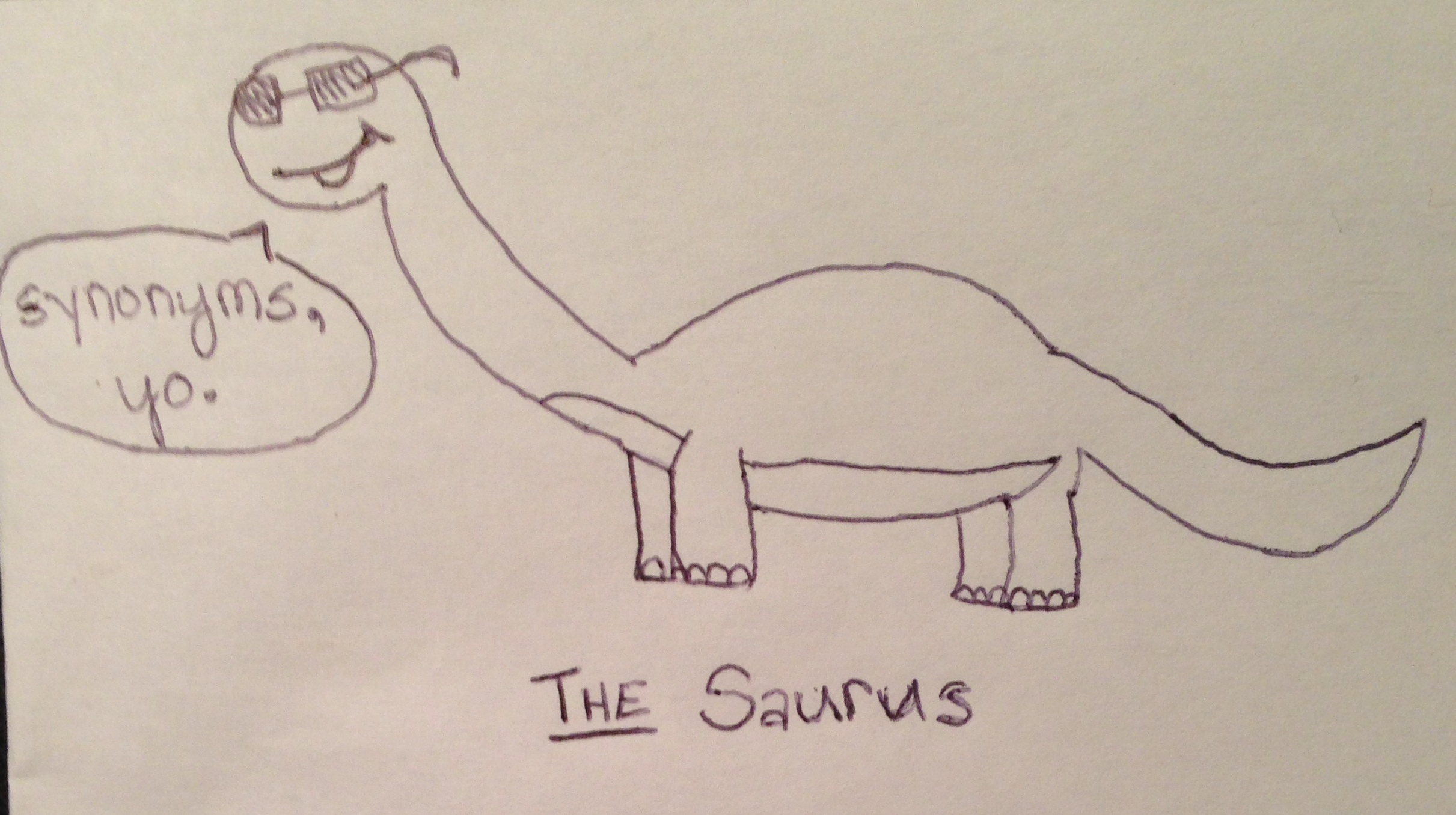
If, after reading this blog post, you still believe that a thesaurus is nothing but a large book that should never be opened, refer to Layne’s post regarding voice. Her advice regarding the thesaurus is especially useful for all the visual learners out there. However, if you are more inclined to listen to advice form non-writing center consultants, refer to my cool hand-drawn friend, The Saurus-

the saurus_carly

Next time you are swimming in a sea of ‘said’s, remember that the thesaurus, whether you wish to view it as a helpful tool or a dinosaur with a superior vocabulary, is an excellent composition companion.

Alternatives to Procrastinating

Jessica Winck, Assistant Director

Approaching the end of the semester can be a stressful time, and those of us who are inclined to procrastinate might feel especially anxious. I tend to believe that procrastination involves more than just actively avoiding work. It often relates to a writer’s sincere challenges with any of the following: understanding an assignment; feeling overwhelmed by the workload in college; worrying about whether s/he “has what it takes.” None of these is easy to deal with, and we know that avoiding work doesn’t help us in the long run. If you’re worried about procrastination, try some of these strategies:

Contact your instructor about any questions you have. This might sound obvious, but not everyone feels comfortable with this approach. What if my instructor will think I’m stupid, or that I’m not trying hard enough, or that I’m not good enough to be in this class? Meanwhile, confusion about an assignment prevents us from working on it. Email your instructor or ask to visit her or his office hours, which are set aside specifically for helping students address questions and concerns.

If you have a large assignment on your hands, consider breaking it down into smaller, more manageable pieces. How we see the task plays a large part in our approach to it. “Write a research paper” sounds like a scary and overwhelming task. Try talking to your instructor about how you can approach the assignment in parts. You can also go to the writing center and work with a consultant on setting some manageable goals for completing the assignment. These should be goals that you can reasonably meet in the amount of time you give yourself. You will get more done, and you will likely feel more confident about finishing the assignment.

Try setting a timer when you write. This might sound like an odd piece of advice, but it’s one I always stand by. I often use the Pomodoro method: write for 25 minutes, then take a 5-minute break. Write for another 25, then take another 5. Writers who struggle with procrastination might find this method especially helpful. Over time, you start to notice that some tasks don’t take as much time and energy as you imagined. Tasks become less intimidating and more manageable. Plus, you don’t have to focus on writing for an indeterminate amount of time. If you grow tired or you need a coffee break, you don’t have long to wait; but for the time being, you write. Also check out what Alex Clifton, a writing center consultant, wrote about some online resources that help you keep writing in pre-set blocks of time.

DSCN1660Write with a friend or a group. Working alongside others can be encouraging, and it also keeps you accountable. My colleague Meghan Hancock and I often meet for the specific purpose of writing and working. It’s a great arrangement because we have a shared understanding that we write when it’s time to write (and yes, we set a timer). Since your classmates are working on the same assignment, ask them to join you. Though the time you make is for writing and working, it also presents the opportunity to get to know more people and to feel supported at the same time. Contrary to some of the received wisdom out there that good writers work independently without any help, you actually don’t have to do all this alone.

On that note, make an appointment at the Writing Center. We will be happy to sit down and work with you wherever you are in the process of writing. Plus, having specific times set aside to talk with others about your writing helps you stay motivated.

There are many alternatives to procrastination, and I hope you try some of the ones here. Have a great rest of your semester!

Why Do We Write?: In Defense of The Paper

Daniel Ernst, Consultant

The paper is a collegiate common denominator. In just about every class in every discipline, writing papers is required. Therefore, it’s easy to see the paper as busywork, a pointless academic exercise often with no real world counterpart. But the paper is more than some arbitrary unit of learning by which an instructor attempts to measure a student’s intellect. If we think about what we really do when we write, we see in fact that the writing process offers a unique and effective learning arena.

This isn’t just armchair philosophizing either; writing’s unique relationship with learning has been well documented by scholars in fields from psychology to linguistics to composition theory. One composition/education theorist in particular, Janet Emig, provides a general overview of writing’s role in learning in her article “Writing as a Mode of Learning.” Emig first distinguishes writing from other forms of language usage—reading, talking, and listening. Then, she explains how writing distinctively requires the deployment of and interaction among multiple learning methods, such as analysis, synthesis, experience, and genesis.

DSCN1632Writing’s interactive and multifaceted process is what makes it so challenging, but this process also fosters a uniquely instructive learning environment and sets it apart from other forms of language usage. For example, take the idea of analysis. College students are commonly asked to analyze; the term analysis (or its sister term ‘critical thinking’) appears on almost every essay prompt or class syllabus in one form or another. This is because analysis is a powerful educational tool in which an idea’s deconstruction into its elemental building blocks helps students better understand its composition. In general, though, analysis is accomplished through class readings and discussions. So if reading, talking, and listening in class helps to take apart these big ideas, what then to do with all the disassembled pieces? This is where writing comes in.

Writing papers is your chance to take the deconstructed concepts and theories and build something new. In other words, synthesize new connections/conversations that become new ideas. Not only is this a critically important move from “destructive” to “constructive” intellectual work, but it’s also your opportunity to contribute, as many of my teachers have put it, to the scholarly conversation. The significant and sort of radical thing here is that these are your ideas and your unique contributions. And in formulating these contributions, you are forced, through the nature of writing, to confront ideas in a special way. Writing’s combination of and interaction between analysis and synthesis, mediated by the writer’s own experience and end-goals, promotes a participatory brand of learning that is unrivaled and truly indispensable. So the next time you are assigned to write a paper, try to embrace the chance to learn in a unique way and capitalize on your opportunity to participate and contribute your voice and your ideas.

In Conclusion: Framing Your Paper

Arielle Ulrich, Consultant

Working at the writing center, I constantly hear students say that they hate writing conclusions. These students will bring in papers that seem finished, but end abruptly—or they may have written a conclusion, but it’s only a sentence or two re-stating the last paragraph.

I’m no stranger to this struggle. Even the conclusion to the simplest paper can leave me stumped, and I often have to leave the paper alone for a few hours while I try to think of the “perfect” conclusion. Of course, as the last thing the reader sees in the paper, conclusions are very important. But my obsession with the perfect conclusion instead psyches me out, leaving me with a case of writer’s block.writersblock

When this happens, I remind myself that a good conclusion cannot fix a bad paper, nor will it solve any of its organizational or structural problems. I find it more helpful to consider a conclusion as the closing statements of my argument. By this point, I should have already said everything I needed to say and written the meat of my paper. I’ve argued, elaborated, and explicated every point. My conclusion will simply wrap up my paper and place my topic into context for the reader.

  1. In light of this, I have a few tips for conclusions. Which tip you follow may depend on your field, so consider which strategy works best for your paper. These are my three go-to tips: Explain the significance of your paper. Make sure the reader knows why your topic is important. Usually, this involves placing your question into a broader context or comparing it to a current issue. If you cannot think of the significance, ask yourself, “so what?” This approach is especially useful in history or expository papers.DSCN1639
  2. Recommend further research. Now that you’ve examined the current research on your topic, you have the chance to take the next step and recommend a course of action for the future. Is there a topic or approach you would ask a future researcher to consider? In other words: what questions are you left with at the end your paper? This tip will work best with papers that have a significant research component.
  3. Synthesize your points. This strategy requires that you not only summarize your paper, but also put together the pieces for your reader. How does your argument come together? If your paper is either very long or complex (or both!), this type of conclusion would be a good choice.

Any of these strategies would guarantee that your reader leaves knowing the purpose of your paper. You also shouldn’t feel that you can use only one of these strategies at a time—in some papers, you may use all of them, provided they are relevant.

These two writing center sites also have good pointers. Feel free to peruse these before writing your next paper:

University of North Carolina, Chapel Hill: http://writingcenter.unc.edu/handouts/conclusions/

University College, Toronto: http://www.uc.utoronto.ca/intros-and-conclusions

Happy writing!

What is Voice and Where Do You Get It?

Layne Porta, Consultant

I remember being told when I first started doing college level writing that I needed to work on my voice. When I asked my professor what exactly she meant by that, I was told that voice is what makes your writing uniquely your own. I was frustrated and confused: Isn’t the fact that I’m writing it what makes it uniquely my own?

Now that I am a graduate student and writing consultant, I often see the same kinds of feedback on my students’ papers. What I would like to offer here are some thoughts on what voice is and how you get it, as well as some resources that can help you along the way to finding your voice.

What I have come to learn about voice is that it is much more about practical decisions you make in your writing than some mystical quality that appears like mist in the night. The writing process itself is an unending sequence of decisions–from word choice to punctuation to paragraph breaks–and all of these decisions add up to create your voice. For example, I love to use dashes in my writing, which can make my voice sound more conversational. Voice can also come from the kinds of metaphors and similes you choose to explain concepts, or the length of your sentences. I have found that one of the biggest factors in creating (and understanding) your voice is word choice. For example, one of my least favorite words is fickle, but one of my favorite words is capricious. They mean the same thing, but my voice will sound very different depending on that decision. There are many resources that can help in making decisions about the words you want to use. For example, on websites such as visualthesaurus.com and visuwords.com, you can type in a word and it will bring up a word web that will feature synonyms and variations of that word clustered according to connotation. The example below is a screen capture of a visual thesaurus app I recently downloaded:

"Volatile" on Visual Thesaurus
“Volatile” on Visual Thesaurus

I have often heard the idea from both students and peers that voice isn’t as important in academic writing as it is in creative writing. I believe this is a huge misconception. Voice is crucial to academic writing because it plays a large role in engaging your audience, establishing a formal tone, and creating your credibility as a writer. In sum, voice plays a very active role in helping you achieve your rhetorical goals. Furthermore, you can have more fun with the writing you will do during your time in college or after if you embrace your voice as a writer.

If you find yourself wanting to learn more about voice and how to get it, I suggest two very helpful websites that offer comprehensive discussions about voice. The first is “Understanding Voice and Tone in Writing” by Julie Wildhaber, featured on quickanddirtytips.com. This article offers tips on defining your voice as well as some helpful examples of how voice will change according to genre. Another useful article on writingcommons.org by Kyle D. Stedman, is “Making Sure Your Voice is Present” which also offers excellent suggestions for finding your voice as well as some YouTube videos about voice.

layneOne thing to keep in mind is that finding your voice is like everything else in writing–it requires practice. So in response to my initial question as a beginning college student: yes, the fact that I am writing my paper is what makes it uniquely my own. But voice takes this a bit further, and requires that you do some writing to see how your personality comes across. My suggestion, then is to trust your instincts as a writer. Your writing is a reflection of your thoughts and your personality. Your voice, and your awareness of your voice, will come through the more comfortable you get with writing.

Don’t Fear the Outline: It’s Really Just a Helpful Sidekick

Jamison Huebsch, Consultant

Outline is an unusual word in the world of writing; in normal usage it suggests a lack of substance, a mere shape of something larger. We use the word because it is supposed to represent the shape of things to come in our work. Yet in the process of writing an outline can sometimes feel limiting, because it can be a commitment to a direction for an essay or story. An outline can be a big help in the early planning stages of writing however, and I would like to share a few tips I’ve picked up on creating an outline. The first tip is not to stress out about an outline, because it is supposed to be a helpful map and not a constraint.

Imagine it like this: you are deep in the middle of a paragraph, and have put your best ideas down on the paper but you still feel like it’s a bit of a mess. Where do you go next? Pull out your trusty outline you made earlier and let it guide you. You can review the important concepts you wanted to cover, see what the next topic you planned to discuss, and then you are right back on track without any wandering about. The key is what you include in your outline, to give yourself guidance later.

Let’s start with two important parts of the introduction: the audience information, and the thesis. Your introduction is usually the best place to clue your reader into information they may not know but is important to your topic. You should note down anything you feel you might have to explain such as technical information, acronyms, or concepts. In creative works you might consider a character’s back-story or important information about where the story takes place. Not everything you write down in the outline has to be used later. If you writing a creative work you may not need a thesis either, but it is still a good place to record your original plan for the plot. If you producing other academic work however, you will definitely want a thesis. There is lots of help available on making a good thesis, including on the Purdue OWL, but as long as it summarizes the central point of your paper well you are on good ground.

The next section is sometimes referred to as the body, but I like to think of it more like a skeleton. You want to get the central ideas of your work sectioned out, and then you can break them down into smaller easier to plan steps. So pick major concepts and give each one its own section. In a creative work you might list the scenes you plan to write, so you can get a feel for the shape and flow of the plot. In a class paper you could review the major topics or issues related to your argument. If you have already done your research for the paper, an outline can help you space out your citations and ensure that you cover everything important before moving on to the next source. You want the sections to follow each other in an order that makes sense, so by looking at it in the large scale abstract you can better see where you might need transitions added to your text.

When you have covered all your main points and noted all the important details to your paper it’s time for an ending. Regardless of if you call it a conclusion or an epilogue, a good work leaves it reader with a proper send off. This is your last chance as a writer to leave a good impression on your reader. Luckily a conclusion in an academic paper is like a mirror of the introduction: you review the important points of your argument briefly, and similar to your earlier thesis it DSCN1642should contain a clear and concise statement of your position. Creative writers are still stuck crafting sappy endings or killing off everyone’s favorite characters, but that’s the job you signed up for. Either way you’ll know by now if you followed your earlier road map or set off into the unknown, but at least you brought directions.

I hope these few short tips about outlines help someone out, and don’t forget that you can come by the Writing Center. We not only can help you with brainstorming and planning your first outline, but with all the fun stuff that comes after. Good luck with your writing!