Category: Process

Finding the Time to Write

Ashley Taylor, ConsultantAshley T
One of my favorite questions to ask writers out in the world is:

“When do you find time to write?”

Out of the various answers, whether creative or academic, ultimately the collective response in the midst of a busy life is to schedule time to write. However, you can’t stop your third shift manual labor job and say “hold on, I have to finish this paragraph real quick” or tell your 5 month old baby “I need this time to myself, sorry.” The world doesn’t stop for writing assignments.

Students live busy lives and learn to balance their schedules between academic, work, and personal life. But writing can be a monster when put under pressure, which can cause writers to put off an assignment, feel overwhelmed by the writing process, or feel as if they have to make sacrifices in the other areas of their life just to tackle the next rhetorical essay, research proposal, or short story.

A polished draft is not required to make an appointment with the us. You can make up to three sessions in the same week and we help through all stages of the writing process. My absolute favorite appointments are when we brainstorm and plan because in those sessions, writing feels approachable, manageable, and a little less scary.

When I hear that the key to finding time to write is to schedule it, it seems as if that means on my own. Schedule alone time, to write alone, to tackle writing alone. But that’s not the case. You are most certainly not alone in having a busy life and even when writing alone, there’s an audience involved as a silent party. Sharing your writing through all the stages of the process helps to foster the idea that writing is most certainly a social act. Reach out. Schedule time with others.

Here are just a few resources that can be helpful in this process:

In the University  Writing Center alone we have consultants who are a parent-to-be, a new parent for the first time, a new parent for the second time, a parent with two children entering grade school, and a parent with three teens. We have consultants who are planning weddings and starting internships. Many of our consultants are graduate students in our first year of the master’s program and PhD candidates taking steps toward building careers. We are students with writing assignments in the midst of busy personal lives and we know the value of reaching out.

Have compassion for yourself.

We are a resource for you.
How I Write: Nancy Gall-Clayton

Our “How I Write” series asks writers from the University of Louisville community and beyond to respond to five questions that provide insight into their writing processes and offer advice to other writers. Through this series, we promote the idea that learning to write is an ongoing, life-long process and that all writers, from first-year students to career professionals, benefit from discussing and collaborating on their work with thoughtful and respectful readers.

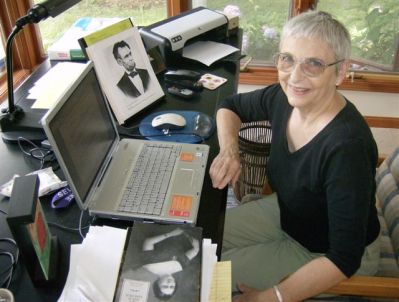
Nancy Gall-Clayton is a local playwright. She has written over 75 plays, and her work has been performed on stages in Louisville and around the world. To see more about her work and interests visit http://www.nancygallclayton.net/    gall-clayton-at-work

Location:
 Just across the Ohio River in Jeffersonville, Indiana (after 40 years in Old Louisville!).

Current project: A full-length play about Dr. Mary Edwards Walker (1832-1919), commissioned by Looking for Lilith Women’s Theatre Company to be produced in July 2017 at the Clifton Center.

Currently reading: The Castle Cross The Magnet Carter, first novel by playwright Kia Corthron; Gilgamesh, A Verse Play by Yusef Komunyakaa, and The Dramatist, bimonthly magazine of the Dramatists Guild.

What type(s) of writing do you regularly engage in?

I write full-length plays as well as 10-minute plays, the latter a form popularized by Jon Jory, former Producing Director of Actors Theatre of Louisville. I write history plays, plays on social justice issues, comedies, and plays that feature complex women.

When/where/how do you write? 


Anywhere and everywhere: on my laptop in my home office, at coffee shops, at the public library, in motels, and on airplanes. I also write on napkins at restaurants, on a pad kept on by bedside table to record thoughts that wake me up, and on a pad in my car (at red lights only!).

What are your writing necessities—tools, accessories, music, spaces? 


Quietness. Either a computer or a pen and pad of any kind.

What is your best tip for getting started and/or for revision?

Just write! Writing itself – even if you start with drivel – generates more writing and better writing. Don’t revise until you have a complete rough draft. You can’t make much progress if you keep revising the first page! Don’t censor yourself; just write!

What is the best writing advice you’ve received? 


Kate Aspengren at the University of Iowa Summer Writing Festival shared this with me long ago: Imagine your protagonist walking across a field toward you through fog and mist. As she comes closer, you hear your character begin “There’s something I really want you to know about me….” What the character says may not make it into your play or story, but it will inform your writing.

Also, here’s an idea from The Playwright’s Process, a book by Buzz McLaughlin: Fill out an imaginary but very detailed job description for your characters. Again, you’ll learn a lot. What you discover (who should we contact in case of emergency, for example) probably won’t be in your final product, but you’ll know your characters so much better than you would have otherwise.

Do you know someone who would be great for How I Write? Send us your recommendations!


Getting Going on a Personal Statement: Motivation and the Role of the Writing Center

track-960393_960_720

Cassie Book, Associate Director 

There’s no shortage of advice about writing your personal statement for graduate school applications on the University Writing Center’s blog or website. Our past writing consultant bloggers have tackled the personal statement from several angles:

Five Tips for Writing a Killer Personal Statement

Personal Statements Part I: Just How Personal Is It?

Personal Statements Part II: Research and Focus

Timely Tips for the Personal Statement

Tips on Crafting an Effective Personal Statement

We also have a handout on personal statements, which comes in handy during appointments.

With so much great advice, you should be good to go, right? No? In my experience, both as a writer and a consultant, the most difficult aspect is getting started. So that’s what I’d like to write about today: moving from nothing to something on your personal statement or statement of purpose.

We do have a helpful FAQ about getting started on personal statements, so I’d suggest checking that out too. However, here are three strategies, adapted for this particular writing task, to jump start your process. These strategies will work best after you’ve reviewed genre basics about personal statements and the instructions for your specific program applications.

  1. Freewrite: Prompt yourself with an open-ended question such as “Why am I interested in this specific program?” and set a timer for five or ten minutes. Keep your pen or pencil moving on the page or your fingers typing on the keyboard. The point isn’t to produce coherent writing; the point is to work yourself up to an idea you can build on later.
  2. Start a shoe-box collection: If you have time, take a day, week, or month to let ideas for your personal statement simmer in your mind. When an idea or experience comes to you, write it down and put it in a box or envelope. When it comes time to draft, you’ll already have a few starting places.
  3. Create visual or a map: Generate ideas visually either with a paper/pencil or a digital mind map. You might find that approaching the project visually loosens your writer’s block and helps you see the personal statement in a new light organizationally and logically.

Getting started is not a problem unique to personal statements. The difference with personal statements is you can’t distract yourself from writing with reading or research. Writing a personal statement always comes back to thinking about constructing yourself with words, and that is what you’re trying to avoid! No matter how much anyone says “just start writing,” sometimes you just feel frozen.

This is a moment where the Writing Center can be a huge help in your writing process. When I talk with new peer writing consultants about their job, one of our first discussions centers around the various roles a writing consultant can play. One of those roles is the motivational coach. And this is the role we’ll play for you as we help you get started on your personal statement. You don’t have to write anything beforehand, just schedule an appointment to brainstorm and bounce ideas off someone else. Bring your personal statement instructions, and we’ll have a low stakes conversation to help you generate ideas.

Another opportunity the University Writing Center offers is the New Year. New You: Personal Statement Workshops in January. The workshop will be designed to help you even if you haven’t gotten started yet. We’ll talk about personal statements in general, give you some prompts for getting started, and look at a few examples.

So, if you know that you’re applying to graduate school in the next few months, but you’re having trouble getting started, let the Writing Center do what we do best: talk with you. Schedule an appointment or stop by one of our workshops in January. You do have to write about yourself, but there is no reason to do it alone.

How I Write: Dr. Jose M. Fernandez

Our “How I Write” series asks writers from the University of Louisville community and beyond to respond to five questions that provide insight into their writing processes and offer advice to other writers. Through this series, we promote the idea that learning to write is an ongoing, life-long process and that all writers, from first-year students to career professionals, benefit from discussing and collaborating on their work with thoughtful and respectful readers.

jose-fernandez-pic

Dr. Jose M. Fernandez is an Associate Professor of Economics in the College of Business. His research is in the areas of crime, health, and industrial organization.

Current project: “Less Alcohol, Less Service: Do local alcohol bans affect the number and mixture of full and limited service restaurants?”

Currently reading: Dollars and Sex, Naked Money, and Harry Potter & the Cursed Child.


What type(s) of writing do you regularly engage in?

I primarily write for scholarly journals in economics and health policy. These articles tend to be technically dense filled with economics jargon, tables, and equations.

When/where/how do you write?

I need a fairly quiet place to write with few interruptions. The few interruptions is key for me. This usually means I am writing in my office after hours when my colleagues and students have gone home or at my house while my wife is at work and my children are at school.

The interesting part to being an academic researcher is to find the answer to a research question. You do all this work with data collection and analysis just to be the first person to better understand this little corner of our world. It is a thrilling high that comes with the job, but all this effort goes to waste if we do not share it with everyone else. Therefore, we write afterwards. When I write my papers I actual start in the center. Since I am a data head, I first write the data description and analysis sections of the paper first.

Next, I write the literature review. There is an old saying that goes, “if it is good it isn’t new and if it is new it probably isn’t good.” This quote always reminds me to look into the scholarly literature for the works of others that inspired or contributed to the question and answer that I am presenting.

Lastly, I write the introduction and the conclusion. I write these pieces last because they are the most important. We live in a world with information overload, you need to grip the reader’s attention in that opening paragraph. You need to convince them that their time is worth reading the next 30 pages. If you can’t achieve that, then you want to at least explain the question and tell them the punchline by the time they have reached the end of the introduction even if they skimp on the details.

What are your writing necessities—tools, accessory, music, spaces?

I mainly need my computer with a word processor or Latex editor, my statistical program, and google scholar. I do not really play music unless I am cleaning data.

What is your best tip for getting started and/or for revision?

My best advice for revisions is to read your paper out loud. Your brain tends to fill in missing words for you when you read silently, but out loud it is easier to catch. Secondly, I recommend printout your paper or using MS Words track changes, get some coffee, and a red pen. Much of my revisions are taking sentences and first making them into the active voice. In the second pass my goal is to make the sentences shorter and remove grammatical/spelling errors.

For writing scholarly papers in general I like these two resources: Economical Writing by Deirdre McCloskey and, for students, an Economics sample paper.

What is the best writing advice you ever received?

I received two pieces of advice that have helped me with my writing. First, THERE IS NO SUCH THING AS A PERFECT PAPER. This phrase will help you get over the anxiety of writing in the first place. Your first draft should be rough. It should be a brain dump where you get everything you wanted to say about the topic down on paper. This will get you started and revisions will take care of the rest.  The second piece of advice is for when you are stuck. I tend to write in bulk, but if I am not feeling creative or inspired that day I force myself to write at least one page. This single page serves several purposes. I have something concrete to show I have worked today. Next, it has started me to think more about the topic. The best part is that even if you do this every day for a month you will have a paper done by the end of the month.

Do you know someone who would be great for How I Write? Send us your recommendations! 


Pulling Together a Portfolio

Ashleigh Scarpinato, Consultantashleigh-s

There are so many help systems and articles designed to help you write a research paper, but what about all us Creative Writers out there? Who is going to guide us through the chaos that is a printed rough draft with a coffee stain in the center or a Cheetos smudge on page seven? If you have taken any Creative Writing classes, chances are you have had a chance to workshop your pieces in class, but where do we go from there? What pieces make it into our portfolios, and how do we make all the peer reviews when they are often telling us differing or conflicting suggestions?

Here are some notes about my method for pulling together a portfolio:

Phase 1: What to Include

Drafting a poetry portfolio is going to be different from drafting a short story portfolio, but the method can be the same. Start small, go through and pull out your best pieces. Look at your feedback, what did you peers identify as your strongest work? When deciding which pieces I want to include, I always look back at the speaker’s voice. I start by identifying which speakers are the most honest or believable. I had a peer in undergrad that would say, “I am not buying this line,” and it became my goal in writing and revising to ask myself: is this believable, will my reader buy this? And I challenge you, reader, to do the same.

Phase 2: Making Revisions

After pulling together the pieces you (and your peers) identify as your strongest pieces, collect all your peer reviews on each of them (hopefully, you still have them hanging around somewhere). I put all the peer revisions and notes in one pile and have a freshly printed copy in the other. Now, begin reading more thoroughly through those comments, noting which ones you like and find most effective. As you identify which changes you would like to make, write them onto your clean copy. This helps give yourself a base while also eliminating some of the chaos.

Phase 3: More Revisions (they never truly stop)

What if some of your peers recommended you change something in your piece? Do you have to listen to them? Although this might depend on their suggestion, please do not feel the need to change something that you do not feel comfortable with. As the writer, if you feel as though you are not doing the writing justice, that might be a sign to leave that detail, image, or word. Most importantly, if you do not change something, make sure that you can justify that choice.

Phase 4: What Time is it?

Get some sleep. I promise you will make more errors and have more typos on a lack of sleep than you will well rested. Along with lack of sleep may come lack of motivation, and you might find it difficult to convince yourself to read back over your revisions. I repeat, get some sleep. Your work will still be there in the morning—provided you didn’t forget to save it while surviving on coffee and Cheetos. When you come back to it in the morning, try reading your work aloud. This can help you hear how something sounds and allows you an opportunity to locate the typos you may have glanced over while skimming the piece.

Phase 5: Come to the Writing Center

We love Creative Writing pieces, and we do not get enough in here! Creative Writing work can be more personal, but as writers ourselves, we understand that the speaker’s voice does not necessarily coincide with the author’s voice. As tutors, we do not need to know if a piece is non-fiction or fiction, and we can help you through whatever part of the writing process you need help with.

I hope you found these notes helpful as you go forth into the world of revising and editing. Stand strong; you can do this.

Finals Stress: You’re Not in This Alone

Carrie Mason, Consultant carrie-m

It’s about this time when you’re starting to freak out. Deadlines and commitments and all that heavy, heavy, jazz. Caffeine consumption is at an all-time high, sleep at an all-time low, and you’re not even sure if you took time for lunch. There. Is. Too. Much. To. Do. The four (or ten) page essay starts to feel like a full length novel, and the book you desperately needed isn’t at the library and you thought you had time for an inter library loan but it turns out you don’t and now you’re hoping Google Books has it as a preview and then you realized that you forgot about the one page reflection piece over some book you skimmed and then the professor talks about the in class exam you also forgot about and your mom called to say that your grandma misses you and you should call her.

Stop. Breathe. Relax. You can’t do anything if you’re thinking about everything. And that’s a lesson I’m still trying to learn.

It’s almost impossible for me to multitask when it comes to research and writing or any kind of homework, really. In the past, I’ve been able to obsess about a single project, conquer, and move on. It doesn’t seem like that strategy will work particularly well this go around. There are too many assignments due at the same time. Perhaps you’re finding yourself in the same boat. Whatever battle plan you’ve used before, it isn’t working now. Maybe you found that out at midterms and now these last assignments are even more daunting. Regardless of how it happened, you realize the boat has sprung a leak. Man overboard. But you can’t abandon ship. And neither can I. We have invested too much to give up now. We are actively working toward our dreams, to better ourselves, and the pursuit of something much greater than an in-class exam. So, knowing the journey has its rough parts, I offer some tips that might help keep us all afloat until we hit the winter break shoreline.

  1. Coffee is not water and you should drink less of the bean juice and more of the h20.
  2. Don’t let school work take away your sleep. Not only do we turn into incorrigible creatures when we don’t sleep; we don’t do better on our assignments either.
  3. Energy drinks are also not water.
  4. Breaks are good for your mind and soul and sanity.
  5. Focus on a task for half a day, take a substantial break, and then switch tasks. This can help you gain progress on multiple projects (this is my current method).
  6. Eat real food.

I wish I had more things to say that would be encouraging and provide step by step instructions for end of semester success. But this is all I got. I could say start earlier, but I think we all already know about that. In fact, we probably already know most of the things I’ve suggested. I certainly didn’t learn them all on my own. And I think that’s the greater lesson here. You–whoever you are–are not the only one who is drinking way too much caffeine. You are not the only one who didn’t get a book in time. You are not the only one who forgot to eat lunch. You are not alone. Finish Strong.

Personal Statements Part 2: Research and Focus

We bring you the second installment in this week’s series on the personal statement.  See part one here.

Stephen Cohen, Assistant Director for Graduate Student Writing20150824_140027

Working with writers at both the Belknap and HSC campuses has taught me that, despite differences in discipline and focus, writers everywhere are working through very similar hurdles and anxieties. Students across both campuses right now are thinking about taking the next step in their academic careers; often this involves applying for residencies, internships, or further graduate study. Though these applications can be stressful, I try to help people think of them as opportunities to present themselves and find the program that is the best fit.

Many of these applications require a version of the “personal statement” essay. For this post, I’ll be thinking through some of the most common stumbling blocks in this process and (hopefully) giving you a few useful tips to help you through writing a statement of your own. Also remember that one of the best ways to develop a personal statement is to make an appointment to discuss it with one of our consultants here in the University Writing Center.

1. Do your homework.

Find out what the requirements are for the statement – and don’t deviate from them. How many words? Does the application ask you to address specific questions? Carefully adhering to guidelines demonstrates to the committee that you’ve taken time to understand their particular application process, and, by extension, their program.

Speaking of which, you’ll want to find out what you can about the school and the program to which you’re applying. Mission statements and program descriptions are great places to look for information that you can use to your advantage – demonstrate to the committee that you understand how their program differs from others and that you are excited about what makes it unique.

If you are applying to multiple programs, try to contain anything that applies to a specific program to one paragraph. That way, you can switch that paragraph out for each program without having to do extensive revision on the rest of your letter.

2. Put your best foot forward.

People often understand “polishing” a personal statement to mean carefully proofreading it and ridding it of errors. While this is important (you don’t want to send a letter addressed to University of Louisville to University of Kentucky because you forgot to change it!), it’s more important to think about polish as careful presentation of the experiences you list on your CV or Resume.

Think carefully about what you list on your CV/Resume and choose the experiences that best demonstrate why you are a great candidate for a given program – you’ll want to use your experiences to show a committee not only how well prepared you are for graduate study, but also what makes you unique – what you can bring to the program that others can’t. Remember, the committee won’t necessarily know how your work (as a student assistant, for example) has prepared you for the demands of grad school – you’ll have to tell them.

If there was ever a time to toot your own horn, this is it. Though you don’t want to seem arrogant, most people I’ve worked with err too far on the side of caution. This is your chance to let the committee know how great you are – take it!

This is also an opportunity to answer any questions you think might be raised while the committee considers your other materials. Is there a gap on your resume? Don’t leave the reason for it up to the committee’s collective imagination – explain it to them, in the most positive terms possible.

3. Be Specific

Be sure you include particular reasons for your proposed path of study, and where possible, who you would like to study with. Remember the part about doing your homework? The more you know about a program, the better positioned you are to explain specifically how that particular program can help you meet your academic and career goals in ways that other programs can’t.

Use appropriate details to support any claims you make about yourself and your preparedness (in my case, an example might be not “I am a good teacher,” instead I would write “I have successfully taught introductory Rhetoric, Literature, and Business Writing courses).

4. Be Yourself

Often, a program will ask for a personal statement because they want a sense of who you are that they just can’t get from scanning a CV. Coordinate the experiences you’ve selected to write about to demonstrate some personal characteristic(s) that you think will appeal to the committee. In other words, rather than writing “I am a hard worker,” choose to detail a few experiences from your CV/Resume that demonstrate how hard you’ve worked.

Use the personal statement as a place to tell the committee what you think are the most important things to know about you – the things that make you different from another candidate. What life events have led you to consider your course of study? What challenges have you faced along the way, and how have you overcome them in order to achieve the accomplishments listed elsewhere in your application materials?

The personal statement is only a small part of your overall application, but a thoughtfully prepared statement can have a big impact on how your whole package is received.

Kill Your Darlings: Four Steps to Making Difficult Revisions

Anthony Gross, Consultant

anthonygross

“In Writing, you must kill your darlings.” This somewhat morbid advice from the celebrated author William Faulkner is telling of what it feels like for writers to omit—or “kill”—pieces of writing they have grown to love. The phrase “kill your darlings” is often interpreted as the need for fiction writers to kill off major characters, but it is more broadly applicable to entire sections of writing within any genre. Whether you define yourself as a writer and tend to become deeply attached to your writing or as a student hoping simply to finish a paper with a good grade, killing parts of your writing, no matter how much you love them or how much they contribute to your word count, is an essential part of the revision process. To help you manage the brutal task of murdering your compositional babies, I offer the following advice:

Don’t become too attached.

It’s good to get something down on the page, but don’t become too attached to your original writing. When you’re struggling to come up with ideas and you’re struck by a sudden pang of inspiration, what you produce at the beginning of your draft may not coincide with your concluding thoughts. Especially when you’re crunched for time on an assignment, it’s tempting to skip revising and go straight to editing—that is, skip major structural and ideological changes and target lower order concerns. Your goals will vary depending on the type of writing you are doing, but whether you are producing an argumentative essay, a short story, or an application letter, you should aim to make the individual parts of your writing add up to a cohesive whole. In making sure every aspect of your writing conveys your overall purpose for writing, cutting those pieces that don’t, your reader will be better equipped to understand your ideas.

Give yourself time.

Have you ever looked back at a piece of writing you hurriedly composed for a class during a previous semester and thought, “Oh my goodness; why didn’t anyone tell me how bad this is?” As time lapses, we gain perspective, and we’re able to view our past selves, including those constructed through our writing, more objectively. With this in mind, it’s a good idea to let your work sit for a period of time before committing to the self you’ve constructed in your writing. If you find that you’re still pleased with what you’ve produced a few days, weeks, months, or even years ago, great. But if you’re anything like me and countless other writers, I bet you’ll find something that needs to be killed. It’s also good to note that major revisions should come before minor editing because the small things that you’ll find yourself editing— from spelling to grammar—may be axed from the final project.

Eliminate the unnecessary

Killing your darlings is really about eliminating unnecessary sections of your writing despite how much you love them. This isn’t to say that you have to nix your creative voice, but you must balance creativity with utility to ensure that every aspect of what you’ve written contributes to your purpose for writing. You should read for obscurity, redundancy, and argumentative support. If you find that what you’ve written might confuse your readers, even if it makes good sense to you, clarify or cut it. If you find that a section of your writing repeats an already stated idea to no useful effect, cut it. And if you find yourself including superfluous details, whether they are plot points that aren’t meaningful to your story or argumentative details that don’t progress your thesis, cut them. If deleting these sections permanently is too stressful, create a separate word document where you can paste them in case you change your mind. Remember, you may have spent a lot of time producing your draft, but if what you’ve written doesn’t help your readers discover your purpose, you haven’t met your ultimate goal.

Collaborate

Killing aspects of your writing that you’ve become attached to can be really difficult, especially if you’re so blinded by that attachment that you can’t differentiate purposeful from superfluous details. If you find that you can’t revise on your own, get some outside help. This could be as simple as asking a family member or friend for their opinion, but talking to someone familiar with the genre in which you are writing might be more helpful. University writing centers are a great place to work with other writers who can help identify what they, as a reader, see as essential or non-essential to your draft at any point in your composition process.

Killing your darlings can be difficult, but it is an important step in ensuring you produce your best work possible.

Watch Your Tone: The Sound of Academic Writing

Rhea Crone, Consultant

Most of us have received corrections, or suggestions for revision, on papers handed back to us by professors. Some of these comments are straightforward; “awkward word choice,” “incorrect spelling,” or “subject/verb disagreement” come to mind. Some comments, however, aren’t so clear. Among those in the latter camp are the dreaded question marks, free-floating in the margin; nefarious squiggles beneath phrases, sentences, or worse, entire paragraphs; and of course, some of the most loaded comments of them all: those suggesting a revision to “tone.”

DSCN3687So, what exactly does “tone” suggest when written in a margin? Isn’t it a term used to describe the way something sounds? How can a paper sound wrong, and why is any kind of sound significant if the paper’s argument is sufficiently advanced? Moreover, why must academic writers use one tone over another, and for that matter, why must we use any kind of tone, at all? There is no single correct response to any of these questions. In fact, in composition studies—a field that aims to simultaneously promote a sense of authorial ownership in writers of all levels, study the individual styles and needs of writers, and develop the most effective ways to teach everyone to write as effectively as possible—there is a long standing tension between those who say academic writers should not have to adhere to a specific “tone,” at all, and those who say that we must.

One has to wonder if there is a consensus on any aspect of such a debatable, fissured topic. Luckily, a set of general guidelines regarding the term itself exists. These guidelines usually take into account the following, give or take a few preferences or nuances depending on the reader/grader of a paper:

  • Use of clear and direct language, or the “active voice”;
  • Avoidance of personal pronouns, especially “we, you, you all, I,” etc.;
  • Omission of colloquialisms and/or regionally various terms and phrases.

To extrapolate from this short list a bit, academic tone is generally used so that a writer can quickly and effectively get their point(s) across, and so that the reader does not have to overexert themselves trying to understand what the author is saying. Academic tone also typically foregrounds information and argumentation, and demands that prose not sound as if it is merely the expression of an author’s opinion. Overall, this “tone” hinges on the following values: concise communication, and the establishment of authorial credibility. It also assumes that the reader of an academic paper wants to know, first and foremost, what the paper is talking about; and, of course, that the author of the paper knows what they’re talking about. Furthermore, use of the academic tone does not simply assume a certain reading style on behalf of a paper’s audience, but is ultimately an expression of respect for the reader. It does not, for example, ask the reader to believe unsupported claims, spend more of their time than necessary on reading through a paper, or require them to exert more mental energy on working through an argument than is necessary.

Now that we know what academic tone is, and why writers might want to use it, we can better understand the consequences of failing to use it correctly. These consequences don’t always result in a few required revisions or a point deduction. Indeed, academic tone can sometimes be broken with/from to great effect. Practiced, seasoned writers will sometimes switch their tone briefly, in order to emphasize a particular aspect of their argument. For example, placing a casual aside in parentheses, or including a quote from pop culture, can be used to draw attention to, and/or make a bit clearer, an important passage. In order to effectively break with/from academic tone, however, one must first understand and utilize it well. The reason for this is twofold: to borrow an adage, one must first understand a set of rules in order to break them, and the overall tone of a paper must be academic in order for a divergence/variation in that tone to be noticed at all, much less to great effect. If this tone is not broken pointedly, with some kind of rhetorical purpose, the author runs the risk of losing the attention and/or the comprehension of the reader, frustrating the reader, intellectually fatiguing the reader, losing authorial credibility, and/or needlessly obscuring an argument.

No blog post on academic tone would be complete without a disclaimer regarding various academic disciplines. Of course, not every discipline will require that papers be written in/with an academic tone. This is primarily because different disciplines address different audiences, and therefore value and judge tone differently, and sometimes it will not be necessary to write in a strictly formal, academic tone. Further, regardless of discipline, the occasional professor will encourage informal tone at various (more than likely initial) stages of any given writing assignment. Usually, however, it is best to assume that the academic tone is valued and will be expected in/of the majority of your papers.

Ya dig?

For further and/or more specific information on academic tone, please feel free to peruse the following sites: