Category: How I Write

Five Tips for Interpreting Writing Prompts

Cheyenne Franklin, consultant

The writing prompt. This piece of paper is your ultimate guide through what can feel like endless avenues of ideas or a desolate blank page. But sometimes these precious few words from instructors can seem like an encoded script. Well like any code, there is a key. Here are some secrets I’ve learned to interpret assignment sheets.

Secret #1: When you don’t know where to begin…

DSCN3677Look for keywords. Certain words go with particular writing genres. If you see words like argue or defend, then your instructor is likely looking for an argumentative essay, so be sure to take a clear stance and use evidence to support your claims. Rhetoric(al) refers to the intentional strategies that people use to make an argument. So if this keyword appears in your assignment, your instructor either wants to see you making strategic moves in making your argument or wants you to discuss the strategies used by the author of a text you’re studying. In the second case, you’ll want to write an analysis, so DO NOT just summarize the text.

For more key writing prompt words, see the key terms section of the UNC Writing Center handout on Understanding Assignments. You also might enjoy this blog post on “Deciphering Common Keywords in Assignment Prompts,” written by one of our previous consultants.

Secret #2: When you’re unfamiliar with the genre…

Determine what the purpose of the assignment is. Assignments have two types of purpose: an academic purpose and a real-life purpose.

To determine the first purpose, think about what skills your class has discussed. Instructors make assignments to give you a chance to show what you’ve learned. Consider what has been emphasized in class recently. Can you put this knowledge to practice in the assignment?

The second purpose requires you to use your imagination. Remember that college writing is to prepare you for real world writing. Imagine your audience extends beyond your instructor. What goal might you have other than a grade? Now how should you approach the assignment to accomplish that goal?

See Duke University’s list of college essay genres for a description of each genre and its characteristics.

Secret #3: When you’re told not to have a thesis…

Think again. What about the assignments that forbid “personal opinion?” Isn’t a thesis an opinion? Well not in an academic sense.

What instructors mean when they warn against personal opinion is that you should not make claims based on personal feelings. You should make claims based on statistical or textual evidence, reliable resources, and clearly drawn logic. Your instructor will almost always look for a main point in your essay (aka a thesis). Just make sure the thesis is your analysis NOT your opinion.

Secret #4: When your assignment includes a quote…

You cannot ignore it. Some assignment sheets include a passage from a text you’ve studied in class. Although the instructions might not directly ask for you to address this quote, you should reference it somewhere in your essay unless otherwise instructed.

Secret #5: When you still have no idea…

It’s time to talk to your instructor. Remember that your instructor wants you to understand the assignment and wants to know if it’s unclear. Most instructors revise their assignments based on the responses they receive, and if you’re confused, there’s a good chance others are too. Just be sure to discuss your confusion respectfully. You’ll save yourself a lot of time and worry.

In the end, your instructors don’t mean for their assignments to confuse you. Still, we all encounter certain prompts that confuse the inspiration right out of us. As you gain more experience with the lingo and genres it will get easier.

What Justin Bieber Can Teach You about Genre

Jessica Good, Consultant

biebergenreJustin Bieber’s new single, “Sorry,” blends related genres— the rhythmic pulse of electropop, the warm notes of tropical house, and the verse-chorus structure of pop—to create a danceable plea for forgiveness. While we typically discuss artists in the context of music, Bieber’s lyrics cross into a genre of writing: the public apology.

Genres in writing categorize recognizable patterns of organization, tone, and style. We can recognize Bieber’s song as a public apology because it conforms to a pattern established by politicians and celebrities before him. Effective public apologies (like private ones, let’s be real) are organized around a series of rhetorical moves:

  • Initiate communication with desired audience
  • Admit to making a mistake
  • Acknowledge the consequences of that mistake
  • Explain perspective of the situation (if appropriate)
  • Express remorse
  • Ask for forgiveness

Additionally, the tone is penitential, while the style is appropriately descriptive. Apologies tactfully allude to what was done without delving into the nuances of the initial conflict. The primary differences between our private apologies and Bieber’s public one are those of audience and context. We address individuals to mend relationships, while, in “Sorry,” Bieber moves to redeem his reputation to an anonymous ex who represents the listening public as a whole.

DSCN3626Although we often reserve the labels of genre for public texts, we routinely communicate in different genres. Those emails you send to your instructors? There’s a genre for that: professional communication. Did you send your aunt a card expressing how excited you are about the concert tickets she sent for your birthday? That’s the thank-you-note genre, one you probably learned all too well after your high school graduation. In both of these cases, like in the instance of an apology, a rhetorical context prompts you to enter into certain conventions of organization, style, and tone. Abiding by those conventions enables you to effectively communicate your purpose to your audience.

While genre is certainly a label that we can apply to published writing, it can also act as a guide to forming texts as we write. When you approach your next writing project, consider asking yourself:

What is the context?

Context refers to the broader situation undergirding the occasion of writing. As a student, your context is often academic. Your instructor issues an assignment, usually by handing you a prompt and a rubric, and expects to receive a final draft on a specified date. In this case, your broad situation will include the texts you’ve read and the discussions you’ve had in class; the occasion for your writing is the assignment. You can pull from the knowledge gained through your situation as a class participant to effectively manage that assignment.

We often assess context unconsciously, but pausing to identify it will help lead you to the appropriate genre.

Who is your audience?

Part of the context of any writing situation will include your audience, or who you’re writing to. Since your audience most likely includes your instructor, keep in mind any expectations (s)he may have. Look at your prompt: what is emphasized? How is the assignment structured? Does it call for outside research, or is it primarily textual analysis?

Try to remember that even though your instructor may be your most prominent audience member, the act of academic writing propels you into the past and current research surrounding your topic. Consider if you need to include information showing how your argument enters into or even advances that larger conversation.

What are the conventions?

Conventions are rules of organization, style, and tone. You’ll approach a 4-5 page rhetorical analysis differently from an abstract of a lab report for your chemistry class because of the different standards associated with each of them. When writing in the rhetorical analysis genre, you’ll construct a thesis; emphasize active voice and an objective tone; and provide in-text citations in MLA format. In contrast, you may adopt passive voice in your abstract to emphasize the results rather than your presence as the scientist. Your citations may be in APA or another style to emphasize the timeline of work by previous researchers.

Knowing the conventions of your chosen genre will enable you to effectively communicate your intended meaning to your audience.

(Not to blow your mind, but knowing conventions also gives you the power to break them for rhetorical effect. Read more here!)

What is your purpose?

Finally, but most importantly, remember your purpose. Conventions are only a frame through which you make your argument. Focus on the point you want to communicate. Your audience should come away aware of your thesis rather than your chosen style or the tone with which you engaged sources.

So, what can Justin Bieber teach you about genre? Besides pitting your friends who like his music against those who don’t, he shows us that genre is common to communication, not just libraries and bookstores. No text is produced in isolation; there is always a rhetorical context informing its construction and reception. As a result, every text you create abides by the conventions of a genre to effectively advance your purpose.

Genre can be a powerful tool—if the Biebs can use it, you can too.

Reasons for Differences in Citation Styles

Deanna Babcock, Consultant

DSCN3612

Before deciding to start on a Master of Arts in English, I had actually gotten my first Bachelor of Arts degree in Psychology. Switching from social sciences to humanities was harder than I’d expected. One of the most difficult problems I’ve encountered is navigating between two distinct writing styles. Each field has a different set of expectations and values for writers, and these expectations are not immediately easy to recognize or grasp.

The values of each field, however, are identifiable in their chosen citation styles: American Psychological Association (APA) for many social sciences fields; Modern Language Association (MLA) for humanities. These are usually seen just as ways to avoid plagiarism, but the styles reflect the values of the fields that use them. Students are not often given reasons behind why one field uses APA and another uses MLA, or why other fields use additional styles.

While there are several differences between APA and MLA, I have chosen to focus on five of the most significant factors to highlight the expectations of each. Understanding of these differences can help writers identify what a particular field values and why, making writing in said field a less intimidating venture.

  1. Structure

APA is often very structured. Most guides to using APA provide a list or sample of subheadings that are recommended for research reports: Introduction, Methods, Analysis, Results, and Discussion. MLA is less structured and does not suggest using subheadings, though they can be included. This is one reason MLA seems less formal than APA, as the structure and layout are of little importance in the former.

  1. Ideas

In APA, collaboration between authors is important. Researchers build on past work from other scholars to emphasize progress in the field (Dowdey 339). Experiments may be replicated to the very last detail if researchers hope to find new results, or to ensure the results of the first experiment were logical. Original ideas are less important than the methods and results of a study. On the other hand, new ideas are crucial when writing in MLA. The humanities fields value creativity and unique interpretations.

  1. Quotations and Paraphrasing

Paraphrasing is more common in APA papers than quotations. The reason is similar to the previous point: in APA, the results and the data are generally more important than a scholar’s exact words (339). Rephrasing the main ideas from a source is usually sufficient. Quotations are more commonly used in MLA, where exact wording is more important. English studies in particular consider a primary source – a book, for instance – to be almost sacred (333). This also leads to page numbers being so important in in-text citations to give readers the opportunity to reference the work. Direct quotations are preferred over paraphrasing in order to respect the author’s words and to avoid potentially misrepresenting ideas by changing the words.

  1. Importance of Years

Many writers are confused about the use of publication years in in-text citations of APA. The reason for putting the years is to show whether sources being used are recent or not (339). In the social sciences, research that is decades old may be outdated, while more recent studies may contain updated information based on further development of knowledge. The year of a work hardly matters in MLA, which deals with books, art, and music that can be centuries old. This also explains why the date in APA is second only to the author on the reference page, and is one of the last things listed in MLA (334).

  1. Evidence and Interpretations

When it comes to providing evidence to support an argument or idea, APA frequently uses data and statistics (338). As the focus is scientific in nature, numbers are crucial for proving a point. In MLA, evidence comes in the forms of quotations, especially from primary texts (332); discussion of a novel, poem, or work of art must include specific references to that work. An author’s individual interpretations and arguments must be backed up in these same ways: data for APA, support from the given text(s) for MLA.

The differences between these two citation styles reflect what is important to the fields that use them. Recognizing the differences and their reasons makes it easier to understand why each style requires certain things, and easier to write for the conventions in a particular style or field.

Dowdey, Diane. “Citation and Documentation Across the Curriculum.” Constructing Rhetorical Education. Ed. Marie Secor and Davida Charney. Carbondale: Southern Illinois UP, 1992. 330-351. Print.

How I Write: Brian Buford

Our “How I Write” series asks writers from the University of Louisville community and beyond to respond to five questions that provide insight into their writing processes and offer advice to other writers. Through this series, we promote the idea that learning to write is an ongoing, life-long process and that all writers, from first-year students to career professionals, benefit from discussing and collaborating on their work with thoughtful and respectful readers.

Our featured writer this week is Brian Buford. Brian is Assistant Provost for Diversity and Director of the LGBT Center. With nearly 30 years of service to the University of Louisville, Brian has dedicated his career to building a campus community where all students, faculty, and staff feel welcome, safe, and included. Key achievements under his leadership include: opening a staffed LGBT Center in 2007, the first of its kind in Kentucky; earning a five-star rating on the Campus Pride index; launching the Bayard Rustin themed housing community for LGBT students and allies, the first of its kind in the south; opening a satellite LGBT Center on the Health Sciences Center campus; partnering with community leaders on Feast on Equality, a signature fundraising event; and being hailed by LEO Weekly as “the most LGBT friendly public university in the south.”

Brian_BufordLocation: Louisville, Kentucky

Currently reading: I’m always looking for good articles and social media to use in my Multicultural Issues class.

1. What type(s) of writing do you regularly engage in?

For my own personal growth, I keep a journal and, in fact, have stacks of them hidden away that I wrote years ago. I think I still have the journal I kept when I was 15. It’s sort of sweet to read what my 15-year old self was thinking. For work, I often write to communicate with people about LGBT identity. Sometimes people feel more comfortable interacting with me through email or social media, so I write to answer their questions and to help them move along in their journey.

2. When/where/how do you write?

I have a hectic life, so I carry my journal with me wherever I go. I was writing in it at the dentist’s office the other day because that was my only break.

3. What are your writing necessities—tools, accessories, music, spaces?

On the one hand, I’m old school. I like a hardbound notebook, with no lines, for writing and journaling. But when it comes to reading, I’ve completely embraced the e-book. I love the idea that I can travel light but still have plenty of good reading at my fingertips.

4. What is your best tip for getting started and/or for revision?

If I’m writing a sensitive email message to someone who’s coming out or struggling with their identity, I read it over and over to make sure the words convey just the right message. I know from first-hand experience that leaving out one word can change everything. I think my comfort zone is writing conversationally. So I also try to ask myself if this is how I would say it if we were having a chat.

5. What is the best writing advice you’ve received?

If you’re submitting something to be published, or even if you are just sending in a cover letter for a job application, ask the best writer you know to proofread it for you. You’ll be amazed at the little things we all miss. That being said, I’ve been on the run today and I’m sending this in without following my own advice.

The Scientific Method of Writing

Copy of DSCN3660Jenny Kiefer, Consultant

If your middle school experience was anything like mine, the words “science fair” conjure images of a loud gymnasium, colorful tri-fold cardboard displays, and perhaps even small aquariums with animals or displays to touch and hold. It was during these science fairs that I was first introduced, as I’m sure you may have been as well, to the scientific method.

Why am I talking about the scientific method on a writing center blog? Believe it or not, the scientific method is very much related to writing. The same six steps which may have led you to performing an experiment about whose nose was better between a dog and a human are the same six steps which can help you with your next writing project.

Question

Every piece of writing starts with some spark of interest. Whether you are delving into your own experiences for a personal narrative, dissecting a novel for analysis, or beginning a long research project, your writing and research should begin with a question that interests you and makes you want to uncover the answer. What was a moment in which I felt like an outsider? Why do butterfly wings develop spots that look like eyes? What would happen if aliens landed on earth? The more passionate you are about your question, the more fun you will have researching and writing.

Research

Once you have your question, you’ll need to do some research to give you some background to use in order to answer your question. This research could include journal articles, prior experiment reports, or primary texts like a poem, novel, or even a film. If you are writing a creative piece, your research might include interviewing family for more information to include in a personal narrative or looking up the proper procedures for an EMS responder for a short story.

Hypothesis

Once you have done your background research, you can formulate your “hypothesis” – your argument for your writing. The “hypothesis” may be, in many cases, your thesis statement. It is the answer to your original question and the main point or set of points that you will claim to be true. Just like in your grade school’s science fair, your hypothesis should be based on your research findings.

Analysis

Once you’ve done your research and formulated your thesis, you’ll need to create an analysis. You’ve told your reader what you have found to be true – whether it is that butterflies developed “eyes” to ward off predators or that Antigone is a true representation of tragedy – and now you need to convince the reader that your findings are, indeed, accurate. While you may not be hosting an experiment with control groups for your writing, you will need to provide evidence of your claims, just as you would when presenting scientific fact. Often the best evidence is quotations from a primary source (which may be a novel or relevant book) and secondary sources (journal articles, prior experiments or case studies) which provide support to your argument. If you are trying to convince your reader that the society in The Great Gatsby was shallow, you might quote Daisy’s famous line regarding her daughter to support your argument: “I hope she’ll be a fool—that’s the best thing a girl can be in this world, a beautiful little fool.”

In creative writing, this evidence is often called “showing instead of telling.” While you may not be attempting to persuade your reader of a certain belief or conclusion in a poem or work of fiction like you may be in other types of writing, you are trying to convince the reader of other things, such as emotions or motives. The best way to do this is to show these things to your reader, by describing things like body language, dialogue, setting, and mood. Instead of simply telling your reader that your character is sad, you’d instead show this by the tears in his eyes, the jeans he’s been wearing for several days, and the frown on his face.

Results

Just like a scientific report, in the conclusion of your writing, you will provide the results of your research and thesis. Your results are the culmination of all of the previous steps of your writing project. Instead of using your conclusion to merely summarize what you’ve already said, you can model even this section after a scientific report: what is the importance and significance of what you’ve written? How does it advance the understanding of your original question? You’ve given your argument and you’ve given your evidence to support your argument; your conclusion is where you further express the implication of what you’ve written.

Writing is definitely more of an art than a science; however, thinking about writing and the writing process in different ways can often aid with writer’s block through the various stages, especially getting started. The next time you begin a writing project, imagine a flashback sequence to the sixth grade science fair and think of the scientific method.

Opportunity Instead of Failure: 5 Tips for Rewriting

DSCN3636Emily Blair, Consultant

So you’ve realized that your paper maybe doesn’t fit the prompt as well as you imagined, or your professor suggests you need to rewrite some or most of your first draft. At the University Writing Center, we can help with this common writing situation, but here are a few tips to get you started on your own.

  1. Don’t think everything is “wrong.”

When you hear the phrase “substantial revision,” you might think you need to throw out all of your original paper and begin again. While this MIGHT be true (see tip #2), it probably isn’t. Perhaps your thesis statement didn’t reflect your ideas well, or your research skewed toward an interesting idea that unfortunately didn’t always fit with the prompt. However, if your ideas and thesis are solid, a “substantial revision” might mean rewriting a body paragraph or two in order to better support that thesis. Don’t think that everything you’ve already done is useless now!

2. Don’t be afraid of the blank Word document, again.

So you spent a week tweaking this paper, perfecting your word choice, refining your argument to a fine point, and your professor wrote Revise! in the margins. While you might be tempted to ignore their suggestion because of the amount of time and energy you poured into your work, this is commonly referred to as a Sunk Cost Fallacy, meaning that you shouldn’t compare the time you spent on a project that will not, in the end, work, against the time you would have to spend revising it. If your goals for the paper are to successfully navigate a writing assignment, don’t be afraid of the new document, or of reworking a major part of your paper. The time spent revising will pay off.

3. Ask for clarification.

If your professor suggests that you should substantially revise your paper, ask exactly what she means. Perhaps the ideas, research, and thesis are great, but you have some sentence structuring issues through the paper. Maybe one of the body paragraphs doesn’t support your thesis, but the rest of the paper reads well. Without clarification, you might spend time and energy changing things that don’t need changing, or actually be weakening your paper in the process.

4. Go back to the beginning.

What was your first thought when you received the assignment or prompt? How did your thought process progressing to your final paper draft? Were there points where you knew parts of your paper were less than stellar, but you continued working because of a deadline or other pressures? Or, were you rushing to finish the paper because of a time crunch? Many factors affect how college students write and edit their work, and being able to chart your working attitude with your writing can help you see where you might expand, improve, and revise.

5. Carry revision strategies into your next first draft.

I know, thinking about your next writing assignment while in the throes of a rewrite sounds ridiculous, but rewriting allows us to revisit our writing process and consider what we might improve on for the future. Do you spend too much time on sentence level revisions and ignore the larger flow of your paragraphs? Do you find yourself distracted from your thesis, leading to a muddled body section? Are your conclusions focusing too much on previously stated facts and not enough on connections and expansions? Rewriting is the time to look at your writing with fresher eyes than you would while editing a first draft, and you can and should think about the revising process as you begin brainstorming for your next assignment.

Peter Elbow wrote in Writing With Power: Techniques for Mastering the Writing Process, Second Edition, “Don’t let yourself engage in taking the whole thing apart again for major revising even though your feelings say, ‘This thing must be completely done over, it’s worthless’” (174). He describes the nausea that sometimes accompanies the revising process, and even as a published and respected writer and professor, he feels the panicked revulsion at what he has written, and how he thinks he should change his writing. So you aren’t alone if the revision process seems overwhelming! At the University Writing Center, we enjoy working with writers at every phase of their writing process, and hope you will come in with a revision (or anything else) soon!

How I Write: David Bell

Our “How I Write” series asks writers from the University of Louisville community and beyond to respond to five questions that provide insight into their writing processes and offer advice to other writers. Through this series, we promote the idea that learning to write is an ongoing, life-long process and that all writers, from first-year students to career professionals, benefit from discussing and collaborating on their work with thoughtful and respectful readers. Thanks to writing center consultant Jenny Kiefer for this week’s post.

Our featured writer this week is Dr. David Bell. Dr. Bell is the fiction professor at Western Kentucky University, where he has helped lead a new MFA program. An award-winning author of several horror/suspense novels, his most recent work is titled Somebody I Used to Know. Dr. Bell received his MA from Miami University in Oxford, Ohio and his PhD from the University of Cincinnati.

Dr. Bell will be hosting a discussion and book signing for Somebody I Used to Know this Saturday, September 12, at Barnes and Noble, located at 801 S. Hurstbourne Parkway. The discussion will begin at 1 P.M. and the book signing will begin at 2 P.M.

Location: Bowling Green, KYDavidBellphoto-2

Current projectSomebody I Used to Know

Currently reading: Cabal by Clive Barker

1. What type(s) of writing do you regularly engage in? I pretty much only write fiction. Novels and novellas. Unless you count Facebook posts and Tweets. Those are usually non-fiction.

2. When/where/how do you write?

I have to use a computer. My handwriting is so bad even I can’t read it. I mostly write at home, either at my desk or out on my back patio when the weather is nice.

3. What are your writing necessities—tools, accessories, music, spaces?

I can write in a lot of different places. In the summer and during the holidays I visit family so I write in their houses. I write in my office on campus. If there’s a deadline–and there usually is–I can work anywhere. I really can’t listen to music when I write because tSomebodyIUsedToKnow_18.7_redhe music distracts me.

4. What is your best tip for getting started and/or for revision?

Don’t worry about how bad the first draft is. Revision can save a bad first draft. Just get it down and then figure out the problems later. No one has ever written a perfect book or story, so you don’t have to try to either.

5. What is the best writing advice you’ve received?

Write the kind of book you would like to read.

Fighting Back Against “Writer’s Block”

Joanna Englert, Writing Consultant

??????????

It’s February: it’s cold, the days are short, and there’s another holiday that gives cause for eating too much chocolate. Hard as you might wish, chances are your assignments don’t go on hold for the cold weather and short days. And with so much time indoors, it might be hard to find inspiration for that research essay on climate change or that memoir you keep meaning to get to, i.e., you might be struck by that fear-inducing nuisance known as writer’s block. Trust me, you’re not alone. We all know it: that blank page as empty as the branches outside, that trashcan filled with crumpled sheets of scribbles, and that forehead-to-the-desk sense of hopelessness. But don’t fear—you CAN get it done! I, too, have fought the battle against writer’s block, and with a few things in mind, I’ve learned it’s absolutely beatable. So, below are some of the most helpful tips I’ve discovered for breaking down the writer’s block wall and getting that paper done. Hope they help you as much as they’ve helped me!

1. Just Write!

The golden rule for overcoming writer’s block is simple: write. You might be thinking, easier said than done. I know, I know. But when I say write, I mean write anything. Anything! A stream-of-consciousness journal entry, a limerick about your cat, your favorite recipe for chocolate chip cookies. Again, anything. Then, move on to writing something for your paper. Whether it’s the beginning, the middle, the end, or an outline, just remember that getting words down on paper, regardless of how good or bad they are at first (revision exists for a reason!), is progress. A lot of the time, just writing will get your creativity flowing and can remove some of the pressure to get the perfect idea down for your paper. It’s easier to go back and revise than to aim for perfection the first time around!

2. Quiet Those Distractions

Back away from technology for a minute. Shut down those computers, put that phone out of reach somewhere in the basement, turn off the TV, Spotify, etc., and just give yourself a moment of quiet to sit, reflect, and think. It may help clear your head and get you focused!

3. Find a Comfortable Spot

Virginia Woolf was on to something when she wrote A Room of One’s Own. To write, it truly helps to place yourself in a comfortable environment. For me, my favorite space is on my bed with nothing short of ten pillows, tea or coffee appropriately by my side, my cat on my lap, and my favorite moleskin notebook at hand. Want to get out of the house? (Because sometimes I just NEED to get out.) Find your favorite coffee shop and settle into a cozy spot in the corner. Coffee, quiet music and mumbling, space to spread out your work—trust me, it helps. At the very least, you’ll be able to devote brain power to your paper rather than to how uncomfortable you are!

4. Pace Yourself

One of the most helpful tips someone shared with me is to schedule working time and break time. Adopting the idea of writing anything, work for twenty-five minutes, and then enjoy a five or ten minute break. This gives you a chance to relax (and if you’re like me, reward yourself with that omnipresent Valentine’s chocolate) and an incentive to work.

5. Sleep On It

Okay, so this obviously doesn’t work if you’re in crunch-time mode, but if you give yourself the leisure of starting early, you can conquer writer’s block by stepping away and forgetting about it for a bit. Believe it or not, your mind knows you’ve been thinking about your topic. Even if you’re not consciously focused, your mind is working on it. You’d be surprised how something may just come to you if you step away and let it. In fact, if you’re really committed, keep a notebook and pen by your bed. Some of my ideas for creative writing or paper topics have come to me just before falling asleep. If you don’t have to get out of bed, you’re more likely to jot things down then!

6. Talk It Out

For some people, talking through a project is the best way to organize ideas and get creative juices flowing. As it happens, we at the Writing Center are happy to talk through your papers with you, so be sure to come and see us at any stage in your writing process!

Now that you’ve made it through this article, I hope these tips help you as much as they’ve helped me. So, dodge the weather, curl up with a notebook and some chocolate, and get going. Happy writing, everyone! (And be sure to stop by and see us at the Writing Center!)

How I Write: Joe Turner, Professor of English

Our “How I Write” series asks writers from the University of Louisville community and beyond to respond to five questions that provide insight into their writing processes and offer advice to other writers. Through this series, we promote the idea that learning to write is an ongoing, life-long process and that all writers, from first-year students to career professionals, benefit from discussing and collaborating on their work with thoughtful and respectful readers. The series will be featured every other Wednesday.

Our featured writer this week is Professor Joe Turner. Dr. Turner is new to the Department of English at University of Louisville. He teaches courses in rhetoric and composition and has research interests in the history of rhetoric, Roman and Medieval rhetoric, and Medieval literature.

joe turner

Location: Bingham Hall, 317D

Current project: An academic article on perceptions of style in the late Middle Ages – plain, direct speech and complex, ornate speech, and what a person’s speaking style revealed about their character, social class, and education. There was, in the Middle Ages as today, a mistrust of people who speak well: behind their glib words could be any number of motivations.  Because rhetorical training (similar to what occurs in our English 101 and 102 courses today) was central to medieval educations, and few people received educations, using rhetorical figures was a marker of high status and education.

Currently reading: Kathy Davidson’s Now You See It, as many graphic novels as I can get my hands on, and texts related to my research (such as the Poetria Nova, the Rhetorica ad Herennium, and Chaucer’s Canterbury Tales).

1. What type(s) of writing do you regularly engage in?

I write articles, lesson plans, and short blogs (for my courses). In these blogs, for example, I outline the class’ structure and provide a digital record that students can review.

2. When/where/how do you write?

I write scholarship in my office and lessons/blogs at home. I find that my dog, Anya, is far too interesting for me to sustain work on any academic projects while at home.

I generally dedicate all day Tuesday and Thursday to writing scholarship. In the mornings I do my reading at home. First, I re-read my writing from the previous writing session. Then, I read a few articles/chapters that are pertinent to the article or the next section of the article. After that, I drive to campus and begin writing. If I get stuck, I normally start reading the piece from the beginning and try to chart out where I should go next.

3. What are your writing necessities—tools, accessories, music, spaces?

Diet Coke. I have to have caffeine, and I don’t drink coffee. I also find that my office is conducive to writing in ways that my home is not.

4. What is your best tip for getting started and/or for revision?

Make a schedule and stick to it. I find that a dedicated space and a routine have become writing cues. Once I arrive in the office on my “writing days,” sit down and open my diet Coke, my mind automatically switches to writing mode. It’s become a habit and a ritual.

5. What is the best writing advice you’ve received?

My PhD advisor told me to write every day because once you stop writing, it’s easy to make excuses to continue not writing. Writing is a learnable skill like any other. It’s not something that some people have and other people don’t. The only way to learn a skill is to practice it, over and over, and to make conscious efforts to improve.

How I Write: Heather A. Slomski, Former Axton Fellow in Fiction

Our “How I Write” series asks writers from the University of Louisville community and beyond to respond to five questions that provide insight into their writing processes and offer advice to other writers. Through this series, we promote the idea that learning to write is an ongoing, life-long process and that all writers, from first-year students to career professionals, benefit from discussing and collaborating on their work with thoughtful and respectful readers. The series will be featured every other Wednesday.

Our featured writer this week is Heather A. Slomski. She is the author of The Lovers Set Down Their Spoons, winner of the 2014 Iowa Short Fiction Award and published by the University of Iowa Press. She received her MFA from Western Michigan University and held the Axton Fellowship in Fiction at the University of Louisville. Her stories have appeared in TriQuarterlyAmerican Letters & Commentary, Columbia: A Journal of Literature and ArtThe Normal School, and elsewhere. A recipient of a Minnesota State Artist Initiative Grant and a Minnesota Emerging Writers’ Grant, she currently lives in Minnesota with her husband and son and teaches writing at Concordia College.
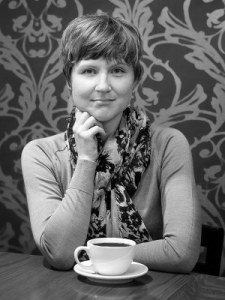
heather slomski

Location: Moorhead, MN

Current project: The Starlight Ballroom, a novel-in-progress

Currently reading: Italo Calvino’s The Complete Cosmicomics, which, just out this fall, brings together for the first time in the states all thirty four of his “cosmicomic” stories.

 1. What type(s) of writing do you regularly engage in?

Fiction. Up until recently—short fiction. Currently, I am working on a novel.

 2. When/where/how do you write?

I write best early in the morning, starting at about 5:30. I either write at the dining room table (to be near the stove for making coffee and the large windows for watching the snow fall, but only if no one else is awake), in my study, or at a coffee shop. I alternate between these spaces, depending on my mood; however, I tend to go in phases. For example, I’ll write primarily in my study for a few months and then relocate to a coffee shop when I feel stifled or need a change of scenery.

3. What are your writing necessities—tools, accessories, music, spaces?

When I am writing at a coffee shop I use a pair of noise-cancelling headphones to block out conversations and the music that the coffee shop is playing. Sometimes I am listening to lyric-free music; often I am just wearing the headphones and not listening to anything. Regardless of where I’m working, I usually only listen to music when I’m using it as a sort of soundtrack for the piece I’m writing. For example, I listened to a compilation of fifty Ennio Morricone compositions while writing “Before the Story Ends,” the last story in my collection. Listening to this album helped me to create the mood I desired for the story. Even now when I listen to that album it conjures up for me the world of my story. Most of the time, however, I am not listening to music. Wearing the headphones while working at a cafe, even though I can still hear the muffled noises around me, provides a kind of mental block—a shield between the noises and me. I often like a little distraction, but not too much. (This is one of the main reasons I like to work at a cafe; it usually provides a suitable amount of “activity.”) Occasionally, however, whether I’m at a cafe or at home, I’ll listen to some jazz or classical music if the silence is too quiet and if I can find something that fits the mood of the piece I’m working on.

I also use my headphones to listen to my works-in-progess. I use a program called Ghost Reader, a text-to-speech converter, which allows me to listen to my computer (the voice I usually use is “Alex”) read aloud what I’m working on. Hearing my work aloud helps me with my sentence rhythms, pacing, and transitions. Before I began using Ghost Reader I would intermittently read my own work aloud as I wrote, but now I prefer to listen to my computer read it to me. Also, when I listen to “Alex” read sections of my work aloud, I enter this sort of in-between space where I am almost reading and writing at the same time. I find positioning myself in this in-between space very productive.

I also keep a stack of books next to me while I’m writing. These are books that in some way relate to what I’m working on, or books that I feel might inspire me, often just by sitting in a stack at my elbow. Occasionally I’ll open one of these books and flip through it. Sometimes I’ll read a random passage or reread a specific passage for a particular reason. Sometimes I’ll open a book to look at its large structure. If it’s a novel, for example, I might look at the chapter lengths. If it’s a collection of poetry I might look at its sections or parts and think about the philosophy behind this organization. (And of course I’ll read an occasional poem.) If it’s a story collection I’ll look at the order of the stories or also its sections or parts if it is divided up in such a way. If it’s a play, I’ll look at the set description, the list of characters, the lengths of the scenes, the way the dialogue and stage directions are laid out on the page, etc. I love going to the theatre for the immersive experience it offers, but I read plays in part for a different reason. I love the way plays look on the page. I am drawn to the white space around the text, which somehow makes the words more three-dimensional and the actions—even subtle ones—more “active.” I am very interested in the relationship between fiction and drama, and I sometimes like to play with this relationship in my work. “The Lovers Set Down Their Spoons,” the title story of my collection, blends these two genres into a hybrid form.

4. What is your best tip for getting started and/or for revision?

I try not to start a story until I feel sure that I have what I need in order to begin. I do think it’s possible, at least for me, to start a piece too early, and maybe not to ruin it but to at least make the process more difficult and less enjoyable. I try not to begin a piece until I have a clear sense of the emotional landscape or mood, equipped with a definite setting, a few key images, and usually a few phrases or lines of dialogue. The emotional landscape is always based on a situation between characters that involves some kind of conflict, even if I’m not exactly clear on the conflict when I start.

On the other hand, I have to begin writing a story before I know too much about it. The act of writing for me is wholly a process of discovery. I discover the story and I get to know my characters as I write. If I know too much when I sit down to write, much of the magic is lost and my writing feels dull. Edward Albee says that he thinks about his plays for a long time before he begins writing them—that he doesn’t begin writing until he knows his characters so well that they essentially write the play for him. While this process clearly works very well for him, it does not work for me. I need the excitement of discovery to breathe life into the words as I write them.

My revision process is pretty standard. When I feel confident enough in a draft, I give it to a few trusted people to read. I am very careful of giving a draft to my readers too early. I need to be sure that I’ve gotten a piece as far along as possible—that I’ve explored what I set out to explore and that I’ve reached a conclusion that satisfies me, at least for the time being. If I give a draft to my readers too early, I run the risk of writing the story that they want to read rather than the story I want to write.

5. What is the best writing advice you’ve received?

On a draft of one of the first stories I turned in for a graduate-school workshop, Stuart Dybek wrote to me to be careful of being precious. This was in reference to a rather tender story, and in a tender story especially there is a fine line between being “precious” or affectatious and being emotionally honest. This was very important advice for me as a young writer. It helped shape my approach to writing in that I try to write with as light a hand as possible; I try to keep myself, the writer, out of the way so that all the reader sees are the characters and the honesty of their emotions. If a writer is too present, particularly in delicate scenes, the writing runs the risk of coming off as forced, false, affectatious, or “precious.” Of course, there is also the danger of being too distant as a writer. This can result in emotionless prose and characters. The key is to strike the right balance.