Author: UofL University Writing Center

Upcoming Workshops, Events, and Writing Groups in the Spring Semester

DSCN3694Laura Tetreault, Assistant Director

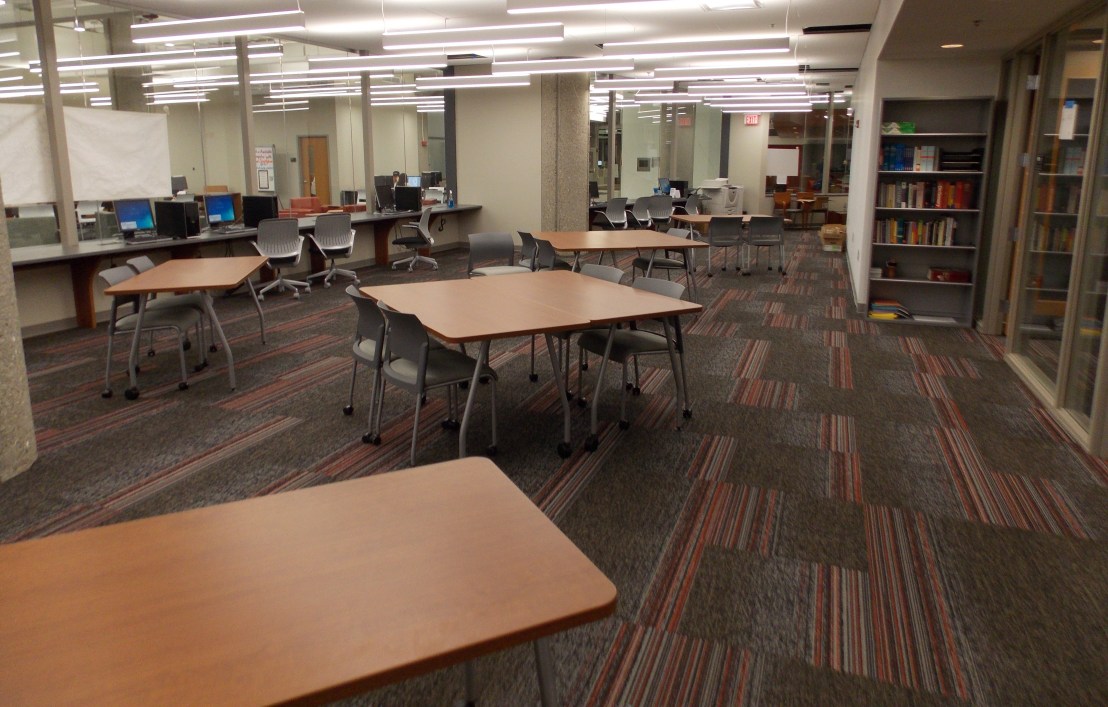
As one of the Assistant Directors of the University Writing Center, I had the privilege of working closely this semester with our staff and consultants to help develop some new projects. We are hoping to use the new, more centrally located space on the first floor of the Ekstrom Library to host some exciting events in the spring semester, with the goal of working with more writers and strengthening campus conversations about writing.

We are hoping in particular to strengthen the Writing Center’s contributions to the creative writing community here at UofL. We enjoying working with many writers completing academic or professional projects, but some may not know that we can also work with any writers doing creative writing—whether for classes or for personal projects. Although I believe that any strict separation between “academic” and “creative” is a false one, I am also invested in expanding the Writing Center’s presence as a welcoming space for creative writers. Many of our consultants this year have expertise in creative writing and are eager to work with students on fiction, poetry, nonfiction, screenwriting, or any other genre.

One of the upcoming projects connecting the Writing Center with creative writing will be a series of three writing workshops aimed at any undergraduate writers. Each workshop will be themed around a specific topic or genre of writing, and we hope for these to be highly participatory. In addition to learning about the overall topic of each workshop, writers will produce work during the sessions through interactive brainstorming and drafting activities. We plan for these to be helpful to writers working on a variety of projects, whether those are for personal, professional, or academic purposes.

The Writing Center is already a space for writers across campus working on a wide variety of projects. We are also thinking of other ways to make our new location a space to bring writers together, build community, and celebrate the creative work that many of our students do every day. With these goals in mind, we are hoping to host events such as a student open mic night.

We are also continuing our already successful graduate student and junior faculty writing groups this spring. Please refer to our website for more information if you are a graduate student or faculty member who would like to participate in a group that provides support, accountability, and feedback for any kind of writing project.

To stay up to date on these and other upcoming projects, please return to this space in the spring for more specific details and feel free to follow us on Twitter at @UofLWritingCtr. We wish all of our readers a restful winter break and a happy holiday season!

 

Writing Center Staff Accomplishments – Fall 2015

The consultants and administrators who work in University Writing Center work to help people become more successful writers and to create and support a culture of writing on campus. Yet it’s important to remember that our consultants (who are all first-year MA students) and our assistant directors (who are PhD students) are also active in their scholarly and creative work. It’s time to take a moment and recognize their accomplishments for the Fall 2015 semester.

Emily Blair had a proposal accepted to present at the Southern Studies Conference in February, 2016. Her presentation will be titled, “The Universal Redneck: Representations of Rednecks and Hillbillies in Contemporary Country Music.”

Cassie Book, Associate Director of the University Writing Center, presented at the International Writing Center Association conference in October. Her presentation was titled, “(W)Centering Multiliteracy: An Unexpected Journey.”

Stephen Cohen, Assistant Director for Graduate Student Writing, will be presenting at the 2016 Conference on College Composition and Communication on “The Rhetoric of Patients: How to Access Care in an Epidemic.”

Cheyenne Franklin had her article, “Quintilian Education and Additive Bilingualism,” published in the journal Queen City Writers.

Jenny Kiefer had her poem, “Between Our Legs: On Women of the Warren County Jail,” published in the journal White Squirrel. Jenny was also selected for an editorial internship at Louisville Magazine for Spring 2016.

Jessica Good was selected for an editorial internship at Louisville Magazine for Spring 2016.

Jamila Kareem, Assistant Director for the Virtual Writing Center, was awarded a Scholars for the Dream Travel award to the 2016 Conference on College Composition and Communication. Her presentation is titled, “Transitioning with Civic Acts of Writing: For Black Students, an Alternative to Pre-College Credit Models.” Jamila also presented at the Feminisms and Rhetoric Conference in October on “Womanist Rhetorical Pedagogy.”

Amy Nichols, Assistant Director of the University Writing Center, has been accepted to present at the 2016 Conference on College Composition and Communication. Her presentation is titled, “The WPA Course: Pursuing Miller’s Intellectual Bureaucrat.”

Laura Tetreault, Assistant Director of the University Writing Center, had a coauthored article (with Bruce Horner) titled “Translation as (Global) Writing” accepted by the journal, Composition Studies. Laura also presented at the Feminisms and Rhetoric conference in October on  “Queer Women’s Slam Poetry as Embodied Performance” and will present at the 2016 Conference on College Composition and Communication on “Queer Action in the Extracurriculum.”

Write In, Build Community

Write In, Build Community

Cassie Book, Associate Director

We’re off to a good start at our new location on Ekstrom Library’s first floor. Since we moved, over 500 writers have visited for over 800 appointments! Yet, another benefit of the new space— location and design— is an improved ability to accommodate larger crowds.

On December 9th we’ll host the first big event in the new space, a Write In. We join nearly 90 writing centers worldwide in the International Write In. The general purpose is for writing centers to create community around writing during a particularly stressful time of the semester. Every center will adjust the theme to its local context. For our Write In, we will simply open our doors for UofL writers to use our space to work on final papers and projects. We’ll provide snacks and handouts; writing consultants will be available to answer brief questions. The Write In forwards our Center’s mission to support writing as integral part of the university and as a lifelong learning process. Just making time to sit and write is an important aspect of any writer’s process!

While the typical daily activity in the University Writing Center takes the form of focused 50 minute consultations, the Write In offers a comfortable and motivating space to write. So, if you’re UofL a student, faculty, or staff and could use a break from your usual writing routine, drop in on Wednesday, December 9 from 6-9 p.m. in the University Writing Center.

DSCN3762
The New University Writing Center on Ekstrom Library’s first floor will host its first big event, a Write In, on December 9.

Watch Your Tone: The Sound of Academic Writing

Rhea Crone, Consultant

Most of us have received corrections, or suggestions for revision, on papers handed back to us by professors. Some of these comments are straightforward; “awkward word choice,” “incorrect spelling,” or “subject/verb disagreement” come to mind. Some comments, however, aren’t so clear. Among those in the latter camp are the dreaded question marks, free-floating in the margin; nefarious squiggles beneath phrases, sentences, or worse, entire paragraphs; and of course, some of the most loaded comments of them all: those suggesting a revision to “tone.”

DSCN3687So, what exactly does “tone” suggest when written in a margin? Isn’t it a term used to describe the way something sounds? How can a paper sound wrong, and why is any kind of sound significant if the paper’s argument is sufficiently advanced? Moreover, why must academic writers use one tone over another, and for that matter, why must we use any kind of tone, at all? There is no single correct response to any of these questions. In fact, in composition studies—a field that aims to simultaneously promote a sense of authorial ownership in writers of all levels, study the individual styles and needs of writers, and develop the most effective ways to teach everyone to write as effectively as possible—there is a long standing tension between those who say academic writers should not have to adhere to a specific “tone,” at all, and those who say that we must.

One has to wonder if there is a consensus on any aspect of such a debatable, fissured topic. Luckily, a set of general guidelines regarding the term itself exists. These guidelines usually take into account the following, give or take a few preferences or nuances depending on the reader/grader of a paper:

  • Use of clear and direct language, or the “active voice”;
  • Avoidance of personal pronouns, especially “we, you, you all, I,” etc.;
  • Omission of colloquialisms and/or regionally various terms and phrases.

To extrapolate from this short list a bit, academic tone is generally used so that a writer can quickly and effectively get their point(s) across, and so that the reader does not have to overexert themselves trying to understand what the author is saying. Academic tone also typically foregrounds information and argumentation, and demands that prose not sound as if it is merely the expression of an author’s opinion. Overall, this “tone” hinges on the following values: concise communication, and the establishment of authorial credibility. It also assumes that the reader of an academic paper wants to know, first and foremost, what the paper is talking about; and, of course, that the author of the paper knows what they’re talking about. Furthermore, use of the academic tone does not simply assume a certain reading style on behalf of a paper’s audience, but is ultimately an expression of respect for the reader. It does not, for example, ask the reader to believe unsupported claims, spend more of their time than necessary on reading through a paper, or require them to exert more mental energy on working through an argument than is necessary.

Now that we know what academic tone is, and why writers might want to use it, we can better understand the consequences of failing to use it correctly. These consequences don’t always result in a few required revisions or a point deduction. Indeed, academic tone can sometimes be broken with/from to great effect. Practiced, seasoned writers will sometimes switch their tone briefly, in order to emphasize a particular aspect of their argument. For example, placing a casual aside in parentheses, or including a quote from pop culture, can be used to draw attention to, and/or make a bit clearer, an important passage. In order to effectively break with/from academic tone, however, one must first understand and utilize it well. The reason for this is twofold: to borrow an adage, one must first understand a set of rules in order to break them, and the overall tone of a paper must be academic in order for a divergence/variation in that tone to be noticed at all, much less to great effect. If this tone is not broken pointedly, with some kind of rhetorical purpose, the author runs the risk of losing the attention and/or the comprehension of the reader, frustrating the reader, intellectually fatiguing the reader, losing authorial credibility, and/or needlessly obscuring an argument.

No blog post on academic tone would be complete without a disclaimer regarding various academic disciplines. Of course, not every discipline will require that papers be written in/with an academic tone. This is primarily because different disciplines address different audiences, and therefore value and judge tone differently, and sometimes it will not be necessary to write in a strictly formal, academic tone. Further, regardless of discipline, the occasional professor will encourage informal tone at various (more than likely initial) stages of any given writing assignment. Usually, however, it is best to assume that the academic tone is valued and will be expected in/of the majority of your papers.

Ya dig?

For further and/or more specific information on academic tone, please feel free to peruse the following sites:

Five Tips for Interpreting Writing Prompts

Cheyenne Franklin, consultant

The writing prompt. This piece of paper is your ultimate guide through what can feel like endless avenues of ideas or a desolate blank page. But sometimes these precious few words from instructors can seem like an encoded script. Well like any code, there is a key. Here are some secrets I’ve learned to interpret assignment sheets.

Secret #1: When you don’t know where to begin…

DSCN3677Look for keywords. Certain words go with particular writing genres. If you see words like argue or defend, then your instructor is likely looking for an argumentative essay, so be sure to take a clear stance and use evidence to support your claims. Rhetoric(al) refers to the intentional strategies that people use to make an argument. So if this keyword appears in your assignment, your instructor either wants to see you making strategic moves in making your argument or wants you to discuss the strategies used by the author of a text you’re studying. In the second case, you’ll want to write an analysis, so DO NOT just summarize the text.

For more key writing prompt words, see the key terms section of the UNC Writing Center handout on Understanding Assignments. You also might enjoy this blog post on “Deciphering Common Keywords in Assignment Prompts,” written by one of our previous consultants.

Secret #2: When you’re unfamiliar with the genre…

Determine what the purpose of the assignment is. Assignments have two types of purpose: an academic purpose and a real-life purpose.

To determine the first purpose, think about what skills your class has discussed. Instructors make assignments to give you a chance to show what you’ve learned. Consider what has been emphasized in class recently. Can you put this knowledge to practice in the assignment?

The second purpose requires you to use your imagination. Remember that college writing is to prepare you for real world writing. Imagine your audience extends beyond your instructor. What goal might you have other than a grade? Now how should you approach the assignment to accomplish that goal?

See Duke University’s list of college essay genres for a description of each genre and its characteristics.

Secret #3: When you’re told not to have a thesis…

Think again. What about the assignments that forbid “personal opinion?” Isn’t a thesis an opinion? Well not in an academic sense.

What instructors mean when they warn against personal opinion is that you should not make claims based on personal feelings. You should make claims based on statistical or textual evidence, reliable resources, and clearly drawn logic. Your instructor will almost always look for a main point in your essay (aka a thesis). Just make sure the thesis is your analysis NOT your opinion.

Secret #4: When your assignment includes a quote…

You cannot ignore it. Some assignment sheets include a passage from a text you’ve studied in class. Although the instructions might not directly ask for you to address this quote, you should reference it somewhere in your essay unless otherwise instructed.

Secret #5: When you still have no idea…

It’s time to talk to your instructor. Remember that your instructor wants you to understand the assignment and wants to know if it’s unclear. Most instructors revise their assignments based on the responses they receive, and if you’re confused, there’s a good chance others are too. Just be sure to discuss your confusion respectfully. You’ll save yourself a lot of time and worry.

In the end, your instructors don’t mean for their assignments to confuse you. Still, we all encounter certain prompts that confuse the inspiration right out of us. As you gain more experience with the lingo and genres it will get easier.

What Justin Bieber Can Teach You about Genre

Jessica Good, Consultant

biebergenreJustin Bieber’s new single, “Sorry,” blends related genres— the rhythmic pulse of electropop, the warm notes of tropical house, and the verse-chorus structure of pop—to create a danceable plea for forgiveness. While we typically discuss artists in the context of music, Bieber’s lyrics cross into a genre of writing: the public apology.

Genres in writing categorize recognizable patterns of organization, tone, and style. We can recognize Bieber’s song as a public apology because it conforms to a pattern established by politicians and celebrities before him. Effective public apologies (like private ones, let’s be real) are organized around a series of rhetorical moves:

  • Initiate communication with desired audience
  • Admit to making a mistake
  • Acknowledge the consequences of that mistake
  • Explain perspective of the situation (if appropriate)
  • Express remorse
  • Ask for forgiveness

Additionally, the tone is penitential, while the style is appropriately descriptive. Apologies tactfully allude to what was done without delving into the nuances of the initial conflict. The primary differences between our private apologies and Bieber’s public one are those of audience and context. We address individuals to mend relationships, while, in “Sorry,” Bieber moves to redeem his reputation to an anonymous ex who represents the listening public as a whole.

DSCN3626Although we often reserve the labels of genre for public texts, we routinely communicate in different genres. Those emails you send to your instructors? There’s a genre for that: professional communication. Did you send your aunt a card expressing how excited you are about the concert tickets she sent for your birthday? That’s the thank-you-note genre, one you probably learned all too well after your high school graduation. In both of these cases, like in the instance of an apology, a rhetorical context prompts you to enter into certain conventions of organization, style, and tone. Abiding by those conventions enables you to effectively communicate your purpose to your audience.

While genre is certainly a label that we can apply to published writing, it can also act as a guide to forming texts as we write. When you approach your next writing project, consider asking yourself:

What is the context?

Context refers to the broader situation undergirding the occasion of writing. As a student, your context is often academic. Your instructor issues an assignment, usually by handing you a prompt and a rubric, and expects to receive a final draft on a specified date. In this case, your broad situation will include the texts you’ve read and the discussions you’ve had in class; the occasion for your writing is the assignment. You can pull from the knowledge gained through your situation as a class participant to effectively manage that assignment.

We often assess context unconsciously, but pausing to identify it will help lead you to the appropriate genre.

Who is your audience?

Part of the context of any writing situation will include your audience, or who you’re writing to. Since your audience most likely includes your instructor, keep in mind any expectations (s)he may have. Look at your prompt: what is emphasized? How is the assignment structured? Does it call for outside research, or is it primarily textual analysis?

Try to remember that even though your instructor may be your most prominent audience member, the act of academic writing propels you into the past and current research surrounding your topic. Consider if you need to include information showing how your argument enters into or even advances that larger conversation.

What are the conventions?

Conventions are rules of organization, style, and tone. You’ll approach a 4-5 page rhetorical analysis differently from an abstract of a lab report for your chemistry class because of the different standards associated with each of them. When writing in the rhetorical analysis genre, you’ll construct a thesis; emphasize active voice and an objective tone; and provide in-text citations in MLA format. In contrast, you may adopt passive voice in your abstract to emphasize the results rather than your presence as the scientist. Your citations may be in APA or another style to emphasize the timeline of work by previous researchers.

Knowing the conventions of your chosen genre will enable you to effectively communicate your intended meaning to your audience.

(Not to blow your mind, but knowing conventions also gives you the power to break them for rhetorical effect. Read more here!)

What is your purpose?

Finally, but most importantly, remember your purpose. Conventions are only a frame through which you make your argument. Focus on the point you want to communicate. Your audience should come away aware of your thesis rather than your chosen style or the tone with which you engaged sources.

So, what can Justin Bieber teach you about genre? Besides pitting your friends who like his music against those who don’t, he shows us that genre is common to communication, not just libraries and bookstores. No text is produced in isolation; there is always a rhetorical context informing its construction and reception. As a result, every text you create abides by the conventions of a genre to effectively advance your purpose.

Genre can be a powerful tool—if the Biebs can use it, you can too.

Reasons for Differences in Citation Styles

Deanna Babcock, Consultant

DSCN3612

Before deciding to start on a Master of Arts in English, I had actually gotten my first Bachelor of Arts degree in Psychology. Switching from social sciences to humanities was harder than I’d expected. One of the most difficult problems I’ve encountered is navigating between two distinct writing styles. Each field has a different set of expectations and values for writers, and these expectations are not immediately easy to recognize or grasp.

The values of each field, however, are identifiable in their chosen citation styles: American Psychological Association (APA) for many social sciences fields; Modern Language Association (MLA) for humanities. These are usually seen just as ways to avoid plagiarism, but the styles reflect the values of the fields that use them. Students are not often given reasons behind why one field uses APA and another uses MLA, or why other fields use additional styles.

While there are several differences between APA and MLA, I have chosen to focus on five of the most significant factors to highlight the expectations of each. Understanding of these differences can help writers identify what a particular field values and why, making writing in said field a less intimidating venture.

  1. Structure

APA is often very structured. Most guides to using APA provide a list or sample of subheadings that are recommended for research reports: Introduction, Methods, Analysis, Results, and Discussion. MLA is less structured and does not suggest using subheadings, though they can be included. This is one reason MLA seems less formal than APA, as the structure and layout are of little importance in the former.

  1. Ideas

In APA, collaboration between authors is important. Researchers build on past work from other scholars to emphasize progress in the field (Dowdey 339). Experiments may be replicated to the very last detail if researchers hope to find new results, or to ensure the results of the first experiment were logical. Original ideas are less important than the methods and results of a study. On the other hand, new ideas are crucial when writing in MLA. The humanities fields value creativity and unique interpretations.

  1. Quotations and Paraphrasing

Paraphrasing is more common in APA papers than quotations. The reason is similar to the previous point: in APA, the results and the data are generally more important than a scholar’s exact words (339). Rephrasing the main ideas from a source is usually sufficient. Quotations are more commonly used in MLA, where exact wording is more important. English studies in particular consider a primary source – a book, for instance – to be almost sacred (333). This also leads to page numbers being so important in in-text citations to give readers the opportunity to reference the work. Direct quotations are preferred over paraphrasing in order to respect the author’s words and to avoid potentially misrepresenting ideas by changing the words.

  1. Importance of Years

Many writers are confused about the use of publication years in in-text citations of APA. The reason for putting the years is to show whether sources being used are recent or not (339). In the social sciences, research that is decades old may be outdated, while more recent studies may contain updated information based on further development of knowledge. The year of a work hardly matters in MLA, which deals with books, art, and music that can be centuries old. This also explains why the date in APA is second only to the author on the reference page, and is one of the last things listed in MLA (334).

  1. Evidence and Interpretations

When it comes to providing evidence to support an argument or idea, APA frequently uses data and statistics (338). As the focus is scientific in nature, numbers are crucial for proving a point. In MLA, evidence comes in the forms of quotations, especially from primary texts (332); discussion of a novel, poem, or work of art must include specific references to that work. An author’s individual interpretations and arguments must be backed up in these same ways: data for APA, support from the given text(s) for MLA.

The differences between these two citation styles reflect what is important to the fields that use them. Recognizing the differences and their reasons makes it easier to understand why each style requires certain things, and easier to write for the conventions in a particular style or field.

Dowdey, Diane. “Citation and Documentation Across the Curriculum.” Constructing Rhetorical Education. Ed. Marie Secor and Davida Charney. Carbondale: Southern Illinois UP, 1992. 330-351. Print.

Welcome to the New University Writing Center

Bronwyn T. Williams, Director

Welcome to the new University Writing Center! On Friday we moved to our new, larger space on the first floor of Ekstrom Library. After fifteen years on the third floor, we’re excited about being in a space that is larger, more convenient and easier to find. We’ve always believed that writing is at the center of the intellectual life of the University, and now

The New University Writing Center

we have a space that is even more at the center of the daily life of the students, faculty, and staff with whom we work. We want to use this space to continue to support and nurture a culture of writing at UofL. Our mission is to support and celebrate writing of every kind, from course assignments to dissertations to job letters to poetry. We think the new space will allow us to continue to engage in that mission and offer us the opportunity to realize plans and initiatives that we’ve had for a number of years. The central location of the new University Writing Center space, just to the left as people enter from the east doors off the Quad, will also allow us to collaborate with Library Reference and other offices.

Although our location – and furniture – is new, our fundamental work will not change. We will continue to work with anyone in the University community on any kind of writing and at any point in the writing process. We will continue to offer individualized response and advice to writers about their current writing projects and any other concerns or questions they have about writing. We will continue to help writers with their current projects, as well as offer advice and suggestions that can help them succeed in future writing situations. That said, there are some new features to our new space that will allow us to grow in important ways. For example, our new University Writing Center includes have multimedia consulting rooms where we can work with multimodal assignments as well as conduct online, video consultations with distance education students.

We also plan to start using the new, more visible University Writing Center space for other writing-related events and activities. We will continue to use the Writing Center for meetings of our Junior Faculty Writing Groups, and plan to start offering writing group activities for graduate students and for undergraduate creative writers. Keep an eye on our social media and website for more news about these opportunities. We also hope to hold other writing events in our new space, DSCN3765such as readings by student and faculty writers.

It is important to thank Dean Bob Fox, of the University Libraries, for his vision and ongoing support that made this space possible, as well as Dean of Arts and Sciences Kimberly Kempf-Leonard for her support that allowed us to have new furniture in the Writing Center.

In January we will hold an official re-opening celebration, and we hope you will join us then to celebrate writing and writers at UofL. In the meantime, come by and see us and enjoy the new University Writing Center.

Feedback Isn’t a Snowflake: Handling Revision Anxiety

This weeDSCN3615k, consultant Karley Miller shares her strategies for navigating multiple (and sometimes conflicting) pieces of writing advice.

My last writing project took me a month to revise. I set a goal to have revisions completed in a week, used that week to think about getting started, then spent the next three weeks stressed about not having met my own self-imposed deadline. Did someone say writing is a process?

Since I sent my revised draft off to receive more feedback, I’ve had some time to think about the source of my revision anxiety. Feedback. It’s potentially the most important, and confusing, and anxiety-inducing thing (for me, at least, and maybe you too). So, feedback is important (you’re writing for an audience, right?). Not only is feedback from one person important, feedback from multiple people, if possible, is even more important. Feedback, especially from multiple people, can be confusing. Each person comes to a piece of writing from a totally unique perspective. No two people are completely alike—neither is their feedback. This isn’t to say that feedback exists, from each source, as its own special snowflake of insight, but the differences in opinion are large enough to create, like, anxiety frostbite if you spend too long scrutinizing them. Maybe that’s a stretch, but sifting through feedback in order to improve a draft can be stressful, which is why I want to share, with anyone who has been kind enough to read this far, my favorite new piece of writing advice (not claiming it as my own, rather it has probably existed since our ancestors scratched petroglyphs into cave walls, and only just now reached me): writing is much about learning when to listen and when not to.

This is not to say that revision anxiety is cured by seeking feedback from two different people and deciding, after reading their comments, that one person doesn’t know what they’re talking about. It is to suggest, however, having a little faith in your own purpose. By the time you’ve received feedback from multiple people, you’ve spent hours turning your thoughts into words on a page. I don’t believe you can write a sentence without some idea of what you’re intending to communicate. This is where learning when to listen, and when not to, comes in. If you have a clear idea of your argument, or your story, or your sentence, for example, not every single word of feedback is going to help you better communicate that idea. For example, if I write, “Feedback isn’t a snowflake,” and you say, “This makes no sense,” I’m not going to change my idea (because I am, at this point, very wedded to the idea that feedback can be compared to a special snowflake but is not, exactly, one), but I might, in my blog, try very hard to explain it because your feedback let me know that I was unclear, and I, myself, am able to understand that this sentence is a stretch. If I can’t explain it, maybe I should cut it.

Moral of the story? All feedback should be taken into consideration, and applied only after you are sure making the change won’t alter your message. Unless, of course, feedback makes you reconsider your message (argument, etc.). In which case, good luck, and the Writing Center is here to give you even more feedback on a new and improved message. Although, as you can see, it’s a process for everyone (very seriously considering revising this blog about feedback/revision to exclude the snowflake comparison, although now I’m thinking the winter theme works nicely with the change of seasons).

You Can’t Teach That: Facilitating Discussion on Tutor-Writer Rapport?

DSCN3709Amy Nichols, Assistant Director

As one of the assistant directors at the writing center, I have the opportunity to teach two lessons in Bronwyn’s “Writing Center Theory and Practice” course, where our graduate consultants receive training during the fall semester. Recently, I facilitated one of our class discussions around “Student-tutor relations in the Writing Center.” Writing center sessions can include wildly varying levels of language and disciplinary expertise between both tutors and writers, making relationship-building critical to successful communication. In addition, rapport is also a crucial (and under-discussed) part of being a successful student, employee, or person generally.

Building individual relationships, particularly in professional settings, is a complex and deeply contextualized activity, and most of what I know about it is instinctive, built on trial and error over time. Because of this, I had a difficult time planning our lesson. For our discussion, I ended up choosing two recent articles from the journal Language and Education: Cynthia Lee’s (2015) “More than Just Language Advising: Rapport in University English Writing Consultations and Implications for Tutor Training” and Innhwa Park’s (2014) “Stepwise Advice Negotiation in Writing Center Peer Tutoring.” Lee’s focus on individual elements that go into building a relationship and Park’s discussion on how to deal with minor disagreements helped us find a way in to this difficult-to-teach subject.

Lee’s framework pulled from discourse and rapport scholarship to detail descriptions of the kinds of behaviors that we often take for granted: greetings, small talk, qualifiers/mitigation devices, open-ended questions, first-person plural pronoun use, and praises/related forms of encouragement (436). Saying hello and chatting about unrelated matters tend to be givens in social interaction, but they can also help ease the tension when two people don’t know one another well. Qualifiers such as “maybe” or “perhaps” and open-ended questions such as “Can you tell me more about your goals for this project/assignment?” help build understanding and ease discussions around disagreements. First-person plural pronouns like “we” and “us” are helpful in creating a more team-oriented work environment during sessions, while encouragement and praise help build confidence.

I don’t know about the consultants (feel free to comment!), but it was really helpful for me to have a conversation about those elements of a writing center session that often go unrecognized and (seemingly) unnoticed, but which can make a real difference to the success or failure of a session. For example, a few of our consultants shared that small talk tends to make them uncomfortable, particularly if students responded to small talk by discussing their frustration with particular assignment or situation, while another shared that she sees such situations as an emotional opening to help writers address their concerns. Understanding a variety of approaches to such small interactions and the rationale beneath them gave me more resources for interacting with a variety of personalities.

Park’s article details the ways in which advice resistance is a negotiated construction for both the tutor and the writer. She discusses the steps that resistance, acknowledgment, and resolution move through within sessions, and I thought her work might prove a helpful springboard for discussing the ways in which we negotiate advice resistance in our own sessions. We did discuss ways that we tend to navigate through (or around) resistance during our discussion. One of our consultants commented that, while she was aware of her own intentional practices in navigating resistance, she had not thought about the fact that writers might also follow certain linguistic formulations in constructing their resistance, such as saying “Yes, but what I was really trying to do there was….”. We also discussed the ways in which people from different classes and cultures might navigate resistance more or less directly than the examples in the article, which led one of our consultants to ask a very helpful question about balancing a knowledge of intersectionality (every person is different) with strategic approaches to consulting (we have to apply concrete strategies to our work).

Ultimately, I enjoyed our discussion, but I would love to hear some comments. Consultants, how did the session go from your perspective? Colleagues (and that includes you, too, consultants), how would you/do you encourage productive discussion on building relationships/rapport during writing center sessions? Writers, what kinds of discussions have been most helpful to you in moving your writing forward?