Our “How I Write” series asks writers from the University of Louisville community and beyond to respond to five questions that provide insight into their writing processes and offer advice to other writers. Through this series, we promote the idea that learning to write is an ongoing, life-long process and that all writers, from first-year students to career professionals, benefit from discussing and collaborating on their work with thoughtful and respectful readers.
Dr. Jose M. Fernandez is an Associate Professor of Economics in the College of Business. His research is in the areas of crime, health, and industrial organization.
Current project: “Less Alcohol, Less Service: Do local alcohol bans affect the number and mixture of full and limited service restaurants?”
Currently reading:Dollars and Sex, Naked Money, and Harry Potter & the Cursed Child.
What type(s) of writing do you regularly engage in?
I primarily write for scholarly journals in economics and health policy. These articles tend to be technically dense filled with economics jargon, tables, and equations.
When/where/how do you write?
I need a fairly quiet place to write with few interruptions. The few interruptions is key for me. This usually means I am writing in my office after hours when my colleagues and students have gone home or at my house while my wife is at work and my children are at school.
The interesting part to being an academic researcher is to find the answer to a research question. You do all this work with data collection and analysis just to be the first person to better understand this little corner of our world. It is a thrilling high that comes with the job, but all this effort goes to waste if we do not share it with everyone else. Therefore, we write afterwards. When I write my papers I actual start in the center. Since I am a data head, I first write the data description and analysis sections of the paper first.
Next, I write the literature review. There is an old saying that goes, “if it is good it isn’t new and if it is new it probably isn’t good.” This quote always reminds me to look into the scholarly literature for the works of others that inspired or contributed to the question and answer that I am presenting.
Lastly, I write the introduction and the conclusion. I write these pieces last because they are the most important. We live in a world with information overload, you need to grip the reader’s attention in that opening paragraph. You need to convince them that their time is worth reading the next 30 pages. If you can’t achieve that, then you want to at least explain the question and tell them the punchline by the time they have reached the end of the introduction even if they skimp on the details.
What are your writing necessities—tools, accessory, music, spaces?
I mainly need my computer with a word processor or Latex editor, my statistical program, and google scholar. I do not really play music unless I am cleaning data.
What is your best tip for getting started and/or for revision?
My best advice for revisions is to read your paper out loud. Your brain tends to fill in missing words for you when you read silently, but out loud it is easier to catch. Secondly, I recommend printout your paper or using MS Words track changes, get some coffee, and a red pen. Much of my revisions are taking sentences and first making them into the active voice. In the second pass my goal is to make the sentences shorter and remove grammatical/spelling errors.
For writing scholarly papers in general I like these two resources: Economical Writing by Deirdre McCloskey and, for students, an Economics sample paper.
What is the best writing advice you ever received?
I received two pieces of advice that have helped me with my writing. First, THERE IS NO SUCH THING AS A PERFECT PAPER. This phrase will help you get over the anxiety of writing in the first place. Your first draft should be rough. It should be a brain dump where you get everything you wanted to say about the topic down on paper. This will get you started and revisions will take care of the rest. The second piece of advice is for when you are stuck. I tend to write in bulk, but if I am not feeling creative or inspired that day I force myself to write at least one page. This single page serves several purposes. I have something concrete to show I have worked today. Next, it has started me to think more about the topic. The best part is that even if you do this every day for a month you will have a paper done by the end of the month.
Our “How I Write” series asks writers from the University of Louisville community and beyond to respond to five questions that provide insight into their writing processes and offer advice to other writers. Through this series, we promote the idea that learning to write is an ongoing, life-long process and that all writers, from first-year students to career professionals, benefit from discussing and collaborating on their work with thoughtful and respectful readers
Joey Wilkerson is a 2L at the Brandeis School of Law. He received his bachelors in English from the University of Louisville and his Masters in Communication from Bellarmine University. His goal is to work in criminal law and one day be a judge.
Joey is also the Program Coordinator Senior for the African American Male Initiative in the Cultural Center.
Current project: Asteroid Mining- The Environmental Cost
Currently reading: Problems in Criminal Law
What type(s) of writing do you regularly engage in?
These days, the bulk of my writing is dedicated to legal briefs and legal memos.
When/where/how do you write?
Typically I write either at home or in the office.
What are your writing necessities—tools, accessories, music, spaces?
Mac Book Air, bourbon, 90’s movies on TV.
What is your best tip for getting started and/or for revision?
Read your papers aloud. When you hear it verbally, you can catch a lot of mistakes.
You’ve picked a paper topic, done some research, and now you’re ready to begin writing that term paper. Or maybe you’ve just struck on a bit of inspiration for a new poem, or a short story—maybe even the next great American novel. There’s only one question left: Where do you go to write?
The question seems simple, but sometimes the answer isn’t. Over the years, I’ve had to do a lot of writing, and one factor that has turned out to be crucial for any writing project I’ve undertaken has been my writing environment, the physical places and spaces I inhabit while writing.
Researchers have taken an interest in how material environments and writing tools can aid or inhibit writing. In a study of how college students’ “composing unfolds materially through space and time in a mobile culture,” Stacey Pigg observes, “While the materiality of academic writing easily slips under the radar, how students access and incorporate places and technologies in composing habits outside classrooms may be one of the most important determinants of their success within them” (271). In other words, the places where we write, and the technologies we employ in our writing (i.e. pen and paper, laptops, desktops, typewriters, stone and chisel, etcetera) constitute foundational elements of the composing process.
Indeed, as examples of famous writers illustrate, writing is often a ritualistic, idiosyncratic process deeply rooted in particular environments and surroundings. Mark Twain reportedly wrote while lying in bed. Dylan Thomas had his writing shed where, legend has it, his wife would lock him up each day to ensure he got some writing done. Similarly, Virginia Woolf sometimes wrote in a toolshed she had converted into a “writing lodge.” Sir Walter Scott apparently liked to compose poetry on horseback.
I find other writers’ writing places and spaces interesting and inspiring, but not all of us have access to a cozy writing shed overlooking rolling English hills—or a horse to sit astride, if you’re interested in that sort of thing—while we write. So where do we turn to carve out writing spaces for ourselves?
Perhaps the local coffee shop. As Pigg suggests, “Informal public spaces such as cafés, coffeehouses, and commons areas serve as commonplace productive locations for many writers” (261). Pigg further explains that such environments often provide Wi-Fi to support mobile laptops, or in-house desktops in commons areas. These spaces thus offer technological access in addition to “clean space” where writers can concentrate on their projects (261).
Public spaces help many writers write, but they are not ideal for everyone. A quiet-seeking introvert at heart, I’ve learned that coffee shops—even library study areas—are not great writing spaces for me. I’ve tried to write in such places, only to realize I don’t really feel comfortable in them, or there’s too much going on for me to focus. Consequently, I’m unable to do much writing in those environments. Though the café or common area are good work areas for many, I’ve discovered that I do better by writing in my bedroom at home. There, I have a small, worn desk and lamp that help me settle into writing. The environment is a quiet one where I feel comfortable and able to focus (most of the time). In addition, writing at home better accommodates my idiosyncrasies. For example, while I write, I like to take breaks to stand up and pace around a bit, a practice I’m not exactly comfortable trying in a coffee shop. I also like the convenience of being down the hall from the kitchen if I want a snack or a drink of water, or in case I feel like brewing some coffee or tea. In short, at home in my room I simply feel a greater sense of quiet and am consequently able to get more writing done.
All of this rambling is simply to say that if the coffee shop helps facilitate your writing, or the park bench, or the library, or maybe a room at home, go there and write. If you find you’re stuck in a rut, consider seeking out a different writing space for a while and observe whether or not the new environment helps you break through your writer’s block. We all have to write somewhere. Learning which environments are most conducive to our writing practices can help us demystify writing and develop our composing processes in productive ways.
Works Cited
Pigg, Stacey. “Emplacing Mobile Composing Habits: A Study of Academic Writing in Networked Social Spaces.” CCC 66.2 (2014): 250-75.
There are so many help systems and articles designed to help you write a research paper, but what about all us Creative Writers out there? Who is going to guide us through the chaos that is a printed rough draft with a coffee stain in the center or a Cheetos smudge on page seven? If you have taken any Creative Writing classes, chances are you have had a chance to workshop your pieces in class, but where do we go from there? What pieces make it into our portfolios, and how do we make all the peer reviews when they are often telling us differing or conflicting suggestions?
Here are some notes about my method for pulling together a portfolio:
Phase 1: What to Include
Drafting a poetry portfolio is going to be different from drafting a short story portfolio, but the method can be the same. Start small, go through and pull out your best pieces. Look at your feedback, what did you peers identify as your strongest work? When deciding which pieces I want to include, I always look back at the speaker’s voice. I start by identifying which speakers are the most honest or believable. I had a peer in undergrad that would say, “I am not buying this line,” and it became my goal in writing and revising to ask myself: is this believable, will my reader buy this? And I challenge you, reader, to do the same.
Phase 2: Making Revisions
After pulling together the pieces you (and your peers) identify as your strongest pieces, collect all your peer reviews on each of them (hopefully, you still have them hanging around somewhere). I put all the peer revisions and notes in one pile and have a freshly printed copy in the other. Now, begin reading more thoroughly through those comments, noting which ones you like and find most effective. As you identify which changes you would like to make, write them onto your clean copy. This helps give yourself a base while also eliminating some of the chaos.
Phase 3: More Revisions (they never truly stop)
What if some of your peers recommended you change something in your piece? Do you have to listen to them? Although this might depend on their suggestion, please do not feel the need to change something that you do not feel comfortable with. As the writer, if you feel as though you are not doing the writing justice, that might be a sign to leave that detail, image, or word. Most importantly, if you do not change something, make sure that you can justify that choice.
Phase 4: What Time is it?
Get some sleep. I promise you will make more errors and have more typos on a lack of sleep than you will well rested. Along with lack of sleep may come lack of motivation, and you might find it difficult to convince yourself to read back over your revisions. I repeat, get some sleep. Your work will still be there in the morning—provided you didn’t forget to save it while surviving on coffee and Cheetos. When you come back to it in the morning, try reading your work aloud. This can help you hear how something sounds and allows you an opportunity to locate the typos you may have glanced over while skimming the piece.
Phase 5: Come to the Writing Center
We love Creative Writing pieces, and we do not get enough in here! Creative Writing work can be more personal, but as writers ourselves, we understand that the speaker’s voice does not necessarily coincide with the author’s voice. As tutors, we do not need to know if a piece is non-fiction or fiction, and we can help you through whatever part of the writing process you need help with.
I hope you found these notes helpful as you go forth into the world of revising and editing. Stand strong; you can do this.
Franklin Roosevelt, in 1938 in face of the rise of fascism around the world, had this to say about the role of education in politics:
Democracy cannot succeed unless those who express their choice are prepared to choose wisely. The real safeguard of democracy, therefore, is education. It has been well said that no system of government gives so much to the individual or exacts so much as a democracy. Upon our educational system must largely depend the perpetuity of those institutions upon which our freedom and our security rest. To prepare each citizen to choose wisely and to enable him to choose freely are paramount functions of the schools in a democracy.
This quote has been on my mind the past few days in the run up to, and in the wake of, the recent presidential election. I’ve been thinking about the role of education in civic and political discourse and, more specifically, the role we should play in such issues in the University Writing Center. We have always welcomed and worked with writers from every political position, and that will not change. Our goal will continue to be help each writer become a stronger writer, but also to create writing that reflects ethical critical thinking and a commitment to civil discourse. Still, I think there is more to be said, and more to be done, on our part. Although it may seem that an organization of fewer than 20 people in a large university and larger city is limited in the impact it can have on such issues, I believe that the daily work of small groups of committed people is one essential way that education – and by extension, change – happens. At this moment, then, I want to make a more explicit, more emphatic statement about the principles we hold in the University Writing Center and the actions we intend to take to support those principles.
An Inclusive, Safe Space: The University Writing Center Mission Statement says that “The Writing Center is dedicated to being a safe, inclusive environment. We work to make the Writing Center a welcoming place where writers feel comfortable bringing the diverse range of perspectives found in the university community.” There is nothing wrong with that statement. Yet, I want to be clearer about what it means today when friends and colleagues whose identity positions – whether by race, religion, gender identity, sexual orientation, disability, cultural background, or others – are making them feel further marginalized, silenced, and threatened. We need to be more than welcoming. We need to be advocates. We need to be activists. We will renew our commitment to making the University Writing Center a place were writers can express their identities and be assured that they will receive a respectful and supportive response. Trust and safety are key elements to writing and teaching and we will continue to work as a staff to educate ourselves, listen carefully, and reflect on issues of identity, language, and power so that we can respond as allies and advocates for writers in the UofL community. We will also work harder to get the word out about this aspect of our work in University Writing Center sessions.
Supporting Writing on Campus and in the Community. We will commit ourselves to more events and activities that support the writing and voices of people who feel silenced and marginalized in our culture and that engage conversations about the political nature of reading and writing. We have been engaging in these kinds of activities through our LGBTQ Writing Group, our events during Banned Books week, and our plans to celebrate International Mother Language Day in February. We will continue with our plans to engage in literacy tutoring in the community through Family Scholar House and the Western Branch of the Louisville Free Public Library to support the writing and expression of ideas of people in the city. At this point I do not know what other events we will be planning. I want to listen to the community, in and out of the university, to think about how best we can support literacy practices that are empowering on both an individual level and community level. We will also renew our commitment to be part of conversations about the role of writing in culture and politics.
Education and Civil Discourse: Finally, we will continue to do what we do best: Educate. Our mission statement also says that we consider “writing to be an indispensable part of the intellectual life of the university as both a vital means of communication and an essential tool for learning.” What is not explicit in that statement, but is part of our mission and identity is a commitment to critical thinking and civil discourse. We will work with all writers, from all political viewpoints, to help them learn how to create arguments that are evidence-based, nuanced, and engage respectfully with opposing points of view. We will work with all writers to encourage a discourse that, even when in opposition, is respectful of the humanity of others. We will engage in conversations that help writers understand the influence of culture and systems of power on issues of education, language, and learning. We will work to help writers understand how their identities are positioned by larger cultural ideologies and narratives and help them explore options on how to communicate their ideas most effectively to their intended audiences. We will continue to believe in and advocate the value in listening, and responding, thoughtfully to the ideas of others. We regard empathy as a strength, not a weakness.
We will do our part, small though it may be, to keep communication and conversation going. We will continue to work toward writing that connects our minds and our shared humanity.
It’s about this time when you’re starting to freak out. Deadlines and commitments and all that heavy, heavy, jazz. Caffeine consumption is at an all-time high, sleep at an all-time low, and you’re not even sure if you took time for lunch. There. Is. Too. Much. To. Do. The four (or ten) page essay starts to feel like a full length novel, and the book you desperately needed isn’t at the library and you thought you had time for an inter library loan but it turns out you don’t and now you’re hoping Google Books has it as a preview and then you realized that you forgot about the one page reflection piece over some book you skimmed and then the professor talks about the in class exam you also forgot about and your mom called to say that your grandma misses you and you should call her.
Stop. Breathe. Relax. You can’t do anything if you’re thinking about everything. And that’s a lesson I’m still trying to learn.
It’s almost impossible for me to multitask when it comes to research and writing or any kind of homework, really. In the past, I’ve been able to obsess about a single project, conquer, and move on. It doesn’t seem like that strategy will work particularly well this go around. There are too many assignments due at the same time. Perhaps you’re finding yourself in the same boat. Whatever battle plan you’ve used before, it isn’t working now. Maybe you found that out at midterms and now these last assignments are even more daunting. Regardless of how it happened, you realize the boat has sprung a leak. Man overboard. But you can’t abandon ship. And neither can I. We have invested too much to give up now. We are actively working toward our dreams, to better ourselves, and the pursuit of something much greater than an in-class exam. So, knowing the journey has its rough parts, I offer some tips that might help keep us all afloat until we hit the winter break shoreline.
Coffee is not water and you should drink less of the bean juice and more of the h20.
Don’t let school work take away your sleep. Not only do we turn into incorrigible creatures when we don’t sleep; we don’t do better on our assignments either.
Energy drinks are also not water.
Breaks are good for your mind and soul and sanity.
Focus on a task for half a day, take a substantial break, and then switch tasks. This can help you gain progress on multiple projects (this is my current method).
Eat real food.
I wish I had more things to say that would be encouraging and provide step by step instructions for end of semester success. But this is all I got. I could say start earlier, but I think we all already know about that. In fact, we probably already know most of the things I’ve suggested. I certainly didn’t learn them all on my own. And I think that’s the greater lesson here. You–whoever you are–are not the only one who is drinking way too much caffeine. You are not the only one who didn’t get a book in time. You are not the only one who forgot to eat lunch. You are not alone. Finish Strong.
Our “How I Write” series asks writers from the University of Louisville community and beyond to respond to five questions that provide insights into their writing processes and offer advice to other writers. Through this series, we promote the idea that learning to write is an ongoing, life-long process and that all writers, from first-year students to career professionals, benefit from discussing and collaborating on their work with thoughtful and respectful readers.
During our 2016 National Day on Writing Celebration on October 20, Deja Curry stopped by to respond to our How I Write question prompts.
About Deja
My name is Deja Curry, I have lived in Louisville, KY all of my life. I am currently a Biology major but want to minor in English, because it was one of my first loves. I am a 2nd year student at the University of Louisville, and come from a huge family. I have hopes of one day opening up my own Women’s Clinic to help young mothers. My wish is to help educate and enrich the lives of people around me either through word, song or play. I hope that my poems or writing can help these causes that I hold so dear to my heart.
Currently Reading: Unwholly by Neal Shusterman
What type(s) of writing do you regularly engage in? Poetry, freestyle writing, lines of plays
When/where/how do you write? On the bus, on campus, in my spare time
What are your writing necessities– tools, accessories, music, spaces?
A pen/pencil, a notebook, a blank computer screen, then I unleash
What is the best writing advice you’ve ever received?
Dig deep, write what you know, but don’t be afraid to write what you don’t know.
Rewind about two months. Your professor has distributed the syllabus, and you notice that the culminating writing project in the course is a long one, we’ll say 8-10 pages. But it’s not due until December, so you may approach it in an out-of-sight-out-of-mind way. That kind of thinking may have been appropriate or even necessary then, but as we approach November, you probably need to start thinking about this assignment.
As unlikely as it may seem, we’re at a pretty critical stage of the semester. Midterms have passed, and finals aren’t for about another month. A lot can happen in that month, and if you have a couple large writing assignments due around that time like I do, a lot should happen. What I want to illustrate in this post is how I approach larger writing assignments and the writing process I employ to complete those assignments. I understand everyone has their own way of jumping into writing projects and their own writing processes. However, I feel it’s a helpful practice to engage with and think about how others tackle these kinds of projects.
Prewriting or searching for an interest
Sometimes in these longer projects, your professor may provide a very specific, narrowed prompt for you to explore. Often, though, the prompt will be open-ended and up to you to decide what to write about. When I find out about a longer assignment toward the beginning of the semester, I personally take a mental note to keep a look out for subjects in the class that resonate with me, regardless of the specificity of the prompt. I register this mental note in order to approach the assignment with a subject that I know I can commit time to. I’ve found when I have no attachment or personal connection to a topic, my writing suffers because I’m demotivated to think about it critically. My writing isn’t the only thing to hurt in this kind of instance: my grade on the assignment is resultantly lower. So, throughout the first part of the semester, I try to engage with the material in the course that piques my academic interest.
Discovering a general topic
Usually, I try to find several topics that interest me in the first couple of months in a course. I attempt to find as many as possible for two reasons: to make connections between them and to give myself as many options potentially to write about. I make notes throughout the semester about which class discussions and which readings are most interesting to me, and from there I catalog questions I can consider answering in the writing assignment. To give a concrete example, as an undergraduate student I took a senior level Philosophy of Aesthetics course. I was an English major, and this kind of course was both out of my field of study and my comfort zone. However, throughout the semester, I found the philosophy of Immanuel Kant on art to be interesting. Additionally, in that same semester I came to appreciate the film Drive. Resultantly, I connected the two and completed an admittedly compelling body of writing. So this example fits in the context of my thinking about writing. Continuing, once I’ve found a general topic or connection of topics in an academic or social issue, I turn to the next step of the process.
Researching and understanding relevant scholarship
At this point, which typically happens for me about a month before the assignment is due, I’m feeling pretty good. I very loosely understand what I want to write about, and now it’s time for me to acquaint myself with the scholarship already out there. The reason I approach this research portion of the process at this time is because I’m not too familiar with my topic yet, and my objective for the assignment is still malleable and subject to change. Research at this stage is really important to me: my original line of thinking about the topic will either be strengthened or challenged, which I realize are both potential and necessary outcomes. If I find in this stage that my loose topical interest has either been too thoroughly researched or, conversely, totally neglected in scholarship, I then consider refining the subject I want to write about. Usually, though, my topic after becoming acquainted with scholarship in the area is bolstered and ready for execution.
Getting my ideas out a.k.a. the rough draft
This stage might be the hardest for me. I frequently find myself too critical of the execution of my ideas in writing, and as a result the process is slowed tremendously. To combat this grueling self-criticism, I remind myself that the first and roughest draft can be changed entirely before the submission of the final draft. In getting my ideas out, I like to draft a loose outline to provide some semblance of a framework for the assignment. This practice allows me integrate relevant scholarship into my draft, and it also relieves some of the stress of finding a template off which I can direct my ideas. I understand how confining the outline can be, but I personally see its value in helping me organize my ideas to flow in the form of a draft. Once my outline is in a position I’m comfortable with, I transport my ideas into the draft.
Proofreading, revision, and the final draft
With arguably the most difficult part of my process complete, the revision stage is a time for polishing and coming to terms with the submission. Here, I’ll suggest some strategies I employ to engage with creating my final draft. First and most importantly, I read my writing aloud. Like Melissa alluded to in last week’s post, speech in writing is hugely important for me. Not only do I literally write out loud at times, I also find revising out loud to be integral to my writing. Reading what I’ve written allows me to hear how my ideas are expressed, further affording me the positions as both writer and reader. I’ll go ahead and plug the Writing Center here. The Writing Center, though effective for the writer at any stage of the process, is especially beneficial at this part since it offers an external and honest peer-evaluation of the delivery of your ideas. If something didn’t sound right, or if something could potentially be stated more clearly, the consultants there relish the opportunity to let you know. Politely, I’ll add. When I’ve completed these steps regarding the final drafting stage, I usually feel comfortable enough to boldly and confidently submit it. It’s time to move on and forget. Right?
Postwriting and its applications
Though it’s indeed time to move on to other pressing assignments, it’s certainly not time to forget. At this stage, I’m glad I’ve submitted the project, but I look for ways to think about what went right in this particular process and what could be improved. I ask myself necessary questions at this stage: did I wait too long or not long enough in formulating my topic? Was my use of scholarship compelling? Did I give myself enough time to execute my ideas effectively in the drafting stage? These are just a few examples of the questions I ask myself in order to improve my writing for the next time I write.
I’ve found this process to be particularly helpful in my writing. I hope you, too, can find similar success without the headache of waiting until the last minute!
It’s getting to be that time of year. Temperatures are dropping, the leaves are changing, and the mild weather beckons us to venture outdoors for a whiff of that fresh fall air. However, for college students, fall marks the approach of another type of season, one that is riddled with anxiety and dread…crunch time. Due dates for final papers are right around the corner, final exams are in sight, and yet while we are just beginning to feel that mid-semester lull, we are painfully aware of the need to begin planning for these end-of-semester requirements. However, while it is awfully tempting to procrastinate, I would suggest that now is the time to kick our homework habits into a new gear and I have a few strategies to help you through the writing process.
CC Image Courtesy of Marcie Casas on Flickr
If you’ve been to the Writing Center, you know that we always ask writers to read their drafts out loud. There are many reasons that we’ve adopted this as a common practice. Thinking about our life experience with language and communication, most of us will notice that we have far more experience with speaking and listening rather than with reading. So in many ways, hearing drafts read aloud allows us to approach the writing process in forms that we are much more familiar with.
In the early stages of the writing process, we are mainly concerned with getting our ideas written down on paper before we forget them. There is of course an ordering process that goes on in our brain while this occurs, but it is often unique and idiosyncratic, and unfortunately all of this background information of how we came to formulate these ideas is often left out of the paper.
CC Image courtesy of Simon James on Flickr
Being a listener of our own writing can help tremendously in spotting these gaps. Do to the unique cognitive experience of reading we tend to fill in a lot of the “gaps,” especially when we are reading our own work. Think about it. How many times have you proofread a piece multiple times, and still found typos, misspellings, and faulty punctuation? Our brains have a way of correcting our mistakes for us. They know what to expect, so they fill in the correct information for us. And this goes beyond the mere mechanics of the written language. As readers of our own work, we also have a way of filling in other types of gaps, ones that are crucial to filling in the background information that enables our work to make logical sense to other readers.
There is a ton of data that we, as the writers, take for granted that the reader may not know or pick up on. For example, have you ever used a quote from a text and expected it to speak for itself? Then you found in a second reader’s feedback that he or she was unsure about what you were trying to say by using that quote. This is because we understand that quote from a different perspective. Unlike the reader, we are privy to the context surrounding it. We’ve read all of the lines leading up to that quote. Likewise, we saw what the author did in the following sentences. And while the quote itself may seem like an exemplary statement of the purpose of the piece, we as outside readers need that surrounding context to make sense of it.
As listeners of our own work, we are bypassing some of those cognitive fill-in processes that occur when we read silently, and are able to evaluate our text from a new communicative standpoint. Reading aloud helps us hear the ways we have mapped the order of ideas in a paper and evaluate how well it makes sense. Since we are evaluating it from a spoken standpoint, we are able to identify more quickly when something “doesn’t sound right.” Transitions that may seem obvious when we are reading are brought out in the open and we are able to hear when we shift ideas too abruptly.
Likewise grammatical errors are easier to spot such as when we forget a word, or form awkward sentences. Sometimes our sentences are too long, or we repeat words and ideas too often. Reading out loud is one of the most powerful proofreading techniques available for spotting these types of errors.
Listening to our work can also be the most effective tool for evaluating the tone in our work. Sometimes, in reading aloud, we find that we are way too casual or chatty and we can question whether or not we are portraying ourselves as an authoritative figure on the topic. Conversely, we can also question if we are being too formal. Listening allows us to gain a bit more of an objective standpoint. It enables us to hear the possible ways that outsiders interpret our work.
So, now that I’ve fully convinced you of the awesome benefits that reading aloud offers, you can read through some of my quick tips for how to go about it.
Use a hard print copy
Hard printed copies not only allow a refuge from the mind numbing glare of the laptop screen, but when we read on paper, we can follow along with our finger. This helps us to avoid skipping over things that we might read on through when looking at a screen. Likewise, if we get hung up on specific areas, we can underline and mark up the margins so that we can return to them later with a fresh perspective. This can really speed up the revision process.
Try to read at a moderate pace
This will not only give us an authentic feel of our “voice,” but it will also allow us to see how the ordering of our ideas work and may highlight areas that need better transitions. Conversely, reading aloud slowly may allow us to mimic the mental processes that occur when we read silently, thus filling in those cognitive gaps that are missing in the work itself.
Don’t sweat the small stuff
All too often, we as writers spend a great amount of time on fixing minor errors such as spelling and grammar, but in the end it’s all about the content and how well you present it in a comprehensible fashion. You can have a perfectly polished paper, but what’s the point if the ideas aren’t relevant or don’t make sense? Likewise, if you’re reading a powerfully written piece that really appeals to you as a reader, are you really going to discard it as nonsense due to a few silly comma splices? I’m not saying that editing for errors is not important, but this aspect of revision should always be saved for the final stages of the writing process.
Have a friend read for you
Beforehand, tell them to read it exactly as it’s written, mistakes and all, and also have them read the entire piece without stopping. This way you can really get a feel for how your paper will be interpreted by others. Likewise, while someone else reads it, take notes on a separate piece of paper.
Do a reverse outline while your friend reads
Reverse outlines are great for interpreting the ordering of our own work. If someone else reads aloud for you, it frees up your hands to quickly jot down the main gist of each paragraph. After they are finished, you can see how the flow of your topic operates, and perhaps identify areas of weakness, repetition, or ineffective ordering.
CC Image courtesy of Miguel Angel on Flickr
Now, fellow luddites such as myself may respond to my next suggestion with a familiar mantra: “Technology Arrggh!” As students we all have a precarious relationship with our laptops. Beyond our loathing of Blackboard’s counterintuitive interface or our frustration with the shortcomings of Microsoft’s grammar and spellcheck program, most of us have had that moment in our academic career when we’ve gone on a writing binge, trying to complete a paper at the last minute, and the unthinkable happens; our computer crashes and we lose all of our hard work and have to start from scratch. I myself have come dangerously close to pitching my laptop through my living room window multiple times. However, technology does have its benefits too when not driving us to the brink of madness. One of these is the text-to-speech software application that allows our computers and other devices read aloud for us.
Some of us may be uncomfortable allowing others to read our work in the early stages of the writing process. In the Writing Center, many of our new clients begin a session by warning us that they are “not good writers” showing how self-conscious they are about their work. But it’s important to know that all writers struggle through the writing process with his or her own particular hurtles, and no one sits down and just completes a perfect draft in one sitting. Everyone has their own unique struggles with the writing process, and one of the fastest and most effective ways for working through those issues is by working with others. Likewise, the University Writing Center offers a safe and supportive environment for doing this. However, sometimes there are other obstacles such as time-constraints or scheduling conflicts keeping students from taking advantage of this helpful resource. This is where text-to-speech software can help. While technology can never completely fill in useful feedback that only human interaction can offer, it can enable us to read our work in alternative ways that can substitutes some of the helpful practices we perform in the Writing Center.
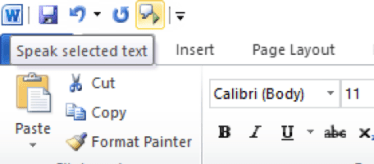
There are several web-based applications that allow computer and other devices to read texts allowed for you. However, I’ve found that some of these are very glitchy while other more operative ones can be expensive. You may not know this, but Microsoft Word actually has one built right into its program, and as an English major, I’ve had tons of experience with it and found it to be a pretty effective tool in the revision process. At this point you are probably asking “where is this handy tool and how do I use it?” Well, below I’ve included the steps for activating and using Word’s speech-to-text program.
1. Click the “Customize Quick Access Toolbar” arrow in the top left-hand corner of the screen.
2. Click “More Commands.”
3. In the “Choose commands from” list, select “All Commands.”
4. Scroll down to the “Speak” command, select it, and then click “Add.”
5. Click “OK.”
6. Now the text to speech icon is available for as a quick access tool.
After you have added the Speak command to your Quick Access Tool Bar, you can have your text read to you by highlighting the portions you want to hear and then clicking the “Speak” command icon. If you want to hear your entire text read through, simply press “Control a,” and word will highlight your entire document before you select speech. If you are in the earlier revision process, where you are still organizing your ideas, I recommend you follow along by ear, and take good notes on a separate piece of paper, by either reverse outlining, or just simply jotting down ideas. If you are in the later stages of the writing process, I recommend reading along with your eyes, and pausing the application to correct punctuation and spelling errors.
But it’s important to remember that everyone’s process is different. You may be the type of writer that can’t move on until you correct minor errors along the way. This is fine so long as it’s not handicapping the flow of your process. Remember that while the lower order concerns will have to be addressed at some point in the writing process, it may be a more practical approach to save them for the final stages of revision. Remember, we often end up cutting, or completely revising entire chunks of our writing with an eye towards content. So you may end up spending a whole lot of time revising something to make it grammatically correct, only to find that that section ends up getting removed altogether. Regardless, do what works for you.
Our “How I Write” series asks writers from the University of Louisville community and beyond to respond to five questions that provide insights into their writing processes and offer advice to other writers. Through this series, we promote the idea that learning to write is an ongoing, life-long process and that all writers, from first-year students to career professionals, benefit from discussing and collaborating on their work with thoughtful and respectful readers.
During our 2016 National Day on Writing Celebration, we invited Watson Conference attendees to respond How I Write question prompts. In an exercise in mobility (the conference theme!), we transcribed their written responses on the blog. We also included the original responses in the photos so you can see the differences between handwritten and transcribed responses.
Tom Lavelle is a faculty member and department head at Stockholm School of Economics.
Currently reading: The Sympathizer
What type(s) of writing do you regularly engage in?
*Feedback to students
*Course descriptions
*Email (various functions)
*Scholarship (various genres)
*PPT slides
*Poetry
When/where/how do you write?
When: When I can/have time- for long projects, emails almost anytime, feedback before class
Where: office at work, office at home, café near my office
How: often under time pressure
What are your writing necessities—tools, accessories, music, spaces?
Solitude is essential- everything else is negotiable
What is your best tip for getting started and/or for revision?
Getting started: Deciding what I want to do- what I hope the text will accomplish
Revision: See writing as a network of choices, each with consequences for voicing & delivery
What is the best writing advice you’ve received?
Make a claim and back it up.
Ashley Taylor is a Graduate Teaching Assistant in the English department at the University of Louisville.
Current project:
Rhet comp -> pedagogical benefits of elocution
Creative writing
-> dreamscape poetry
What type(s) of writing do you regularly engage in?
Poetry and prose
When/where/how do you write?
With tutoring, grad school, and raising two children, I have limited time for creative work. Most of my writing comes in bits-> notes on my phone, post it notes in an agenda, a line here and there. Then I make time at the University Writing Center or with a friend to help piece the bits together & brainstorm themes that arise.
What are your writing necessities—tools, accessories, music, spaces?
Post its (paper & electronic)
Notes on my phone
READING OTHER POETS
What is your best tip for getting started and/or for revision?
For getting inspired -> READ
For brainstorming -> talking it out
For revision-> read aloud/writing center appointment
What is the best writing advice you’ve received?
Write what is uncomfortable to write
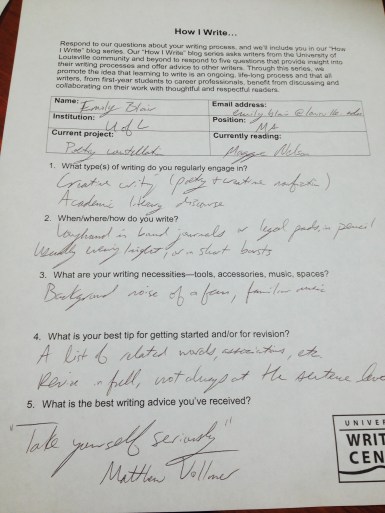
Emily Blair is pursuing her MA in English at the University of Louisville.
Current project: Poetry
Currently reading: Maggie Nelson
What type(s) of writing do you regularly engage in?
Creative writing (poetry and creative nonfiction)
Academic literary discourse
When/where/how do you write?
Longhand in bound journals or legal pads in pencil
Usually every night, or in short bursts
What are your writing necessities– tools, accessories, music, spaces?
Background noise of a fan, familiar music
What is your best tip for getting started/revision?


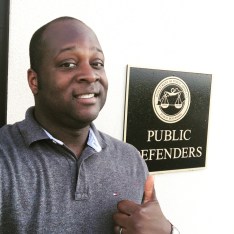 Joey Wilkerson is a 2L at the Brandeis School of Law. He received his bachelors in English from the University of Louisville and his Masters in Communication from Bellarmine University. His goal is to work in criminal law and one day be a judge.

 University Writing Center. We have always welcomed and worked with writers from every political position, and that will not change. Our goal will continue to be help each writer become a stronger writer, but also to create writing that reflects ethical critical thinking and a commitment to civil discourse. Still, I think there is more to be said, and more to be done, on our part. Although it may seem that an organization of fewer than 20 people in a large university and larger city is limited in the impact it can have on such issues, I believe that the daily work of small groups of committed people is one essential way that education – and by extension, change – happens. At this moment, then, I want to make a more explicit, more emphatic statement about the principles we hold in the University Writing Center and the actions we intend to take to support those principles.
 pond to our How I Write question prompts.
 Melissa Rothman, Consultant






 Current project:
 Current project: Poetry
 University of Louisville Writing Center