Month: October 2022

The Shape of Writing: Halloween and Writing Go Hand-in-Hand

Andrew Messer, Writing Consultant

There was a conversation I had with Dr. Bronwyn Williams, the director of our community of writing consultants, where he told me that all spy movies are literacy narratives. Well, that got me thinking, truly thinking—and this may very well have been the first time I had a truly deep thought in months, coming fresh off of summer break at the time—about what other stories are technically literacy narratives. Some other types of action movies, sure. Superheroes? It’s possible to make that argument. However, fate would grant me a serendipitous revelation just as it was time to write up a blog post of my own. What better day to talk about the literacy of horror movies than today, Halloween? And better yet, is there a more apt movie to talk about than John Carpenter’s Halloween (1978)? I think not.

We find literacy in Carpenter’s film in a variety of ways, most notably in the question of why Michael Myers wears his signature mask. There are a myriad of answers, and one of them is that he is trying to hide. The movie begins with Michael hiding from his sister before he, well… you know what happens. Michael isn’t just hiding his face though: he is hiding his ability to be read. He withholds from both the viewer and the other characters of the film the ability to be read and understood. It takes great effort, strife, horror, as well as some sleuthing for the characters to finally track down Michael from his old home to the killings he gets up to throughout the film. It takes a great deal of intellectual and psychological literacy for the doctor to track Michael across Haddonfield to his showdown with Laurie Strode.

Now, you might be wondering—I know I sure was—what has this to do at all with writing or writing center work. Great question! All of these aspects of literacy shown in Halloween started to remind me of something oddly familiar—the writing process itself. Fellow horror buffs may recall, but in the script for Carpenter’s film, Myers is referred to as the Shape; I think this is an apt metaphor for beginning the writing process, for what is the beginning of a draft but a vague shape? The Shape of drafting can be many things: procrastination, intimidation, a confusing prompt or topic, or even something as scary as a new or unfamiliar genre. The Shape finds a way to haunt all of us when we start the drafting process, and it tries to turn us into Bob if we let it.

Starting a paper is much like the events of this film: scary and disjointed without a lot to keep the threads together. Sometimes the meaning and message remains masked, if you’ll excuse the pun. Sometimes it can be something you feel like running from, avoiding it until the last minute. Sometimes you must be Laurie Strode and—metaphorically, of course—stab at your paper wildly with a knitting needle until something comes out loosely approximating what you are trying to accomplish. Either way, the Shape must be confronted to move forward, and often that is done by looking back on what you have accomplished in the past. Relying on your knowledge and the skills in literacy and writing that you have developed over many years of being a thoughtful and insightful human being.

And insightful you are. You are a writer and a reader all-in-one, and just like Laurie you will figure out what the Shape is. Though you may not always unmask it in the end, and sometimes when you think you have finished a draft the Shape will haunt you still. Yet again, just like Laurie, you are not alone. If need be, let the Writing Center be your Loomis: let us help you uncover the Shape of your writing because there is no need to face it alone. Writing, much like surviving a slasher, is a collaborative process—oftentimes taking much more planning and effort to overcome than previously thought possible. But we are here, and we know the Shape just as you do.

This all makes it seem so horrifying, and perhaps this analogy might scare you away from ever writing again. However, dear reader, if you are anything like me, then you will understand that pit in your stomach when you start to write something new. The Shape looming oppressively near you, watching from the corner and remaining masked and hidden from view. Yet, you must remember to always carry the will of Laurie Strode inside you. Clutch tightly to that knitting needle, cower for a moment if you need to, but in the end we all must face the Shape, and more often than not, we win in the end.

Happy Halloween, and happy writing!

Halloween. Directed by John Carpenter, Compass International Pictures, 1978.
Sustainability is More Than Science: Exploring Climate Change Education Across Cultures

Bronwyn T. Williams, Director

The weather report: Today in Louisville it is partly cloudy and 68 degrees. In Manila, Philippines it is 88 with thunderstorms. In Graz, Austria it is cloudy and 60 degrees, in Rustenburg, South Africa it 85 and sunny and in Sydney, Australia it is 63 and raining. If you are teaching a classroom of students about climate change in any of these places, their immediate experience of climate will be the transitory weather they see out the window. Yet, from the perspective of the global climate emergency, things look quite different. In Louisville and in Graz, there have been increases in flooding and heat emergencies in the summers. The Philippines continues to be battered by stronger and more frequent typhoons. The countryside around Sydney still shows scars of the unprecedented wildfires of 2020 and, in Rustenburg, increasing heat and drought conditions mean that sometimes students are sent home from school when there is no water.

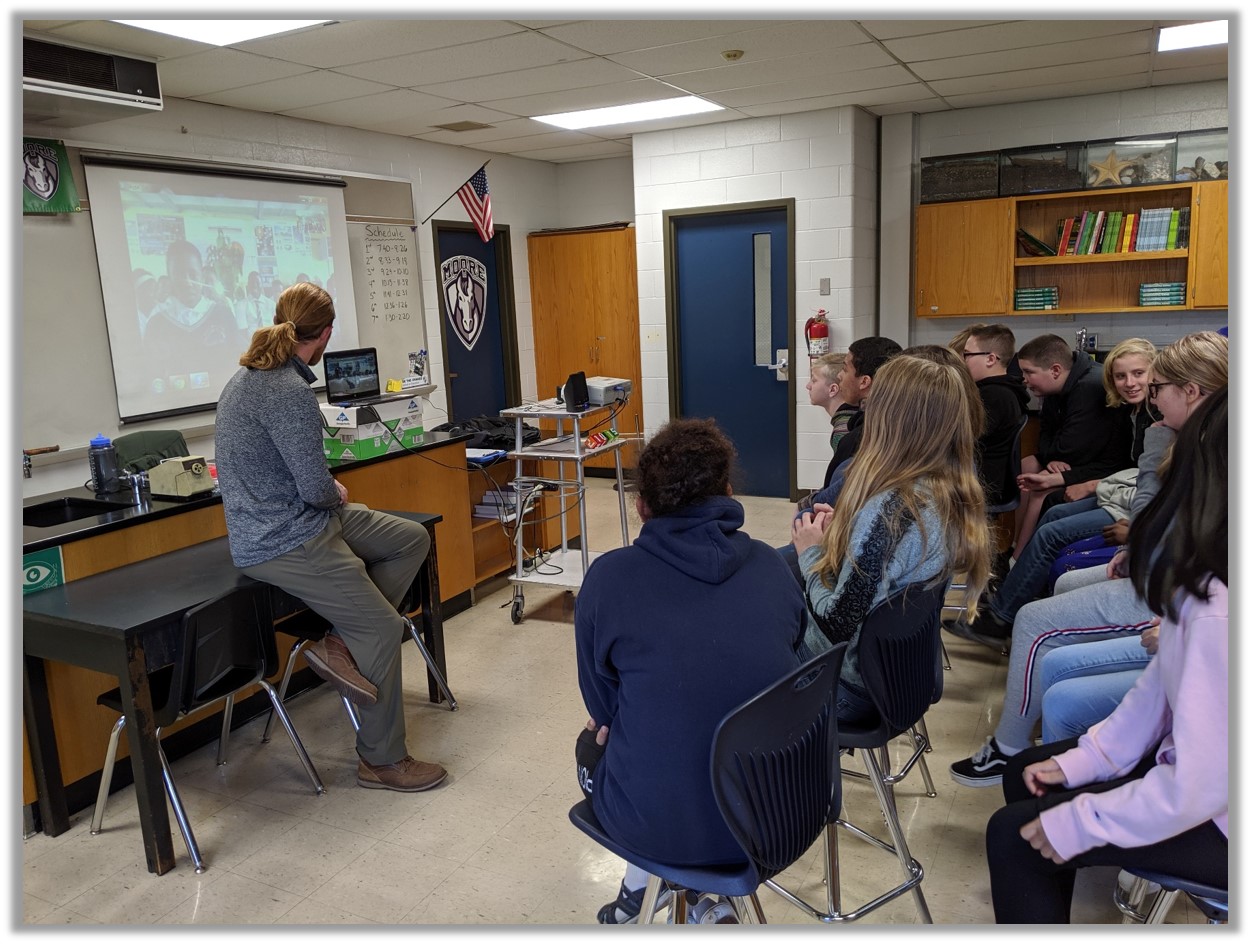
Louisville students talk with South African students by video

Climate change is simultaneously global in scope, yet experienced locally in quite different ways. From the perspective of education, it can be a challenge to convey to students how what is happening to the climate is more than the immediate weather out the window, but also not as abstract as an image of a polar bear on an iceberg. Currently I’m involved in a climate change education project focused on thinking of new ways of learning – and writing – about climate change across cultures. This interdisciplinary education project is initially focused on connecting middle-school students from around the world share what they are learning – and experiencing – about how climate change affects their local communities. The researchers and teachers involved in the pilot stage of this Global Climate Change Education Project – from Austria, South Africa, the Philippines, Australia, and the US – will gather here at the University of Louisville next week for a planning conference funded by a Spencer Foundation grant. The goal of the project is to help students learn about climate change not only from the perspective of science, but also how it affects, and is affected by, history, politics, culture, and the media. We hope that making these kinds of human connections across cultures can make climate change seem less abstract and, as a result, can lead to a greater sense of empathy and an increased commitment to the behavioral change and political action required to address the climate emergency.

The project brings together teachers and researchers from the sciences, education, and social sciences, and all have crucial roles to play in our planning. But, from my perspective as a literacy researcher and writing teacher, I also see writing and communication as key parts both of how students learn about climate change, and how they will communicate with people in their communities and with their peers across cultures. Part of what intrigues me about working on this project are the interdisciplinary possibilities. The science part of it is crucial, of course, but issues of sustainability are also about culture and community. And our explorations of culture and community are through science, but also through stories, history, poetry, images, film, and more. If we are to communicate and build relationships across cultures, we need to understand more about place and identity, and how those shape both science and our daily lives. What’s more, there is substantial research that indicates that what persuades people to act on social issues is not only facts and evidence-based reasoning, but also narratives, emotions, and relationships.

So I’ve found myself thinking about how science, art, narrative, oral history, poetry, and more might be brought together in climate change education, both in this project and others. This raises questions that are shaping many of my research and teaching interests right now. How is sustainability more than science? How must we also explore and examine issues of culture, community, history, and relationships in terms of climate change? What experiences and relationships motivate people toward action in a given context? How do we promote agency in students? And how is all of that mediated through interpreting and creating texts – both in print, but also in sound, video, images and other media and modes?

In exploring these, and other questions about location, culture, and sustainability, I am also interested in how we can use digital technologies to create these kinds of texts and opportunities for communication. We’ve already been doing some pilot projects among the students involving writing, video, and other forms of communication. Down the line we may explore other ideas, such as possibly creating a digital repository of student climate change narratives, interviews, podcasts and more, where people can upload video or audio or print and then they are available to others for teaching and research. Sharing this kind of writing would be another way to get students communicating about local knowledge across cultures and, I hope, increasing knowledge and empathy.

We are in the early days of this project, but I am eager for the conversations and work we will engage in next week in the planning conference and to think about how writing and literacy will play a role in climate change education going forward. As a teacher and researcher I have always been interested in the knowledge people have in their daily lives and how we draw on that, and connect it, to issues and ideas in school. I believe that, to engage in kind of broad-based change needed to address the climate emergency we need to explore new perspectives for that are grounded in local knowledge, languages, and cultures. We’re taking what we hope will be a helpful steps next week for learning and action across communities and cultures. Stay tuned.

Dr. Strangeword or: How I Learned to Stop Worrying and Love to Write (Allusion)

Wendell Hixson, Writing Consultant

There is no need to be an “expert!” Far too many writers, readers, students, and scholars see writing as requiring the gravest of literary circumstances. Many believe that writing must possess grandiloquence, gravitas, gratitude, grammaticality, and—especially—graftiquilimentiploricissitudinousness (neologism; I trust you’ll look up everything in italics that you don’t know). However, the magical qualities of writing, of your voice lie not in some Ivory Tower, swirling in the minds of some rhetorical warlock or literary lich (alliteration), but at your very fingertips. The unhindered imagination can create entertaining and enjoyable examples of writing without a need for scholarly expertise.

As two francophone thinkers posited, “Literary history seems deliberately to ignore writing as practice, as work, as play” (Thomas and Motte 98). And they’re, frankly, dead on. I live by the mantra that one should have fun with their writing. Fun can be the driving farce (malapropism) behind the most successful research and prose, as fun is usually the best motivator. Sometimes the very essence of rewarding, valuable writing is held not in researched ideas, dense argumentation, or scholarly opinion. Sometimes the very essence of rewarding writing is just having a chuckle at a simple and silly play on words. And sometimes you may end up learning the difference between the endless devices and playful maneuvers found within the English language, and the unique devices within other languages as well.

Perhaps you’ll come across words like (and, yes, these are all real) lipogram, chiasmus, petrosomatoglyph, epizeuxis, bdelygmia, clerihew, butyraceous, syzygy, ekphrasis, bibliobibuli, zeugma, absquatulate, phantasmagoric, lugubriousness, floccinaucinihilipilification, hippopotomonstrosesquipedalian, pneumonoultramicroscopicsilicovolcanoconiosis, and jib. Perhaps you’ll even use them. This is the fun of language: the exploration and wonder of the gift we’ve so luckily evolved. It operates much like a magic, a power with which we can create meaning and reality out of nothingness. Most any sounds, amalgam of letters, and absurd or beautiful stories develop our very understanding of this powerful tool (e.g. The Dictionary of Obscure Sorrows or Gertrude Stein’s Tender Buttons). Language is a boundless, bottomless ocean that we are rarely encouraged to truly navigate. Language can be morphed into humorous contests, such as Monty Python’s Word Association Football or Rosencrantz & Guildenstern’s Questions Game (both of which I recommend watching). Language can be manipulated for the sake of art, such as Edgar Allan Poe’s extended vocabulary or Lewis Carroll’s fantastical prose (read “The Bells” and/or “Jabberwocky”). Language can be invented for the sake of worldbuilding, such as Star Trek’s Klingon or Tolkien’s Middle-earth (which inspired real world uses of these languages). Succinctly, it makes us feel. And that is a power that should be embraced, nurtured, protected, and proliferated.

Now, this is not to advocate for disregarding formal academic writing as a whole. This is not a call to challenge a professor for stifling your creativity. There is a time and a place for pure fun and freedom, and—really—a research paper, a dissertation, or a scientific journal are not always the most appropriate sites for Tolkien’s Elvish or the word “lugubrious.” That’s okay. It can be symbiotic. We language-users still have an obligation and an ability to balance our teaching and communication with our capacity to entertain. Sometimes that means foregoing a pun or poetry (wordplay), but it doesn’t mean foregoing interest in your ideas and how you write them (rhetorical devices). Our world can be a worrisome place that requires our attention, compassion, and power whenever we can lend it. And, hopefully, we can use our voices to mend relationships, to empower those we care about, to stand against and maybe inspire those who feel silenced. To use your voice for good is all one can ask. So, I truly wish that your ongoing adventure through language brings you a greater sense of confidence in yourself, and I hope it also brings an appreciation for how genuinely, innately powerful our voices really are. And that doesn’t mean it’ll ever be perfect. As I said, you don’t need to be an “expert.” You just have to be human.

Thomas, Jean-Jacques and Warren F. Motte join. “Oulipo: A Primer of Potential Literature.” South Atlantic Review 53 (1988): 185.

Indigenous Literatures and Writing Histories

Charlie Ward, Writing Consultant

Land is sacred. It provides us with nourishment and safe keeping: our strongest relationships are born from shared homes, gently rocking us to sleep like a mother and her newborn. We cannot survive without the land; yet, this land has not always been ours.

October 10 is Indigenous Peoples’ Day: an observation and commemoration of Native and Indigenous histories and cultures. This is the second year the United States has officially observed the holiday; however, its creation spans back as far as 1977. The International Conference on Discrimination Against Indigenous Populations in the Americas is attributed with first suggesting its observation to combat the revisionist history presented during Colombus Day celebrations.

Fundamental misunderstandings of Indigenous history permeate the cracks of western academia. Many are unable to identify the cultural nuances of the Indigenous peoples, as well as their influence on writing and literature. Consider your knowledge of Indigenous history: what land is Louisville, Kentucky is on? Are you able to name the tribes of the Anishinaabe? Why do some people use Indigenous versus Native American versus American Indian?

Here are the answers:

1.) Louisville, Kentucky is on Adena, Cherokee, Hopewell, Miami, Osage, Seneca-Iroquois, and Shawnee land.

2.) The Anishinaabeg consist of the Algonquin, Mississaugas, Nipissing, Odawa, Ojibwe, and Potawatomi peoples.

3.) Various names exist for various reasons. American Indian has been reclaimed by many Native and Indigenous peoples. Native American was coined around the 1960s as a response to anti-Indigenous racism. Indigenous considers the origins and the claim to land that Indigenous peoples hold. First Nations, Aboriginal peoples, and Native Canadians may also appear in works regarding discourse around Indigenous peoples of Canada. You may notice that I switch back and forth between my terminology in this piece, but identity is preferential and personal: always ask before you ascribe a label.

How many of these did you all get right—even partially? Western academia has long withheld Indigenous history from us: we are not the first to be required to learn these things in our own time, and we will not be the last.

What does this all have to do with writing? Well, a lot.

As I mentioned previously, Indigenous culture has influenced writing and literature. The oral traditions of many tribes aided in the development of literature as a shared medium. People gathered to share many fictional narratives, characterized by experiences with the metaphysical world and transformative identities; the indulgent details furthered the performance of storytelling. Indigenous myths and legends explored the role of animals, one’s relationship to the earth, and morality. For example, Ababinili And The Humans is a Chickasaw myth about how humans came to be. The first line mentions the “moon, sun, wind, rainbow, thunder, and fire”—they don’t exist as symbolic figures, but instead as characters that propel the plot.

While it was important for generations to pass down oral traditions, colonization hierarchized written works. Settlers found writing to be indicative of a more enlightened people, i.e., a more western-ized people. I think it’s good to note that Indigenous peoples in the United States and Canada experienced colonialism differently; my historical account is simplified, but it’s necessary to understand that tradition was influenced by outside pressures. In addition, settlers imposed barriers to publishing for Indigenous authors—barriers that Indigenous authors broke and continue to combat today.

Looking at the historical development of writing and literature can aid us in our understanding of the current climate. For Indigenous peoples, writing and oral tradition were both a form of resistance. Writing combated settler’s notions of civilization, revealing rich cultural narratives; oral tradition built the foundation of writing, as well as uniting community and family. I think miseducation can prevent us from viewing Indigenous history as something innate to the development of literature—Indigenous cultures have existed longer than we know, therefore it’s right to assume that they have an influence on the way we write.

Colonialism’s desire to view Indigenous culture as anything beyond uncivilized pervades in modern discourses: we turn ourselves away from oral communication and struggle to acknowledge its importance in cultivating ideas and identity. Talking builds communities, unites enemies, and keeps us mentally sound. What’s better than discussing your ideas with a friend before writing them down?

We see imagery from Indigenous literature in contemporary narratives: heroes, villains, and moral quandaries are more popular than ever! Indigenous writing isn’t just mythological tales, but shared discourses. There There by Tommy Orange, The Plague of Doves by Louise Erdrich, and Where the Dead Sit Talking by Brandon Hobson all explore ideas of community and identity; they’re read by audiences world-wide, and well worth a read.

When teaching in the writing center, I think it’s important to keep the historical and cultural identities of our students in mind. The priorities of western academia aren’t always going to be the priorities of writer’s—and that’s fine! We should also be looking at the influences of non-western and non-white people on writing: we owe a lot of respect and recognition.


Bibliography

“Ababinili and the Humans.” Accessed October 7, 2022. https://www.firstpeople.us/FP-Html-Legends/Ababinili_And_The_Humans-Chickasaw.html. “Indigenous Writing since 1867: Once Neglected Now Celebrated.” Indigenous Writing since 1867: Once Neglected Now Celebrated – Indigenous Studies – Simon Fraser University.