
Bronwyn T. Williams, Director
Earlier this year, Edward English, one of the assistant directors in the University Writing Center, suggested that we create a new promotional video drawing on the perspectives of our writing consultants about what they find meaningful in their work teaching writing. I agreed that it was a great idea and, this spring, Edward and consultants Michelle Pena and Jacob DeBrock, created the video you see here, titled, “Our Community”.
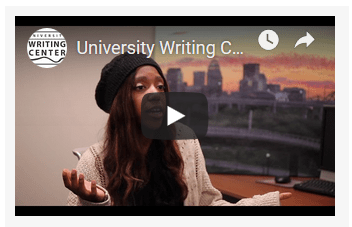
What I appreciate, and thoroughly enjoy, about this video is what they captured about the intangible, but essential, role that caring and community play in the work we do at the University Writing Center. On our website and in our presentations we always foreground, and rightly so, the expertise we have in teaching writing that can help students, staff, and faculty become stronger writers. Yet, just as crucial to our approaches to writing pedagogy is the work we do to create a culture of caring and empathy. We do this through a focus on listening, starting where the writer is, and, most of all, always remembering that we are responding to a person, not just a set of pages. You can see this commitment, and the pleasure it brings, in the words of the consultants in this video.

Empathy, listening, and caring, are not qualities that will show up in any official end-of-year reports. Emotions and ethics are typically not assessed by university administrators or accrediting agencies, or always considered appropriate ideas for discussion on a university campus. Still, these are the ineffable qualities that make our University Writing Center a distinctive and successful place for learning on campus. Because we focus on working with writers, not just on drafts, we know that we help writers develop a stronger sense of agency and confidence about their work. Because we listen first, and then respond, we also engage in conversations about how writers are shaping their identities, and how those are negotiated in the systems of power in the University and culture.
We did, in fact, work with an impressive number of writers this year – more than 5,000. Out of those visits came stronger drafts and more confident writers. We are grateful for the trust that writers from across the UofL community show in bringing their writing here and letting us work with them to make it stronger. What the numbers can’t show that the video gives a glimpse of is the care, compassion, and that vital sense of community that the consultants build every day with each other and all the writers who walk through our door.
We will be open during the summer, starting May 6, from 9-4 every weekday. You can find out more on our our website. You can also follow us on our blog and on on Twitter, Facebook, and Instagram.
Beyond Tutoring – Workshops, Events, and Community Writing
Our commitment to working with writers and supporting a culture of writing extend beyond our daily consultations. Here is a just a glimpse of what we have been working on this year.
Workshops, Writing Groups, and Dissertation Writing Retreats: Our staff did more than 220 presentations about our University Writing Center services and more than 40 workshops about writing that took place both in and out of classroom settings. Our popular Creative Writing, LGBTQ+ and Faculty and Graduate Student Writing Groups continued to give UofL writers supportive communities through which they could create and talk about writing. We again held a our annual spring Dissertation Writing Retreat in May. We will be continuing all of these groups and workshops, so be sure to check our our website for information and dates.
Writing Events: Once again we hosted or took part in a range of writing-related events,

including our Halloween Scary Stories Open Mic Night, the Celebration of Student Writing, Kick Back in the Stacks, and International Mother Language Day. Thanks to our ongoing partnership with the UofL Creative Writing Program, we again hosted a reading in the Axton Creative Writing Reading Series as well as two open-mic nights and one workshop in collaboration with the Miracle Monocle Literary Magazine.
Community Writing: We also continued our work with our community partners, the Western Branch of the Louisville Free Public Library and Family Scholar House. Once again we are grateful for the participatory and collaborative partnerships with these organizations . You can find out more about these community writing projects, including how to get involved with them, on our website.
The Best Writing Center Staff in the Business
 The most important staff news of 2019 was the addition to the University Writing Center staff of Amber Yocum, as our Administrative Associate. Amber is in charge of our front desk, our scheduling system, office management, and supervising our student workers. She is brilliant and innovative and we’re lucky to have her as part of our community.
The new “Our Community” video also shows the community that our staff create among themselves. They do exceptional work as consultants and as full-time graduate students, but they also find time to take care of each other, and to laugh. I’m proud of them for that and think the university and the world can use more of it. It is the inspired and tireless work of all of our staff that, day after day, allows us to support UofL writers and create a culture of writing on campus and off. They also make this a fun place to work. Thanks go to Associate Director Cassandra Book and Assistant Directors, Aubrie Cox, Edward English, Rachel Rodriguez, and Christopher Stuck. Our consultants this year have been Quaid Adams, Brooke Boling, Josh Christian, Jacob DeBrock, Nicole Dugan, Katie Frankel, Anna-Stacia Haley, Rachel Knowles, Catherine Lange, Michelle Pena, Liz Soule, Jon Udelson, Abby Wills, and Adam Yeich. Our student workers were Taylor Cardwell, Wyatt Mills, and Jency Trejo.
Writing Center Staff Achievements
The University Writing Center is also an active site of scholarship about the teaching of writing. Staff from the Writing Center were engaged in a number of scholarly projects during the past year in rhetoric and composition, literature, and creative writing.
Bronwyn Williams, Director I had two Writing Center-related publications this year, co-authored with former University Writing Center associate and assistant directors. One was “Find Something You Can Believe In”: The Effect of Dissertation Writing Retreats on Graduate Students’ Identities as Writers.” with Ashly Bender Smith, Tika Lamsal, and Adam Robinson in Re/Writing the Center: Approaches to Supporting Graduate Students in the Writing Center. (Utah State University Press. 2019). The other publication was “Centering Partnerships: A Case for Writing Centers as Sites of Community Engagement,” with Amy McCleese Nichols, in Community Literacy. 2019. I also presented at the International Writing Centers Association Conference in with Cassie Book, Layne Gordon, and Jessie Newman, from UofL.
Cassandra Book, Associate Director published “Digital Curation as Collaborative Archival Method in Feminist Rhetorics.” with Pamela VanHaitsma. in the journal Peitho, spring 2019. She also gave the keynote address at the Southeastern Writing Center Association Kentucky Statewide Tutor Conference, with Josh Christian and Liz Soule at Asbury University in April 2019. In addition, she presented at the Conference on College Composition and Communication, the Thomas R. Watson Conference on Rhetoric and Composition, and the International Writing Centers Association Conference.
Aubrie Cox, Assistant Director for the Virtual Writing Center published “Final Transmission.” in Little Fiction. 2018 Flash Issue. She gave a reading at “Live at Surface Noise,” in December 2018. She was also awarded the UofL Creative Writing Graduate Student Award for Poetry, 2019
Edward English, Assistant Director of the University Writing Center presented at the Rhetoric & Religion in the Twenty-First Century Conference and Thomas R. Watson Conference on Rhetoric and Composition.
Rachel Rodriguez, Assistant Director of the University Writing Center presented at the Conference on College Composition and Communication.
Christopher Stuck, Assistant Director For Graduate Student Writing presented at the Rhetoric Society of America Conference and served as Graduate Student Coordinator for the Discourse and Semiotics Workshop Series.
Consultants
Quaid Adams presented at the International Society of Contemporary Legend Research Conference, the UofL Graduate Student Regional Research Conference, and served as a Graduate Editor for Issue 12 of Miracle Monocle as well as the forthcoming anthology of Queer and Rural Southern Writers.
Brooke Boling served as a Graduate Editor for Issue 12 of Miracle Monocle as well as the forthcoming anthology of Queer and Rural Southern Writers.
Josh Christian presented the keynote address at the Southeastern Writing Center Association Kentucky Statewide Tutor Conference, with Cassie Book and Liz Soule at Asbury University in April 2019. He also gave a workshop at the same conference, also with Liz Soule. He was awarded a UofL Creative Writing Scholarship and will be a Graduate Program Peer Mentor Coordinator next Year.
Jacob DeBrock presented at the Louisville Conference on Literature and Culture since 1900.
Nicole Dugan completed her M.A. Culminating Project, titled, “Writing the Self: First-Generation Students, Personal Statements and Textual Authority.”
Katie Frankel presented at the Indiana University Interdisciplinary Graduate Conference and had a book review of Sons of Blackbird Mountain published in Interstice. She also received a UofL Creative Writing Scholarship.
Anna-Stacia Haley received a UofL Creative Writing Scholarship.
Rachel Knowles completed her M.A. Culminating Project, titled, “Talking It Out: Towards Interdisciplinarity in Online Organizational Crisis Response”
Catherine Lange presented at the UofL Graduate Student Regional Research Conference.
Michelle Pena presented at the UofL Graduate Student Regional Research Conference
Liz Soule presented the keynote address at the Southeastern Writing Center Association Kentucky Statewide Tutor Conference, with Cassie Book and Josh Christian at Asbury University in April 2019. She also gave a workshop at the same conference, also with Josh Christian.
Jon Udelson published a short story in Juked titled “Out & Elsewhere” and had a A book chapter accepted into the edited collection Style and the Future of Composition Studies. He presented at the Conference on College Composition and Communication, the Thomas R. Watson Conference on Rhetoric and Composition. He was named a board member of the Creative Writing Studies Organization. In the fall he will start a job as an Assistant Professor of English at Shenandoah University.
Abby Wills presented at the Uofl Graduate Student Regional Research Conference and the University of Cincinnati English Department Interdisciplinary Conference.
Adam Yeich was named the Assistant Director of Creative Writing for 2019-20. He presented at the UofL Graduate Student Regional Research Conference and the Louisville Conference on Literature and Culture since 1900. He served as a Graduate Editor for Issue 12 of Miracle Monocle , where he had a book review published, as well as the forthcoming anthology of Queer and Rural Southern Writers.
 One writer was working on a paper in which she had to identify an area in her life where she possessed rare expertise, and our brainstorming led her to a past job as a phlebotomist and her unique knowledge on how to draw blood.
  know what you want to write about, you’ve done your research, and you’re in the perfect environment to let your thoughts turn into words. The problem is you don’t know how to start or where to go after that.
 Sometimes this difficulty stems from the fact that you may not have read the necessary book or article, but most of the time it stems from the widely known struggle of trying to organize your thoughts. What if I told you that there was a way to help you get off of the struggle bus?
 University of Louisville Writing Center