Tag: writing tips

In Conclusion: Framing Your Paper

Arielle Ulrich, Consultant

Working at the writing center, I constantly hear students say that they hate writing conclusions. These students will bring in papers that seem finished, but end abruptly—or they may have written a conclusion, but it’s only a sentence or two re-stating the last paragraph.

I’m no stranger to this struggle. Even the conclusion to the simplest paper can leave me stumped, and I often have to leave the paper alone for a few hours while I try to think of the “perfect” conclusion. Of course, as the last thing the reader sees in the paper, conclusions are very important. But my obsession with the perfect conclusion instead psyches me out, leaving me with a case of writer’s block.writersblock

When this happens, I remind myself that a good conclusion cannot fix a bad paper, nor will it solve any of its organizational or structural problems. I find it more helpful to consider a conclusion as the closing statements of my argument. By this point, I should have already said everything I needed to say and written the meat of my paper. I’ve argued, elaborated, and explicated every point. My conclusion will simply wrap up my paper and place my topic into context for the reader.

  1. In light of this, I have a few tips for conclusions. Which tip you follow may depend on your field, so consider which strategy works best for your paper. These are my three go-to tips: Explain the significance of your paper. Make sure the reader knows why your topic is important. Usually, this involves placing your question into a broader context or comparing it to a current issue. If you cannot think of the significance, ask yourself, “so what?” This approach is especially useful in history or expository papers.DSCN1639
  2. Recommend further research. Now that you’ve examined the current research on your topic, you have the chance to take the next step and recommend a course of action for the future. Is there a topic or approach you would ask a future researcher to consider? In other words: what questions are you left with at the end your paper? This tip will work best with papers that have a significant research component.
  3. Synthesize your points. This strategy requires that you not only summarize your paper, but also put together the pieces for your reader. How does your argument come together? If your paper is either very long or complex (or both!), this type of conclusion would be a good choice.

Any of these strategies would guarantee that your reader leaves knowing the purpose of your paper. You also shouldn’t feel that you can use only one of these strategies at a time—in some papers, you may use all of them, provided they are relevant.

These two writing center sites also have good pointers. Feel free to peruse these before writing your next paper:

University of North Carolina, Chapel Hill: http://writingcenter.unc.edu/handouts/conclusions/

University College, Toronto: http://www.uc.utoronto.ca/intros-and-conclusions

Happy writing!

What is Voice and Where Do You Get It?

Layne Porta, Consultant

I remember being told when I first started doing college level writing that I needed to work on my voice. When I asked my professor what exactly she meant by that, I was told that voice is what makes your writing uniquely your own. I was frustrated and confused: Isn’t the fact that I’m writing it what makes it uniquely my own?

Now that I am a graduate student and writing consultant, I often see the same kinds of feedback on my students’ papers. What I would like to offer here are some thoughts on what voice is and how you get it, as well as some resources that can help you along the way to finding your voice.

What I have come to learn about voice is that it is much more about practical decisions you make in your writing than some mystical quality that appears like mist in the night. The writing process itself is an unending sequence of decisions–from word choice to punctuation to paragraph breaks–and all of these decisions add up to create your voice. For example, I love to use dashes in my writing, which can make my voice sound more conversational. Voice can also come from the kinds of metaphors and similes you choose to explain concepts, or the length of your sentences. I have found that one of the biggest factors in creating (and understanding) your voice is word choice. For example, one of my least favorite words is fickle, but one of my favorite words is capricious. They mean the same thing, but my voice will sound very different depending on that decision. There are many resources that can help in making decisions about the words you want to use. For example, on websites such as visualthesaurus.com and visuwords.com, you can type in a word and it will bring up a word web that will feature synonyms and variations of that word clustered according to connotation. The example below is a screen capture of a visual thesaurus app I recently downloaded:

"Volatile" on Visual Thesaurus
“Volatile” on Visual Thesaurus

I have often heard the idea from both students and peers that voice isn’t as important in academic writing as it is in creative writing. I believe this is a huge misconception. Voice is crucial to academic writing because it plays a large role in engaging your audience, establishing a formal tone, and creating your credibility as a writer. In sum, voice plays a very active role in helping you achieve your rhetorical goals. Furthermore, you can have more fun with the writing you will do during your time in college or after if you embrace your voice as a writer.

If you find yourself wanting to learn more about voice and how to get it, I suggest two very helpful websites that offer comprehensive discussions about voice. The first is “Understanding Voice and Tone in Writing” by Julie Wildhaber, featured on quickanddirtytips.com. This article offers tips on defining your voice as well as some helpful examples of how voice will change according to genre. Another useful article on writingcommons.org by Kyle D. Stedman, is “Making Sure Your Voice is Present” which also offers excellent suggestions for finding your voice as well as some YouTube videos about voice.

layneOne thing to keep in mind is that finding your voice is like everything else in writing–it requires practice. So in response to my initial question as a beginning college student: yes, the fact that I am writing my paper is what makes it uniquely my own. But voice takes this a bit further, and requires that you do some writing to see how your personality comes across. My suggestion, then is to trust your instincts as a writer. Your writing is a reflection of your thoughts and your personality. Your voice, and your awareness of your voice, will come through the more comfortable you get with writing.

Don’t Fear the Outline: It’s Really Just a Helpful Sidekick

Jamison Huebsch, Consultant

Outline is an unusual word in the world of writing; in normal usage it suggests a lack of substance, a mere shape of something larger. We use the word because it is supposed to represent the shape of things to come in our work. Yet in the process of writing an outline can sometimes feel limiting, because it can be a commitment to a direction for an essay or story. An outline can be a big help in the early planning stages of writing however, and I would like to share a few tips I’ve picked up on creating an outline. The first tip is not to stress out about an outline, because it is supposed to be a helpful map and not a constraint.

Imagine it like this: you are deep in the middle of a paragraph, and have put your best ideas down on the paper but you still feel like it’s a bit of a mess. Where do you go next? Pull out your trusty outline you made earlier and let it guide you. You can review the important concepts you wanted to cover, see what the next topic you planned to discuss, and then you are right back on track without any wandering about. The key is what you include in your outline, to give yourself guidance later.

Let’s start with two important parts of the introduction: the audience information, and the thesis. Your introduction is usually the best place to clue your reader into information they may not know but is important to your topic. You should note down anything you feel you might have to explain such as technical information, acronyms, or concepts. In creative works you might consider a character’s back-story or important information about where the story takes place. Not everything you write down in the outline has to be used later. If you writing a creative work you may not need a thesis either, but it is still a good place to record your original plan for the plot. If you producing other academic work however, you will definitely want a thesis. There is lots of help available on making a good thesis, including on the Purdue OWL, but as long as it summarizes the central point of your paper well you are on good ground.

The next section is sometimes referred to as the body, but I like to think of it more like a skeleton. You want to get the central ideas of your work sectioned out, and then you can break them down into smaller easier to plan steps. So pick major concepts and give each one its own section. In a creative work you might list the scenes you plan to write, so you can get a feel for the shape and flow of the plot. In a class paper you could review the major topics or issues related to your argument. If you have already done your research for the paper, an outline can help you space out your citations and ensure that you cover everything important before moving on to the next source. You want the sections to follow each other in an order that makes sense, so by looking at it in the large scale abstract you can better see where you might need transitions added to your text.

When you have covered all your main points and noted all the important details to your paper it’s time for an ending. Regardless of if you call it a conclusion or an epilogue, a good work leaves it reader with a proper send off. This is your last chance as a writer to leave a good impression on your reader. Luckily a conclusion in an academic paper is like a mirror of the introduction: you review the important points of your argument briefly, and similar to your earlier thesis it DSCN1642should contain a clear and concise statement of your position. Creative writers are still stuck crafting sappy endings or killing off everyone’s favorite characters, but that’s the job you signed up for. Either way you’ll know by now if you followed your earlier road map or set off into the unknown, but at least you brought directions.

I hope these few short tips about outlines help someone out, and don’t forget that you can come by the Writing Center. We not only can help you with brainstorming and planning your first outline, but with all the fun stuff that comes after. Good luck with your writing!

How to Get Unstuck: Ways to Start Writing and Tips to Keep Going

Alex Clifton, Consultant

Writing is hard. Starting any kind of writing—or keeping it flowing—can be so difficult. Very rarely do people get out what they want to say on the first try. I should know; I just drafted the opening sentence of this blog post five or six times, going through wildly different options. It can be challenging to figure out what you initially want to say, and even harder when you feel like giving up after one or two paragraphs because the words just aren’t coming. Here are some tips to get you writing and keep you writing!

If you have trouble at the beginning of a writing session because you are thinking too much about other homework, life problems, cat pictures, etc., freewrite for five to ten minutes. It doesn’t have to be anything sophisticated; just grab a notebook and write down everything you are thinking, as it comes to you, for that short period of time. Afterwards, you’ll have cleansed those thoughts from your brain for the time being, so you can get down to working instead of wondering whether or not you’ve cleaned your aquarium.
DSCN1650

Occasionally, you might struggle to find a topic to write about. It might help to make a list of things you are interested in or want to mention in your essay. This can be especially helpful with personal narratives or persuasive essays. For example, if you’re trying to think up concrete examples to support your idea that fish are the best pets ever, you might make a list describing the pros of keeping fish as pets, another list about your experience keeping fish as pets, and another list with all the facts you know about fish that might persuade someone that fish are great. Again, these thoughts do not have to be organised perfectly; list-making is just another way to get you thinking about what you want to write about!

When working on a paper, remember that you don’t have to write everything in a linear manner—there is no rule that says you have to start with your introduction and plough through in the “right order.” If you’re really struggling to make a point, make a note of where you want it in your essay and then continue writing so you don’t lose your momentum. You can always go back and revisit different portions of your paper, and you might be able to rephrase your thoughts better after you’ve written another section.

Sometimes, it’s hard to get a rough draft out at all. One way to get you writing for blocks of time is to use an app like Write or Die (found at writeordie.com). Don’t let the name scare you: it’s a website that helps you write for however long you decide, be it fifteen minutes or an hour. It motivates partially through annoying you: on one mode, a loud pitch will play if you stop writing for too long, and on kamikaze mode, your work will begin to unwrite itself! (Kamikaze is an optional mode.) The great thing about Write or Die is that it gets you writing, and just writing, for however long you need. Think of it as freewriting for your paper; you can type in anything while you are drafting and then go back and revise it afterwards. It will help you get a draft out and may even add to your productivity, especially when you realise you’ve written for half an hour straight without constantly checking social media or your favourite news sites. I’ve found that using it has helped me learn how to write in chunks of time more effectively, so I can sit down to a half-hour writing session and get work done rather than just goofing around. (A word of warning: if you do use Write or Die, make sure that you copy, paste, and save your work in a separate word document—Write or Die will not save it for you.)

Finally, at the risk of sounding shamelessly self-promoting, come into the Writing Center! We’re here to help you with all of your writing needs at any stage of the writing process. You don’t even have to have a word on the page to make an appointment for an assignment. We can help you discuss your ideas and brainstorm possibilities, or we can read over what you have already written and help figure out where your paper will go next. Sometimes it just helps to talk it all out with someone who wants to hear about your ideas—and trust me, we definitely want to hear what you have to say.

I hope some of these strategies work for you. Try one next time you get stuck writing a paper and see if it helps!

Five Places That Make Writing Easier

Megen Boyett, Consultant

DSCN1655It’s the start of the semester, which means, it’s time again to think about research papers! I know, it’s only the second week, and yet, that paper looms ahead of you on your syllabus. It will not be ignored and it will not be denied, but it will be here in about 15 weeks. Worst of all, it’s going to need outside information and some advance planning, both things that a four-day caffeine binge during finals week won’t provide.

The worst thing about new semesters is that, once again, you have the opportunity to find out how little you know and how much you wish you knew. But take heart! The best part about new semesters is that they’re a new beginning! You’ve got time again to get things done right! And, better still, there are resources for you to use right here on campus. Here are five places to get what you need for those research papers and have a less stressful semester:

  1. The Writing Center, of course!

Are you unsure where to start an assignment? Do you need some help figuring out what it’s asking for, or what you should do next? Have you written as much as you think you possibly can on a topic, but only gotten halfway through the page requirement? Bring your assignment and whatever you have so far into the writing center. Sit and talk it over with us for a while (let’s say, up to fifty minutes). Believe me when I say, it’s oh-so-helpful to have someone to talk about your work with, especially when they aren’t giving you a grade at the end. If nothing else, you’ll leave knowing what questions to ask when you go back to class.

  1. The Research Lab at Ekstrom Library

You know the sources are out there! You just don’t know where to start looking, and it’s a little intimidating to wade through so much information on your own. Fortunately, the librarians at Ekstrom do have a good idea of where you should start. You can ask questions at the research desk (1st floor), you can set up an appointment to learn how to use databases, or you can even chat with a librarian online at http://louisville.edu/library/services/ask.html.

  1. Citation Databases

Does thinking about citation styles give you a cold sweat? Then, of course, ask your writing center consultant. We all have our favorite sites for citation help. One of the most commonly suggested is the OWL, or the Online Writing Lab at Purdue. It has quick links to citation style guides and plenty of examples. Another really good program is EndNote, which stores all your sources for you and formats bibliographies and in-text citations. Best of all, it’s free through the U of L library!

  1. Your professors

I have yet to meet a U of L professor who won’t make time during office hours for a student to talk about a paper. Your professors are valuable resources because, after all, they wrote the assignment. Not only can they answer questions about what they want you to do, they’re also good for helping you talk through ideas and suggesting potential sources. Put their expertise to use!

  1. The Writing Center, again

You’ve researched, you’ve drafted, you’ve cited to your heart’s content. You’re pretty confident that you know what your professor wants and even how to do it. Now it’s all (or almost all) down on paper, but you’re still not sure that your paper says what you want it to. Come back to the writing center and read your paper aloud with a consultant! Never underestimate the value of talking about your writing with a student who’s been trained to talk about writing. Being able to hear feedback before you hand in a paper not only gives you one last chance to make changes and turn in the paper you meant to write, it’ll with future writing assignments, too. (Plus, it’s really fun to talk about something you created with someone who wants to read it. Trust me.)

Here’s to a fabulous semester! Here’s to knowing what you’re doing and to asking when you don’t know! Here’s to caffeine headaches after something other than an all-night paper-writing-palooza, because, after all, don’t you have better reasons to stay up till 2 am?

Happy Writing!

Experiences, Advice, and Inspiration from First Year Cardinals: A Collaborative Blog

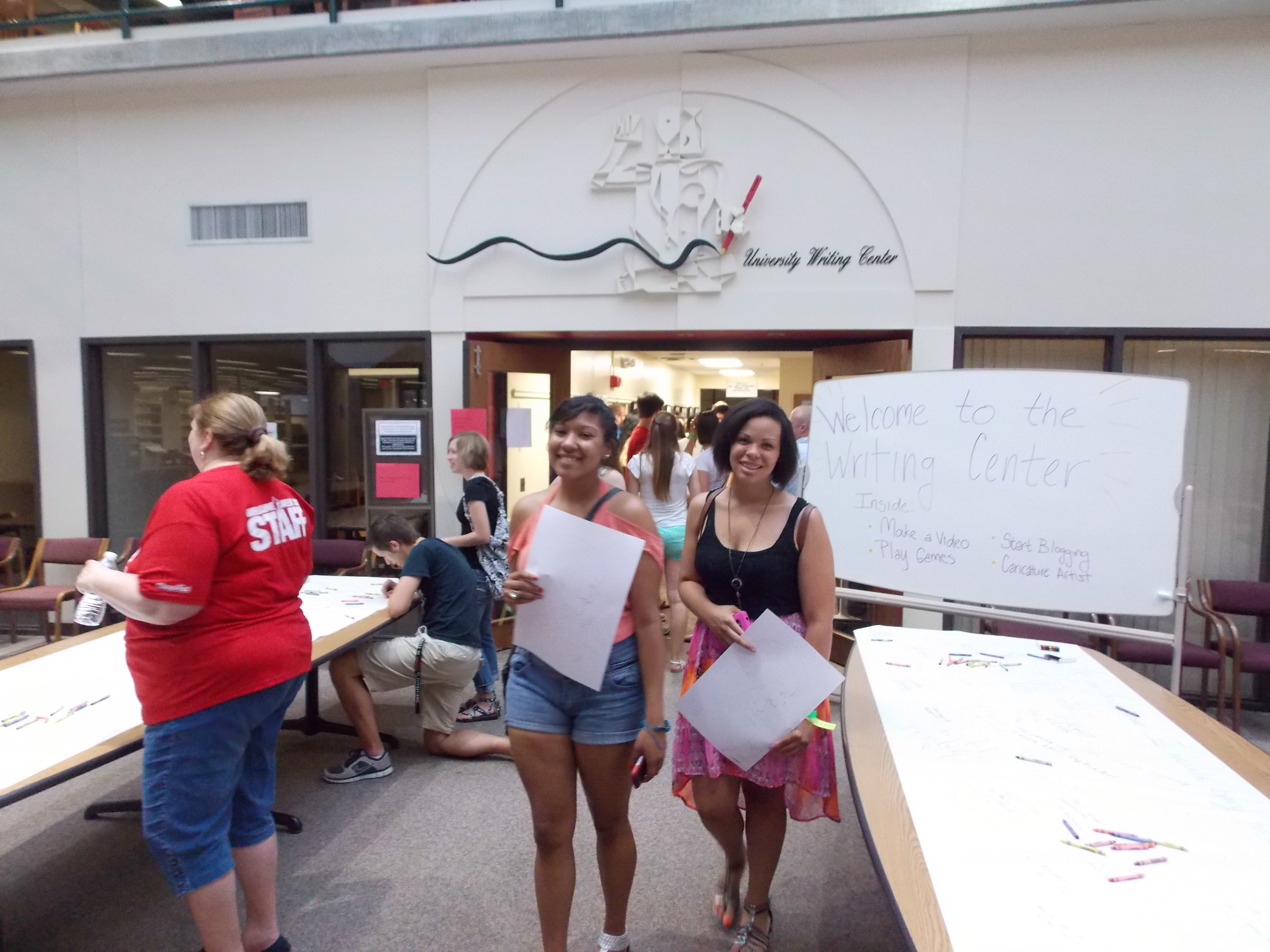
Last Thursday, the University Writing Center participated in the Office of First Year Initiatives Night at the Museum event. In the past, this event has been held at the neighboring Speed Art Museum, but since the museum is currently under construction it was moved to Ekstrom Library, where the Writing Center also happens to be located. We were excited to be involved in this event which, like many others in the week before school starts, aims to familiarize first-year students with campus, build community, and get everyone ready for the Fall semester.

There were many features available throughout the event, including a magician, a fire show, a scavenger hunt and others. DSCN1679On the 3rd floor in the Writing Center, in addition to the caricature artist, students were able to make videos about their experiences with writing, help decorate banners promoting what they believe about writing, and help write a collaborative blog post for this blog. To get the words flowing, we did offer some topic suggestions asking students to reflect on their best experiences with writing or advice about writing.

The night was filled with stories of papers, like this one:

My best writing experience was when I finished my 14 page Extended Essay for the International Baccalaureate Program in 2 freaking days. When results came in I received a 7 (the highest possible grade)!!! YAY!!!

And this one:

The best writing compliment I ever received was an accusation of plagiarism. That may sound a little mixed up, but it really was. Because what my teacher said to me wasn’t “you cheated” or “this isn’t yours” but rather “you couldn’t have possibly written this well”. And when I finally convinced him I had, he told me that it was essays like mine that showed that his class truly mattered.

By far, though, the most popular theme of the night was “best writing advice”:

Don’t use clichés!

Try as many different writing styles as possible. Try outlining, but if it doesn’t work you can always try something else! You never know when you will find a method that works for you. Most importantly, ASK FOR HELP!

When you finish a paper, read it backwards to catch spelling errors.  Then, make sure to have someone else read it.  They’ll probably see errors that you missed!

Be brief.DSCN1676

Make your diction sophisticated enough to be intelligent but simple enough to be practical.

Get rid of the fluff.

Don’t use “be” verbs!

If you use garbage words (nice, good, bad, like, ect.) I’m judging you.

Don’t use a semicolon unless you know how to use it. Seriously.

Write what you feel, when you feel it. Edit later.

In addition to the circulating stories of experiences, compliments, and advice, some students took the opportunity to listen to their inner muse and offer a demonstration of word play.

Poetry is

Like

Fight Club.

T h e r e       a r e      n o      r u l e s.

(except if it’s iambic pentameter, then there are rules. Sorry)

I wish I could speak English. I know incredibly close to no English. No English. No English. At all. Ever. 2+2=*

Everything is either everybody’s fault or nobody’s fault. Connections are limitless. Such is the madness of life and the living.

And, as ever, we should remember:

DSCN1682

Here at UofL,

The possibilities soar,

Proud to be a Card.

And:

I thank you are the best.

Compiler’s Note: The participating students all chose not to include their names. The Writing Center would like to thank all the students who visited us at the Night at the Museum event as well as those who participated in the collaborative blog, videos, and other activities. Thanks also go to First Year Initiatives for organizing this event and including us.

Timely Tips for the Personal Statement/Application Essay

MichelleThings are pretty slow around the Writing Center this time of year, but we have had plenty of recent or soon-to-be graduates working on personal statements or applications for graduate school.
To be honest, writing a personal statement or similar application material can be a little awkward, especially when there isn’t a specific prompt beyond “Tell us about yourself and why you want to pursue a career in this field.” It can be unnatural for some people to talk about themselves in the self-appraising manner of this genre of writing. The openness of the requirements—combined with the necessity of “selling yourself” as an applicant to a committee of people you’ve never met—leaves many clients in the Writing Center unsure of whether they’ve written something unique and compelling or ordinary and boring.
Below is some of the most common advice I have given to clients lately:
1. Prove it. Don’t just say you want to be a doctor because you love to help people (or whatever your motivation is). Give the application committee some evidence to believe that. For example, show the committee that you’ve already been trying to help people, as evidence that you’ll continue to be motivated to do that in the future. What has caused you to want to help people, how have you been doing that already, and why do you want to continue helping in the future?
Also, you can move from recounting your resume of past activities to talking about the specifics of your plan for the future. For example, I recently had a client applying to dental school who described a program he plans to implement in his own dental practice one day. Maybe you haven’t thought quite that far ahead, but you should still be able to prove to your committee that you have thought about how your motivations will play out in future action.
2. Connect experiences/activities you’ve done to who you are as an applicant. I often have clients who include compelling personal stories separated from a seemingly disconnected list of qualifications. They start off telling about growing up in poverty and how it has motivated them to be social workers for the disadvantaged, but then spend several paragraphs listing off every organization or job they participated in during college.
However, who you are and the things you have done shouldn’t be divorced from each other in your personal statement. If you’re going to include a significant job experience or volunteer opportunity in your personal statement, make sure to connect it back to how it has contributed to the person you are that’s applying to the program you want to be a part of. If the relevance seems flimsy, perhaps that activity is better fit for your resume or CV than your personal statement. Stick to activities that are more than qualifications; you want to use activities/experiences that fit in with the larger story you’re telling about who you are and why you want to be a lawyer, doctor, professor, social worker etc.
3. Watch transitions between paragraphs. Sometimes clients have a good handle on selecting and connecting experiences that have contributed to the people and professionals they are and are becoming. Instead, what seems disconnected in their writing is the relationship between those experiences. These personal statements jump from one internship, volunteer activity, or life experience to the next without demonstrating to the reader how those activities come together as a whole. Often that’s because it can be hard to reflect on the connections between seemingly discrete life events; however, working to create transitions between paragraphs are essential for helping the reader understand a cohesive picture of the message of your personal statement.
Purdue’s Online Writing Lab (OWL) offers lots of help with transitioning between paragraphs at the following link: http://owl.english.purdue.edu/owl/resource/574/1/. But sometimes, the most effective method of working on transitions is to discuss it with someone else who can help you identify and verbalize the connections between your paragraphs.
4. Find someone in your field who can read over your personal statement for you. We can give you lots of tips and things to think about here in the Writing Center, but it also helps to find a professional in your desired field who has already been admitted to and completed law school, dental school, etc. They’ve already been through the application process successfully and are often more in tune with the writing conventions of their field than other people. Also, they’re often happy to help potential future colleagues.
There are many web pages that offer other advice for personal statements or statements of purpose that often go along with graduate school applications. Here are a few helpful resources:

Books about Writing: Some Summer Reading Recommendations

Ashly Bender, Assistant Director (with some crowd-sourced inclusions)

Ashly_Version_3Lists of must-read books are pretty common around this time of year. Summer after all is when we—theoretically at least—get a break from school and sometimes work so that we can indulge in the more relaxing pleasures of life. Oprah has a list, the New York Time’s has a list, People’s Magazine… you get the idea. As you start collecting tomes to craft your own list, here are a few the Writing Center (and some of our closest friends) would recommend.

First, a caveat. Many other lists you may peruse will likely focus on tantalizing or even soul-searching fictions, maybe the most recent non-fiction adventure thriller, or a witty collection of essays. This list on the other hand collects five books that explore the craft and the role of writing. These books are recommendations for those who want to push their writing to the next level by engaging in some thoughtful and reflective conversation with established authors who are excited about sharing and learning techniques to improve their art. Many of these books are written by creative writers, but at least one of the following books is not. That’s important, because, as we well know, the art of writing encompasses much more than just novels, poems, and the like. So, without further ado and in no particular order…

  1. Bird by Bird by Anne Lamott

If I had to pick one word to describe this book, it would be “reassuring.” Much of Bird by Bird explores the painful and drawn-out process of writing. It doesn’t shy away from the hard parts and addresses them with a refreshing frankness, as demonstrated in the chapter on “shitty first drafts.” Despite embracing what seems to be the negative aspect of the craft, Lamott similarly emphasizes the great reward that comes from sharing your written work, even in its early stages. All the great advice in the book is made even more engaging by the illustrative examples Lamott includes from her own professional and personal life.

2. On Writing by Stephen King

Authored by one of the most prolific writers of our time, this short book offers not only writing advice but also insight into a mind who has left an indelible mark on our culture—if not our own minds. King’s classic thriller stories have kept many of us up at night, perhaps repeating “I don’t believe, I don’t believe” if you experienced IT too young, as I did. This book is the next best thing to learning at the feet of the masters—or your writing instructors. Plus, it could be both fun and enlightening to read in conjunction with some of King’s novels and short stories.

3. Literacy in American Lives by Deborah Brandt

This book focuses more on role of writing and reading practices in United States rather than necessarily delivering writing advice. Still, I consistently advise writers that the best way to improve your writing is to know your own habits and style so that you can make effective changes. This includes your experiences with reading and writing throughout your life, and possibly the experiences of your family members. Brandt’s book, informed by hundreds of interviews done in Wisconsin and the American Midwest, traces the histories of individuals and families to offer insights about our expectations and beliefs about writing and reading.

4. Zen and the Art of Writing by Ray Bradbury

Regular readers of the Writing Center’s Facebook page will likely not be surprised by Bradbury’s inclusion on this list. I’m especially fond of him. This fondness stems not only from my reading of his work, but from listening to his impassioned speeches about the art of writing. In a recent commencement speech he delivered, Bradbury argued that he was so good at writing because he loved all the things he wrote about and because he loved so many things. He called himself the World’s Greatest Lover but also invited his listeners to challenge him for the title. I have not read this collection of essays yet (it’s on my own summer reading list), I expect to find these essays as filled conviction and inspiration as his speech and the beauty of experiencing his writing first hand.

5. Style: The Basics of Clarity and Grace by Joseph M. Williams (and Gregory Colomb)

In contrast to other books on this list, this book is a more instructional, at least in terms of traditional expectations. It is in fact a short collection of lessons on crafting clear writing. This is a good book for readers who are aiming to learn tactics and apply them to their writing without as much of the inspirational recollection of personal writing experiences that can be found in the previous four. Since this is another book on my “to buy” list, I will share that this book made the list because it was recommended to me by a prolific professor who happens to edit books before they are published. It is one of the books she regularly recommends to the authors she works with on the publishing side of her career. Can’t get much higher recommendation than that, right?

These five books are just a slice of the range of smart and very useful books on this topic. What other books might you recommend? What other books would you like to read on this topic? Let’s get this summer rolling—or reading, as the case may be.

Time Away: One Key to Productivity

Brit Mandelo, Consultant

BritThough a variety of factors can contribute to low productivity, burn-out—minor or major—is the source of woe for many, many writers who are juggling high stress levels, large required outputs of work, and tight deadlines. I’m not talking procrastination; that’s a whole different animal. What I mean, here, is the sensation of doom and desperation, accompanied by a deep exhaustion, that can follow on the heels of a hard run of productivity. You just feel wrung out, but there’s still more to be done. Ignore the deadline for a bit, though. While it may sound counterintuitive, one of the solutions that can help is taking time away from the project in question: for ten minutes or for a day, a break offers a chance to recuperate.

Giving the brain a chance to rest is no different than giving the body a chance to rest. If you were doing a strenuous physical activity, you’d likely take a breather before moving on to the next challenge. The same principal can work to stave off burn-out, at least temporarily—long enough to rally and finish that research paper, possibly. The idea is to count in that break time as part of the process; don’t worry about the deadline while taking a break, or your stress level isn’t likely to decrease much at all.

Instead, if the half-finished sentence staring you down is giving you a headache, step away. Take a short walk, do the dishes, listen to music, go outside—whatever fits your fancy. An activity that isn’t mentally challenging offers extra breathing room, though sometimes a pleasant brain-stimulation, like a favorite movie or album, can be refreshing as well. Washing dishes or picking up around the house are a few of my preferred necessary distractions. (That way, the break also feels a little productive, too.) Don’t think about the project that’s driving you up a wall. If an idea happens, delightful. If not, don’t worry about it. Take the time to breathe, to loosen up, to let go of some of that doom.

When you return to the page after the break, it might not be easy, but it also might not be harrowing and awful.

The Rhetoric of Style: Writing is Like Getting Dressed in the Morning

Lauren Short, Consultant

You greet the day with panic because you overslept. Again. All that matters now is grabbing your things and making your way out the door looking reasonably presentable to society. Even though you may be thinking to yourself, “I have nothing to wear,” you somehow find a few articles that do the trick. When it comes to drafting a paper, a panic similar to a missed alarm can be so overwhelming that you think, “I have nothing to write,” but you shouldn’t feel pressure to create your magnum opus the first time. When it comes to writing (and getting dressed in the morning) you don’t have to reinvent the wheel–follow a formula that works for you and feel free to throw on an unexpected accessory once in a while.

While at the university, generally everyone has to wear a top, bottoms, and shoes (or at least one would hope). A typical paper includes an introduction, body, and conclusion. Though forms of style and styles of writing will differ within specific contexts, you get the basic idea. If you’ve got an outline to work from, the next step is easy. What really makes our work special is the extras that we use to define ourselves, our style, if you will, just as each person has a distinguishing characteristic about his or her choice in dress. If you’re not sure what your strengths are as a writer, feel free to ask! Ask your friends, family, professors, or your trusty neighbors at the writing center. Realizing that you have something unique about your writing, be it your indelible voice, your penchant for creating an organized paper, or your strength for research.

Recently, a student came in hoping I could help check over his paper before he turned it into class. From the get-go, I noticed that he had an unmistakable colloquial voice about his writing. While some of his paragraph structures needed work and he needed to find relevant research to validate his claims, I was taken with the way he could turn a common phrase and make it sound appropriate for an academic paper. Some of his words needed updating, but for the most part, I didn’t want him to lose his voice. This student’s voice was like a perfectly-tied bow tie upon his paper.

Another student needed help brainstorming for an upcoming paper and seemed desperate to lock down a thesis statement. Her sources were in order, her notes were organized, and she was able to answer all of my questions, indicating that she knew what she wanted to write, but was afraid it would all come out wrong. Since this student had indicated her skills for organization, I tried to steer her in the direction of asking questions that would answer her writing prompt. We made a few organized lists that detailed what she wanted to express and were able to cross out extraneous details until we were left with a few concise statements to form a thesis. This student’s organizational intuition was a polished pair of pearl earrings to pull together the rest of her ideas.

LaurenThe overarching message here is that just as we have a closet for getting dressed, we also have an arsenal of skills for writing papers. One man’s strength is another’s weakness, so it just takes practice to determine what you need to work on and what you need to highlight in your writing. Remember that just like personal style, writing can be fun! Let it be the place where you show off your knowledge, entertain a crowd, or move someone to tears. Once you get the basics, feel free to play around a little. Write in a format you’ve never experienced before. Try coming from a different perspective. Mess with language. Because if we conform to a prescribed popular notion of what writing is, we will never develop anything new. Create a style all your own–and if you need any help along the way, you know where to find us…