Tag: writing tips

Getting Started with Revising

Adam Robinson, Associate Director

With a week left to go in the semester, I imagine that many of you are finishing up final revisions.  I have some advice about how you might start the revision process.

AdamFirst, I recommend that you think about revising and editing as two different processes.  Revising is connected to rethinking your argument, reorganizing parts of your paper, rewriting paragraphs, adding new sources, taking out paragraphs that don’t seem to fit in the paper.  Editing focuses more on proofreading your grammar and punctuation errors, checking your citations, rephrasing sentences that may confuse readers.  Revising and editing are equally important, but as you probably know through experience, revision takes a lot more time.

It’s useful to make this distinction between revising and editing for a few reasons, but one in particular comes to mind.  If your professor asks you to revise, then you know based on the distinction you have made between revising and editing, that she or he wants you to make some significant changes to your paper—to restate your thesis—to rewrite a section of the paper—to add new sources that strengthen your argument.  Your professor does want you to edit your work too—but editing doesn’t do the work of revision.

Okay…so you have in your mind the differences between the two.  What next?

I’d reread your paper.  Odds are you haven’t read your paper in a while, so it’s very likely you will have a new perspective when you do so.  Hopefully, you’ll notice places where you can add more analysis or you’ll notice a paragraph doesn’t have as much substance or insight as some of the others in your paper.   Hopefully, you’ll notice some parts of your paper you really like too.  You may decide to focus your revision on what you feel you are doing well.  That’s an important thing to note.  Oftentimes, a writer will view the “good parts” of her or his paper as the parts that can be left alone when revising and editing.  But sometimes the opposite should happen.  Sometimes the best section of a paper needs to be more than a section of the paper—it needs to be the whole paper!   The big point here is that a big part of revision has little to do with actual writing—thinking or rethinking is equally important.

After you’ve reread the paper and started to come up with things to work on, check again on what you were asked to do with the assignment.  This starts with taking another look at the assignment sheet as it usually will have some clues about how you can approach your revision.  Not only do assignment sheets have lists of requirements (this many sources, this many pages, etc.), but often they have insight into why your professor asked you to do the assignment to begin with.  This seems obvious I know, but it’s easy to miss assignment details when you write your first draft.  Writers are often just eager to get thoughts down on the page with early drafts, so details can get skimmed over.

Look at professor comments if you have them.  Read those comments as soon as possible to be sure you understand what you’re professor has written—you may need clarification.   And I recommend drawing a diagram—or some kind of chart—where you organize the comments your professor gave you.  What comments ask you to revise?  What comments ask you to edit?  If you take anything away from reading this blog, it may be the following the point: Be sure to address those revision comments.  It’s easy to fix commas and misspelled words (the editing stuff)—it’s harder, for example, to strengthen your paper by reworking your introduction so it frames your paper more effectively or by rewriting a paragraph so it connects better to your argument.

Finally, this comment relates to any paper that requires you to use sources or requires you to analyze a book, film, etc.—which is a lot of papers in college.  Before you go and track down more sources, go back to the sources you already have.  For example, you may be citing a scholarly source or analyzing a novel.  Scholarly sources and novels can be pretty dense; you usually need to read them more than once to really get everything the writer is trying to say.  So rereading all or part of that source again may allow you to draw on some more material.  And also go back to your paper, to the places where you use sources.  Are you getting everything you can out of the source?  When you quote, do you take time to discuss the quote and really flesh out for the reader what you see when you read the quote?  Basically, what I mean to get across here is that you may have all the material you need right in front of you.  Or you may not!  You may need to read some more.  You may need to change the direction of your paper.  But at least doing some of this preliminary work can help you figure out what you will need to do to successfully revise.

Before I end this blog, I have to credit Alex Clifton (a consultant in the University Writing Center) who  created a wonderful handout about revision strategies.  Check out Alex’s handout, along with all of our other newly revised handouts, all of which, are located on our new website.

Good luck revising!

Adam
5 Pieces of Writing Advice to Reconsider

Jacob Robbins, Consultant

Giving writing advice, by its very nature, is a difficult minefield to navigate. It is often handed down in what appear to be timeless platitudes, as if only recently and begrudgingly translated from the Latin. While they are situationally applicable, the following instances of (mis)guidance suffer from their often indiscriminate use:

“Show don’t tell”DSCN1622

In many cases, this is actually excellent advice. There is no easier way to guarantee that one’s personal statement is dull than by turning a riveting personal anecdote into a grocery list or instruction manual. Vivid details ensnare the reader, and can ensure persistent attention. However, continuing to do so with no reprieve is not only exhausting, but also tends to dilute the descriptions with increased use. Showing often draws its power from poignant use, so blanketly following this rule can actually have the opposite intended effect.

“Clichés are bad”

This one may be the hardest to put a half-hearted defense for. If you just use the same old, same old tired phrases, you’ll just end up beating a dead horse. Also, the individual meanings you intend to impart upon your utterances may be lost in the process. That being said, if you are attempting to win the The Bulwer-Lytton Writing Contest, clichés are right on the money.

“Edit as you go”

One should absoltutely edit as they go, because that indicates attention to the minutiae of the paper. However, it seems as if this statement excludes the possibility of (or diminishes the importance of) editing on a largger, more global level. In other words, this maxim only covers hald the equation. Editing is a constant process that requires attention to meticulous details as well as the big picture, rather than one to the exclusion of the other.

“Only use said”

There is no denying that “said” is the most direct way to indicate speaking attribution. However, the monotony of using it exclusively can quickly develop a white-washing effect similar to that which is created by the overapplication of the other “rules” found on this list. “People say things in a variety of ways that can be reflected in language; it would be a shame to unnecessarily limit our capacity to describe that variation,” mused Jacob.

“Write what you know”

This is by far the worst offender of the bunch. Depending on one’s perspective (or philosophical stance), the argument can easily be made that knowing itself is a tenuous and perhaps impossible goal. Conversely, writing what you know may be the only possible option. Read generously, this statement warns against fabrication. Hopefully this is not something we need remind ourselves constantly as we write.

At points, I was perhaps too critical or too ungenerous in assessing the value of these time-honored directives. However, I believe that negative experiences or habits connected to the constant overapplication of these phrases can be put in perspective when viewed through this critical lens. As in most (if not all) things, these expressions are best used in moderation, rather than generally.

The Last Stretch – Making it through Final Papers

Jamison Huebsch, Consultant
DSCN1642
It can be stressful near the end of the semester. You have final papers due, perhaps in most of your classes, and you’re often not sure if they will be finished in time and to your professor’s standards. At least I’m often worried about that. Perhaps you haven’t even started your final papers yet. If so, don’t panic because it happens to the best organized of us, but try not to let nerves stop you for working on your paper. After all, the night before its due will come not matter what, and it’s best if you’re not trying to pull an all-nighter cranking something out. To help out I’m going to offer some tips on getting your final paper across the semester finish line, so that you can enjoy your break with everyone else:
  1. Manage Your Stress! :Take note that I didn’t write “Don’t stress”. That is almost impossible, as people have been stressing out about finals since classes instituted them. Finals are a stressful time, so learn to manage it instead. Since you know you are going to be stressed (and maybe are already suffering from some), managing your stress so you can remain productive is very important. Some of the most helpful tips on dealing with finals stress can be found in an article by our own Carly Johnson here: (https://uoflwritingcenter.wordpress.com/2014/03/17/keep-calm-and-start-your-final-projects/).
  2. Getting started:If you haven’t started on your final papers yet, it’s time to brainstorm. Your professors will give your guidelines for what will be acceptable paper topics, but it can be hard to pick what you should write about sometimes.  Since almost every paper will be based on issues discussed in class, you might think about what have been the major themes in the class so far. Perhaps you had a favorite book or topic, and you can expand on that. Other times you wish something had been covered in class but it wasn’t, so you can explore it on your own. Regardless of what you pick, deciding as early as you can and getting to work on collecting your research and materials is crucial.  Bounce ideas off friends who haven’t gotten sick of you talking about school. Making an appointment with the Writing Center can also be helpful, even if you’ve gotten started late, as we can help you at any step of the way from brainstorming all the way to revision.
  3. Plan Your Work:Hopefully you already have an idea for your final paper. Review the guidelines your professors have given you for your final paper. You might work on an outline, or start your bibliography or reference list. Sometimes it can be helpful, if you have the time, to annotate your research sources as a form of pre-writing. I personally find it helpful to make a checklist of any major requirements the paper should have, in my own work this is often things like which sources I have to add to my literature review or which theories apply to the topic I’ve chosen. Your class may vary, but making up a list of important details to cover can help you to avoid missing anything important. It also gives a real sense of accomplishment as you tick off things from your list as you write them, and this can be very important on large projects when you might spend days writing. Completing small goals and recognizing it can help you stay motivated.
  4. Revision:Once you’ve a draft done of your final paper, you’re nearing the finish line already. However revision and polishing are important steps before the final draft stage, and can often make a big impact on your final grade. The first thing would be to review any feedback you have gotten from the professor on past work. Usually you’ve turned in some sort of preliminary assignments, giving you a chance to see what the teacher thought you did well or what you still needed work on. When you revise take the time to do multiple passes, each one focusing on a specific goal like improving your transitions or checking if you used passive voice. Try reading your paper aloud, to yourself or a friend, so that you can hear how it sounds (and this is a good technique for catching errors). Double check your thesis, and make sure that it agrees with your paper all the way through to your conclusion. This is another good time to consider coming to the Writing Center if you can.
  5. Relax!:To twist a meme: Summer is coming! Once you’re done with your paper, take some space from it. If it’s due tomorrow, then go celebrate being finished. If it’s not due for a while, then take a day (or two!) off before giving it one last once over for revision. It can be very helpful to get some distance from your own work when doing revision. Once that is done however, go turn it in! Summer awaits!Make sure you get plenty of rest, and enjoy what time off you have, if you are like me you will be back in class doing it all over again soon enough. As you near the end of your particular academic goal, You might even begin to miss the whole crazy cycle.

How I Write: Kyle Coma-Thompson — Novelist

Our “How I Write” series asks writers from the University of Louisville community and beyond to respond to five questions that provide insight into their writing processes and offer advice to other writers. Through this series, we promote the idea that learning to write is an ongoing, life-long process and that all writers, from first-year students to career professionals, benefit from discussing and collaborating on their work with thoughtful and respectful readers. The series will be featured every other Wednesday.

This week’s feature writer is novelist Kyle Coma-Thompson, whose most recent book is The Lucky Body (Dock Street Press, 2013). His work has appeared or is forthcoming in Boston Review, AGNI, The American Reader, New American Writing, Bat City Review and elsewhere. He has held fellowships as an Axton Fellow in Creative Writing at University of Louisville, a Bennett Fellow at Phillips Exeter Academy, and a Hoyns Fellow at the University of Virginia.

How I Write:
Kyle Comacoma-thompson-Thompson

Location: Louisville, KY

Current project(s):
A novel, a collection of short stories, a collection of poetry.

Currently reading:
Cemetery of Mind—Dambudzo Marechera;
To Each His Own—Leonardo Sciascia

  1.  What type(s) of writing do you regularly engage in?

    Fiction and poetry.

  2. When/where/how do you write?

    What I write during any given part of the day depends on how much time I have available. If I have a half-hour or hour block of time before my next commitment, I write poetry. If I have two or more hours, fiction. Often I’ll write poems before beginning on a short story, to loosen up.

  3. What are your writing necessities—tools, accessories, music, spaces?

    Whatever’s at hand, I’ll make use of. I keep a pocket notebook to write in while I’m walking, driving, at work, wherever. I keep a notebook for story ideas. Then groupings of notecards on which I sketch out the linear structure of events and details of those story ideas. Then I write drafts of stories or poems on a computer, either at home or at work.

  4. What is your best tip for getting started and/or for revision?

    Take joy in writing garbage. Forget about any needs or desires you may have to write well or to complete an accomplished piece of work. Just generate an overflow of kinetic slop, then sift through it—often the best ideas or stretches of writing come from uninhibited, unambitious play. In other circles, this is called “brainstorming”.

  5. What is the best writing advice you’ve received?

    Even before you even begin to think of writing, empathetic detachment should be a priority. Which means: in a piece of writing, avoid the temptation to address the reader using the first person plural.

How I Write: Thomas Geoghegan — Graduate Dean

Our “How I Write” series asks writers from the University of Louisville community and beyond to respond to five questions that provide insight into their writing processes and offer advice to other writers. Through this series, we promote the idea that learning to write is an ongoing, life-long process and that all writers, from first-year students to career professionals, benefit from discussing and collaborating on their work with thoughtful and respectful readers. The series will be featured every other Wednesday.

This week the “How I Write”geoghegan headshot series features Thomas Geoghegan, the current Associate Dean for Graduate and Postdoctoral Studies at the School of Medicine, as well as a faculty member in Biochemistry and Molecular Biology. He recived his BS degree in Biology from the University of Massachusetts/Boston, and PhD in Biological Chemistry from the M.S. Hershey Medical School associated with Penn State.  Thomas Geoghegan  joined the faculty at UofL in the Department of Biochemistry in the School of Medicine in 1979.

How I Write: Thomas Geoghegan

Location: UofL School of Medicine

Current project: Associate Dean for Graduate and Postdoctoral Studies

Currently reading:  David and Goliath: Underdogs, Misfits, and the Art of Battling Giants by Malcolm Gladwell

  1.  What type(s) of writing do you regularly engage in?

    I began my career as a bench scientist (molecular biologist) writing papers and grant applications (not always successfully I might add).  I also teach and of course needed to write lecture notes, study guides and test questions (again not always successfully).  I no longer write scientific grants and manuscripts. I do however continue to teach and write reports of activities of our office.  For a short time I also wrote a blog on graduate education (once again not always successfully).

  2. When/where/how do you write?

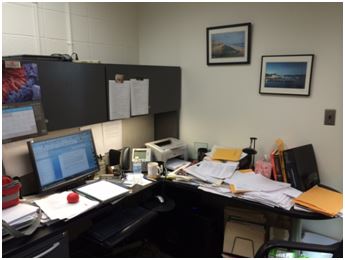
    I mostly write in my small, cramped, and overly cluttered office. geoghegan office

  3. What are your writing necessities—tools, accessories, music, spaces?

    For the most part a pad and paper, and computer.

  4. What is your best tip for getting started and/or for revision?

    Tip for getting started – get started; no really get started.  People write differently but everyone has to get started.  I’m big on getting something down on paper and editing the hell out of it.  In fact I’ll spend 5-10 times more time editing than writing.

    My best tip is to post a bullet list with principles of writing right in front of you.  When you’re stuck (and everyone gets stuck) it refreshes your memory and get’s you started again.

    One caveat; my son is a journalist/writer.  He sits down to write and most of the time it comes out perfect, with few revisions.  Proving that much to my dismay as a molecular biologist , it’s not all genetics (because I can never do that).

  5. What is the best writing advice you’ve received?

    Most of my serious writing is (or was) scientific.  And the best advice I got was to “keep it simple stupid”.  The more you try and elaborate, the more complex and less understandable your arguments are.

Keep Calm and Start Your Final Projects

Carly Johnson, Consultant

I hope you all had a relaxing spring break, full of sunshine and unassigned leisure reading. As we begin this countdown to finals (and Derby) carlyit is difficult to garner the motivation to begin your final projects. However, as someone who has spent many a tear-filled, coffee fueled night feverishly typing a final paper hours before it is due, I can tell you truthfully that it is better to start sooner rather than later. At this point you may be saying to yourself “yeah, but I work better under pressure” and I thought the same thing—until I embarked on what I call “Carly’s 5 fool-proof methods for staying focused and sane throughout finals week,” which I will share with you now:

  1. Take it one step at a time, and reward yourself along the way.I like to set up a schedule for myself prior to finals week that allows me to get a little bit   done each day. When I am on a roll achieving these tasks, I reward myself by watching Netflix for a couple of hours, or purchasing a fancy smoothie. This enables     me to stay on schedule while still allowing myself to have a little taste of the relaxation that awaits me over the summer.
  2. The solution to writer’s block is not avoidance.When I would get stuck on how to start a paper, I used to think that putting it away for    awhile was the answer…and then “awhile” ended up lasting three weeks, and suddenly it       was due. Don’t let yourself fall into this trap. If you’re stuck, ask for help, either from   your instructor, your peers, or by making an appointment with the writing center. Address           these small mental roadblocks before they become big issues.
  3. There is such a thing as too much coffee.During my late night writing sessions, I always thought the more coffee I drank, the          better my paper would become—but the fact is that too much coffee (or other caffeinated    beverage) will make you jittery and will cause your thoughts to race, which will end up making you feel more stressed than when you started. By staying on task with the        schedule mentioned in #1 above, you can avoid these all-nighters entirely.
  4. Feeling stressed? Go on a run.Even if you are someone like myself who only tends to run if there is an emergency, I       have found that physical exercise allows you to drain yourself of that excess negative   energy, and clears your mind so you are prepared to tackle those final projects. If      running isn’t your thing, check out some of the classes offered at the Student Rec Center     (I highly recommend the Zumba classes held on Tuesday and Wednesday nights).
  5. Reschedule social events for an after-finals celebration.If you struggle with turning down fun events with friend while you’re studying, plan an   event for after finals week that you can look forward to. That way, when you pass on plans for the evening you can invite them to your post-finals party, enabling you to     be social and productive simultaneously.

With these five methods, you can be sure to avoid the dark days of finals week, don your Derby hat and ease into your summer vacation knowing that you have overcome the pitfalls of procrastination. Good luck, stay focused, and remember that the writing center is always here to help!

How I Write: John Cumbler– Historian

Our “How I Write” series asks writers from the University of Louisville community and beyond to respond to five questions that provide insight into their writing processes and offer advice to other writers. Through this series, we promote the idea that learning to write is an ongoing, life-long process and that all writers, from first-year students to career professionals, benefit from discussing and collaborating on their work with thoughtful and respectful readers. The series will be featured every other Wednesday.

This week’s featured write is John Cumbler, cumblera professor of history at the University of Louisville who is also in phased retirement. He has published 6 books on social, economic and environmental history. His seventh book From Abolition to Equal Rights for All is now in press and should be out this fall. John Cumbler has also published a couple dozen articles but says he enjoys writing books more. He enjoys research and writing, although teaching is his real passion.

How I Write: John Cumbler

Location: Gottschalk Hall, University of Louisville

Current project: I just finished my last book project- an environmental history of a fragile eco-system. I have a couple short pieces on which I am working, but I am taking a break before I launch into a new book length project.

Currently reading: Mysteries and Game of Thrones

  1.  What type(s) of writing do you regularly engage in?

    History pieces, either articles or book length projects. I also write advocacy pieces for popular media.

  2. When/where/how do you write?

    I write away from other people. I usually write at home when I am alone. I mostly write in the late morning and early afternoon, but if I am caught up in something I can write into the night.

  3. What are your writing necessities—tools, accessories, music, spaces?

    I began my writing career with a pencil and paper and then I would type up what I had written. By the time I was working on my second book I was working directly on the typewriter. My third and fourth books were a combination of paper and pencil and personal computer. By the time I was working on my fifth and sixth book I worked solely on the computer. Being alone is key for me.

  4. What is your best tip for getting started and/or for revision?

    Do what works for you! I find it helps best to put down as much as you can on the first go. I work as long as the ideas seem to be fitting together. When they stop fitting together I take a break. I start up again either later in the day or the next day. Some people work best by disciplining themselves to work for a set period of time. That does not work for me. I work when it works for me to do so. When it doesn’t I take a break. Ideas push my writing. Getting started is hard, but putting down something helps move you along.

  5. What is the best writing advice you’ve received?

    Pick up the pencil and start writing. There are always reasons to put off writing, but eventually you have to begin. Better to begin early and fill in the blanks than to keep stalling until you have everything. Everything is a high bar to get over. My advice to all my students is do what works for you.

Five Strategies to Keep Writing, Even When You Don’t Want To

Ashly Bender, Assistant Director

At the University of Louisville, Spring Break is next week and the Derby festivities are not far behind. The end always seems near in the Spring semester, but at Louisville perhaps it seems always within in reach. After all, university classes are all over by the first week of May to make room for the hats and horses!

For these reasons, and probably others, March is the final push before the end of the semester and final projects. To help you stay motivated, focused, and productive during these weeks, here are five strategies to keep yourself writing and working. Feel free to use them at other times of the year! 🙂

  1.  Write 100 words every day. Ashly_Version_3The key to finishing any large writing project is to make a habit out of writing every day—or nearly every day. This habit makes it easier to write because your mind becomes accustomed to the practice and also because it keeps your project fresh in your mind. Some days, obviously, are harder than others, so my personal strategy is to make sure I wrote 100 words every day. This is a small amount that keeps me accountable, keeps my project fresh in my mind, and allows me to feel productive even on days when I’m feeling writers block. Also, often if you can eke out 100 words, more come flowing. But if they don’t, you’ve still met your goal for the day. For a quick reference, the sentences in this strategy make up 145 words, including this sentence.
  2. Tally the number of hours you work, and reward yourself. A good friend of mine who just defended her dissertation uses a strategy of rewards to motivate herself. For every hour that she works, she earns one tally. In the evening or on the weekend, she can trade in tallies for hours of play or relaxation time. If you can hold yourself to it, this kind of reward system is great for making sure you stay on task when you’re supposed to be working. The strategy also helps you schedule time for working and time for relaxing so that you don’t have to feel like you’re working all the time.
  3. Take a break. If you’re really feeling overwhelmed by your project, it may be time to take a break. When we’re struggling with a project, we can get caught up in thinking about the struggle or the impending deadline and lose our ability to actually do productive writing or work. That’s the point at which walking away, for a little while, can actually be helpful. “A little while” might be 15 minutes, an hour, or even a day. You don’t want to take too long of a break, or else going back to the project will seem daunting. Before you take your break, try writing down questions you’re having, what you need to write about next, or other goals you have for the project.
  4. Write on a different “surface.” Dan McCormick wrote a couple weeks ago about how different tools or “surfaces” help us think about our projects differently and can lead to break-throughs. If you’re feeling worn out on a project, try writing about it on paper or in a different program. You might even try writing in a different location. The key here is to change things up a little to open the possibility for new thinking and new ideas.
  5. Talk instead of write. Especially if you’re feeling stuck on a project, it might be a good idea to talk about it instead of writing about it. You could, of course, come in to the writing center. Even I have met with another consultant to just talk about what I wanted to write about—that way I could hear it out loud and another person could help me figure out if it made sense. The consultant wrote down things I was saying, what I seemed excited about, what was interesting to her. After the appointment, I had some notes to move forward with. Another option is to use voice recording software. Word has a talk-to-text function (though it needs a little training), Dragon is a great talk-to-text program, and then there’s always just basic sound recording software on your phone or computer.

So, even though the allure of warmer temperatures, Derby, and other summer events are just around the corner—don’t give up on your projects! Try any or of all these strategies to find out what will keep you writing and working. And, remember, the Writing Center is a great resource for all stages of the writing process.

How I Write: Mike Rutherford — Sports Writer

Our “How I Write” series asks writers from the University of Louisville community and beyond to respond to five questions that provide insight into their writing processes and offer advice to other writers. Through this series, we promote the idea that learning to write is an ongoing, life-long process and that all writers, from first-year students to career professionals, benefit from discussing and collaborating on their work with thoughtful and respectful readers. The series will be featured every other Wednesday.

This week we hear from founder and author of CardChronicle.com, Mike Rutherford, who introduces himself as follows:

My name is Mike Rutherfordrutherford_trophy and I think the first season of Laguna Beach is as good as television is ever going to get. More? All right, then.

I’m 29-years-old, I graduated from Trinity High School and Bellarmine University here in Louisville, and I also attended Brandeis Law School for a short period before accepting my current job. What could have possibly pulled me away from a life of writing that completely prohibits any hinting at the F word? Well, I am the college basketball editor for SBNation.com, which is very F bomb friendly, and am in the middle of my third season with that gig.

I’m also the founder and author of CardChronicle.com, a Louisville sports blog (although we’re not supposed to use that word anymore) that I started all the way back in 2007. Additionally, I co-host a weekly radio show on ESPN 680 and do a variety of other (legal) Internet things.

How I Write: Mike Rutherford

Location: Louisville, Ky

Current project: CardChronicle.com/General college basketball coverage insanity

Currently reading: A Fraction of the Whole by Steve Toltz

  1.  What type(s) of writing do you regularly engage in?

    I’m probably best known for writing blog posts – which I suppose is sort of an all-encompassing title for a number of different types of writing – for my website, CardChronicle.com. Most of the work requirements for my full-time gig revolve around editing, assigning and laying out, but I do write weekly features and occasionally standard news stories. I also write a weekly column for The Voice-Tribune here in town, and do freelance work for various online publications across the country.

  2. When/where/how do you write?

    The where is the easiest to answer, because it’s almost always from home, which I really like. If you’re reading something written by me before, say, 1 p.m. on a weekday, there’s a pretty strong chance that I wrote it topless and in pajama pants. Go ahead and store that image.

    As far as the when is concerned, the biggest drawback of always needing to know if something important is happening in the world of Louisville sports or general college basketball is that it prevents you from being able to dedicate yourself to more exhaustive pieces during the day. This being the case, it’s extremely rare that I write a feature anytime other than really late. Like really, really late. Like, I can tell you the last five anchors of “Up to the Minute,” the CBS news show that airs before the first morning local news (I’ll love you forever, Melissa McDermott).

    There are few things I’ve written over the past five years or so that I’m really proud of which weren’t formed at least partially between midnight and 7 a.m. If I’m being distracted by emails or if I’m worried that something is going to break on Twitter, then I’d just as soon not even attempt to pen something contemplative or overly insightful, because I know I’m going to look back and be disappointed. Plus, I think it’s been scientifically proven that your brain is at its creative peak when you’re the most tired. I can’t remember where I read that, so you’re just going to have to pretend I’m someone reputable and roll with it.

    How do I write? I’d say with reckless abandon and a complete disregard for any sense of dignity. No, but seriously, I do it with words.

  3. What are your writing necessities—tools, accessories, music, spaces?

    Music is out if I’m doing anything where I actually have to think, but I do like having it on for busy work. When I’m up really late, I like to have the television on but muted. I also like to try and find a live program, because otherwise I feel a little disconnected and depressed. It sounds weird, but it legitimately helps me when I have a visual reminder that there are other people in the world awake and accomplishing things while I’m working…I just don’t want to actually interact with them during the process.

    I don’t necessarily need to roam the house or a room, but I like working with the peace of mind that I can if I need to. If I’m in my room and there are people downstairs, or if I know my fiancé (see, you’re thinking this is all really weird, but it’s just normal enough that an incredibly beautiful woman agreed to put up with it for the rest of her life) might ask me for something, I’m totally unable to dive to deeply into anything.

    If it’s daytime work and I haven’t had coffee yet, then I need coffee. I try to save that until after the busy work of the morning and my 10 a.m. editorial call is over. Eating is always a special surprise.

  4. What is your best tip for getting started and/or for revision?

    Whenever you’re in the brainstorming stages of any piece of writing, there’s always one idea or one line that pops into your head and makes you think, “that’s really good.” Start there. Start with what you know is good, and then work backwards once you have a better sense of what your story is or what you’re trying to say.

    As for revisions, I think what works is different for everyone, but for me comfort is a huge factor. I can respect the hell out of a person and still not trust them (or myself) in a situation where I’m asking for their help. I’m extremely stubborn, but I’m also really passive in situations where I think my time might be wasted. So when I’m working with someone who I respect, but who I’m not really comfortable with, I’ll invariably spend the entire time pretending like I’m listening and wondering if they’re buying it. I have to work with someone who I know I can joke with, and who I know I can get into an argument with and not have it be a big deal.

    Also, if it’s a long-term project, make sure to take some time between finishing your first draft and beginning your first revision. I know that’s pretty standard advice, but I’ve ignored it multiple times and ended up digging myself into a huge hole that could have been easily avoided.

  5. What is the best writing advice you’ve received?

    Keep reading things outside of your genre. From November-March, it’s really hard for me to find time to read things outside of game recaps and player profiles, and I think my writing really suffers as a result. I’ve forced myself to avoid that trend as much as possible this year, and I think it’s had a positive effect. Spending time with writing that’s so dissimilar to the type you immerse yourself in for most of the day helps you access an area that would otherwise stay neglected. It’s been a huge help for me in keeping things fresh and distinctive.

How I Write: James Ramsey — University President

Our “How I Write” series asks writers from the University of Louisville community and beyond to respond to five questions that provide insight into their writing processes and offer advice to other writers. Through this series, we promote the idea that learning to write is an ongoing, life-long process and that all writers, from first-year students to career professionals, benefit from discussing and collaborating on their work with thoughtful and respectful readers. The series will be featured every other Wednesday.

This week we are pleased to featureramsey-portrait James Ramsey, president of the University of Louisville. Before assuming UofL’s top post, he served as senior policy adviser and state budget director for Kentucky and senior professor of economics and public policy at UofL. He has served as vice chancellor for finance and administration at both the University of North Carolina at Chapel Hill and Western Kentucky University. He has been associate dean, assistant dean and director of public administration in the College of Business Administration at Loyola University and research associate for the University of Kentucky’s Center for Public Affairs. Dr. Ramsey is a tenured professor of economics.

A frequent national speaker and writer on economic issues in the public sector, Ramsey has  received a number of honors and awards including the Boy Scouts of America Silver Beaver Award in 2012, Greater Louisville Inc.’s Silver Fleur-De-Lis Award in 2011, Louisville Advertising Federation’s Louisvillian of the Year Award in 2010, Western Kentucky University Distinguish Alumni Hall of Fame in 2010, Louisville Defender Outstanding Community Service Award in 2010, Business First Business Leader of the Year in 2007, University of Kentucky College of Business and Economics Alumni Hall of Fame in 2004, the Governor’s Association’s Outstanding Public Service Award in 2001, Kentucky’s Distinguished Economist of the Year in 1999 and the Fern Creek High School Hall of Fame in 1998.

How I Write: James Ramsey

  1. What type(s) of writing do you regularly engage in?


    At this point in my professional career, most of my writing is of a professional nature:
    a. Communications to various members of the university family including Board of Trustees, Board of Overseers, University of Louisville Foundation, Alumni,  etc.;
     Legislators and public policy makers; Donors;

    b. Policy papers;

    c. I still try to do a bi-monthly newsletter to several different groups, both university and non-university, on the state economy and the state’s economic outlook. 

  2. When/where/how do you write?

    I need silence to write.  While I can close the door to my office, there are always interruptions, either in person or telephone.  Also, there is the constant allure of checking the latest e-mails, etc. I do most of my writing in the car.  At an earlier point in my life, my family and I lived 2-1/2 hours from my place of work.  While I would generally leave home early on a Monday morning, I would try to come back one or two nights during the week for our kids’ school events and then home on the weekend.  The point is, I had a lot of time in the car and I became accustomed to dictating all kinds of communications from responses to e-mails, letters, and in some cases professional economics papers.  I continue that practice.  My home is 20 or so miles from the office so I can often dictate 15 or 20 minutes coming in to work – I’m actually dictating my answers to these questions now as I am on a trip out of town and will be in the car for 3 hours.

    My best time to write is early in the morning – fresh, brain working (late afternoon/evening – brain dead).

  3. What are your writing necessities—tools, accessories, music, spaces?

    When I am writing and not dictating I need a yellow pad and a number of pencils with erasers.  I rarely type other than short cryptic answers – not very proficient at typing.

  4. What is your best tip for getting started and/or for revision?

    It depends to some degree on the type of communication but generally I will first think through key messages to convey or points I want to make.  I jot those down and identify data sources or research needed to support the points to make.  I generally have an outline, very topical but from beginning to end and I try to work through it to ensure that my writing has a logical consistency and flow.  Depending on the type of communication I frequently go through multiple revisions; I struggle over almost every word and go back and forth.   In fact, at some point I generally have to say enough is enough or, more realistically, I reach a deadline and the 18th draft, for example, becomes the final version.  I like to have others read my writing that will be presented or communicated to larger groups for a) typos, spelling, grammar; and b) logical consistency.

  5. What is the best writing advice you’ve received:

    a.       Try not to use any words that are not needed;
    b.      Have others proofread;
    c.       Develop an outline with themes that you are trying to communicate.

Finally, I would love to write a book sometime – not about my profession of economics or higher education administration (I’ve done special chapters for books, etc.) but rather a book that deals with real world experiences.  On two different occasions I have started dictating ideas – one was based on a dog we had for 15 years, telling our family story from her perspective.  The last several years of the dog’s life she was deaf so I thought I’d call it, “I Saw It All … And Heard Some Of It.”  There wasn’t anything particularly amazing that happened in our lives and that’s why I probably never pursued the project – rather the dog would relate family experiences, especially difficult situations like death, tragedy, etc. but from the dog’s perspective.  At one time I thought I would have someone transcribe all this to see how bad it was but …