Category: Writing Center Research

University Writing Center (r)Evolution?

Cassie Book, Associate Director

Many posts here on our blog are about the writing and tutoring processes, but another important part of “who we are and what we do” is participate in scholarly conversations. This month I attended the International Writing Centers Association (IWCA) annual conference. The theme, Writing Center (r)evolutions, challenged me to rethink my own assumptions as a consultant and administrator. I’m sharing a few of the half-formed thoughts and questions. I want to invite you into my conference experience. By doing so, I hope to blur the invisible boundaries between daily practices, personal reflection, conversations, and research; I want to make our behind-the-scenes writing center conversations a bit more visible.

  • Foremost on my mind is the University Writing Center’s impending move to the first floor of the library. We’re excited to gain a more visible space and digital consultation rooms. But we’re also gaining new neighbors: the Digital Media Suite, REACH Computer Resource Center, and Research Assistance and Instruction. Stacy Rice’s presentation confronted anxieties that exist when separate centers, such as writing, speaking, digital, or communication, have somewhat overlapping missions. She challenged all centers to not attempt to divide communication into different realms and instead simply respond rhetorically to the writers and composers who seek response and feedback. Our new space and location affords us the opportunity to collaborate in ways that previously may have been difficult. Will each center embrace opportunity or retreat into our separate spheres? What are the best ways to collaborate?
  • Regardless of any (r)evolution or renovation, I think it’s safe to assume our writing center services will always include the individual consultation. Yet, writing center research still has work to do in understanding the dynamics of writing tutoring. Molly Parson’s research focuses on consultants’ perceptions of conflict during sessions. Parsons made me think about the expectations consultants and writers have for sessions. She seemed to suggest that while both sides may think “good” or “productive” sessions will be those that steer clear of conflict, but, in reality, conflict can spur ideas and those “ah-ha!” moments. Do we learn because of, not despite, conflict?
  • We work with many multilingual writers. Nicole Bailey’s presentation suggested that centers should consider providing tutoring in writers’ home languages when possible. Her ethnographic research in a multilingual university in South Africa suggests that when writers feel comfortable, they will learn more. She’s already embraced the practice at the writing center she directs. How can we bring writers’ home languages into the writing consultation?
  • All the consultants in the University Writing Center are graduate students who complete a course called Writing Center Theory and Practice. Kelsey Weyerbacher and Jack Bouchard, two undergraduate consultants, presented their experience and research data. Their perspectives challenge the (mis)conception that a tutor is just a tutor. Yet, writing centers are fruitful sites for research that informs issues of learning, writing, development process, response, space, and conversation. What happens when tutor-initiated research becomes the rule rather than the exception?
  • Matt Dowell’s presentation suggested that writing centers should pay more attention to paratexts—handwritten notes, charts, marginalia, and drawings—written or drawn during sessions. These texts may have untapped potential. In a separate presentation, Matthew Rossi argued that doodling in sessions can create opportunities for common ground and understanding that talking simply cannot.

Finally, a panel organized by Muriel Harris challenged writing centers to better use online spaces—listservs, blogs, databases, and websites—to share across centers and among local contexts. An important question that arose during the discussions was: Who do our blogs reach? Our UofL Writing Center blog had 7,541 unique visitors in 2014. We’ve had 6,263 so far in 2015. But who are you? Is there a better way to reach our target audiences?

To that end, I encourage you to be radical—comment on the blog and let us know. What are your thoughts on writing center (r)evolutions?
We’re Always Learning About Writing: The Importance of the University Writing Center as a Site of Research

Bronwyn T. Williams, Director

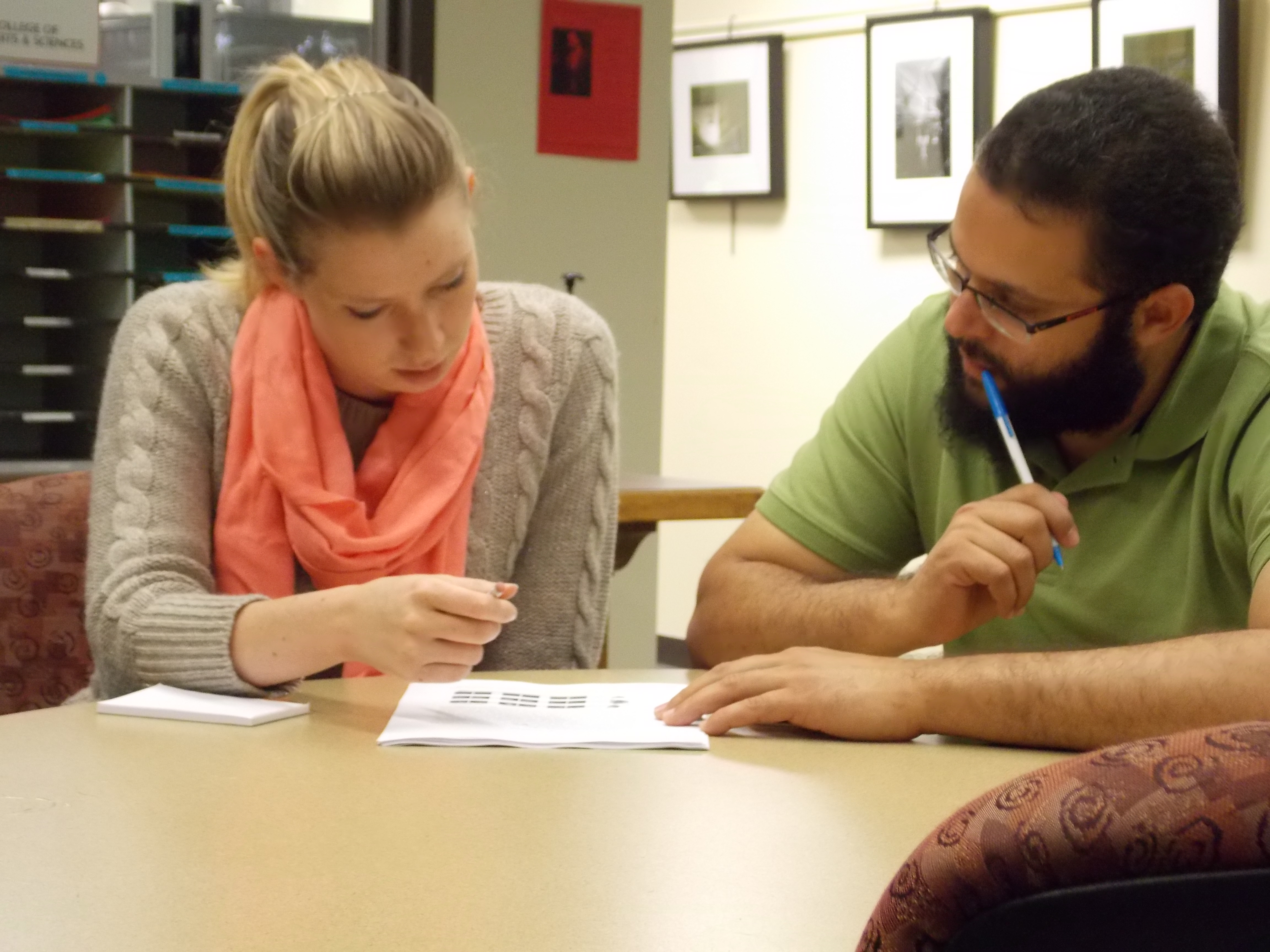
The obvious work of the University Writing Center takes place during the writing consultations. If you walk in and see the room filled with people in conversation about writing project, it might be easy to think about the individual teaching as all that happens here. Yet another important aspect of our work in the Writing Center is not immediately visible during consultations, but is vital to helping us engage in effective teaching with the writers with whom we work. In addition to being a place where people can get support for their writing projects, the University Writing Center is an active research site into the theory and practice of Writing Center work. DSCN1706By learning more about writing and how writers learn, we improve our work and contribute to the scholarly conversations in the the field of Writing Studies. For example, many of the graduate students who work as consultants in the Writing Center also engage in research on everything from how international students work in online consultations, to how to teach ideas about genre in writing, to how Writing Centers work in community colleges. Such research can form the core of a graduate students’ dissertation or MA project, or result in publication in the scholarly journals and books in our field. You can find a list of some of the research projects that have emerged from the Writing Center on our webpage.

Engaging in research is vital to the work we do in the Writing Center. Writing doesn’t stand still. By that I mean that writing is a complex social endeavor that we are constantly having to study to understand. It’s widely accepted in our field that writing is more than just making or deciphering marks on a page. The way we write, the way we learn to write, and what we write are all shaped by the social world that surrounds us. Everything from technology to language to changes in the culture around us influence how reading and writing happens. For example, the rapid changes in digital technology have changed the writing and reading practices of everyone in the University (as is obvious if you’re reading this blog). If you ask twenty people at the University how changes in technology have influenced student writing, you might get twenty different answers, some of which might be accurate and others wildly wrong. Our research, like all research at the University, is intended to help us move beyond our initial opinions and gut instincts to gain a clearer understanding of the complex nature of student writing and student writers today. With such an understanding we can work more effectively with writers to help their work communicate their ideas in creative and critical ways, and to teach them skills and approaches that will help them be better writers in the future.

In addition to working to understand more about how people write and how we can teach them to be better writers, we work to conduct research in an ethical and participatory manner. We do our best not to regard the writers involved in our research as lab rats that we can observe with detachment and analyze at our pleasure. Instead we want to conduct research that is collaborative and participatory in nature. We want to do more than simply comply with University ethics guidelines (which we do, of course). We want to model research with writers in the Writing Center as something that they learn from, and benefits them directly, even as we learn more for ourselves. One of the core values of Writing DSCN1772Center work is a dialogic approach to teaching and learning. We work in conversation with students and faculty who come to the Writing Center. We start from where they are, and respond to their concerns as we also discuss with them the ideas and questions we find in their work. This same kind of participatory and dialogic approach helps shape our research ethics and practices and is part of our identity. We believe in a model of research that is reciprocal and engages everyone involved in learning and creating knowledge.

Tomorrow, we’re taking some of our research on the road. Along with Adam Robinson, Associate Director of the Writing Center, and Ashly Bender and Jessica Winck, two of our Assistant Directors, I will be attending the annual conference of the national Council of Writing Program Administrators. The CWPA is an organization that discusses both the practice of administering writing programs, as well as pedagogical approaches to teaching writing. At the conference, we’ll be presenting on a panel titled, Writing Centers as Enclaves: Creating Spaces for Pedagogical and Political Change. After the conference, I’ll be writing more about this idea next week. As with any academic conference, we’re looking forward not just to presenting our ideas, but in learning from the conversation from the people there. It is all part of  connecting research and teaching in order to improve all of our practices in the Writing Center.