Category: Writing Advice

Alternatives to Procrastinating

Jessica Winck, Assistant Director

Approaching the end of the semester can be a stressful time, and those of us who are inclined to procrastinate might feel especially anxious. I tend to believe that procrastination involves more than just actively avoiding work. It often relates to a writer’s sincere challenges with any of the following: understanding an assignment; feeling overwhelmed by the workload in college; worrying about whether s/he “has what it takes.” None of these is easy to deal with, and we know that avoiding work doesn’t help us in the long run. If you’re worried about procrastination, try some of these strategies:

Contact your instructor about any questions you have. This might sound obvious, but not everyone feels comfortable with this approach. What if my instructor will think I’m stupid, or that I’m not trying hard enough, or that I’m not good enough to be in this class? Meanwhile, confusion about an assignment prevents us from working on it. Email your instructor or ask to visit her or his office hours, which are set aside specifically for helping students address questions and concerns.

If you have a large assignment on your hands, consider breaking it down into smaller, more manageable pieces. How we see the task plays a large part in our approach to it. “Write a research paper” sounds like a scary and overwhelming task. Try talking to your instructor about how you can approach the assignment in parts. You can also go to the writing center and work with a consultant on setting some manageable goals for completing the assignment. These should be goals that you can reasonably meet in the amount of time you give yourself. You will get more done, and you will likely feel more confident about finishing the assignment.

Try setting a timer when you write. This might sound like an odd piece of advice, but it’s one I always stand by. I often use the Pomodoro method: write for 25 minutes, then take a 5-minute break. Write for another 25, then take another 5. Writers who struggle with procrastination might find this method especially helpful. Over time, you start to notice that some tasks don’t take as much time and energy as you imagined. Tasks become less intimidating and more manageable. Plus, you don’t have to focus on writing for an indeterminate amount of time. If you grow tired or you need a coffee break, you don’t have long to wait; but for the time being, you write. Also check out what Alex Clifton, a writing center consultant, wrote about some online resources that help you keep writing in pre-set blocks of time.

DSCN1660Write with a friend or a group. Working alongside others can be encouraging, and it also keeps you accountable. My colleague Meghan Hancock and I often meet for the specific purpose of writing and working. It’s a great arrangement because we have a shared understanding that we write when it’s time to write (and yes, we set a timer). Since your classmates are working on the same assignment, ask them to join you. Though the time you make is for writing and working, it also presents the opportunity to get to know more people and to feel supported at the same time. Contrary to some of the received wisdom out there that good writers work independently without any help, you actually don’t have to do all this alone.

On that note, make an appointment at the Writing Center. We will be happy to sit down and work with you wherever you are in the process of writing. Plus, having specific times set aside to talk with others about your writing helps you stay motivated.

There are many alternatives to procrastination, and I hope you try some of the ones here. Have a great rest of your semester!

How I Write: Jeffery Skinner — Poet

This semester we are beginning a new series for our blog called “How I Write.” This series asks writers to respond to five questions that provide insight into their writing processes and offer advice to other writers. We’ll be featuring writers from the University of Louisville community, but also those from beyond the university who compose in a variety of personal and professional contexts. Through this series, we promote the idea that learning to write is an ongoing, life-long process and that all writers, from first-year students to career professionals, benefit from discussing and collaborating on their work with thoughtful and respectful readers. The series will be featured every other Wednesday.skinner

We begin our series with University of Louisville’s own Jeffery Skinner who describes himself on his website (jeffreyskinner.net/) as a “poet. playwright. professor.” His most recent collection of poems Glaciology, which won the 2012 Crab Orchard Open Poetry Competition, was just published by Southern Illinois Press. You can hear Jeffery Skinner read with Kiki Petrosino on November 7th at 4:30 pm in the Chao Auditorium in UofL’s Ekstrom Library.

How I Write: Jeffery Skinner

Location: Anywhere fairly quiet

Current project: New book of poems

Currently reading: Mark Richard’s memoir, David Jones poems

  1.  What type(s) of writing do you regularly engage in?
    Poetry, and prose of various types: recommendation letters, essays, prose poems, memos, grant applications, etc.
  2. When/where/how do you write?
    During summers I bear down heavily; during teaching time I snatch whatever odd moment that becomes available.
  3. What are your writing necessities—tools, accessories, music, spaces?
    Pen and paper for poems; laptop for prose. I’m fond of parking myself in a coffee shop, and plugging into postclassical, techno, electronica (no human voices).
  4. What is your best tip for getting started and/or for revision?
    a. decide to write with your own voice b. lower your expectations c. don’t stop till you’ve written a predetermined amount (which doesn’t have to be “good”–just done)
  5. What is the best writing advice you’ve received?
    “Writing is easy: you just sit there until drops of blood appear on your forehead.”

Again, we want to thank Professor Skinner for his insightful responses and encourage our readers to attend his upcoming reading. On November 6th, we will post our next entry featuring University of Louisville Law professor Judith Fischer.

Why Do We Write?: In Defense of The Paper

Daniel Ernst, Consultant

The paper is a collegiate common denominator. In just about every class in every discipline, writing papers is required. Therefore, it’s easy to see the paper as busywork, a pointless academic exercise often with no real world counterpart. But the paper is more than some arbitrary unit of learning by which an instructor attempts to measure a student’s intellect. If we think about what we really do when we write, we see in fact that the writing process offers a unique and effective learning arena.

This isn’t just armchair philosophizing either; writing’s unique relationship with learning has been well documented by scholars in fields from psychology to linguistics to composition theory. One composition/education theorist in particular, Janet Emig, provides a general overview of writing’s role in learning in her article “Writing as a Mode of Learning.” Emig first distinguishes writing from other forms of language usage—reading, talking, and listening. Then, she explains how writing distinctively requires the deployment of and interaction among multiple learning methods, such as analysis, synthesis, experience, and genesis.

DSCN1632Writing’s interactive and multifaceted process is what makes it so challenging, but this process also fosters a uniquely instructive learning environment and sets it apart from other forms of language usage. For example, take the idea of analysis. College students are commonly asked to analyze; the term analysis (or its sister term ‘critical thinking’) appears on almost every essay prompt or class syllabus in one form or another. This is because analysis is a powerful educational tool in which an idea’s deconstruction into its elemental building blocks helps students better understand its composition. In general, though, analysis is accomplished through class readings and discussions. So if reading, talking, and listening in class helps to take apart these big ideas, what then to do with all the disassembled pieces? This is where writing comes in.

Writing papers is your chance to take the deconstructed concepts and theories and build something new. In other words, synthesize new connections/conversations that become new ideas. Not only is this a critically important move from “destructive” to “constructive” intellectual work, but it’s also your opportunity to contribute, as many of my teachers have put it, to the scholarly conversation. The significant and sort of radical thing here is that these are your ideas and your unique contributions. And in formulating these contributions, you are forced, through the nature of writing, to confront ideas in a special way. Writing’s combination of and interaction between analysis and synthesis, mediated by the writer’s own experience and end-goals, promotes a participatory brand of learning that is unrivaled and truly indispensable. So the next time you are assigned to write a paper, try to embrace the chance to learn in a unique way and capitalize on your opportunity to participate and contribute your voice and your ideas.

In Conclusion: Framing Your Paper

Arielle Ulrich, Consultant

Working at the writing center, I constantly hear students say that they hate writing conclusions. These students will bring in papers that seem finished, but end abruptly—or they may have written a conclusion, but it’s only a sentence or two re-stating the last paragraph.

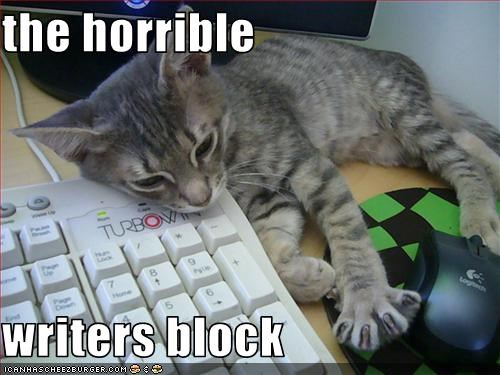
I’m no stranger to this struggle. Even the conclusion to the simplest paper can leave me stumped, and I often have to leave the paper alone for a few hours while I try to think of the “perfect” conclusion. Of course, as the last thing the reader sees in the paper, conclusions are very important. But my obsession with the perfect conclusion instead psyches me out, leaving me with a case of writer’s block.writersblock

When this happens, I remind myself that a good conclusion cannot fix a bad paper, nor will it solve any of its organizational or structural problems. I find it more helpful to consider a conclusion as the closing statements of my argument. By this point, I should have already said everything I needed to say and written the meat of my paper. I’ve argued, elaborated, and explicated every point. My conclusion will simply wrap up my paper and place my topic into context for the reader.

  1. In light of this, I have a few tips for conclusions. Which tip you follow may depend on your field, so consider which strategy works best for your paper. These are my three go-to tips: Explain the significance of your paper. Make sure the reader knows why your topic is important. Usually, this involves placing your question into a broader context or comparing it to a current issue. If you cannot think of the significance, ask yourself, “so what?” This approach is especially useful in history or expository papers.DSCN1639
  2. Recommend further research. Now that you’ve examined the current research on your topic, you have the chance to take the next step and recommend a course of action for the future. Is there a topic or approach you would ask a future researcher to consider? In other words: what questions are you left with at the end your paper? This tip will work best with papers that have a significant research component.
  3. Synthesize your points. This strategy requires that you not only summarize your paper, but also put together the pieces for your reader. How does your argument come together? If your paper is either very long or complex (or both!), this type of conclusion would be a good choice.

Any of these strategies would guarantee that your reader leaves knowing the purpose of your paper. You also shouldn’t feel that you can use only one of these strategies at a time—in some papers, you may use all of them, provided they are relevant.

These two writing center sites also have good pointers. Feel free to peruse these before writing your next paper:

University of North Carolina, Chapel Hill: http://writingcenter.unc.edu/handouts/conclusions/

University College, Toronto: http://www.uc.utoronto.ca/intros-and-conclusions

Happy writing!

What is Voice and Where Do You Get It?

Layne Porta, Consultant

I remember being told when I first started doing college level writing that I needed to work on my voice. When I asked my professor what exactly she meant by that, I was told that voice is what makes your writing uniquely your own. I was frustrated and confused: Isn’t the fact that I’m writing it what makes it uniquely my own?

Now that I am a graduate student and writing consultant, I often see the same kinds of feedback on my students’ papers. What I would like to offer here are some thoughts on what voice is and how you get it, as well as some resources that can help you along the way to finding your voice.

What I have come to learn about voice is that it is much more about practical decisions you make in your writing than some mystical quality that appears like mist in the night. The writing process itself is an unending sequence of decisions–from word choice to punctuation to paragraph breaks–and all of these decisions add up to create your voice. For example, I love to use dashes in my writing, which can make my voice sound more conversational. Voice can also come from the kinds of metaphors and similes you choose to explain concepts, or the length of your sentences. I have found that one of the biggest factors in creating (and understanding) your voice is word choice. For example, one of my least favorite words is fickle, but one of my favorite words is capricious. They mean the same thing, but my voice will sound very different depending on that decision. There are many resources that can help in making decisions about the words you want to use. For example, on websites such as visualthesaurus.com and visuwords.com, you can type in a word and it will bring up a word web that will feature synonyms and variations of that word clustered according to connotation. The example below is a screen capture of a visual thesaurus app I recently downloaded:

"Volatile" on Visual Thesaurus
“Volatile” on Visual Thesaurus

I have often heard the idea from both students and peers that voice isn’t as important in academic writing as it is in creative writing. I believe this is a huge misconception. Voice is crucial to academic writing because it plays a large role in engaging your audience, establishing a formal tone, and creating your credibility as a writer. In sum, voice plays a very active role in helping you achieve your rhetorical goals. Furthermore, you can have more fun with the writing you will do during your time in college or after if you embrace your voice as a writer.

If you find yourself wanting to learn more about voice and how to get it, I suggest two very helpful websites that offer comprehensive discussions about voice. The first is “Understanding Voice and Tone in Writing” by Julie Wildhaber, featured on quickanddirtytips.com. This article offers tips on defining your voice as well as some helpful examples of how voice will change according to genre. Another useful article on writingcommons.org by Kyle D. Stedman, is “Making Sure Your Voice is Present” which also offers excellent suggestions for finding your voice as well as some YouTube videos about voice.

layneOne thing to keep in mind is that finding your voice is like everything else in writing–it requires practice. So in response to my initial question as a beginning college student: yes, the fact that I am writing my paper is what makes it uniquely my own. But voice takes this a bit further, and requires that you do some writing to see how your personality comes across. My suggestion, then is to trust your instincts as a writer. Your writing is a reflection of your thoughts and your personality. Your voice, and your awareness of your voice, will come through the more comfortable you get with writing.

The Dreaded Comma

Jacob Robbins, Consultant

Here at the Writing Center, we religiously emphasize addressing the needs of the writer over the needs of the writing.  In an ideal session, the written work serves only to illuminate the so-called “higher order” needs of the writer such that we can directly help the writer improve not just the piece itself, but also the strategies he or she employs.  However, as any writing consultant with a modicum of experience knows, one must often wade through a great deal of apprehension about “lower order” concerns before broaching larger concerns.  So many students’ attitudes (including my own) about writing are saturated and informed by the red, deleterious ink of overzealous instructors.  By virtue of my past instructors’ methodology, I knew what I was doing incorrectly long before I knew what I was doing well.DSCN1622

There are a great number of relatively minor mistakes whose over inflation causes anxiety in writers of all stages.  Perhaps the greatest offender, though, is the failure (perceived or real) to use commas correctly.  The number of students who come to the Writing Center seeking guidance on comma usage tells me that I am far from alone when it comes to my difficulties.  Their papers bear corrections scolding their comma use, but rarely point out when the student has correctly utilized commas, giving them little understanding of their mistakes.

In fact, it is difficult to outline the rules of comma usage because the term itself is a misnomer. Laws do not govern comma use; rather, it is governed almost exclusively by convention.  Correct comma use was never legislated into the English language.  Instead, we depend on those who came before us to point the way, and a larger academic community to affirm these revered progenitors.  As such, there is no such thing as incorrect comma use in the strictest sense.  This is not to say that incorrect comma use is by any means impossible.  However, achieving this understanding helps us think of commas as tools of effective communication, rather than obstacles to it.   This small, semantic piece of information has helped me a great deal in my struggle to overcome the fear of comma misuse, and sharing this with those I tutor seems to help them in much the same way.  Indeed, my experience leads me to believe that reading aloud best helps with understanding comma use, and is certainly far better than barraging students with technical jargon which I barely understand myself.  Along with helping the student recognize their own voice, reading aloud is necessarily an exercise that indicates pauses throughout when the student naturally stops to breathe.  Pointing these out to the students as opportunities to separate their ideas with commas and let the reader breathe help make comma use far less intimidating.

Don’t Fear the Outline: It’s Really Just a Helpful Sidekick

Jamison Huebsch, Consultant

Outline is an unusual word in the world of writing; in normal usage it suggests a lack of substance, a mere shape of something larger. We use the word because it is supposed to represent the shape of things to come in our work. Yet in the process of writing an outline can sometimes feel limiting, because it can be a commitment to a direction for an essay or story. An outline can be a big help in the early planning stages of writing however, and I would like to share a few tips I’ve picked up on creating an outline. The first tip is not to stress out about an outline, because it is supposed to be a helpful map and not a constraint.

Imagine it like this: you are deep in the middle of a paragraph, and have put your best ideas down on the paper but you still feel like it’s a bit of a mess. Where do you go next? Pull out your trusty outline you made earlier and let it guide you. You can review the important concepts you wanted to cover, see what the next topic you planned to discuss, and then you are right back on track without any wandering about. The key is what you include in your outline, to give yourself guidance later.

Let’s start with two important parts of the introduction: the audience information, and the thesis. Your introduction is usually the best place to clue your reader into information they may not know but is important to your topic. You should note down anything you feel you might have to explain such as technical information, acronyms, or concepts. In creative works you might consider a character’s back-story or important information about where the story takes place. Not everything you write down in the outline has to be used later. If you writing a creative work you may not need a thesis either, but it is still a good place to record your original plan for the plot. If you producing other academic work however, you will definitely want a thesis. There is lots of help available on making a good thesis, including on the Purdue OWL, but as long as it summarizes the central point of your paper well you are on good ground.

The next section is sometimes referred to as the body, but I like to think of it more like a skeleton. You want to get the central ideas of your work sectioned out, and then you can break them down into smaller easier to plan steps. So pick major concepts and give each one its own section. In a creative work you might list the scenes you plan to write, so you can get a feel for the shape and flow of the plot. In a class paper you could review the major topics or issues related to your argument. If you have already done your research for the paper, an outline can help you space out your citations and ensure that you cover everything important before moving on to the next source. You want the sections to follow each other in an order that makes sense, so by looking at it in the large scale abstract you can better see where you might need transitions added to your text.

When you have covered all your main points and noted all the important details to your paper it’s time for an ending. Regardless of if you call it a conclusion or an epilogue, a good work leaves it reader with a proper send off. This is your last chance as a writer to leave a good impression on your reader. Luckily a conclusion in an academic paper is like a mirror of the introduction: you review the important points of your argument briefly, and similar to your earlier thesis it DSCN1642should contain a clear and concise statement of your position. Creative writers are still stuck crafting sappy endings or killing off everyone’s favorite characters, but that’s the job you signed up for. Either way you’ll know by now if you followed your earlier road map or set off into the unknown, but at least you brought directions.

I hope these few short tips about outlines help someone out, and don’t forget that you can come by the Writing Center. We not only can help you with brainstorming and planning your first outline, but with all the fun stuff that comes after. Good luck with your writing!

How to Get Unstuck: Ways to Start Writing and Tips to Keep Going

Alex Clifton, Consultant

Writing is hard. Starting any kind of writing—or keeping it flowing—can be so difficult. Very rarely do people get out what they want to say on the first try. I should know; I just drafted the opening sentence of this blog post five or six times, going through wildly different options. It can be challenging to figure out what you initially want to say, and even harder when you feel like giving up after one or two paragraphs because the words just aren’t coming. Here are some tips to get you writing and keep you writing!

If you have trouble at the beginning of a writing session because you are thinking too much about other homework, life problems, cat pictures, etc., freewrite for five to ten minutes. It doesn’t have to be anything sophisticated; just grab a notebook and write down everything you are thinking, as it comes to you, for that short period of time. Afterwards, you’ll have cleansed those thoughts from your brain for the time being, so you can get down to working instead of wondering whether or not you’ve cleaned your aquarium.
DSCN1650

Occasionally, you might struggle to find a topic to write about. It might help to make a list of things you are interested in or want to mention in your essay. This can be especially helpful with personal narratives or persuasive essays. For example, if you’re trying to think up concrete examples to support your idea that fish are the best pets ever, you might make a list describing the pros of keeping fish as pets, another list about your experience keeping fish as pets, and another list with all the facts you know about fish that might persuade someone that fish are great. Again, these thoughts do not have to be organised perfectly; list-making is just another way to get you thinking about what you want to write about!

When working on a paper, remember that you don’t have to write everything in a linear manner—there is no rule that says you have to start with your introduction and plough through in the “right order.” If you’re really struggling to make a point, make a note of where you want it in your essay and then continue writing so you don’t lose your momentum. You can always go back and revisit different portions of your paper, and you might be able to rephrase your thoughts better after you’ve written another section.

Sometimes, it’s hard to get a rough draft out at all. One way to get you writing for blocks of time is to use an app like Write or Die (found at writeordie.com). Don’t let the name scare you: it’s a website that helps you write for however long you decide, be it fifteen minutes or an hour. It motivates partially through annoying you: on one mode, a loud pitch will play if you stop writing for too long, and on kamikaze mode, your work will begin to unwrite itself! (Kamikaze is an optional mode.) The great thing about Write or Die is that it gets you writing, and just writing, for however long you need. Think of it as freewriting for your paper; you can type in anything while you are drafting and then go back and revise it afterwards. It will help you get a draft out and may even add to your productivity, especially when you realise you’ve written for half an hour straight without constantly checking social media or your favourite news sites. I’ve found that using it has helped me learn how to write in chunks of time more effectively, so I can sit down to a half-hour writing session and get work done rather than just goofing around. (A word of warning: if you do use Write or Die, make sure that you copy, paste, and save your work in a separate word document—Write or Die will not save it for you.)

Finally, at the risk of sounding shamelessly self-promoting, come into the Writing Center! We’re here to help you with all of your writing needs at any stage of the writing process. You don’t even have to have a word on the page to make an appointment for an assignment. We can help you discuss your ideas and brainstorm possibilities, or we can read over what you have already written and help figure out where your paper will go next. Sometimes it just helps to talk it all out with someone who wants to hear about your ideas—and trust me, we definitely want to hear what you have to say.

I hope some of these strategies work for you. Try one next time you get stuck writing a paper and see if it helps!

Five Places That Make Writing Easier

Megen Boyett, Consultant

DSCN1655It’s the start of the semester, which means, it’s time again to think about research papers! I know, it’s only the second week, and yet, that paper looms ahead of you on your syllabus. It will not be ignored and it will not be denied, but it will be here in about 15 weeks. Worst of all, it’s going to need outside information and some advance planning, both things that a four-day caffeine binge during finals week won’t provide.

The worst thing about new semesters is that, once again, you have the opportunity to find out how little you know and how much you wish you knew. But take heart! The best part about new semesters is that they’re a new beginning! You’ve got time again to get things done right! And, better still, there are resources for you to use right here on campus. Here are five places to get what you need for those research papers and have a less stressful semester:

  1. The Writing Center, of course!

Are you unsure where to start an assignment? Do you need some help figuring out what it’s asking for, or what you should do next? Have you written as much as you think you possibly can on a topic, but only gotten halfway through the page requirement? Bring your assignment and whatever you have so far into the writing center. Sit and talk it over with us for a while (let’s say, up to fifty minutes). Believe me when I say, it’s oh-so-helpful to have someone to talk about your work with, especially when they aren’t giving you a grade at the end. If nothing else, you’ll leave knowing what questions to ask when you go back to class.

  1. The Research Lab at Ekstrom Library

You know the sources are out there! You just don’t know where to start looking, and it’s a little intimidating to wade through so much information on your own. Fortunately, the librarians at Ekstrom do have a good idea of where you should start. You can ask questions at the research desk (1st floor), you can set up an appointment to learn how to use databases, or you can even chat with a librarian online at http://louisville.edu/library/services/ask.html.

  1. Citation Databases

Does thinking about citation styles give you a cold sweat? Then, of course, ask your writing center consultant. We all have our favorite sites for citation help. One of the most commonly suggested is the OWL, or the Online Writing Lab at Purdue. It has quick links to citation style guides and plenty of examples. Another really good program is EndNote, which stores all your sources for you and formats bibliographies and in-text citations. Best of all, it’s free through the U of L library!

  1. Your professors

I have yet to meet a U of L professor who won’t make time during office hours for a student to talk about a paper. Your professors are valuable resources because, after all, they wrote the assignment. Not only can they answer questions about what they want you to do, they’re also good for helping you talk through ideas and suggesting potential sources. Put their expertise to use!

  1. The Writing Center, again

You’ve researched, you’ve drafted, you’ve cited to your heart’s content. You’re pretty confident that you know what your professor wants and even how to do it. Now it’s all (or almost all) down on paper, but you’re still not sure that your paper says what you want it to. Come back to the writing center and read your paper aloud with a consultant! Never underestimate the value of talking about your writing with a student who’s been trained to talk about writing. Being able to hear feedback before you hand in a paper not only gives you one last chance to make changes and turn in the paper you meant to write, it’ll with future writing assignments, too. (Plus, it’s really fun to talk about something you created with someone who wants to read it. Trust me.)

Here’s to a fabulous semester! Here’s to knowing what you’re doing and to asking when you don’t know! Here’s to caffeine headaches after something other than an all-night paper-writing-palooza, because, after all, don’t you have better reasons to stay up till 2 am?

Happy Writing!

Experiences, Advice, and Inspiration from First Year Cardinals: A Collaborative Blog

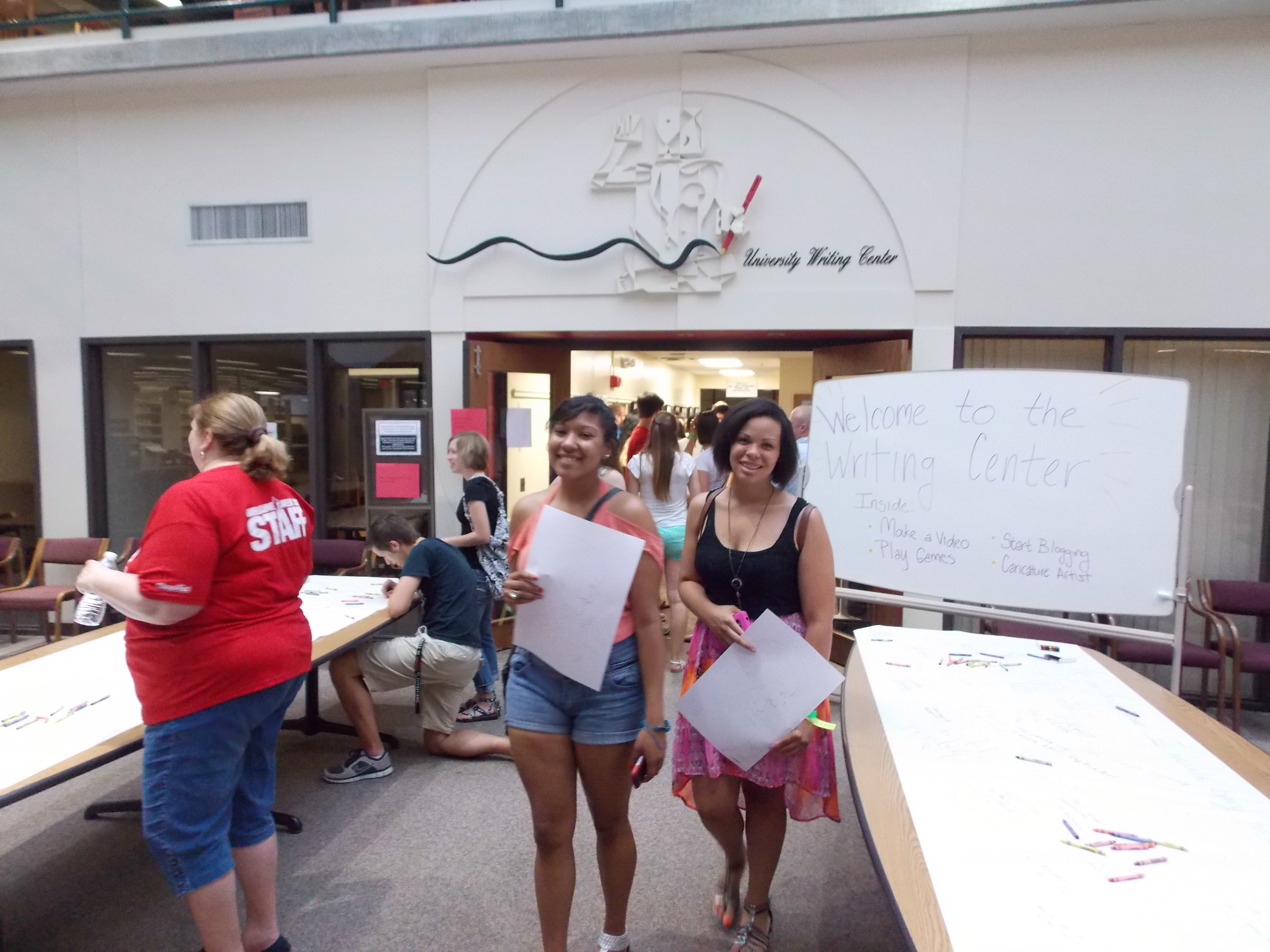
Last Thursday, the University Writing Center participated in the Office of First Year Initiatives Night at the Museum event. In the past, this event has been held at the neighboring Speed Art Museum, but since the museum is currently under construction it was moved to Ekstrom Library, where the Writing Center also happens to be located. We were excited to be involved in this event which, like many others in the week before school starts, aims to familiarize first-year students with campus, build community, and get everyone ready for the Fall semester.

There were many features available throughout the event, including a magician, a fire show, a scavenger hunt and others. DSCN1679On the 3rd floor in the Writing Center, in addition to the caricature artist, students were able to make videos about their experiences with writing, help decorate banners promoting what they believe about writing, and help write a collaborative blog post for this blog. To get the words flowing, we did offer some topic suggestions asking students to reflect on their best experiences with writing or advice about writing.

The night was filled with stories of papers, like this one:

My best writing experience was when I finished my 14 page Extended Essay for the International Baccalaureate Program in 2 freaking days. When results came in I received a 7 (the highest possible grade)!!! YAY!!!

And this one:

The best writing compliment I ever received was an accusation of plagiarism. That may sound a little mixed up, but it really was. Because what my teacher said to me wasn’t “you cheated” or “this isn’t yours” but rather “you couldn’t have possibly written this well”. And when I finally convinced him I had, he told me that it was essays like mine that showed that his class truly mattered.

By far, though, the most popular theme of the night was “best writing advice”:

Don’t use clichés!

Try as many different writing styles as possible. Try outlining, but if it doesn’t work you can always try something else! You never know when you will find a method that works for you. Most importantly, ASK FOR HELP!

When you finish a paper, read it backwards to catch spelling errors.  Then, make sure to have someone else read it.  They’ll probably see errors that you missed!

Be brief.DSCN1676

Make your diction sophisticated enough to be intelligent but simple enough to be practical.

Get rid of the fluff.

Don’t use “be” verbs!

If you use garbage words (nice, good, bad, like, ect.) I’m judging you.

Don’t use a semicolon unless you know how to use it. Seriously.

Write what you feel, when you feel it. Edit later.

In addition to the circulating stories of experiences, compliments, and advice, some students took the opportunity to listen to their inner muse and offer a demonstration of word play.

Poetry is

Like

Fight Club.

T h e r e       a r e      n o      r u l e s.

(except if it’s iambic pentameter, then there are rules. Sorry)

I wish I could speak English. I know incredibly close to no English. No English. No English. At all. Ever. 2+2=*

Everything is either everybody’s fault or nobody’s fault. Connections are limitless. Such is the madness of life and the living.

And, as ever, we should remember:

DSCN1682

Here at UofL,

The possibilities soar,

Proud to be a Card.

And:

I thank you are the best.

Compiler’s Note: The participating students all chose not to include their names. The Writing Center would like to thank all the students who visited us at the Night at the Museum event as well as those who participated in the collaborative blog, videos, and other activities. Thanks also go to First Year Initiatives for organizing this event and including us.