Category: How I Write

How I Write: Joey Wilkerson

Our “How I Write” series asks writers from the University of Louisville community and beyond to respond to five questions that provide insight into their writing processes and offer advice to other writers. Through this series, we promote the idea that learning to write is an ongoing, life-long process and that all writers, from first-year students to career professionals, benefit from discussing and collaborating on their work with thoughtful and respectful readers

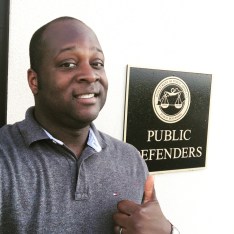
joey-wilkersonJoey Wilkerson is a 2L at the Brandeis School of Law. He received his bachelors in English from the University of Louisville and his Masters in Communication from Bellarmine University. His goal is to work in criminal law and one day be a judge.

Joey is also the Program Coordinator Senior for the African American Male Initiative in the Cultural Center.

Current project: Asteroid Mining- The Environmental Cost

Currently reading: Problems in Criminal Law

What type(s) of writing do you regularly engage in?

These days, the bulk of my writing is dedicated to legal briefs and legal memos.

When/where/how do you write?

Typically I write either at home or in the office.

What are your writing necessities—tools, accessories, music, spaces?

Mac Book Air, bourbon, 90’s movies on TV.

What is your best tip for getting started and/or for revision?

Read your papers aloud. When you hear it verbally, you can catch a lot of mistakes.

What is the best writing advice you’ve received?

“If you’re gonna cite, you better do it right!”

How I Write: Deja Curry

Our “How I Write” series asks writers from the University of Louisville community and beyond to respond to five questions that provide insights into their writing processes and offer advice to other writers. Through this series, we promote the idea that learning to write is an ongoing, life-long process and that all writers, from first-year students to career professionals, benefit from discussing and collaborating on their work with thoughtful and respectful readers.

During our 2016 National Day on Writing Celebration on October 20, Deja Curry stopped by to reshow-i-write-dejapond to our How I Write question prompts. 

About Deja

My name is Deja Curry, I have lived in Louisville, KY  all of my life. I am currently a Biology major but want to minor in English, because it was one of my first loves. I am a 2nd year student at the University of Louisville, and come from a huge family. I have hopes of one day opening up my own Women’s Clinic to help young mothers. My wish is to help educate and enrich the lives of people around me either through word, song or play. I hope that my poems or writing can help these causes that I hold so dear to my heart.

Currently Reading: Unwholly by Neal Shusterman

What type(s) of writing do you regularly engage in?
Poetry, freestyle writing, lines of plays

When/where/how do you write?
On the bus, on campus, in my spare time

What are your writing necessities– tools, accessories, music, spaces? 
A pen/pencil, a notebook, a blank computer screen, then I unleash

What is the best writing advice you’ve ever received? 
Dig deep, write what you know, but don’t be afraid to write what you don’t know.

How I Write: Tom Lavelle, Ashley Taylor, & Emily Blair

Our “How I Write” series asks writers from the University of Louisville community and beyond to respond to five questions that provide insights into their writing processes and offer advice to other writers. Through this series, we promote the idea that learning to write is an ongoing, life-long process and that all writers, from first-year students to career professionals, benefit from discussing and collaborating on their work with thoughtful and respectful readers.

During our 2016 National Day on Writing Celebration, we invited Watson Conference attendees to respond How I Write question prompts. In an exercise in mobility (the conference theme!), we transcribed their written responses on the blog. We also included the original responses in the photos so you can see the differences between handwritten and transcribed responses. 


Tom Lavelle is a faculty member and department head at Stockholm School of Economics.

tom-lavelle

Currently reading: The Sympathizer

What type(s) of writing do you regularly engage in?

*Feedback to students
*Course descriptions
*Email (various functions)
*Scholarship (various genres)
*PPT slides
*Poetry

When/where/how do you write?

When: When I can/have time- for long projects, emails almost anytime, feedback before class

Where: office at work, office at home, café near my office

How: often under time pressure

What are your writing necessities—tools, accessories, music, spaces?

Solitude is essential- everything else is negotiable

What is your best tip for getting started and/or for revision?

Getting started: Deciding what I want to do- what I hope the text will accomplish

Revision: See writing as a network of choices, each with consequences for voicing & delivery

  1. What is the best writing advice you’ve received?

Make a claim and back it up.


Ashley Taylor is a Graduate Teaching Assistant in the English department at the University of Louisville.

Ashley T

ashley-taylor-how-i-writeCurrent project:

Rhet comp -> pedagogical benefits of elocution

Creative writing
-> dreamscape poetry

What type(s) of writing do you regularly engage in?

Poetry and prose

When/where/how do you write?

With tutoring, grad school, and raising two children, I have limited time for creative work. Most of my writing comes in bits-> notes on my phone, post it notes in an agenda, a line  here and there. Then I make time at the University Writing Center or with a friend to help piece the bits together & brainstorm themes that arise.

What are your writing necessities—tools, accessories, music, spaces?

Post its (paper & electronic)

Notes on my phone

READING OTHER POETS

What is your best tip for getting started and/or for revision?

For getting inspired -> READ
For brainstorming -> talking it out
For revision-> read aloud/writing center appointment

What is the best writing advice you’ve received?

Write what is uncomfortable to write


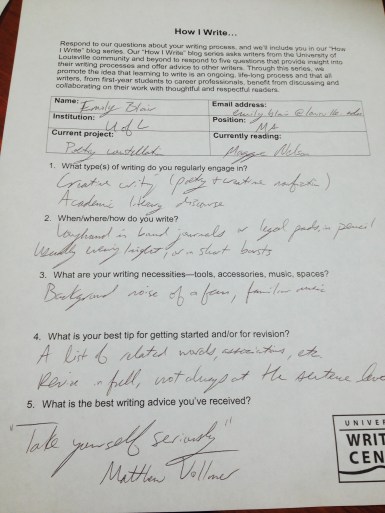
Emily Blair is pursuing her MA in English at the University of Louisville.

DSCN3636
emily-blair-how-i-writeCurrent project: Poetry

Currently reading: Maggie Nelson

What type(s) of writing do you regularly engage in?

Creative writing (poetry and creative nonfiction)

Academic literary discourse

When/where/how do you write? 

Longhand in bound journals or legal pads in pencil

Usually every night, or in short bursts

What are your writing necessities– tools, accessories, music, spaces? 

Background noise of a fan, familiar music

What is your best tip for getting started/revision? 

A list of related words, associations, etc.

Revise in full, not always at the sentence level

What is the best writing advice you’ve received?

“Take yourself seriously” – Matthew Vollmer

How We Write

October 20, 2016 was busier than usual for the University Writing Center. We celebrated the NCTE’s National Day on Writing and welcomed visitors on campus for the Watson Conference.

To build on our “How I Write” blog series, we asked visitors to respond to our “How I Write” questions on banner paper. They’re now displayed on the Writing Center’s glass walls. A few enthusiastic writers also responded to all five How I Write questions, so we’ll share those on the blog soon.

Participants in the Watson conference also stopped by for lunch yesterday. Many UofL English MA and PhD alumni are attending Watson, so they were eager to see our new space. We also met many faculty, staff, and graduate students just curious to see what the University Writing Center is like.

Thank you to everyone who helped out and participated– in person and online– with our #HowIWrite celebration!

Check out the day on our Storify! 

How I Write: Roman Yampolskiy, Professor of Computer Engineering and Computer Science

Our “How I Write” series asks writers from the University of Louisville community and beyond to respond to five questions that provide insights into their writing processes and offer advice to other writers. Through this series, we promote the idea that learning to write is an ongoing, life-long process and that all writers, from first-year students to career professionals, benefit from discussing and collaborating on their work with thoughtful and respectful readers.

Dr. Roman V. Yampolskiy is an associate professor in the department of Computer Engineering and Computer Science at the Speed School of Engineering. He is the founding and current director of the Cyber Security Lab and an author of many books including romanyampolskiyproArtificial Superintelligence: a Futuristic Approach. During his tenure at UofL, Dr. Yampolskiy has been recognized as: Distinguished Teaching ProfessorProfessor of the Year, Faculty Favorite, Top 4 Faculty, Leader in Engineering Education, Top 10 of Online College Professor of the Year, and Outstanding Early Career in Education award.  Dr. Yampolskiy’s main areas of interest are AI Safety, Artificial Intelligence, Behavioral Biometrics, Cybersecurity, Digital Forensics, Games, Genetic Algorithms, and Pattern Recognition. Dr. Yampolskiy is an author of over 100 publications including multiple journal articles and books.  Dr. Yampolskiy’s research has been featured 250+ times in numerous media reports in 22 languages.

Location: Louisville, KY

Current project:

Artificial Intelligence Safety

Currently reading:

Lots of research papers on AI Safety

  1. What type(s) of writing do you regularly engage in?

I write research papers and sometimes books on Artificial Intelligence and Cybersecurity.

  1. When/where/how do you write?

In my office, during work hours and sometimes on planes as I travel a lot.

  1. What are your writing necessities—tools, accessories, music, spaces?

Standing desk, 3-monitor set-up, Endnote software for reference management, Spotify for music.

  1. What is your best tip for getting started and/or for revision?

Start with an outline. Minimize revisions as most reviewers will not agree on changes anyway.

  1. What is the best writing advice you’ve received?

Write daily.

Do you know someone who would be great for How I Write? Send us your recommendations! 

How I Write: Nicholas Siegel

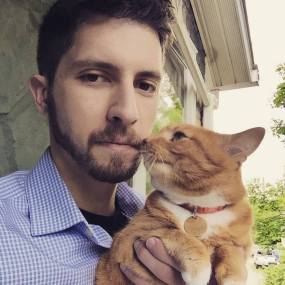
nicholas-siegel-picNicholas Siegel is a fiction writer and freelance journalist from Louisville, KY who earned his MFA in Creative Writing at Spalding University. His fiction has appeared in Bird’s Thumb, Literally Stories, and Five on the Fifth. He currently works as the full time Content Editor for the Sullivan University System and is a lover of bourbon, coffee, music, and cats. You can see his work on his website:  nicholassiegel.squarespace.com.

What type(s) of writing do you regularly engage in?

I mainly write fiction—usually short stories, but I’m also working on a novel. That’s what I studied during my MFA, and it’s my favorite type of writing to do.

I’m also a freelance journalist for a few different local magazines and currently working as Content Editor at the Sullivan University System. It’s nice having the opportunity to do three types of writing that tap into some similar parts of the mind but are vastly different in execution.

When/where/how do you write?

For my fiction, I like to write at my desk at home. I have a small apartment on the second floor of a fourplex, so it’s nice to have my deck door open as I write. I also spend a lot of time doing work in coffee shops, because I enjoy being around other people, even though I’m not interacting with them. As someone who usually feels torn between introversion and extroversion, it’s the perfect compromise.

There really isn’t a specific writing time—just when I’m not at work or out with friends and family. As for how, I use a word processor called Scrivener on my Macbook. It’s been a big help for organization.

What are your writing necessities—tools, accessories, music, spaces?

I like to write in Moleskine notebooks, probably because I have some deep-rooted pretension or insecurity and want to be validated as a writer. Really, though, if I have a notebook that’s on the pricier-side, I’m more inclined to take care of it.

And as I’ve mentioned, I love Scrivener. I don’t use half of the features, but the ones I do use are a huge help. It’s humbling to remind myself that someone like Vonnegut wrote his novels on a typewriter, or that Nabokov filed away scenes on notecards in shoeboxes, but if the technology exists to make my job more pleasurable, I’m going to use it.

What is your best tip for getting started and/or for revision?

Just start writing. Don’t worry so much about whether your first paragraph is exactly where you want to start. You can change that later. Try not to revise as you write. I’m guilty of this, and it slows me down a lot. Get a draft out, as bad as it is, and then go back through and change it.

I doubt I’m the only person to use this analogy, but I like to think of a story’s first draft as a block of stone. Revision is the process of hacking away at it to make a sculpture. You have to get something down to work with in the first place, and you aren’t going to write a sculpture on your first shot, no matter how good you are.

What is the best writing advice you’ve received?

The best advice I’ve been given about writing has been repeated by many people I admire: just write. We come up with all sorts of excuses not to—time, mood, etc. You can’t wait for the muse to strike, or else you’ll only be cranking out a few short poems a year if you’re lucky. When the muse is there, it helps, but it usually isn’t.

In the end, the only thing that separates a writer from anyone else is that a writer writes…a lot. It’s not about skill, or publications, or financial success. It’s just about practice.

How I Write: Amy M. Miller

Our “How I Write” series asks writers from the University of Louisville community and beyond to respond to five questions that provide insights into their writing processes and offer advice to other writers. Through this series, we promote the idea that learning to write is an ongoing, life-long process and that all writers, from first-year students to career professionals, benefit from discussing and collaborating on their work with thoughtful and respectful readers.

Amy M. Miller is a writer and Administrative Coordinator for the nonprofit organization, Louisville Literary Arts. Amy’s essays have appeared in Salon, Hippocampus Magazine, [PANK], The Louisville Review, MOTIF, and Under The Gum Tree. She is a graduate of the Amy MillerSpalding University MFA in Writing program and holds an M.A. in English from University of Louisville. Currently, Amy is working on her first collection of essays as well as several children’s picture books. Amy lives in Louisville, Kentucky with her husband and two children.

Location: Louisville, KY

Current project:

I am drafting and revising two essays and one picture book, while simultaneously seeking representation for two other picture books. Lots of plates, constantly spinning.

Currently reading:

I’m finishing a guilty summer read, Sue Perkin’s Spectacles, a memoir from the host of The Great British Bake Off (I’m addicted). I also have a toe in Dear Mister Essay Writer Guy, by Dinty Moore, Beyond the Beautiful Forevers, by Katherine Boo, and Small Fires, by Julie Marie Wade. I’m a nonfiction writer and reader. All of the nonfiction I read informs what and how I write. That said, I love a good, engrossing novel and next up for me is Lauren Groff’s Fates and Furies and a kids’ middle grade novel my son is reading for school, Wonder, by R. J. Palacio.

1. What type(s) of writing do you regularly engage in?

Well, I’m a multi-tasker (which is a kind way to say I’m distracted). I love many different genres of literature and that is true for my writing, too. I began my MFA work in creative nonfiction, which is still my first love; however, after four years of writing personal and introspective essays, I needed to explore topics that were not about ME. I have always enjoyed the whimsical and hilarious prose of children’s picture books and have collected picture books even before I had kids of my own, so I joined the Society of Children’s Book Writers and Illustrators and have been writing books for 3-7 year-olds. It’s very freeing to write outside of my first genre, and loads of fun, too. Aside from creative writing, I work on public relations work (web content, press releases, social media campaigns), as well as contract grant writing.

2. When/where/how do you write?

I don’t have a specific time when I write because I have kids who constantly require feeding, chauffeuring, and all manner of attention, plus I work part-time. I write when I can — when my kids are in school, my workload is light, and the house is quiet. My writing spot has moved around the house. I used to make a home at the dining room table, but grew tired of moving my papers and iPad on and off the placemat. Most days, I’m parked at my desk in front of a giant screen in my hard swivel chair. When I’m brainstorming or revising, I might take the iPad or a notebook to the couch, where I sit next to my dogs. Invariably, all of my writing happens in the morning or afternoon. If I write at night, I’ll have too many ideas buzzing around my head to sleep.

3. What are your writing necessities—tools, accessories, music, spaces?

I love accessorizing — at least for writing. You cannot beat a good spiral bound notebook for notes — something that can lie flat or be folded over. For writing implements, I prefer a roller ball pen because the fluidity of ink allows me to continue writing without pause and doesn’t leave imprints in the paper. We writers are weird about our instruments. I also like odd colors of pens: purples, oranges, greens. But to be perfectly honest, I spend most of my writing time perched in front of the desktop computer, mostly because it is the most reliable device I own and I can save my work on the cloud and desktop. I also use Google Drive to share writing with critique partners. Over the years, I have moved away from listening to music while I write and prefer silence, but I always have a hot cuppa coffee and a bottle of water next to me.

4. What is your best tip for getting started and/or for revision?

I begin a piece in a variety of ways. Sometimes I have an idea while walking the dogs or sitting in carpool or taking a shower. I try to keep a small notebook in my purse or in the car, or at the least, a scrap of paper and pen nearby. Other times, I just sit at the computer and start free writing. I almost never write the full draft in one sitting. On complicated essays, in which I play with structure, I often need to break away from the writing and map out the essay as an outline. I highly recommend reverse outlining for revision. Start with your draft and outline what is on the page. Does it flow from one idea to the next? If not, move the pieces around and use the outline to direct how and where you will make changes. It feels less scary to cut and paste an outline and it’s a great way to look at the piece more objectively and holistically. Another invaluable word of advice: Always find an impartial reader who you trust to give you constructive feedback! My critique partners always see connections and glitches that I am unable to because I am too close to the piece. Lastly, read your work aloud. This is a foolproof way to find where a piece needs work.

5. What is the best writing advice you’ve received?

Be concise, cut your modifiers, and don’t hold your readers at arm’s length — invite your readers to see all of the ugly, messy truth. Readers respond to flawed narrators and non-fiction writers have a responsibility to the truth, no matter how uncomfortable that truth might be.

How I Write: Maureen McCoy

How I Write: Maureen McCoy

Our “How I Write” series asks writers from the University of Louisville community and beyond to respond to five questions that provide insight into their writing processes and offer advice to other writers. Through this series, we promote the idea that learning to write is an ongoing, life-long process and that all writers, from first-year students to career professionals, benefit from discussing and collaborating on their work with thoughtful and respectful readers.

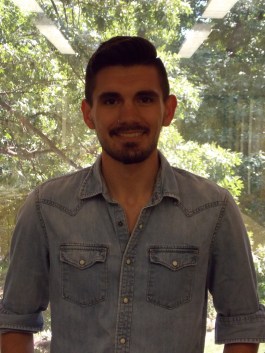
Our featured writer is Maureen McCoy. Maureen is the Coordinator of the REACH Learning Resource Center at the University of Louisville. In August 2016 she began a doctoral programMaureen McCoy focused on College Student Personnel in the College of Education and Human Development at the University of Louisville. Maureen’s Bachelor of Arts degree is in Humanities and Art History, and her Master of Arts degree is in Humanities with a focus on art history and medieval/renaissance studies.
Location: REACH, University of Louisville

Current project: Class papers

Currently reading: One More Thing by B.J. Novak

What type(s) of writing do you regularly engage in?

I am enrolled in a doctoral program in Counseling and Personnel Services through UofL.  Much of my writing is based on research or studies of theory and attempts to apply what I have learned to practical contexts.  I also work in the REACH program on campus as the coordinator for the Learning Resource Center, so I write occasional articles for publication.

When/where/how do you write?

I write in different places.  Sometimes I work at home, but I will also go to the library if I really need to make myself focus.  I like to spread out my materials, so no matter where I am I prefer to have a large table ore area to work.  I will jot down an outline or the major points for my paper and which sources I will use to support them.  This gives me a chance to organize my thoughts and make a plan.  Then I start writing.  I usually work on it by section if I have a clear outline, or I will work through it by source, putting them together as needed.  I cannot write everything in one setting usually, and I take breaks throughout the day to stretch or refresh myself.  I will also proofread my work at the beginning of each writing day to get myself in the right mindset, fix errors, and identify holes in or problems with my argument or organization.

What are your writing necessities—tools, accessories, music, spaces?

I mostly need space for my resources and notes and my laptop.  I prefer quiet, but I will put on instrumental music if I am at home and not in a public place.

What is your best tip for getting started and/or for revision?

Gather everything together and try to make a plan before you get started.  This will help you organize your thoughts.  I revise my work every day as I am working.  I will even walk away from it for a day or two and then revisit it to make sure that it all still makes sense.  Getting started early is essential for me because having time away from the work gives me time to reconsider what I am doing and where I am going when I get back to it.

What is the best writing advice you’ve received?

Do your citations and reference pages as you go so that you don’t miss anything!

Do you know someone who would be great for How I Write? Send us your recommendations! 

Kill Your Darlings: Four Steps to Making Difficult Revisions

Anthony Gross, Consultant

anthonygross

“In Writing, you must kill your darlings.” This somewhat morbid advice from the celebrated author William Faulkner is telling of what it feels like for writers to omit—or “kill”—pieces of writing they have grown to love. The phrase “kill your darlings” is often interpreted as the need for fiction writers to kill off major characters, but it is more broadly applicable to entire sections of writing within any genre. Whether you define yourself as a writer and tend to become deeply attached to your writing or as a student hoping simply to finish a paper with a good grade, killing parts of your writing, no matter how much you love them or how much they contribute to your word count, is an essential part of the revision process. To help you manage the brutal task of murdering your compositional babies, I offer the following advice:

Don’t become too attached.

It’s good to get something down on the page, but don’t become too attached to your original writing. When you’re struggling to come up with ideas and you’re struck by a sudden pang of inspiration, what you produce at the beginning of your draft may not coincide with your concluding thoughts. Especially when you’re crunched for time on an assignment, it’s tempting to skip revising and go straight to editing—that is, skip major structural and ideological changes and target lower order concerns. Your goals will vary depending on the type of writing you are doing, but whether you are producing an argumentative essay, a short story, or an application letter, you should aim to make the individual parts of your writing add up to a cohesive whole. In making sure every aspect of your writing conveys your overall purpose for writing, cutting those pieces that don’t, your reader will be better equipped to understand your ideas.

Give yourself time.

Have you ever looked back at a piece of writing you hurriedly composed for a class during a previous semester and thought, “Oh my goodness; why didn’t anyone tell me how bad this is?” As time lapses, we gain perspective, and we’re able to view our past selves, including those constructed through our writing, more objectively. With this in mind, it’s a good idea to let your work sit for a period of time before committing to the self you’ve constructed in your writing. If you find that you’re still pleased with what you’ve produced a few days, weeks, months, or even years ago, great. But if you’re anything like me and countless other writers, I bet you’ll find something that needs to be killed. It’s also good to note that major revisions should come before minor editing because the small things that you’ll find yourself editing— from spelling to grammar—may be axed from the final project.

Eliminate the unnecessary

Killing your darlings is really about eliminating unnecessary sections of your writing despite how much you love them. This isn’t to say that you have to nix your creative voice, but you must balance creativity with utility to ensure that every aspect of what you’ve written contributes to your purpose for writing. You should read for obscurity, redundancy, and argumentative support. If you find that what you’ve written might confuse your readers, even if it makes good sense to you, clarify or cut it. If you find that a section of your writing repeats an already stated idea to no useful effect, cut it. And if you find yourself including superfluous details, whether they are plot points that aren’t meaningful to your story or argumentative details that don’t progress your thesis, cut them. If deleting these sections permanently is too stressful, create a separate word document where you can paste them in case you change your mind. Remember, you may have spent a lot of time producing your draft, but if what you’ve written doesn’t help your readers discover your purpose, you haven’t met your ultimate goal.

Collaborate

Killing aspects of your writing that you’ve become attached to can be really difficult, especially if you’re so blinded by that attachment that you can’t differentiate purposeful from superfluous details. If you find that you can’t revise on your own, get some outside help. This could be as simple as asking a family member or friend for their opinion, but talking to someone familiar with the genre in which you are writing might be more helpful. University writing centers are a great place to work with other writers who can help identify what they, as a reader, see as essential or non-essential to your draft at any point in your composition process.

Killing your darlings can be difficult, but it is an important step in ensuring you produce your best work possible.

Watch Your Tone: The Sound of Academic Writing

Rhea Crone, Consultant

Most of us have received corrections, or suggestions for revision, on papers handed back to us by professors. Some of these comments are straightforward; “awkward word choice,” “incorrect spelling,” or “subject/verb disagreement” come to mind. Some comments, however, aren’t so clear. Among those in the latter camp are the dreaded question marks, free-floating in the margin; nefarious squiggles beneath phrases, sentences, or worse, entire paragraphs; and of course, some of the most loaded comments of them all: those suggesting a revision to “tone.”

DSCN3687So, what exactly does “tone” suggest when written in a margin? Isn’t it a term used to describe the way something sounds? How can a paper sound wrong, and why is any kind of sound significant if the paper’s argument is sufficiently advanced? Moreover, why must academic writers use one tone over another, and for that matter, why must we use any kind of tone, at all? There is no single correct response to any of these questions. In fact, in composition studies—a field that aims to simultaneously promote a sense of authorial ownership in writers of all levels, study the individual styles and needs of writers, and develop the most effective ways to teach everyone to write as effectively as possible—there is a long standing tension between those who say academic writers should not have to adhere to a specific “tone,” at all, and those who say that we must.

One has to wonder if there is a consensus on any aspect of such a debatable, fissured topic. Luckily, a set of general guidelines regarding the term itself exists. These guidelines usually take into account the following, give or take a few preferences or nuances depending on the reader/grader of a paper:

  • Use of clear and direct language, or the “active voice”;
  • Avoidance of personal pronouns, especially “we, you, you all, I,” etc.;
  • Omission of colloquialisms and/or regionally various terms and phrases.

To extrapolate from this short list a bit, academic tone is generally used so that a writer can quickly and effectively get their point(s) across, and so that the reader does not have to overexert themselves trying to understand what the author is saying. Academic tone also typically foregrounds information and argumentation, and demands that prose not sound as if it is merely the expression of an author’s opinion. Overall, this “tone” hinges on the following values: concise communication, and the establishment of authorial credibility. It also assumes that the reader of an academic paper wants to know, first and foremost, what the paper is talking about; and, of course, that the author of the paper knows what they’re talking about. Furthermore, use of the academic tone does not simply assume a certain reading style on behalf of a paper’s audience, but is ultimately an expression of respect for the reader. It does not, for example, ask the reader to believe unsupported claims, spend more of their time than necessary on reading through a paper, or require them to exert more mental energy on working through an argument than is necessary.

Now that we know what academic tone is, and why writers might want to use it, we can better understand the consequences of failing to use it correctly. These consequences don’t always result in a few required revisions or a point deduction. Indeed, academic tone can sometimes be broken with/from to great effect. Practiced, seasoned writers will sometimes switch their tone briefly, in order to emphasize a particular aspect of their argument. For example, placing a casual aside in parentheses, or including a quote from pop culture, can be used to draw attention to, and/or make a bit clearer, an important passage. In order to effectively break with/from academic tone, however, one must first understand and utilize it well. The reason for this is twofold: to borrow an adage, one must first understand a set of rules in order to break them, and the overall tone of a paper must be academic in order for a divergence/variation in that tone to be noticed at all, much less to great effect. If this tone is not broken pointedly, with some kind of rhetorical purpose, the author runs the risk of losing the attention and/or the comprehension of the reader, frustrating the reader, intellectually fatiguing the reader, losing authorial credibility, and/or needlessly obscuring an argument.

No blog post on academic tone would be complete without a disclaimer regarding various academic disciplines. Of course, not every discipline will require that papers be written in/with an academic tone. This is primarily because different disciplines address different audiences, and therefore value and judge tone differently, and sometimes it will not be necessary to write in a strictly formal, academic tone. Further, regardless of discipline, the occasional professor will encourage informal tone at various (more than likely initial) stages of any given writing assignment. Usually, however, it is best to assume that the academic tone is valued and will be expected in/of the majority of your papers.

Ya dig?

For further and/or more specific information on academic tone, please feel free to peruse the following sites: