Author: UofL University Writing Center

The Prats and Pitfalls of Defining “Academic Writing”

Rick Wysocki, Consultant

We often hear about “academic writing” in higher education.
In essays, we always cite our sources, professors say.
Avoid unclear and passive language.
Don’t use a million-dollar word when a nickel will do.
In my experience in college these maxims were typically presented as absolute truths. In this post I want to look the harmful effects of this tendency.
Don’t get me wrong–I think properly citing sources, emphasizing active voice, and focusing on clarity are all helpful strategies that students should learn. What’s dangerous, however, is presenting them as rules rather than as conventions or rhetorical choices, which can interfere with a student’s sense of agency and force their writing into a non-contextual “academic” mold. In extreme cases, taking conventions for absolutes can lead to bizarre acts of policing language.
A quintessential example of this is Denis Dutton’s “Bad Writing Contest.” Dutton, a professor of philosophy, solemnly swore to uphold the constitution of his self-importance, taking it upon himself to deem certain pieces of writing–by established academics, no less–as bad. Not ineffective. Just bad. One “winner” was Judith Butler, with the following sentence:
“The move from a structuralist account in which capital is understood to structure social relations in relatively homologous ways to a view of hegemony in which power relations are subject to repetition, convergence, and rearticulation brought the question of temporality into the thinking of structure, and marked a shift from a form of Althusserian theory that takes structural totalities as theoretical objects to one in which the insights into the contingent possibility of structure inaugurate the renewed conception of hegemony as bound up with the contingent sites and strategies of the rearticulation of power.” (From Butler’s article “Further Reflections on the Conversations of our Time”)
I want to make it clear that unlike Dutton’s silly contest, I’m not trying to disparage Judith Butler’s writing. If I was, my credibility would and should go right into the toilet; Butler is one of today’s most widely read thinkers, while for some reason no one seems to be talking about the last article Rick Wysocki didn’t have published. This notion of ethos seems to be lost on Dutton, who has awarded “Bad Writing” prizes to Butler, Frederic Jameson, and Homi K. Bhaba–three critics whose main similarities are theories of hegemony and being more influential than Denis Dutton.

DSCN1627

What I do want to call attention to, however, is the fact that Butler’s sentence breaks every one of the maxims I presented above. First, Butler doesn’t cite Althusser. How can we know that Judith Butler is interpreting Althusser correctly without a proper citation in one of the accepted formats?! Next is the passivity of the sentence. “The move from a structuralist account in which capital is understood to structure social relations”? Excuse me, Dr. Butler, but who or what is moving? Finally, if we should be avoiding flooding the market with “million-dollar words” then Butler is acting seriously irresponsibly with her capital. Has anyone found a connection between Judith and Lehman Brothers?

Jokes aside, what I want to show is the types of neuroses that occur when “academic writing” is presented to students as a fixed and objective system. The fact that Judith Butler is “breaking the rules” doesn’t mean that her writing isn’t academic (a fact that should be obvious by her status as being among the modern academics), but that there weren’t any hard and fast rules to begin with, only choices.
My problem with Dutton isn’t that he doesn’t like Judith Butler’s writing–plenty of people disagree with the way she chooses to employ language. What’s intolerable about Dutton’s criticism is that he carried out a “Bad Writing Contest,” not a “’Rhetorical Choices I Disagree with’ Tournament.” The presentation of writing as good, bad, right, or wrong only leads to confusion. Where we can point to citation, active voice, and clarity as conventions of college essays, attempting to define “academic writing” in general is a tricky and potentially dangerous affair. So when you’re thinking about a particular paper or context, keep in mind that notions of “academic writing” are always contingent upon audience, context, and intention. If you need help sorting through these questions, we’re always here to help you in the Writing Center.

The Thesaurus: Your Composition Companion

Carly Johnson, Consultant

carlyA thesaurus always struck me as nothing more than a large, impressive book to place on your shelf and never open…until I turned in my first paper in English Composition 101 my Freshman year of college. My work was riddled with comments written in bold, red pen that stated things like: “repetitive,” “word choice?” and “is this what you meant to say here?” As I examined my paper more closely, I began to realize that my professor was absolutely correct, I was being repetitive—in fact, in the span of four pages, I typed the word “said” roughly fifteen times. In addition, I used the adjectives “nice” and “very” to describe any and all nouns within my paper. “What other words could I have used other than ‘said,’ ‘nice,’ and ‘very’?” I thought to myself. Then, I glanced over at the book I had ignored for so long: the thesaurus.

Many clients come to the writing center with comments from their instructors that convey many of the same messages I mentioned above. Students often become discouraged after reading these critiques, but I’ll let you in on a secret- no one, no matter how talented of a writer they are, knows exactly the right word to use 100% of the time—honestly, probably not even 50% of the time. I urge every writer to use the thesaurus as part of their editing process, and I encourage them to begin by asking themselves questions such as, “Have I used this adjective already?” or  “Does this word convey my tone in the most effective way?” The thesaurus provides an opportunity for a writer to put their best vocabulary forward, and create the most polished final draft possible.

The only negative aspect of using a thesaurus is the sheer number of options it provides for you. I’ve seen students fall into the trap of selecting a word they are not familiar with in an effort to give their paper more variety. If you select a word from the thesaurus that is unfamiliar to you, you run the risk of placing that word in an incorrect context within your sentence. Make sure that, when you use a thesaurus, you are familiar with both the meaning of the word and its connotation. If you are unfamiliar with the word, but desperately wish to use it because it just sounds too perfect, like the word ‘bombastic,’ make sure that the word matches the tone of the rest of your essay. For example, I think the word ‘bombastic’ sounds like it should describe someone who has a loud voice and a charismatic personality, but it actually has a negative connotation and is used to describe someone who is ‘overbearing’ or ‘pompous.’ This is essential to know, especially if I am handing a paper into my professor where one of my sentences states, “I found my professor to be exceptionally bombastic.”

Using a thesaurus is a great way to strengthen your vocabulary, and take your writing to the next level. You don’t even have to open a large, impressive book anymore, either; you can simply right-click on a word within a word processing document and select the “synonyms” option, and within an instant a whole new world of distinct, delightful, and distinguished diction is available at your fingertips.

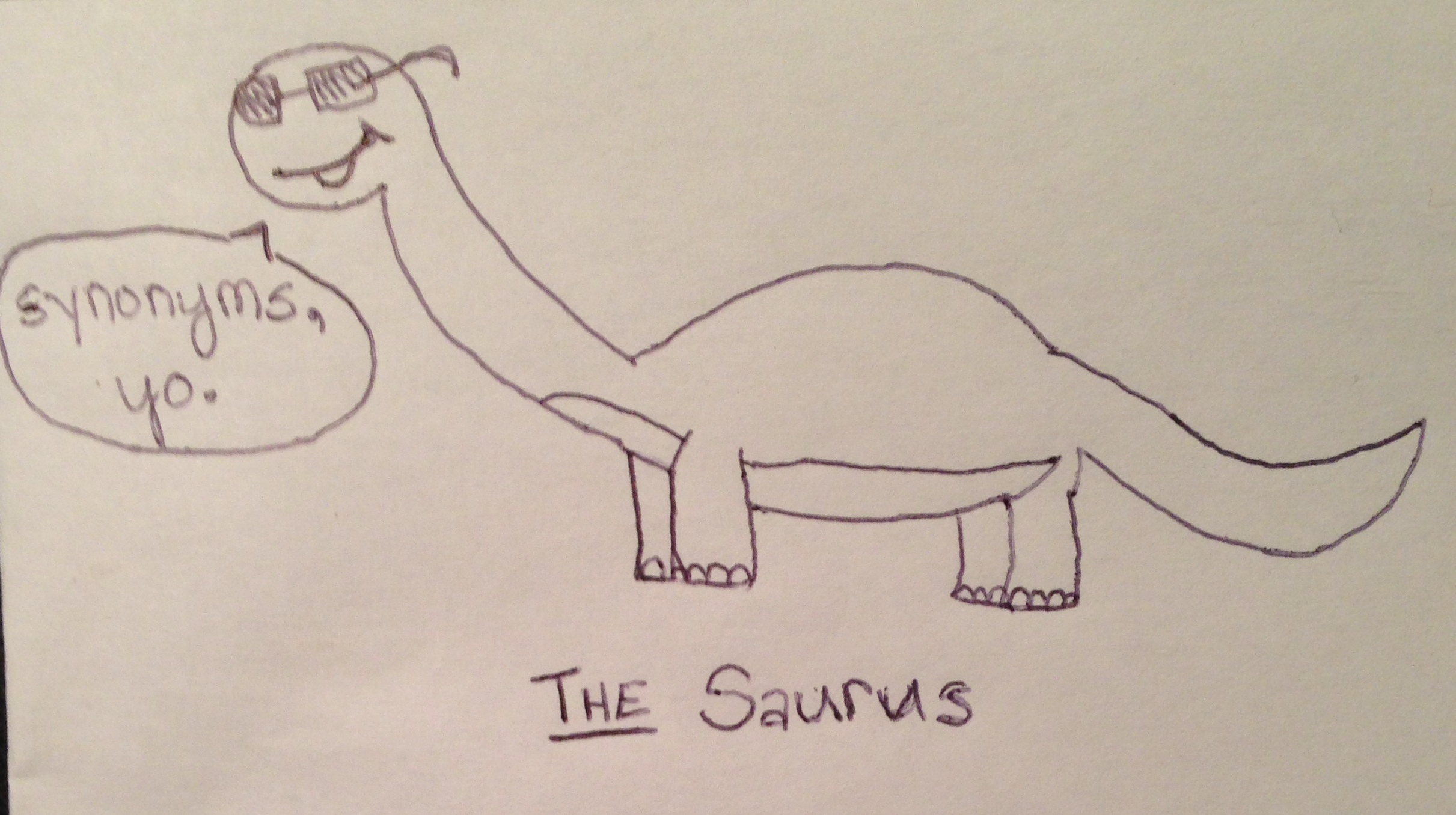
If, after reading this blog post, you still believe that a thesaurus is nothing but a large book that should never be opened, refer to Layne’s post regarding voice. Her advice regarding the thesaurus is especially useful for all the visual learners out there. However, if you are more inclined to listen to advice form non-writing center consultants, refer to my cool hand-drawn friend, The Saurus-

the saurus_carly

Next time you are swimming in a sea of ‘said’s, remember that the thesaurus, whether you wish to view it as a helpful tool or a dinosaur with a superior vocabulary, is an excellent composition companion.

How I Write: Judith Fischer — Legal Scholar

Our “How I Write” series asks writers from the University of Louisville community and beyond to respond to five questions that provide insight into their writing processes and offer advice to other writers. Through this series, we promote the idea that learning to write is an ongoing, life-long process and that all writers, from first-year students to career professionals, benefit from discussing and collaborating on their work with thoughtful and respectful readers. The series will be featured every other Wednesday.

This week we hear from University of Louisville Law professor Judith Fischer. Professor Fischer teaches legal writing and women and the law, and her scholarship includes articles on legal writing, advocacy, women and the law, and law school teaching. Her book Pleasing the Court: Writing Ethical and Effective Briefs examines professionalism in legal writing through numerous examples of judges’ reactions to lawyers’ errors.fischer

How I Write: Judith Fischer

Location:     Law school

Current project: Article on brief writing

Currently reading:  Student papers!

  1.  What type(s) of writing do you regularly engage in?
    For work, I write scholarly writing for books or law review articles and less formal articles for newsletters or bar journals. I also do other miscellaneous kind of writing, such as commenting on student papers and writing emails and letters of recommendation.And of course I also do personal writing, such as emails and thank-you notes in hard copy.
  2. When/where/how do you write?
    For work, I often write during the standard work day, and sometimes I write well into the evening. I write with a computer at a table or desk.
  3. What are your writing necessities—tools, accessories, music, spaces?
    Computer—pencils—pens—paper for printing numerous drafts—whatever sources I need for the project. For my last scholarly article, that included a stack of relevant books.
  4. What is your best tip for getting started and/or for revision?
    To start: Decide when you need to get started and then just start. For example, if I need to have a scholarly article finished by August 15, I know I need to start researching by May and start writing by the end of June.  So I do that.For revision: Read the document aloud while imagining an audience. For example, read the document to an imaginary critical colleague.
  5. What is the best writing advice you’ve received?
    The way to write an article is to start by taking off your shoes. Get down underneath your desk and nail your shoes to the floor. Then get back in your chair, put your feet in your shoes, and write.

Alternatives to Procrastinating

Jessica Winck, Assistant Director

Approaching the end of the semester can be a stressful time, and those of us who are inclined to procrastinate might feel especially anxious. I tend to believe that procrastination involves more than just actively avoiding work. It often relates to a writer’s sincere challenges with any of the following: understanding an assignment; feeling overwhelmed by the workload in college; worrying about whether s/he “has what it takes.” None of these is easy to deal with, and we know that avoiding work doesn’t help us in the long run. If you’re worried about procrastination, try some of these strategies:

Contact your instructor about any questions you have. This might sound obvious, but not everyone feels comfortable with this approach. What if my instructor will think I’m stupid, or that I’m not trying hard enough, or that I’m not good enough to be in this class? Meanwhile, confusion about an assignment prevents us from working on it. Email your instructor or ask to visit her or his office hours, which are set aside specifically for helping students address questions and concerns.

If you have a large assignment on your hands, consider breaking it down into smaller, more manageable pieces. How we see the task plays a large part in our approach to it. “Write a research paper” sounds like a scary and overwhelming task. Try talking to your instructor about how you can approach the assignment in parts. You can also go to the writing center and work with a consultant on setting some manageable goals for completing the assignment. These should be goals that you can reasonably meet in the amount of time you give yourself. You will get more done, and you will likely feel more confident about finishing the assignment.

Try setting a timer when you write. This might sound like an odd piece of advice, but it’s one I always stand by. I often use the Pomodoro method: write for 25 minutes, then take a 5-minute break. Write for another 25, then take another 5. Writers who struggle with procrastination might find this method especially helpful. Over time, you start to notice that some tasks don’t take as much time and energy as you imagined. Tasks become less intimidating and more manageable. Plus, you don’t have to focus on writing for an indeterminate amount of time. If you grow tired or you need a coffee break, you don’t have long to wait; but for the time being, you write. Also check out what Alex Clifton, a writing center consultant, wrote about some online resources that help you keep writing in pre-set blocks of time.

DSCN1660Write with a friend or a group. Working alongside others can be encouraging, and it also keeps you accountable. My colleague Meghan Hancock and I often meet for the specific purpose of writing and working. It’s a great arrangement because we have a shared understanding that we write when it’s time to write (and yes, we set a timer). Since your classmates are working on the same assignment, ask them to join you. Though the time you make is for writing and working, it also presents the opportunity to get to know more people and to feel supported at the same time. Contrary to some of the received wisdom out there that good writers work independently without any help, you actually don’t have to do all this alone.

On that note, make an appointment at the Writing Center. We will be happy to sit down and work with you wherever you are in the process of writing. Plus, having specific times set aside to talk with others about your writing helps you stay motivated.

There are many alternatives to procrastination, and I hope you try some of the ones here. Have a great rest of your semester!

Writing Center Talk, Part 2

Adam Robinson, Associate Director

We give writers thoughtful response and engage them in meaningful dialogue, both of which are aimed at helping writers think about their writing differently and which also hopefully provide these same writers with a bit more confidence to try new things in their writing.  I’d say that’s goal one.  But I can tell you that there are lots of other ways that we help the writers who visit us.

AdamEvery time I write one of these blogs, I can’t help but think back to when I was a student at U of L visiting the Writing Center.  After my first appointment, I was hooked.  I valued my consultant’s feedback, and I appreciated the kindness of the people working there.  But I got something else.  Probably something I didn’t really notice at the time—at least not consciously.  The Writing Center was a place where I felt like a writer, not simply a student who was asked to write something for class for a grade.  I feel like I inhabited both mindsets in college, and my chosen mindset was usually based on how invested I was in the writing I was doing at the time—and that feeling of being invested was determined by many internal and external factors.  Either way, the writing still got done.  But I do find value in being mindful of the fact that if you write, you are a writer.

I like to think that the people who visit us think of themselves as writers when they are in our space—though I hope they feel that way all the time.  We make an effort to remind them of that fact that they are writers.  Consultants treat the writing seriously; that writer’s writing is the subject of conversation.  And the craft of writing is emphasized, meaning that writing is treated as something that can be honed, played with, improved upon—where writing is considered a necessary and lifelong activity.

But I’d like to shift focus away from our consultations.  I’d like to think that students enter that writerly mindset before they even begin their consultations.  I realized this the other day.  My office is right next to the lobby where those who have signed in for appointments are waiting for their consultants to greet them.  I love being near this space.  I get to meet a lot of people and continue conversations with those who regularly visit the Writing Center.

But I also get to hear interesting conversations among students, among writers—and that’s what I want to highlight here.  One of these conversations happened the other day—and when they happen, they generally look the same: writers who don’t know each other sitting around talking about the writing they are doing.  The conversations almost always start with a “what are you here for” type of question but so often move to writers summarizing their projects for each other and sharing their ideas and frustrations.  I think the take-away for those participating in these conversations is that they are reminded that other people are writing too—and are experiencing ups and downs and moments of clarity and confusion.  And an equally important take away is that writing takes on many shapes and sizes at the university.  I’ve listened to doctoral students explain the process of writing a dissertation to a freshmen who has brought in an introduction to college writing paper.  Or an engineering major lay out the details of a technical report to an English major writing a literary analysis.  Or an international student talking about his native language to a native English speaker and sharing his experience of writing in a new language.  When I count these conversations, it makes me realize that the writers who visit talk a lot about their writing when they come—they also answer questions about their writing when they make appointments and of course talk extensively about their projects in their consultations.

I suppose this blog has me wondering how we might have more of these conversations—though the ones that happen organically are the best.  I remember thinking similar ideas when I was an academic advisor.  I’d have conversations all the time with students about their work.  What I found was that students didn’t have many opportunities for talking about the work they were doing in class—or they didn’t take the opportunity.  Among friends they may have been having conversations about what they were learning or reading—or about an interesting idea that their professor mentioned in a lecture.  But they didn’t seem too practiced in talking about their own work—their own projects—which happen to be where they do the most learning.  So I guess it goes without saying that I’m thankful we can provide space for these types of conversations.  If anyone has thoughts, please share!  Thanks.

How I Write: Jeffery Skinner — Poet

This semester we are beginning a new series for our blog called “How I Write.” This series asks writers to respond to five questions that provide insight into their writing processes and offer advice to other writers. We’ll be featuring writers from the University of Louisville community, but also those from beyond the university who compose in a variety of personal and professional contexts. Through this series, we promote the idea that learning to write is an ongoing, life-long process and that all writers, from first-year students to career professionals, benefit from discussing and collaborating on their work with thoughtful and respectful readers. The series will be featured every other Wednesday.skinner

We begin our series with University of Louisville’s own Jeffery Skinner who describes himself on his website (jeffreyskinner.net/) as a “poet. playwright. professor.” His most recent collection of poems Glaciology, which won the 2012 Crab Orchard Open Poetry Competition, was just published by Southern Illinois Press. You can hear Jeffery Skinner read with Kiki Petrosino on November 7th at 4:30 pm in the Chao Auditorium in UofL’s Ekstrom Library.

How I Write: Jeffery Skinner

Location: Anywhere fairly quiet

Current project: New book of poems

Currently reading: Mark Richard’s memoir, David Jones poems

  1.  What type(s) of writing do you regularly engage in?
    Poetry, and prose of various types: recommendation letters, essays, prose poems, memos, grant applications, etc.
  2. When/where/how do you write?
    During summers I bear down heavily; during teaching time I snatch whatever odd moment that becomes available.
  3. What are your writing necessities—tools, accessories, music, spaces?
    Pen and paper for poems; laptop for prose. I’m fond of parking myself in a coffee shop, and plugging into postclassical, techno, electronica (no human voices).
  4. What is your best tip for getting started and/or for revision?
    a. decide to write with your own voice b. lower your expectations c. don’t stop till you’ve written a predetermined amount (which doesn’t have to be “good”–just done)
  5. What is the best writing advice you’ve received?
    “Writing is easy: you just sit there until drops of blood appear on your forehead.”

Again, we want to thank Professor Skinner for his insightful responses and encourage our readers to attend his upcoming reading. On November 6th, we will post our next entry featuring University of Louisville Law professor Judith Fischer.

Why Do We Write?: In Defense of The Paper

Daniel Ernst, Consultant

The paper is a collegiate common denominator. In just about every class in every discipline, writing papers is required. Therefore, it’s easy to see the paper as busywork, a pointless academic exercise often with no real world counterpart. But the paper is more than some arbitrary unit of learning by which an instructor attempts to measure a student’s intellect. If we think about what we really do when we write, we see in fact that the writing process offers a unique and effective learning arena.

This isn’t just armchair philosophizing either; writing’s unique relationship with learning has been well documented by scholars in fields from psychology to linguistics to composition theory. One composition/education theorist in particular, Janet Emig, provides a general overview of writing’s role in learning in her article “Writing as a Mode of Learning.” Emig first distinguishes writing from other forms of language usage—reading, talking, and listening. Then, she explains how writing distinctively requires the deployment of and interaction among multiple learning methods, such as analysis, synthesis, experience, and genesis.

DSCN1632Writing’s interactive and multifaceted process is what makes it so challenging, but this process also fosters a uniquely instructive learning environment and sets it apart from other forms of language usage. For example, take the idea of analysis. College students are commonly asked to analyze; the term analysis (or its sister term ‘critical thinking’) appears on almost every essay prompt or class syllabus in one form or another. This is because analysis is a powerful educational tool in which an idea’s deconstruction into its elemental building blocks helps students better understand its composition. In general, though, analysis is accomplished through class readings and discussions. So if reading, talking, and listening in class helps to take apart these big ideas, what then to do with all the disassembled pieces? This is where writing comes in.

Writing papers is your chance to take the deconstructed concepts and theories and build something new. In other words, synthesize new connections/conversations that become new ideas. Not only is this a critically important move from “destructive” to “constructive” intellectual work, but it’s also your opportunity to contribute, as many of my teachers have put it, to the scholarly conversation. The significant and sort of radical thing here is that these are your ideas and your unique contributions. And in formulating these contributions, you are forced, through the nature of writing, to confront ideas in a special way. Writing’s combination of and interaction between analysis and synthesis, mediated by the writer’s own experience and end-goals, promotes a participatory brand of learning that is unrivaled and truly indispensable. So the next time you are assigned to write a paper, try to embrace the chance to learn in a unique way and capitalize on your opportunity to participate and contribute your voice and your ideas.

In Conclusion: Framing Your Paper

Arielle Ulrich, Consultant

Working at the writing center, I constantly hear students say that they hate writing conclusions. These students will bring in papers that seem finished, but end abruptly—or they may have written a conclusion, but it’s only a sentence or two re-stating the last paragraph.

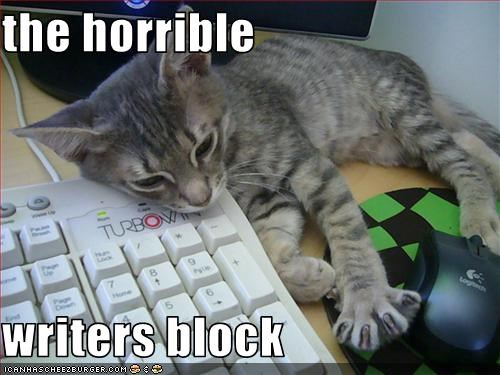
I’m no stranger to this struggle. Even the conclusion to the simplest paper can leave me stumped, and I often have to leave the paper alone for a few hours while I try to think of the “perfect” conclusion. Of course, as the last thing the reader sees in the paper, conclusions are very important. But my obsession with the perfect conclusion instead psyches me out, leaving me with a case of writer’s block.writersblock

When this happens, I remind myself that a good conclusion cannot fix a bad paper, nor will it solve any of its organizational or structural problems. I find it more helpful to consider a conclusion as the closing statements of my argument. By this point, I should have already said everything I needed to say and written the meat of my paper. I’ve argued, elaborated, and explicated every point. My conclusion will simply wrap up my paper and place my topic into context for the reader.

  1. In light of this, I have a few tips for conclusions. Which tip you follow may depend on your field, so consider which strategy works best for your paper. These are my three go-to tips: Explain the significance of your paper. Make sure the reader knows why your topic is important. Usually, this involves placing your question into a broader context or comparing it to a current issue. If you cannot think of the significance, ask yourself, “so what?” This approach is especially useful in history or expository papers.DSCN1639
  2. Recommend further research. Now that you’ve examined the current research on your topic, you have the chance to take the next step and recommend a course of action for the future. Is there a topic or approach you would ask a future researcher to consider? In other words: what questions are you left with at the end your paper? This tip will work best with papers that have a significant research component.
  3. Synthesize your points. This strategy requires that you not only summarize your paper, but also put together the pieces for your reader. How does your argument come together? If your paper is either very long or complex (or both!), this type of conclusion would be a good choice.

Any of these strategies would guarantee that your reader leaves knowing the purpose of your paper. You also shouldn’t feel that you can use only one of these strategies at a time—in some papers, you may use all of them, provided they are relevant.

These two writing center sites also have good pointers. Feel free to peruse these before writing your next paper:

University of North Carolina, Chapel Hill: http://writingcenter.unc.edu/handouts/conclusions/

University College, Toronto: http://www.uc.utoronto.ca/intros-and-conclusions

Happy writing!

What is Voice and Where Do You Get It?

Layne Porta, Consultant

I remember being told when I first started doing college level writing that I needed to work on my voice. When I asked my professor what exactly she meant by that, I was told that voice is what makes your writing uniquely your own. I was frustrated and confused: Isn’t the fact that I’m writing it what makes it uniquely my own?

Now that I am a graduate student and writing consultant, I often see the same kinds of feedback on my students’ papers. What I would like to offer here are some thoughts on what voice is and how you get it, as well as some resources that can help you along the way to finding your voice.

What I have come to learn about voice is that it is much more about practical decisions you make in your writing than some mystical quality that appears like mist in the night. The writing process itself is an unending sequence of decisions–from word choice to punctuation to paragraph breaks–and all of these decisions add up to create your voice. For example, I love to use dashes in my writing, which can make my voice sound more conversational. Voice can also come from the kinds of metaphors and similes you choose to explain concepts, or the length of your sentences. I have found that one of the biggest factors in creating (and understanding) your voice is word choice. For example, one of my least favorite words is fickle, but one of my favorite words is capricious. They mean the same thing, but my voice will sound very different depending on that decision. There are many resources that can help in making decisions about the words you want to use. For example, on websites such as visualthesaurus.com and visuwords.com, you can type in a word and it will bring up a word web that will feature synonyms and variations of that word clustered according to connotation. The example below is a screen capture of a visual thesaurus app I recently downloaded:

"Volatile" on Visual Thesaurus
“Volatile” on Visual Thesaurus

I have often heard the idea from both students and peers that voice isn’t as important in academic writing as it is in creative writing. I believe this is a huge misconception. Voice is crucial to academic writing because it plays a large role in engaging your audience, establishing a formal tone, and creating your credibility as a writer. In sum, voice plays a very active role in helping you achieve your rhetorical goals. Furthermore, you can have more fun with the writing you will do during your time in college or after if you embrace your voice as a writer.

If you find yourself wanting to learn more about voice and how to get it, I suggest two very helpful websites that offer comprehensive discussions about voice. The first is “Understanding Voice and Tone in Writing” by Julie Wildhaber, featured on quickanddirtytips.com. This article offers tips on defining your voice as well as some helpful examples of how voice will change according to genre. Another useful article on writingcommons.org by Kyle D. Stedman, is “Making Sure Your Voice is Present” which also offers excellent suggestions for finding your voice as well as some YouTube videos about voice.

layneOne thing to keep in mind is that finding your voice is like everything else in writing–it requires practice. So in response to my initial question as a beginning college student: yes, the fact that I am writing my paper is what makes it uniquely my own. But voice takes this a bit further, and requires that you do some writing to see how your personality comes across. My suggestion, then is to trust your instincts as a writer. Your writing is a reflection of your thoughts and your personality. Your voice, and your awareness of your voice, will come through the more comfortable you get with writing.

Imagining and Developing Writing Centers: A Reflection on SWCA-KY 2013

Dan McCormick, ConsultantDSCN1636

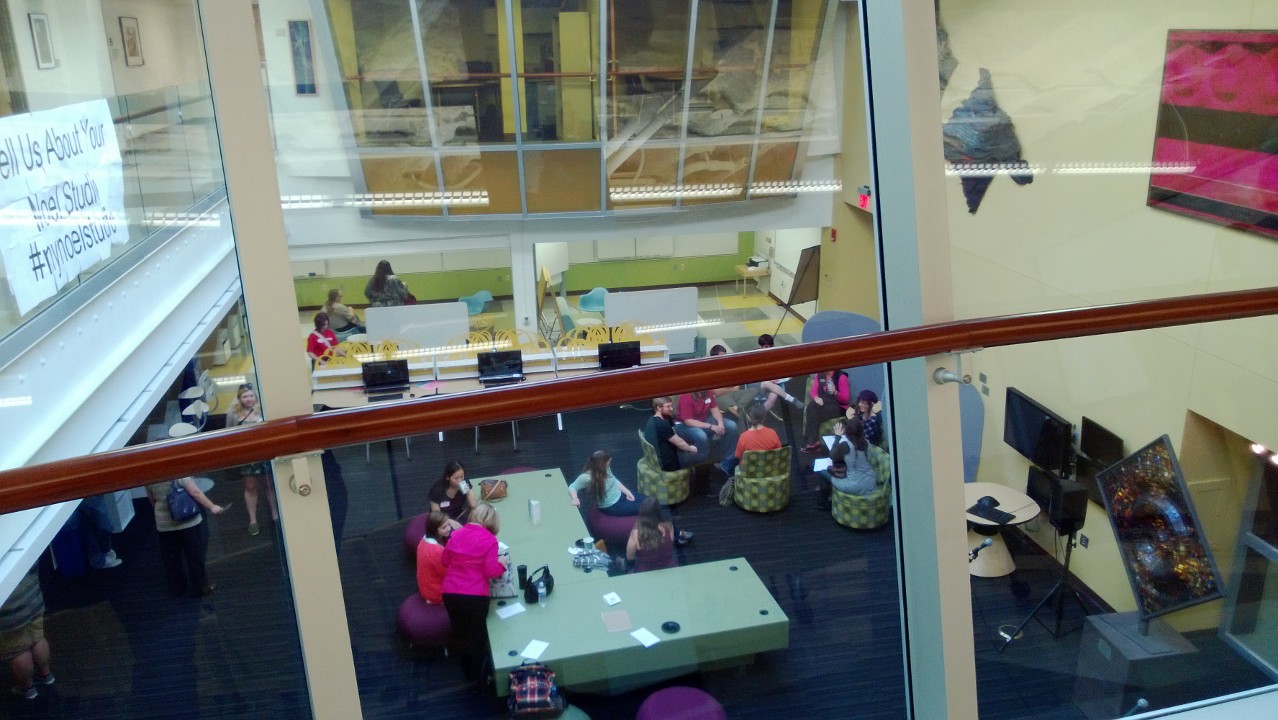
What does a writing center look like?  Does it look like rows of tables and desks?  Couches?  Computers and projectors and marker boards? Does it look like Legos and Play-Doh and glass walls and Ab-Ex décor?

The Noel Studio at Eastern Kentucky University does.  This was the site of the SWCA-KY Statewide Fall 2013 conference, which I attended on Friday September 20th along with the rest of the U of L Writing Center delegation.  Fitting that we should spend our day in a space that brings that aforementioned question to life, because broad questions of what a writing center looks like—in terms of space, technology, methodology, and campus finance—were on everyone’s minds.

The view from above Noel Studio at EKU

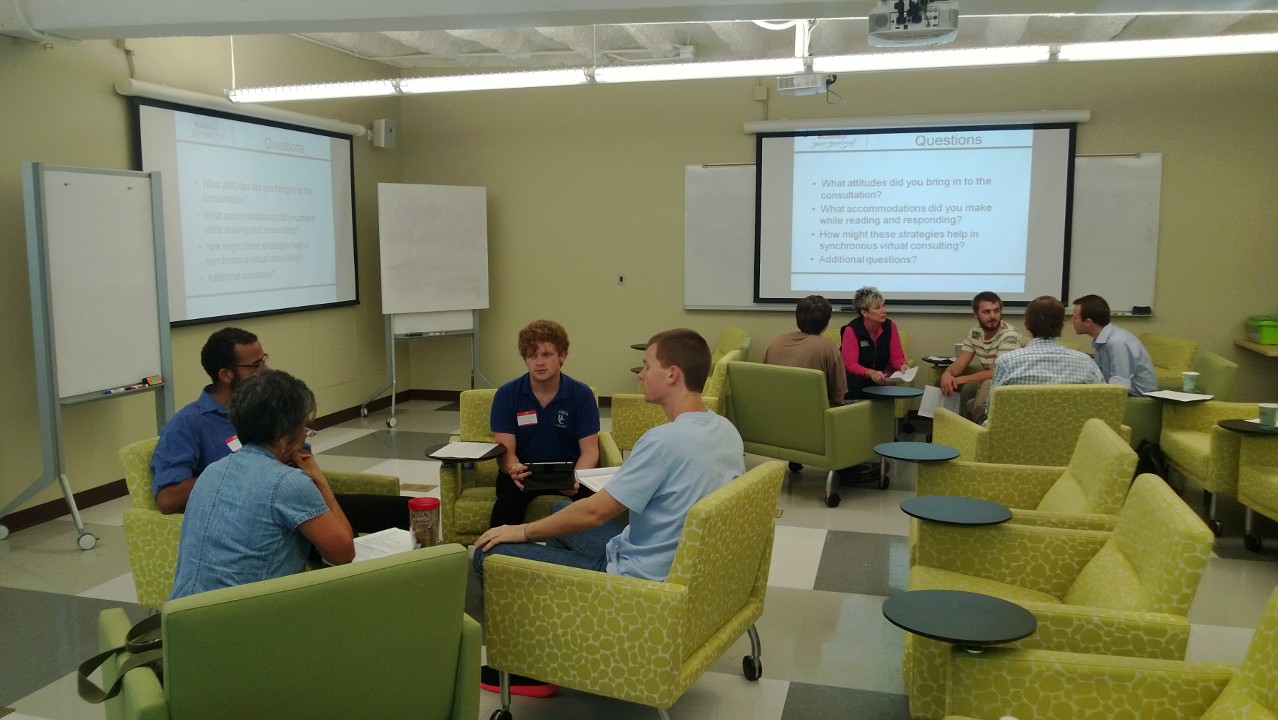
Our ADs Adam, Ashly, Jennifer, and Jessica delivered a presentation on the U of L Virtual Writing Center, which serves students and faculty via email consultation or video chat.  The description of our online pedagogy was not new to me, but it was really cool to hear staff from other centers weigh in.  We discussed the challenge of identifying and addressing each writer’s needs without seeing a face or hearing a voice. (You can read more about our VWC here.)

Participants discussing approaches to virtual consulting
Discussing approaches to virtual consulting

In another session I attended, we discussed research questions on topics such as why students visit writing centers, how to increase visitor numbers, and how to best measure writing centers’ success.  I spoke to one man who was part of team in the process of developing a writing center at Hazard Community and Technical College in Jackson, Kentucky; we discussed how a writing center can best serve the needs of students from disadvantaged economic backgrounds who are interested in trade-programs, nursing, and technical writing.  The conference administrators encouraged all of us to develop our research ideas and submit abstracts for the SWCA regional conference in February 2014.

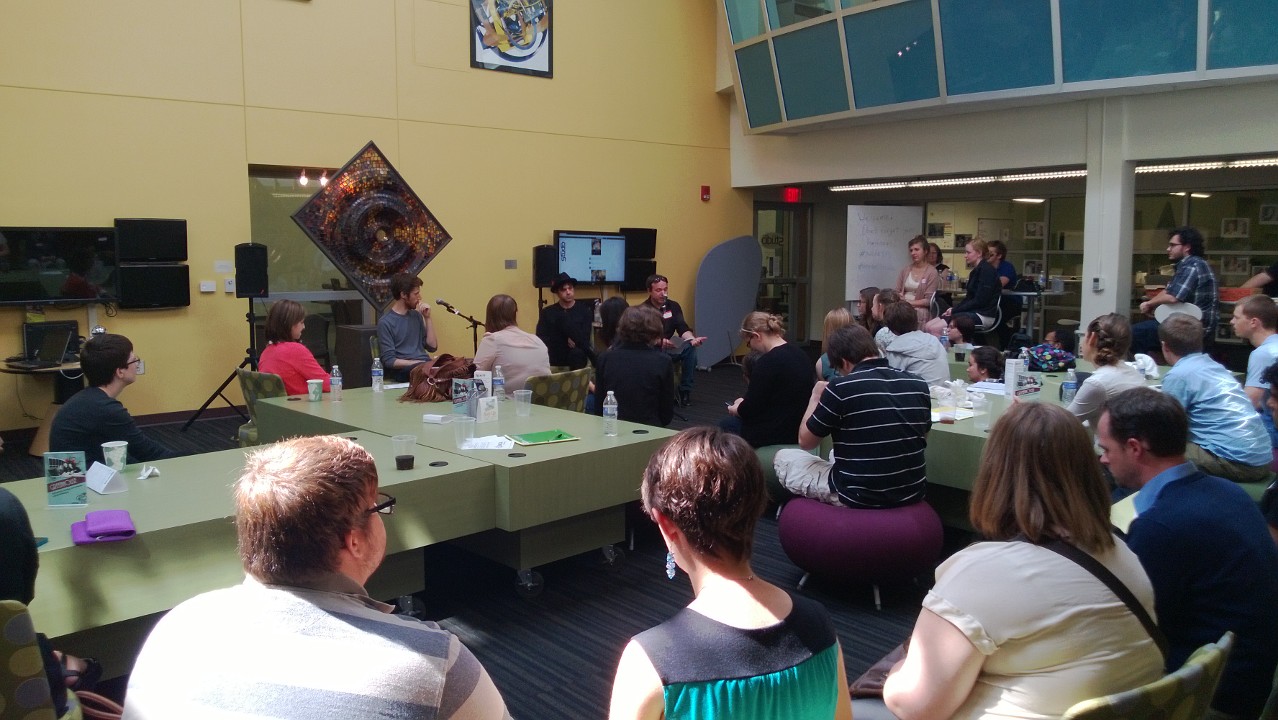
The conference’s keynote was a conversation with Kentucky singer/songwriter Daniel Martin Moore and EKU-alum/producer Duane Lundy, who discussed the collaborative aspect of creativity.  Along with a few songs, Moore shared his thoughts on what makes for the best time and space for writing.  If you’re in a hotel room in Costa Rica and the muse descends, Moore said, it’s time to clear your schedule and focus.  Lundy, on the other hand, described the importance of creating a safe environment for experimentation and creativity while making records at his studio, Shangri-La.  The two agreed that sometimes it’s best to take hold of whatever creative spark the situation offers, and sometimes it’s best to engineer the space and atmosphere to your advantage.  They also discussed how technology has made the process of creating music much easier—that could mean smart phone recording apps, pitch-shifting programs, and even moveable walls.  Drawing parallels between collaboration in the music studio and collaboration in the writing studio, Moore and Lundy emphasized that all creativity has its genesis in the bridges that art builds between people from different times, communities, and experiences.

SWCA-KY '13 Keynote Presentation
SWCA-KY ’13 Keynote Presentation

In sum, I found that writing centers all over Kentucky are asking the same question—what should a writing center look like?  How does technology fit in?  How can we ensure our place in the university’s budget?  How do we meet the needs of students from all economic backgrounds?  And, perhaps most importantly, how do we change the perception of a writing center from fix-it-shop to build-it-studio?  At EKU, it looks like comfy chairs and bright colors.  At U of L, it looks like iPads and an increasing online presence.  What does it look like at your writing center?